How Laser Tattoo Removal Actually Works (and How Long It Takes)
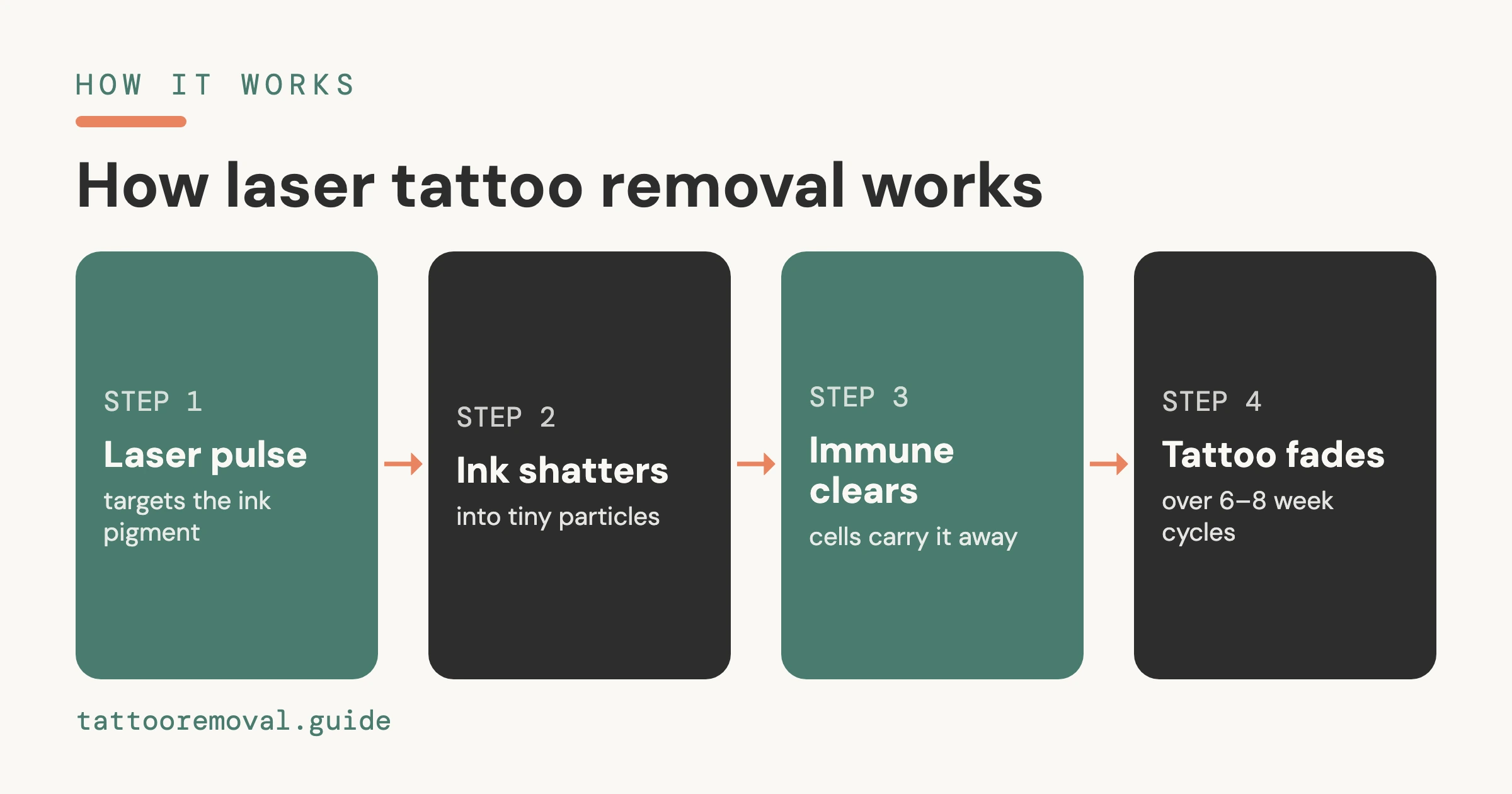
Laser tattoo removal works on one counter-intuitive principle: the laser never removes the ink — it only shatters it, and your own immune system does the removing. Ultra-short pulses of light are absorbed by the ink and break it into microscopic fragments (a photoacoustic effect). Immune cells called macrophages then carry those fragments into the lymphatic system, which flushes them out over the following weeks.
That single fact explains almost everything people find confusing about removal: why it takes several sessions, why those sessions are spaced weeks apart, why some colours resist, and why no honest clinic will promise you an exact number up front. This guide walks through the science and the honest numbers — using medical sources and figures from the Tattoo Removal Guide directory, stamped (as of July 2026).
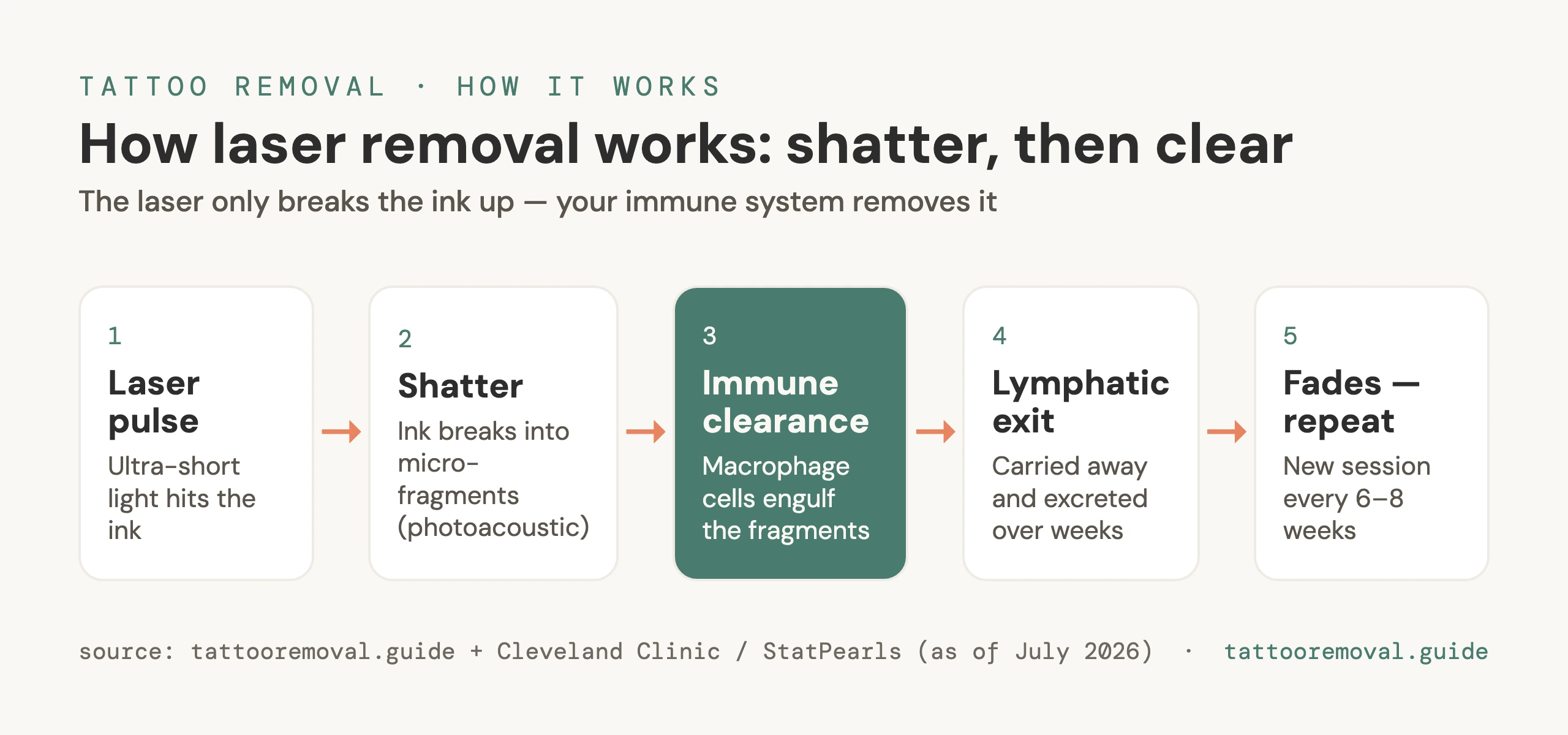 How laser tattoo removal works: the laser shatters the ink, then your immune system clears it over the following weeks.
Key Takeaways
- The laser shatters ink into fragments; your immune system removes them. Removal is a biological clearance process, not an erase button.
- Most tattoos take roughly 5–12 sessions, spaced 6–8 weeks apart minimum, over 6 months to 2 years total.
- Session count is predicted by the Kirby-Desai scale — six factors including skin type, ink colour and density (validated at r=0.757).
- Different wavelengths target different colours: 1064nm for black, 532nm for red, 694/755nm for blue and green.
- Complete removal is common but not guaranteed — faint "ghosting" can remain. Of the 5,700 clinics we track, about 18% note picosecond lasers and 15% note Q-switched (as of July 2026) — both are effective; the right one depends on your ink.
The mechanism: shatter, then clear
When laser light hits tattoo ink, two things happen in a fraction of a billionth of a second. First, the ink particle absorbs the pulse's energy and heats instantly. Second, because the pulse is so short, that energy can't spread as gentle warmth — it arrives as a shockwave that mechanically fractures the particle. Dermatologists call this photoacoustic (or photomechanical) fragmentation. As the Cleveland Clinic explains, the laser breaks the ink into smaller pieces that the body can then absorb and eliminate.
The reason the original tattoo particles were permanent in the first place is that they were too large for your immune system to move. Fresh out of the tattoo needle, ink sits in the dermis, and roving macrophage cells try — and fail — to clear particles that big, so they park around them for years. The laser's job is simply to break those particles down to a size the macrophages can shift. Once shattered, the fragments are engulfed, ferried into the lymphatic system, and excreted. Your kidneys and lymph nodes do the final work, not the laser.
This is why removal is fundamentally a staged biological process, not a single procedure. The StatPearls clinical reference on laser tattoo removal describes the same sequence: selective absorption by the pigment, fragmentation, and then immune-mediated clearance between treatments.
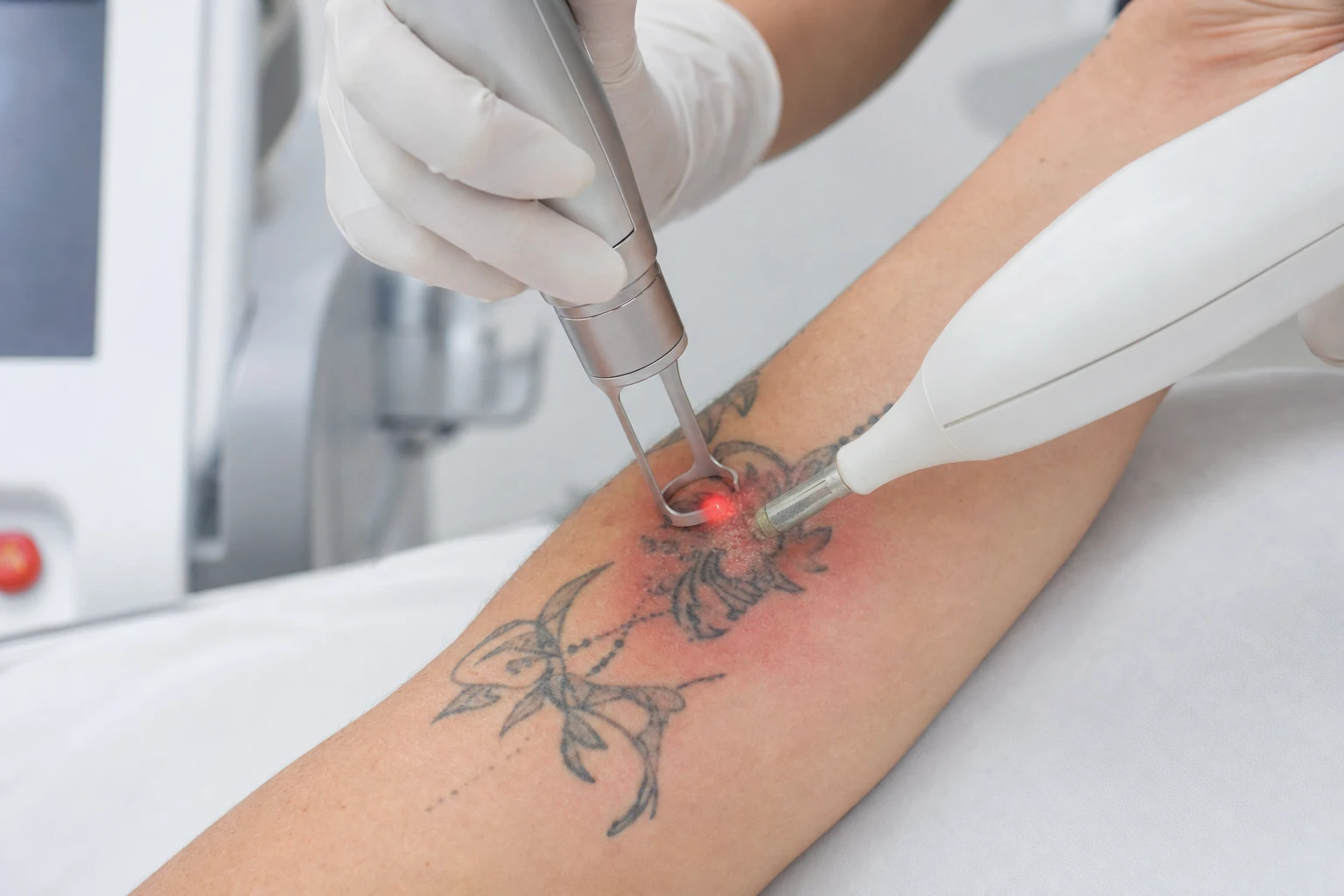 A laser tattoo removal session in progress.
Why it takes multiple sessions
If the laser shatters ink, why can't one long session do it all? Three reasons, all downstream of the mechanism above.
- Each pass only reaches so deep. A single treatment shatters the ink particles the light can penetrate to and be absorbed by. Ink layered beneath is partly shielded until the top layer has cleared. Removal peels back one layer at a time.
- Clearance is the bottleneck, not the laser. After a session, your immune system needs weeks to carry the fragments away. Fire the laser again before that clearing has happened and you're treating skin that's still congested with debris — more risk, no faster result.
- Healing must finish first. The skin needs to recover between passes. Treating too soon raises the risk of blistering, scarring and pigment change without speeding removal.
The waiting period between sessions is the honest name for the biology: we call it the clearing window — the roughly 6–8 weeks the skin and lymphatic system need to heal and flush shattered ink before the next pass. It is a real, mechanism-driven interval, not a scheduling convenience. Some clinicians extend it further for stubborn tattoos, because more waiting often means more clearing per session.
The honest numbers, up front
The single most-searched question — how many sessions? — has no single answer, only a range that depends on your tattoo. Here are the typical figures the medical literature and the American Academy of Dermatology describe, laid out honestly:
| What people ask | Typical answer | Notes |
|---|---|---|
| How many sessions total? | ~5–12 sessions | Wide range; depends on the six factors below |
| Amateur / stick-and-poke tattoo | ~3–7 sessions | Less ink, shallower, easier to clear |
| Professional tattoo | ~8–15+ sessions | Denser, deeper, more layered ink |
| Time between sessions | 6–8 weeks minimum | The clearing window — non-negotiable |
| Total time to clear | ~6 months to 2 years | Driven by spacing, not session length |
| Length of one session | Under 5 minutes (small–medium tattoo) | The laser work itself is fast |
Two things stand out. First, the total time is long — six months to two years — but that's almost entirely the waiting between sessions, not the treatment. The laser work for a small tattoo is over in minutes. Second, no responsible clinic guarantees a session count before assessing your tattoo. Anyone who promises "gone in 5 sessions" sight-unseen is guessing. The ranges are your realistic frame; a consultation narrows them.
The Kirby-Desai scale: predicting your session count
The reason clinicians can estimate at all is a validated scoring tool. In 2009, dermatologists Kirby and Desai published the Kirby-Desai scale in the Journal of Clinical and Aesthetic Dermatology, a system that scores a tattoo across six factors and sums them into a predicted number of sessions. In their retrospective analysis, the score correlated strongly with the actual number of treatments patients needed — a Pearson correlation of r=0.757 (p<0.001). That's a genuinely useful predictor for a biological process, which is why the scale is still taught and used.
The six factors it scores:
| Factor | Why it matters |
|---|---|
| Fitzpatrick skin type | Darker skin (higher Fitzpatrick type) competes with ink for laser energy, requiring more careful, often more numerous, treatments |
| Ink colour | Black and dark inks clear most readily; green, blue and some fluorescents resist and add sessions |
| Amount of ink | Denser, more saturated tattoos hold more pigment to shatter and clear |
| Location | Tattoos closer to the heart (better circulation) tend to clear faster than those on the extremities (ankles, fingers) |
| Scarring or tissue change | Pre-existing scarring impairs both laser delivery and immune clearance |
| Layering | Cover-ups and reworked tattoos stack ink, multiplying the passes needed |
Notice that most of these — colour, density, location, layering — trace directly back to the mechanism: how much ink there is to shatter, how well the laser reaches it, and how efficiently your body can carry the fragments away. The scale isn't arbitrary; it's the biology, scored.
Wavelengths and colour: why one laser isn't enough
A laser only shatters ink that absorbs its specific wavelength. That's why colour is a Kirby-Desai factor, and why clinics use different laser settings or devices for different inks. The rough map:
| Wavelength | Best for these colours |
|---|---|
| 1064nm (Nd:YAG) | Black and dark inks — the most common, and the easiest to clear |
| 532nm | Red, orange and other warm tones |
| 694nm (ruby) / 755nm (alexandrite) | Blue and green — the stubborn colours |
This is the honest reason green and blue have their difficult reputation: they need specific wavelengths (694nm or 755nm) that not every clinic offers, and even then they often take more sessions than black. If your tattoo is multi-coloured, ask a clinic which wavelengths its lasers actually deliver.
A related point on laser type, because it comes up constantly: picosecond and Q-switched (nanosecond) lasers both work by the same photoacoustic principle — the difference is pulse duration, with picosecond pulses being shorter. Both are effective and widely used. Across the directory, roughly 18% of the 5,700 clinics we track note picosecond lasers and 15% note Q-switched (as of July 2026) — neither is universally "better", and the right choice depends on your specific ink and skin, not the marketing label. That's a consultation question.
What a session actually feels like
Each session is short and distinctive. As the laser fires, you'll typically feel a sharp, hot sensation most people compare to a rubber-band snapped against the skin, repeated rapidly. The treated ink area often turns white for a few seconds immediately after each pass — this is frosting, a harmless release of gas from the shattered ink, and it fades within minutes. For a small-to-medium tattoo the whole thing is usually under 5 minutes. Clinics commonly use cold air, ice or topical numbing to blunt the sting.
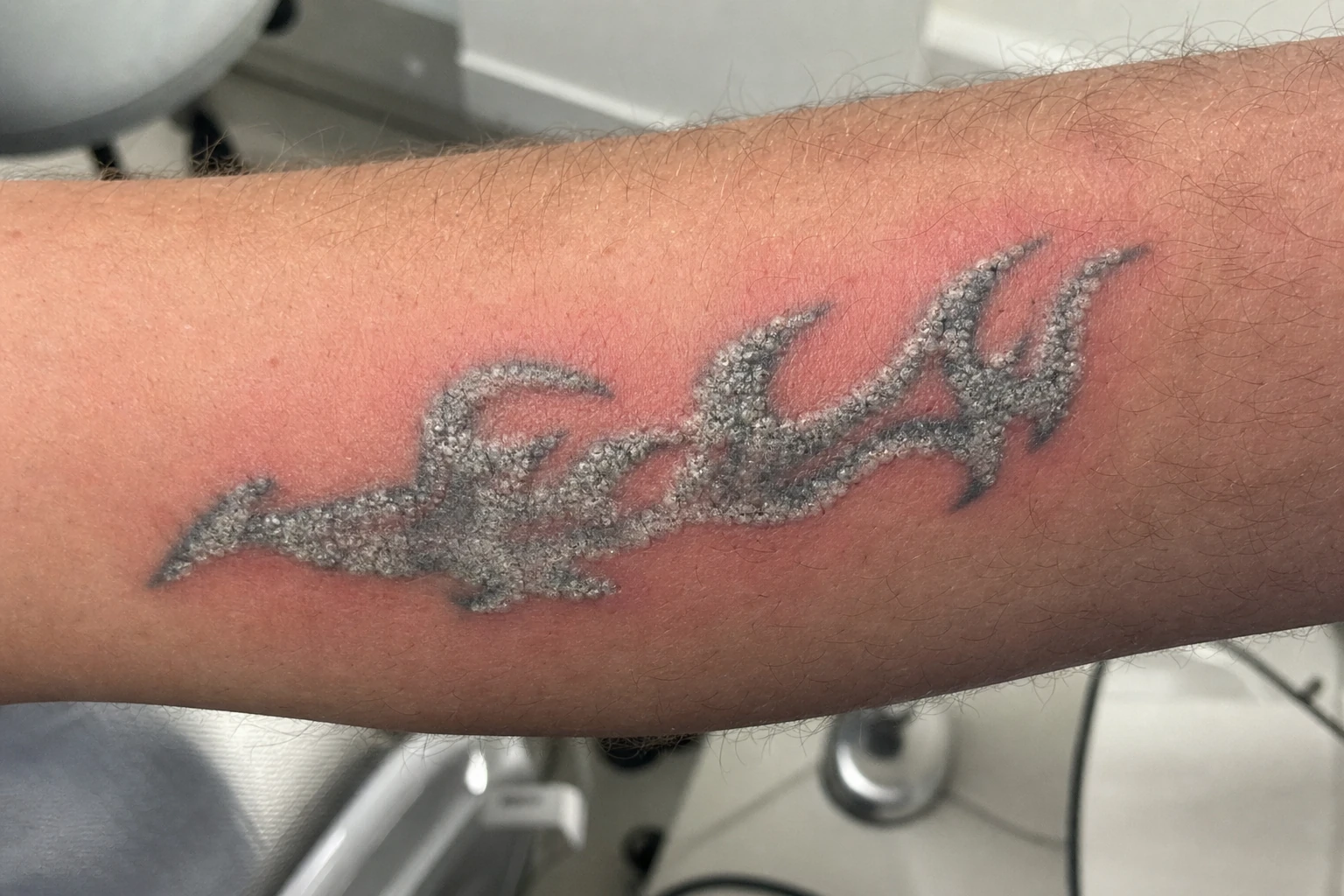 The temporary white 'frosting' seconds after a laser pulse.
Healing between sessions
After a session the area will be red, tender and sometimes blistered or scabbed for a few days to a couple of weeks — normal healing. Standard aftercare is gentle: keep it clean, moisturised and protected from the sun, and don't pick at scabs (picking is the main avoidable cause of scarring). Then you wait out the clearing window while your immune system does the invisible work. This heal-and-clear phase is exactly why the sessions are spaced 6–8 weeks apart, and why the total timeline stretches to months or years even though the laser time is measured in minutes.
Will it fully disappear? The honest answer
Many tattoos fade to clear or near-clear. But complete removal cannot be guaranteed, and it's more honest to say so. Some tattoos leave faint residual shadowing — often called ghosting — where a shadow of the design remains even after the pigment has largely gone. Stubborn colours (green, blue), very dense or heavily layered ink, cover-ups, and certain skin types are the usual reasons a tattoo doesn't reach 100%. The Kirby-Desai factors that predict a high session count also predict a higher chance of residual ghosting.
This isn't a reason to avoid removal — it's a reason to go in with realistic expectations set by a clinician who has actually looked at your tattoo, rather than by a before-and-after photo of someone else's. Outcomes vary by individual.
This is general information, not medical advice. Laser tattoo removal is a medical procedure with real risks (blistering, scarring, pigment change). Session counts, timelines and outcomes vary by person and tattoo — consult a licensed provider for advice about your specific situation.
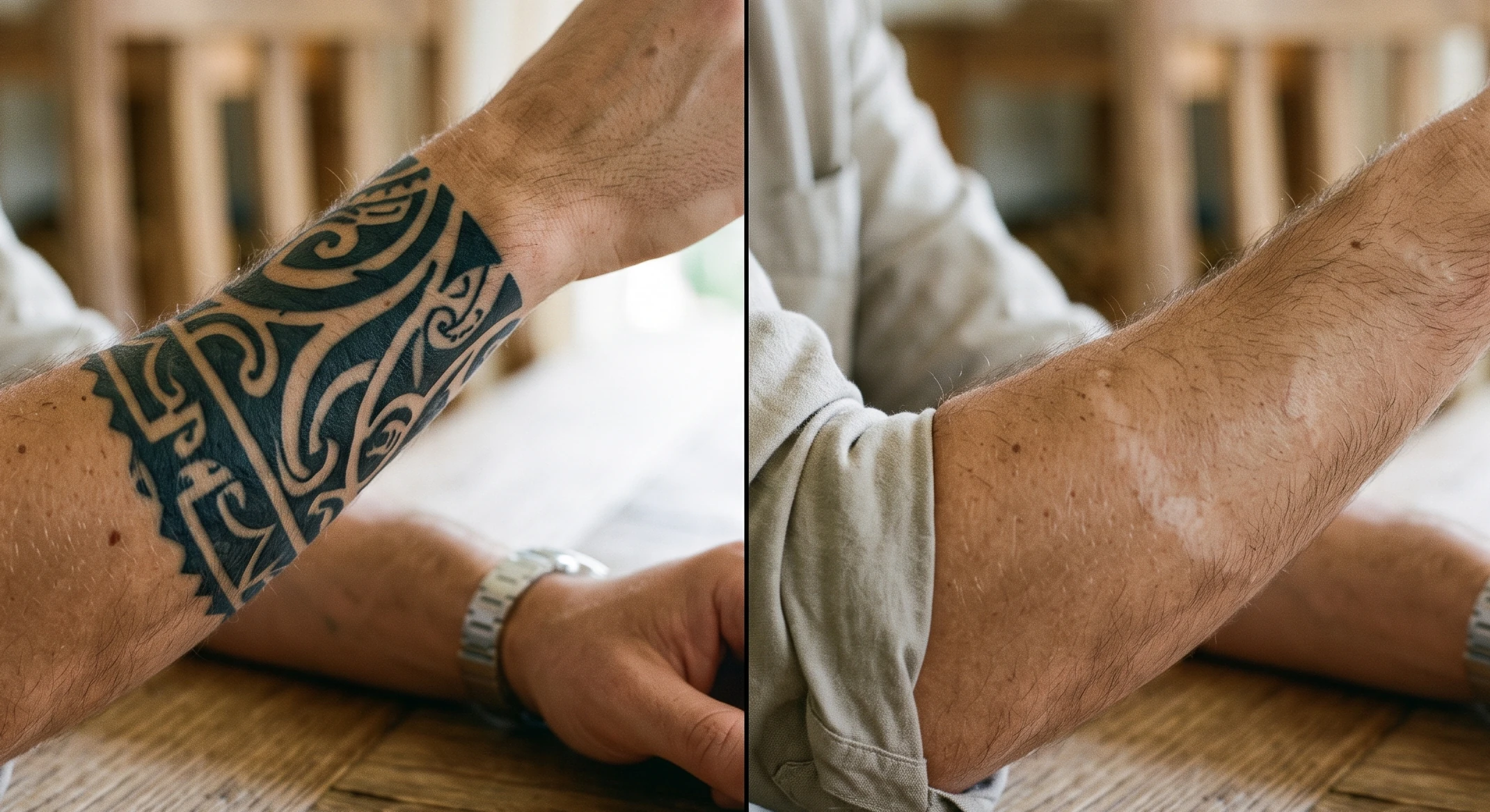 After a full course, only a faint 'ghost' — a barely-visible pale mark — may remain. Illustrative; results vary.
Compare clinics before you commit
Because the number of sessions, the wavelengths available, and the price per session all vary from clinic to clinic, the single most useful thing you can do before booking is compare the options where you live. A clinic with the right lasers for your ink colours can genuinely change your session count — and your total cost.
Compare tattoo-removal clinics in your city to see what's available near you, or start with a dense market like tattoo removal in Melbourne to see how listings, lasers and pricing stack up side by side. For what a full course actually costs, see our guide to what drives tattoo removal cost.
Frequently asked questions
How does laser tattoo removal work?
A laser fires ultra-short pulses of light that are absorbed by the tattoo ink and shatter it into tiny fragments — a photoacoustic effect. The laser only breaks the ink apart. Your immune system's macrophage cells then carry those fragments into the lymphatic system, which clears them over the following weeks.
How long does laser tattoo removal take?
Full removal typically takes about 6 months to 2 years, because sessions must be spaced at least 6–8 weeks apart to let the skin heal and the immune system clear shattered ink. Each individual session is usually under 5 minutes for a small-to-medium tattoo; the long timeline comes from the waiting between sessions, not the sessions themselves.
How many sessions does laser tattoo removal take?
Most tattoos need roughly 5–12 laser sessions, though the range is wide: amateur or stick-and-poke tattoos often clear in about 3–7, while dense professional tattoos can take 8–15 or more. No clinic can guarantee an exact count in advance — the number depends on ink colour, ink density, location and your skin, as captured by the Kirby-Desai scale.
Why does tattoo removal take multiple sessions?
Each laser pass only shatters the ink particles it can reach, and your immune system needs weeks to carry those fragments away before the next pass can reach the layer beneath. Removal is therefore staged: shatter, clear, heal, repeat. Rushing the spacing doesn't speed clearance and raises the risk of skin damage.
What is the Kirby-Desai scale?
The Kirby-Desai scale is a clinical scoring system that predicts how many laser sessions a tattoo may need. It scores six factors — Fitzpatrick skin type, ink colour, amount of ink, body location, scarring and layering — and sums them. In the original 2009 study it correlated strongly with the actual number of sessions required (r=0.757).
Does laser tattoo removal hurt?
Most people describe each laser pulse as a hot rubber-band snap against the skin. During treatment the area briefly turns white — called frosting — as gas is released from the shattered ink. Sessions are short, usually under 5 minutes for a small tattoo, and clinics often use cooling or numbing to reduce discomfort.
Will laser tattoo removal remove my tattoo completely?
Often, but not always. Many tattoos fade to clear or near-clear, while some leave faint residual shadowing or "ghosting", especially with stubborn colours like green and blue or heavily layered ink. Complete removal cannot be guaranteed. A clinician assessing your specific tattoo is the only way to get a realistic expectation.
Related guides
Related Guides
- How It Works
What Is a Q-Switched Laser for Tattoo Removal? (2026)
A Q-switched laser fires nanosecond pulses to shatter tattoo ink. Here's how Q-switched Nd:YAG, ruby and alexandrite lasers work, and why they're still a gold…
- How It Works
What Is a Picosecond Laser for Tattoo Removal? (2026)
What is a picosecond laser? It fires in trillionths of a second to shatter tattoo ink. How it works, the colours it helps, and why it's not always better.
- How It Works
What Affects How Fast a Tattoo Fades? 8 Factors in Removal Speed
What affects tattoo removal speed? Ink colour, depth, age, body location, skin type, your health, smoking, and cover-ups all matter.