What Affects How Fast a Tattoo Fades? 8 Factors in Removal Speed
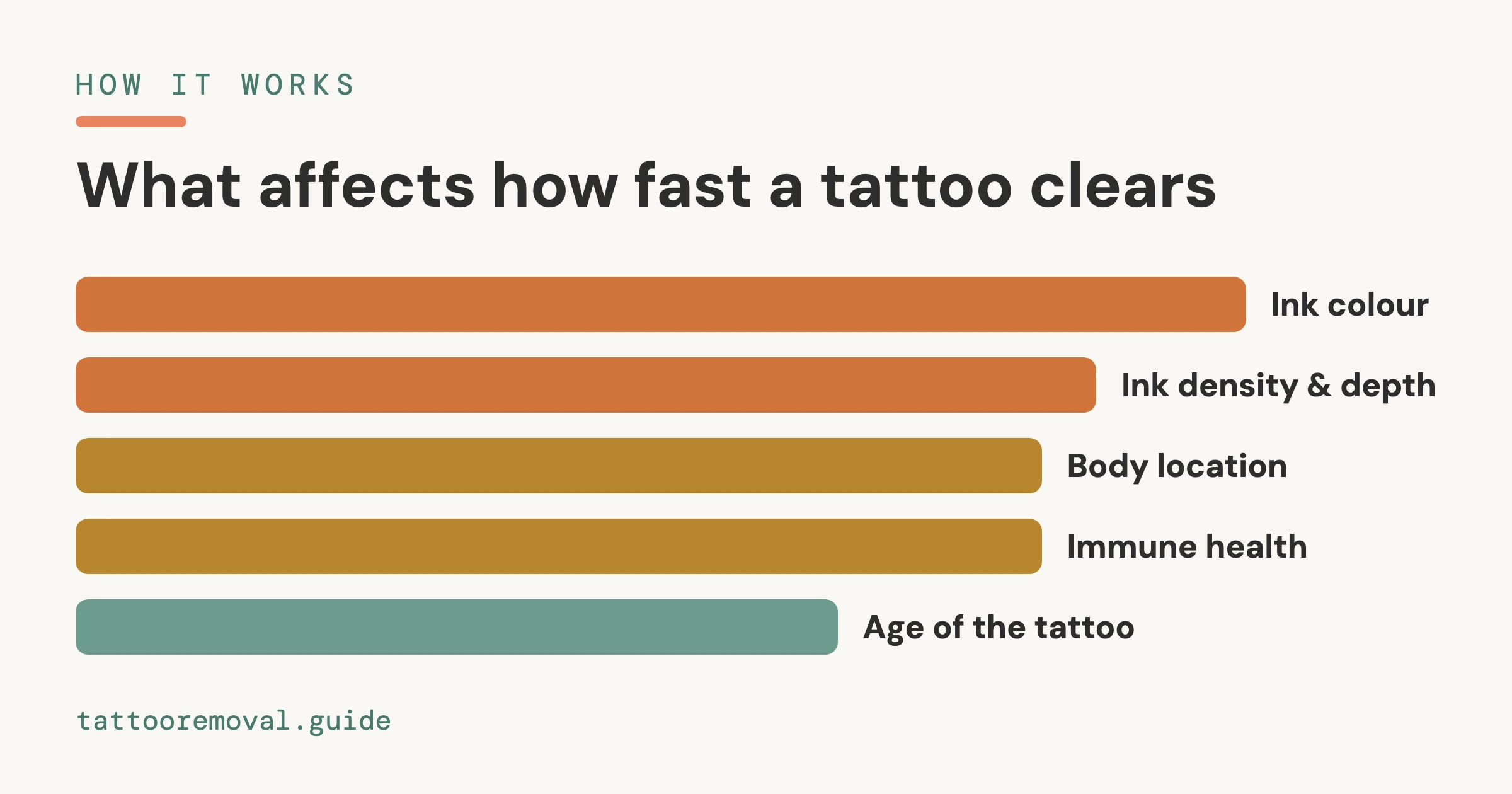
Tattoo removal speed is driven by eight main factors — ink colour, ink depth and density, the tattoo's age, its body location and blood supply, your skin type, your overall health, whether you smoke, and whether it's a cover-up — and most of them are fixed before your first session. Black ink on a well-circulated area of a healthy non-smoker clears fastest; pale colours on an ankle clear slowest. You can influence a few of these; you cannot change the rest.
That's the honest version of a question every removal patient asks: why is this taking so long? The short answer is that the laser is only half the job — your own body does the rest. This guide breaks down each factor, flags the handful you can actually control, and sets realistic expectations. All timelines here are estimates, not promises. Directory figures are stamped (as of July 2026).
Key Takeaways
- Removal speed is mostly decided before you start — ink colour, depth, and your biology are fixed; you don't get to negotiate them.
- Black and dark inks clear fastest; green, blue, yellow and white are the hardest and sometimes can't be fully removed.
- Location matters — tattoos closer to the heart (chest, back, upper arm) tend to clear faster than ankles, hands and feet.
- The few things you control — hydration, not smoking, sun protection, aftercare, and honouring the spacing between sessions — support clearance but guarantee nothing.
- No responsible clinic promises a session count or a completion date before assessing your specific tattoo.
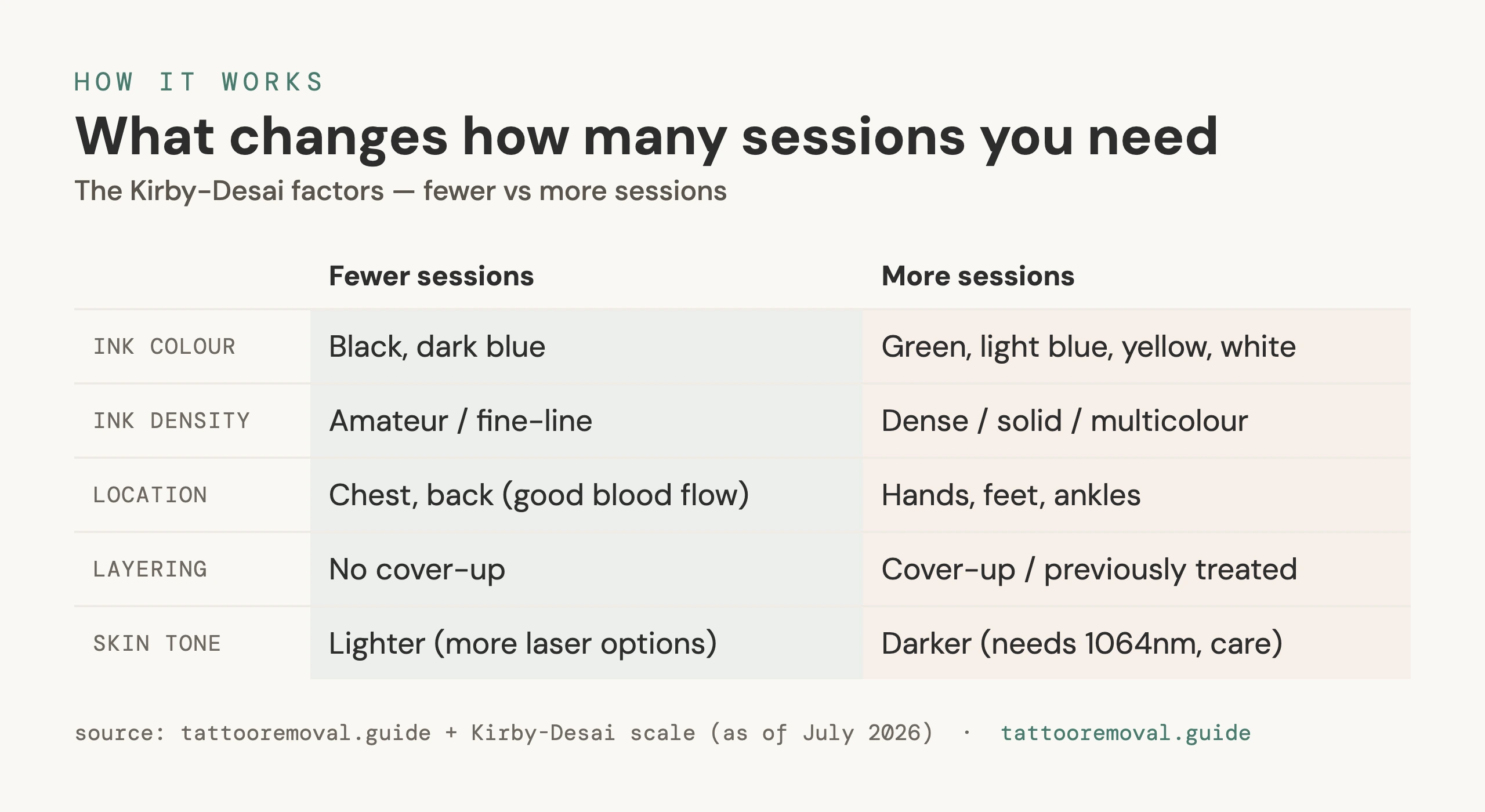 Most drivers are fixed — a few you can influence.
Why does tattoo removal take so long in the first place?
Tattoo removal is slow because the laser doesn't actually remove any ink — your immune system does. A laser pulse shatters the trapped pigment into fragments small enough for the body to carry away, and, as the Cleveland Clinic explains, those fragments are then cleared gradually through the lymphatic system over the following weeks. That biological clearance is the real bottleneck.
Tattoo removal speed is the rate at which shattered ink particles are flushed out of the skin between laser sessions — not how powerful a single session is. It's why sessions are spaced roughly 6–8 weeks apart (to let the skin heal and the body clear the last round) and why a full course commonly runs many sessions rather than a few. Every factor below either helps or hinders that clearance.
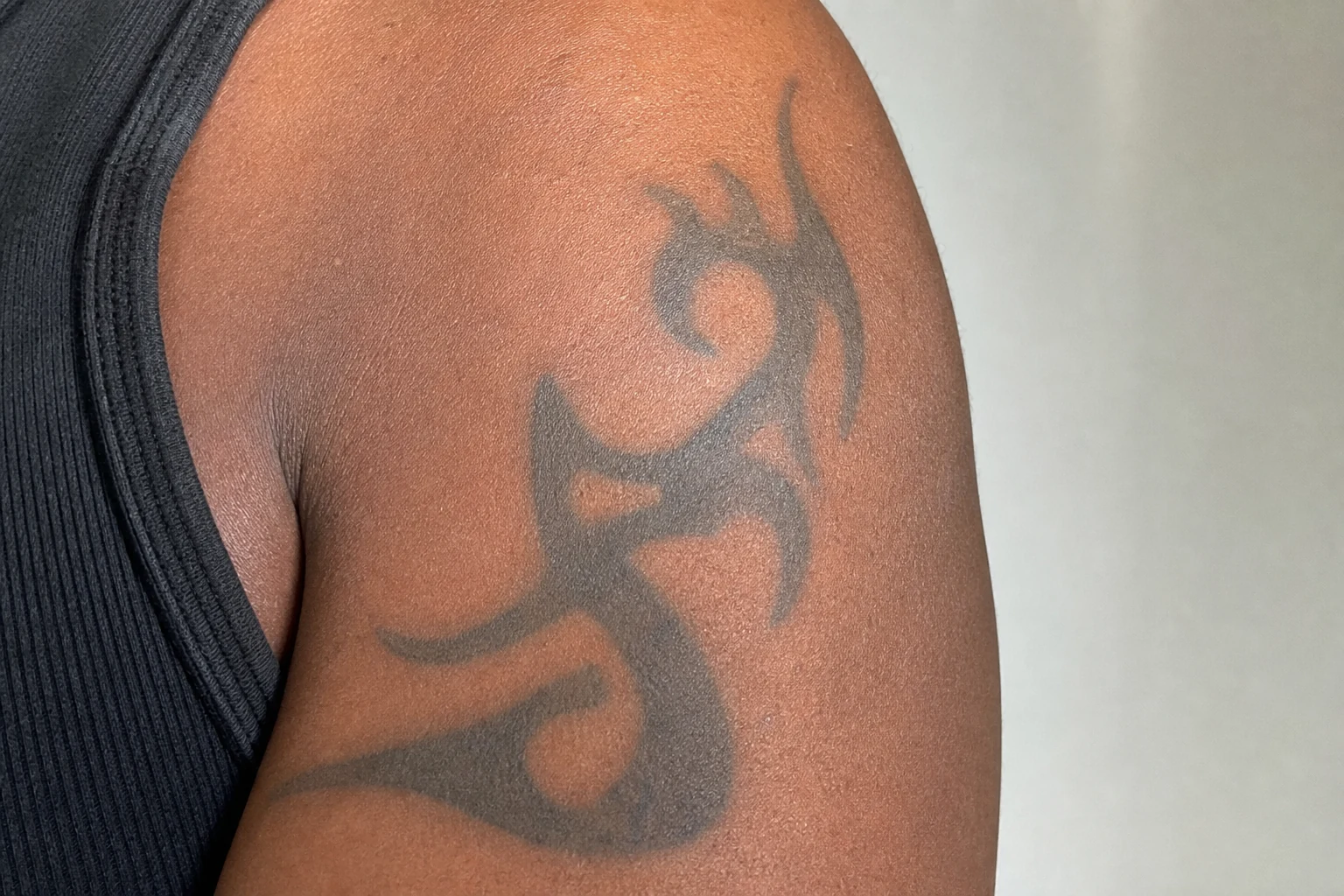 Darker skin is treated at 1064nm to protect its pigment.
The 8 factors that affect removal speed
1. Ink colour
Colour is the single biggest driver. Black and dark inks absorb the widest range of laser wavelengths, so they respond fastest. Green and blue are harder and need specific wavelengths to target them. Yellow, white, pastel, and flesh-toned inks are the most stubborn — StatPearls notes that colours like green and yellow are among the most difficult to clear, and some may never fully go. No provider can guarantee complete removal of a given colour.
2. Ink depth and density
How deep and how heavily the ink was packed matters enormously. A professional tattoo is usually deposited deep in the dermis at high saturation — dense, even, and built to last, which means more pigment for the laser to break down over more sessions. An amateur or stick-and-poke tattoo is often shallower and less saturated, so it can clear faster, though uneven depth makes it less predictable.
3. Tattoo age
Older tattoos have frequently already lost some pigment to years of sun exposure and natural fading, leaving less ink to remove. A freshly saturated new tattoo holds denser pigment and generally needs more sessions. Age helps — but it's only one variable, and a faded old tattoo in a slow-circulation spot can still take its time.
4. Body location and circulation
Because clearance runs on your circulation and lymphatic drainage, where the tattoo sits changes the pace. Areas closer to the heart with richer blood supply — the chest, back, and upper arms — tend to clear faster. Extremities with slower circulation — ankles, hands, feet, and fingers — are typically the slowest and most frustrating to finish.
5. Skin type
Skin tone doesn't slow removal on its own, but it dictates how the laser must be set. Darker skin (higher Fitzpatrick types) is treated with more conservative settings — often a 1064 nm wavelength and lower fluence — to reduce the risk of pigment change and burns. Safer, gentler settings can mean more sessions, a deliberate trade of speed for safety. The FDA cautions that removal can cause lasting skin discoloration, which is exactly why an experienced provider prioritises caution over pace here.
6. Your immune system and general health
Since your body clears the ink, your overall health matters. Good circulation, a well-functioning immune system, adequate sleep, hydration, and exercise all support faster clearance between sessions. Conditions or medications that suppress immune function, or poor general health, can slow the process. This is one reason two people with identical tattoos can progress at different rates.
7. Smoking
Smoking is associated with slower and less complete tattoo removal. Clearance depends on healthy circulation and immune response, and smoking impairs both — so smokers may need more sessions on average to reach the same result. It's one of the few speed factors entirely within your control. We cover the evidence in does smoking affect tattoo removal.
8. Cover-ups and layering
A cover-up stacks new ink over old, so there are effectively two or more tattoos' worth of pigment — often at different depths and colours — in the same patch of skin. That extra density means cover-ups and heavily layered tattoos are among the slowest to remove and the hardest to predict. Older ink hidden beneath a cover can also surface unexpectedly as upper layers clear.
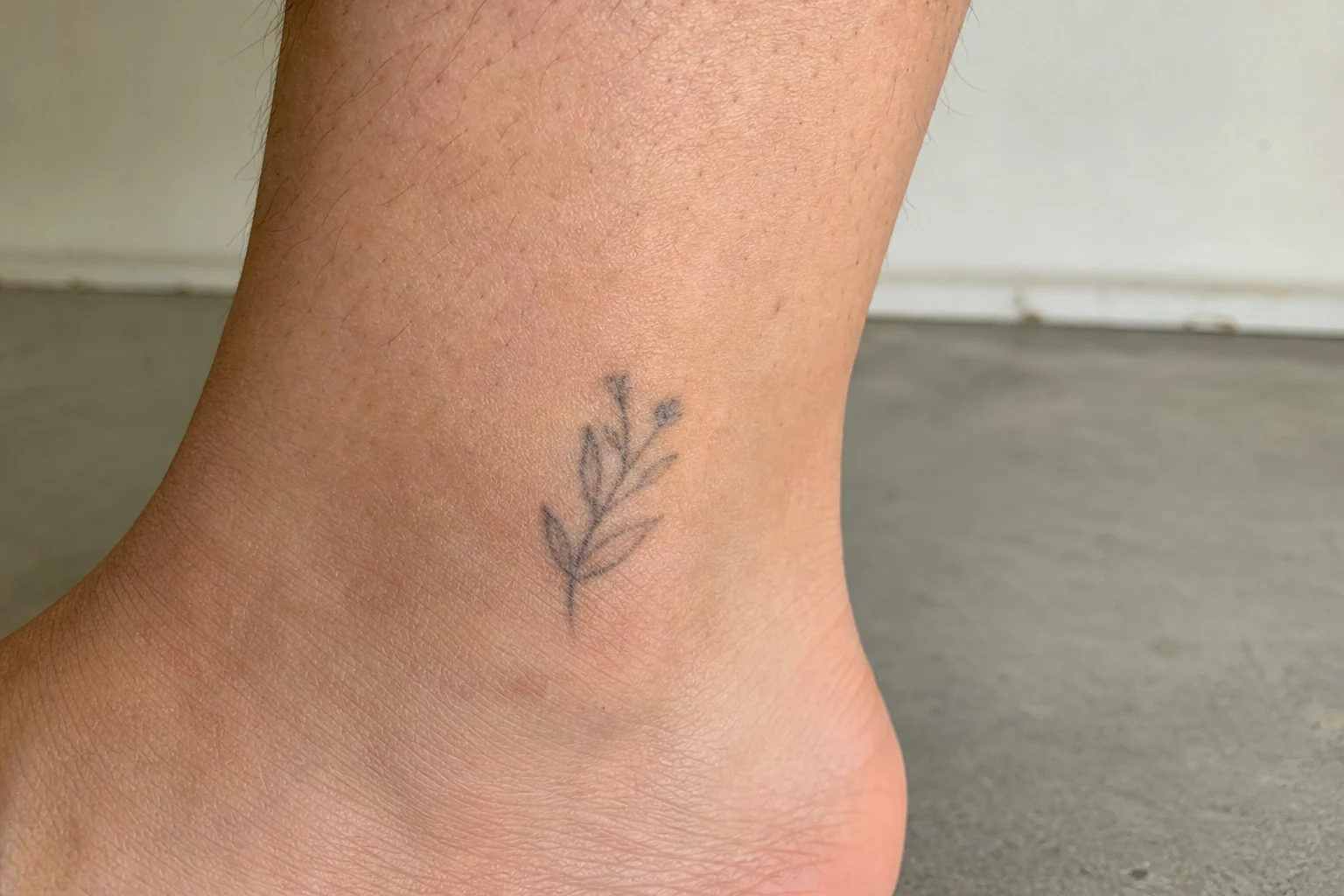 Ankles sit far from strong circulation.
What you can control vs. what's fixed
Here's the honest split — because most of the speed dial was set the day you got inked.
| Factor | Pushes removal FASTER | Pushes removal SLOWER | Can you change it? |
|---|---|---|---|
| Ink colour | Black / dark inks | Green, blue, yellow, white, flesh-tone | Fixed |
| Ink depth & density | Amateur / lightly saturated | Professional, deep, dense | Fixed |
| Tattoo age | Older, already faded | Fresh, fully saturated | Fixed |
| Body location | Chest, back, upper arm (good blood flow) | Ankle, hand, foot, fingers | Fixed |
| Skin type | Allows standard settings | Needs conservative 1064 nm settings | Fixed |
| Overall health | Strong immune / circulation | Impaired immunity, poor health | Partly |
| Smoking | Non-smoker | Smoker | You control this |
| Cover-up / layering | Single-layer tattoo | Cover-up or layered ink | Fixed |
| Hydration & aftercare | Well hydrated, follows aftercare | Dehydrated, skips aftercare | You control this |
| Session spacing | Full 6–8 week heal between rounds | Rushing sessions too close | You control this |
The pattern is clear: the biggest levers — colour, depth, location — are locked in. What you can do is stop smoking, stay hydrated, protect the area from the sun, follow your clinic's aftercare, and never rush the spacing between sessions. As the American Academy of Dermatology advises, sun protection and good skin care matter throughout. These habits support your body's clearance work; they don't buy a guaranteed faster result or a fixed number of sessions.
This is general information, not medical advice. Tattoo removal is a medical procedure with real risks (infection, scarring, pigment change), and speed varies by person, ink, and skin. Session counts and timelines are estimates only — consult a licensed provider about your specific tattoo.
How to set a realistic expectation
Before you commit, ask a provider to assess your specific tattoo against these factors rather than quoting an average off a chart. A black, older, professionally done piece on your upper arm and a fresh, multicoloured cover-up on your ankle are two completely different jobs — and no honest clinic will promise either an exact session count or a completion date up front. What a good consultation can do is tell you which factors are working for you and which are against you, and roughly how many sessions to plan for.
The other lever is choosing the right clinic. Provider experience, laser type, and how conservatively they set the machine all shape both your safety and your pace — especially for harder colours and darker skin.
Compare clinics before you start
Because so much of your removal speed is fixed, the variable you do control is who treats you. The most useful next step is to see which providers near you handle your ink colour, skin type, and tattoo location well — and to ask each one how many sessions they realistically expect for your tattoo.
Compare tattoo-removal clinics in your city to see what's available near you, or start with a dense market like tattoo removal in Melbourne to compare services side by side. For the bigger picture on timelines, read our pillar on how long tattoo removal takes, or dig into one factor you can change in does smoking affect tattoo removal.
Across the 5,700 clinics we track in 1,043 cities (as of July 2026), about 18% publicly list a picosecond laser and roughly 15% list a Q-switched laser — a floor, not a full picture, since most listings don't specify their equipment at all. Neither device category is categorically superior; the right laser depends on your ink and skin, which is exactly the conversation to have at a consultation.
Frequently asked questions
What affects how fast a tattoo can be removed?
Removal speed is driven by ink colour (black and dark inks clear fastest; green, blue, yellow and white are hardest), how deep and dense the ink sits, the tattoo's age, its body location and blood supply, your skin type, your overall health and immune function, whether you smoke, and whether it's a cover-up or layered piece. Most of these are fixed before you start, but a few — hydration, not smoking, sun protection, and session spacing — are within your control.
Why does tattoo removal take so long?
Laser only shatters the ink into smaller particles; your immune system then has to carry those particles away over the weeks between sessions. That biological clearance is the real bottleneck, which is why sessions are spaced roughly 6–8 weeks apart and a full course commonly runs many sessions rather than a few. Denser, deeper, or harder-coloured ink simply needs more of those cycles.
Which tattoo colours are hardest to remove?
Black and dark inks respond fastest because they absorb the widest range of laser wavelengths. Green and blue are harder and need specific wavelengths, while yellow, white, and flesh-toned or pastel inks are the most stubborn and sometimes cannot be fully cleared. No provider can guarantee complete removal of any colour before assessing your tattoo.
Does where the tattoo is on my body change how fast it fades?
Yes. Areas with stronger blood supply and lymphatic drainage — generally those closer to the heart, like the chest, upper arms and back — tend to clear faster because the immune system removes shattered ink more efficiently. Extremities with slower circulation, such as the ankles, hands, feet and fingers, typically respond more slowly.
Can I make my tattoo removal go faster?
You can't change the fixed factors — ink colour, depth, or your skin's biology — but you can support clearance by staying well hydrated, not smoking, protecting the area from the sun, following aftercare, and keeping to the recommended spacing between sessions. These help your body do its job; they don't guarantee a faster result or a set number of sessions.
Does smoking really slow tattoo removal?
Smoking is associated with slower, less complete tattoo removal. Because clearance depends on healthy circulation and immune function, and smoking impairs both, smokers may need more sessions on average. It's one of the few speed factors you can directly change. See our guide on how smoking affects tattoo removal for detail.
Why is my old tattoo fading faster than my new one?
Older tattoos have often already lost some ink to natural fading and sun exposure over the years, so there is less pigment for the laser to clear. Newer, freshly saturated tattoos hold denser ink and usually need more sessions. Age is only one factor, though — a faded old tattoo in a poor-circulation spot can still be slow.
Related guides
Related Guides
- How It Works
What Is a Q-Switched Laser for Tattoo Removal? (2026)
A Q-switched laser fires nanosecond pulses to shatter tattoo ink. Here's how Q-switched Nd:YAG, ruby and alexandrite lasers work, and why they're still a gold…
- How It Works
What Is a Picosecond Laser for Tattoo Removal? (2026)
What is a picosecond laser? It fires in trillionths of a second to shatter tattoo ink. How it works, the colours it helps, and why it's not always better.
- How It Works
How Long Between Tattoo Removal Sessions? The 6–8 Week Clearing Window
How long between tattoo removal sessions? Most clinics wait 6–8 weeks. Why the clearing window exists, why sooner won't help, and when a longer gap is better.