How Long Does Tattoo Removal Take? The Honest Timeline (2026)
Part of the complete guide to how many sessions tattoo removal takes — the full session count, timeline and what drives your number.
How long does tattoo removal take? The honest answer is about 6 months to 2 years for complete removal — but that total is almost entirely waiting, not treatment. Laser sessions must be spaced roughly 6–8 weeks apart so your skin can heal and your immune system can clear the shattered ink, and most tattoos need several sessions. Each session itself is often under 5 minutes.
That single fact — the timeline is set by the gaps, not the sessions — is what this guide unpacks: why the calendar stretches to months or years, how to separate healing time from total removal time, and what makes one person's tattoo take twice as long as another's. Figures from the Tattoo Removal Guide directory are stamped (as of July 2026).
Key Takeaways
- Complete removal typically takes 6 months to 2 years — driven by session spacing, not session length.
- Healing time (skin surface, ~1–2 weeks) is different from total removal time (the whole course, months to years).
- Each session is short — often under 5 minutes for a small tattoo. The long part is the clearing window between sessions.
- The clearing window is the ~6–8 week gap sessions are spaced by, so the skin heals and the immune system flushes shattered ink.
- Colour, ink density, body location, immune health and smoking all lengthen the timeline. Of the 5,700 clinics we track across 1,043 cities (as of July 2026), capabilities vary — so does your likely session count.
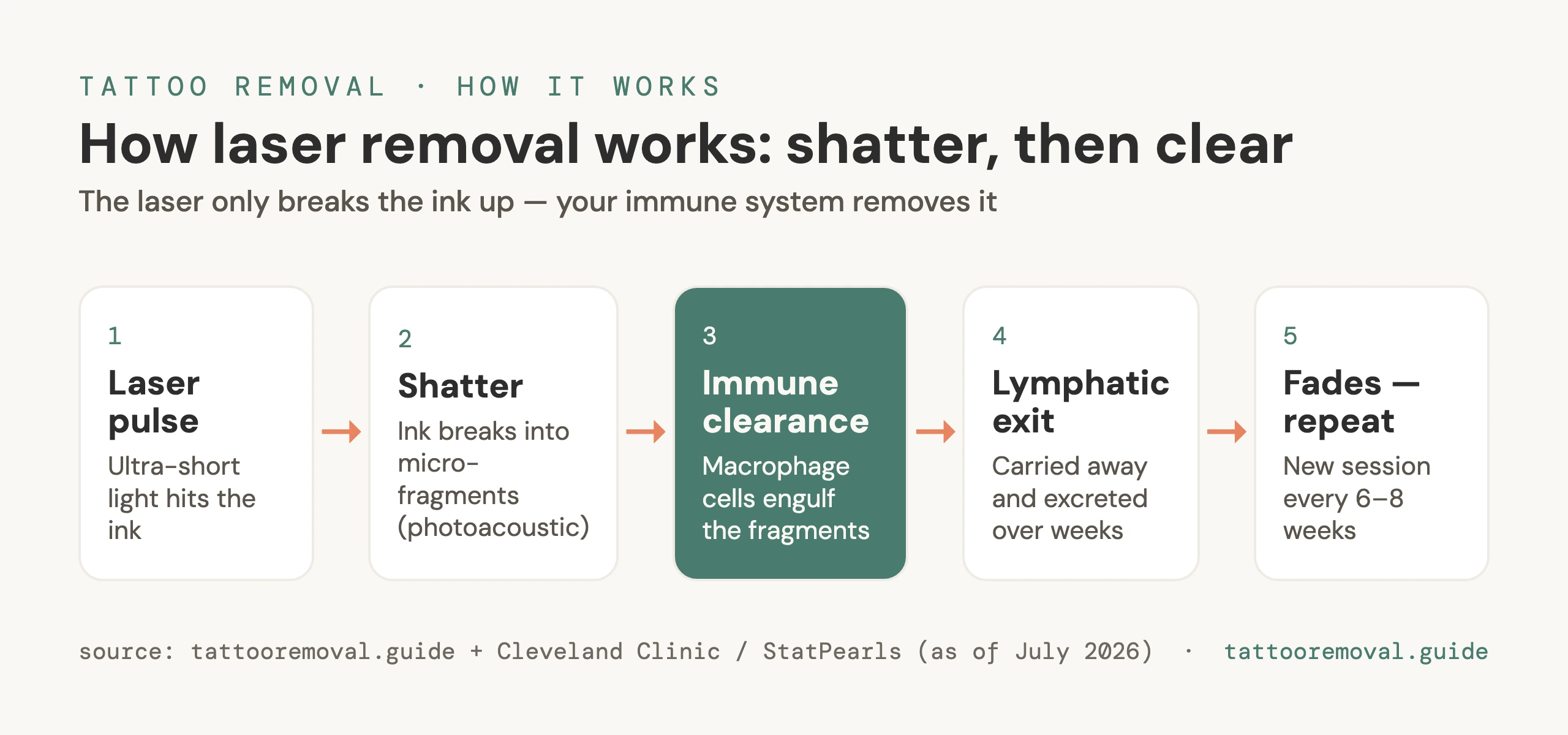 The laser only breaks the ink up — your body removes it, over months.
The honest total: 6 months to 2 years
Set expectations correctly and everything else makes sense. For most people, laser tattoo removal is a 6-month to 2-year project. A small amateur tattoo at the fast end might clear in half a year; a large, dense, multi-coloured professional piece can run past two years.
The reason isn't that the laser is slow. As the Cleveland Clinic explains, the laser only breaks the ink into fragments small enough for your body to absorb and eliminate — the actual removing is done by your immune system over the following weeks. Because that biological clearance can't be rushed, sessions are staged weeks apart, and the total time is simply (number of sessions) × (weeks between them), plus the final fading.
Total removal time is not one long procedure — it's a series of short procedures separated by long waits. That distinction is the whole answer.
 A consultation is where the plan, risks and realistic expectations get set.
Healing time vs. total removal time
These two are constantly confused, so it's worth separating them cleanly.
- Healing time is how long your skin surface takes to recover after a single session: redness, swelling, and any blistering or scabbing. That's usually about 1–2 weeks.
- Total removal time is how long the entire course takes from first session to final result: months to years.
You can be fully healed from a session in a fortnight and still be many sessions — and many months — away from the tattoo being gone. The surface heals long before the ink clears. The American Academy of Dermatology notes that removal requires multiple treatments spaced weeks apart precisely because clearance is gradual.
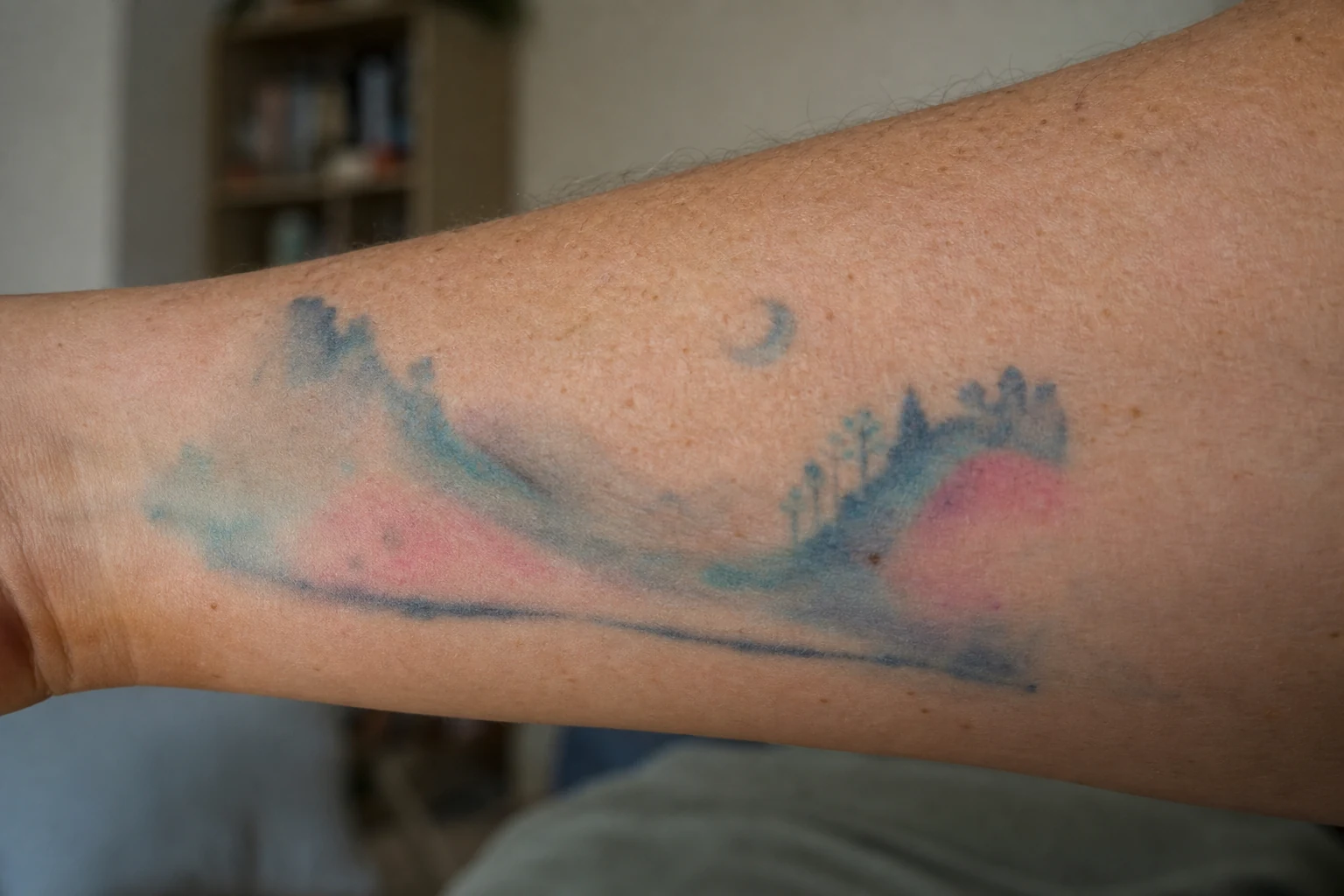 Multicolour work fades unevenly, colour by colour.
The clearing window: why sessions are spaced 6–8 weeks apart
The clearing window is the roughly 6–8 week interval between laser sessions during which the skin heals and the lymphatic system carries shattered ink out of the body. It's a real, mechanism-driven interval, not a scheduling convenience.
Here's what happens inside it. A laser pass shatters ink particles into fragments. Immune cells (macrophages) then engulf those fragments and ferry them into the lymphatic system, which flushes them out over the following weeks. The StatPearls clinical reference describes the same staged sequence: selective absorption, fragmentation, then immune-mediated clearance between treatments. Only once that clearing and healing has largely finished can the next pass usefully reach the ink layered beneath.
Some clinicians deliberately extend the window — 10 or 12 weeks — for stubborn tattoos, on the logic that more time means more fading banked per session.
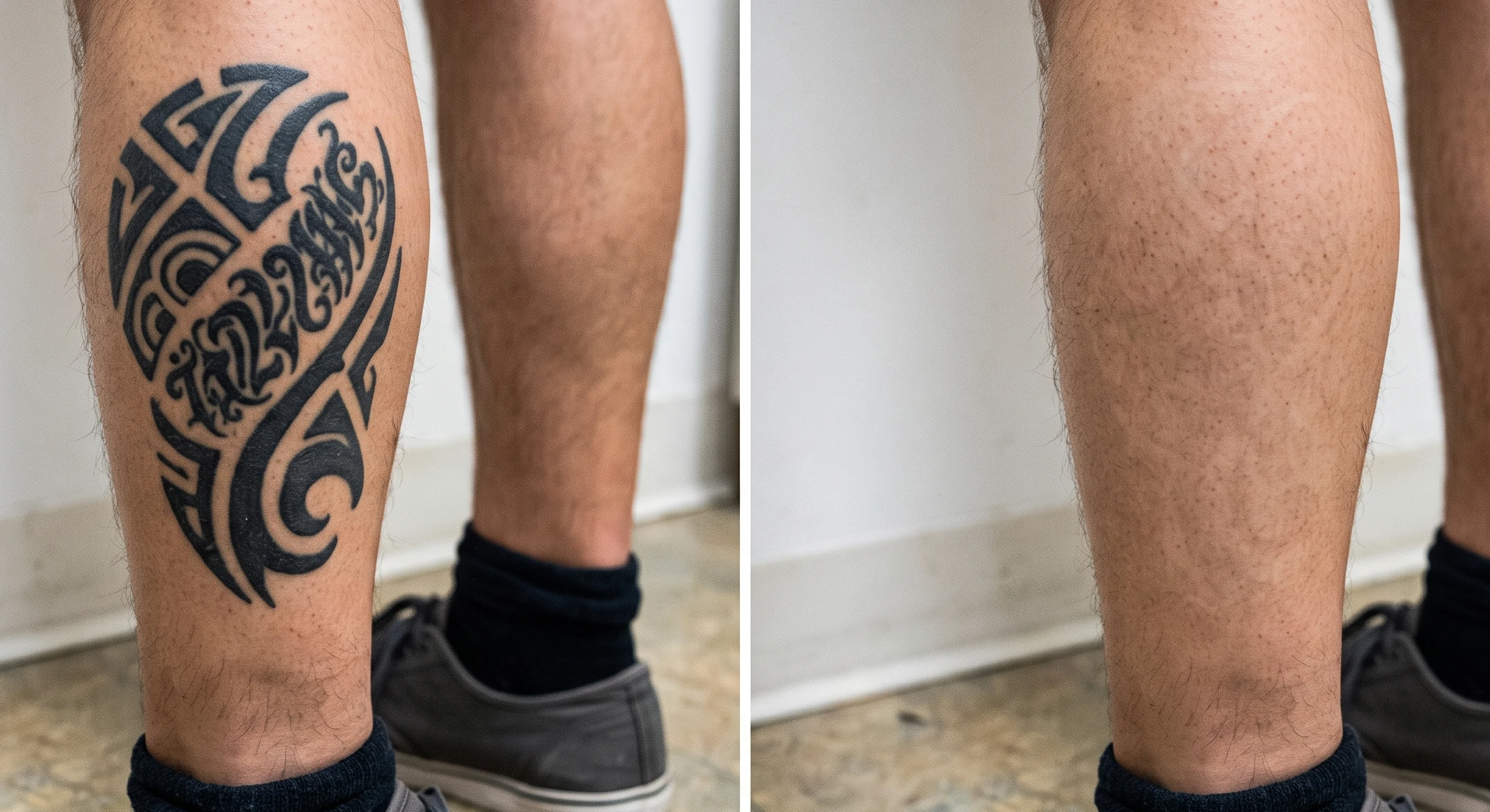 After a full course, only a faint 'ghost' — a barely-visible pale mark — may remain. Illustrative; results vary.
A month-by-month timeline
Here's how a typical course actually plays out on the calendar. This example assumes a mid-range tattoo needing around six sessions; yours may need fewer or many more.
| Timepoint | What's happening | Duration |
|---|---|---|
| Day 0 — Session 1 | Laser shatters ink; frosting and redness | Under 5 min (small tattoo) |
| Weeks 1–2 | Surface heals: scabbing and redness resolve | ~1–2 weeks |
| Weeks 2–8 | The clearing window: immune system flushes fragments; tattoo visibly fades | ~6 weeks |
| ~Month 2 — Session 2 | Next pass reaches the layer beneath | Under 5 min |
| ~Month 4 — Session 3 | Repeat: shatter, heal, clear | Under 5 min |
| ~Month 6 — Session 4 | Fading now obvious | Under 5 min |
| ~Month 8 — Session 5 | Diminishing ink | Under 5 min |
| ~Month 10–12 — Session 6 | Final passes; residual fading continues after | Under 5 min |
| Months 12–24 | Extra sessions if colours or density resist | As needed |
Notice how little of the timeline is laser time. Six sessions of five minutes is half an hour of treatment spread across a year or more. The rest is the clearing window doing its work.
For how the session count is estimated in advance — via the validated six-factor Kirby-Desai scale — see our companion guide on how many sessions it takes to remove a tattoo, and the mechanism behind it in the pillar, how laser tattoo removal works.
Turning a session count into a date
The table above walks one example. Here is the general arithmetic, because the number you will actually be quoted is a session count — and nobody translates it for you.
Most tattoos need 8 to 12 sessions. Multiply by the 6–8 week gap and the calendar answer falls out:
| Your quoted course | Spacing | Calendar time |
|---|---|---|
| 8 sessions (small, simple, black ink) | 6 weeks | ~11 months |
| 10 sessions (typical) | 7 weeks | ~15 months |
| 12 sessions (large, dense or multi-colour) | 8 weeks | ~18 months, sometimes more |
That is the number nobody quotes you. A clinic that says "about ten sessions" has told you the easy half; the half that changes your plans is that ten sessions is the better part of a year and a half.
How long is one session, really? Short — but the honest range is wider than a single figure. A small black tattoo can be done in under five minutes of actual laser time. A large or multi-colour piece is more often 15 to 30 minutes in the chair. Either way, across a whole course that is a few hours of treatment spread over more than a year. You are not paying with chair time. You are paying with patience.
The one timeline that is genuinely shorter: fading for a cover-up
If your goal is a cover-up or a rework rather than a blank patch of skin, the arithmetic changes in your favour.
A cover-up only needs the existing tattoo lightened enough for a new design to sit cleanly over it — not erased. That typically takes 2 to 4 sessions, which is roughly 3 to 7 months of spacing rather than a year-plus.
Decide this before you start. Full removal and fading-for-a-cover-up are different briefs, different session counts and very different timelines, and the clinic will plan the course differently for each. Say which one you want at the consultation. Our guide to fading a tattoo for a cover-up covers what that course looks like.
Planning around a date
Booking a wedding, a holiday or a career change around removal? Count backwards from the event in 6-to-8-week blocks and start early — the honest planning assumption for full removal is around a year, often well over it. Anyone promising a few quick sessions is either describing a fade-for-cover-up or overselling.
If the date is less than a year away and you need full removal, that is worth knowing now rather than at session six. Raise it at the consultation: partial fading, or a cover-up plan, may fit the deadline when full removal does not.
What makes it take longer
Two people can start on the same day and finish a year apart. The Kirby-Desai factors, described in the original 2009 study, map onto the things that stretch a timeline:
| Factor | Effect on the timeline |
|---|---|
| Ink colour | Black clears fastest; green and blue resist and add sessions — often the single biggest delay |
| Ink density | Dense, saturated or layered professional ink holds more pigment to shatter and clear |
| Location / circulation | Tattoos near the heart clear faster; ankles, fingers and feet clear slower (poorer circulation) |
| Immune health | Removal is an immune process — general health affects how efficiently fragments are cleared |
| Smoking | Associated in research with lower clearance success, meaning more sessions and a longer course |
Because the last three all act on the clearance step, they lengthen the total time without changing how quick each session is. They add sessions, and every added session adds another 6–8 week window.
Why rushing the spacing doesn't work
It's tempting to ask for sessions every two weeks to "get it over with." It doesn't help — and it can hurt.
Firing the laser again before the clearing window has finished means treating skin that's still congested with fragments from the last pass and still healing at the surface. You don't remove ink any faster, because the bottleneck is your immune system's clearance rate, not the laser's schedule. What you do raise is the risk of blistering, scarring and pigment change. The waiting isn't wasted time between the real work — the waiting is the real work. Rushing it trades a longer timeline for a worse outcome.
This is general information, not medical advice. Laser tattoo removal is a medical procedure with real risks (blistering, scarring, pigment change). Timelines, session counts and outcomes vary by person and tattoo, and no timeline can be guaranteed — consult a licensed provider about your specific situation.
Get a realistic timeline for your tattoo
The only way to turn "6 months to 2 years" into a number for your tattoo is to have a clinician assess it — your ink colours, density, location and skin all move the estimate. The lasers a clinic actually offers matter too: the right wavelengths for your colours can genuinely cut your session count, and with it your total time and cost.
Compare tattoo-removal clinics in your city to see what's available near you, or start with a dense market like tattoo removal in Melbourne to see how listed clinics, lasers and pricing stack up side by side.
Frequently asked questions
How long does tattoo removal take?
Complete laser tattoo removal typically takes about 6 months to 2 years. That total isn't treatment time — it's waiting time. Sessions must be spaced roughly 6–8 weeks apart so the skin can heal and the immune system can clear shattered ink, and most tattoos need several sessions, which stretches the calendar out to months or years.
How long is each tattoo removal session?
Each individual laser session is short — often under 5 minutes for a small-to-medium tattoo, and rarely more than 20–30 minutes for a large one. The laser work itself is fast. Almost all of the total removal timeline is the 6–8 week gap between sessions, not the sessions.
How long does tattoo removal take to heal?
The skin surface usually heals within about 1–2 weeks after each session — redness, swelling, blistering or scabbing settle in that window. That surface healing is separate from total removal time: the tattoo keeps fading for weeks afterward as your immune system carries the fragments away, which is why the full course takes months to years.
How long between tattoo removal sessions?
Most clinicians space sessions at least 6–8 weeks apart — a period sometimes called the clearing window. The skin needs to heal and the lymphatic system needs time to flush the shattered ink before the next pass. Some clinicians extend the gap for stubborn tattoos, because more waiting often means more fading per session.
Can you speed up tattoo removal by having sessions closer together?
No. Firing the laser again before the skin has healed and the ink has cleared doesn't remove ink faster — the fragments from the previous pass are still being carried away. Shortening the gap mainly raises the risk of blistering, scarring and pigment change without improving the result. The waiting is the mechanism, not a delay.
Why does colour make tattoo removal take longer?
Black and dark inks absorb laser light readily and clear fastest. Green and blue resist because they need specific wavelengths that not every clinic offers, and even then take more passes. Multi-coloured or heavily saturated tattoos therefore need more sessions, which adds months — sometimes years — to the total timeline.
Does tattoo removal take longer on some parts of the body?
Yes. Tattoos closer to the heart, with better blood circulation, tend to clear faster than those on the extremities like ankles, fingers and feet, where circulation is poorer and immune clearance is slower. Location is one of the factors clinicians weigh when estimating how many sessions — and how many months — removal will take.
How many sessions does tattoo removal take?
Most tattoos need 8 to 12 sessions, though small, simple, black-ink tattoos can finish sooner and dense or multi-colour pieces can need more. The session count is only half the answer: multiplied by the 6–8 week gap between sessions, 8 to 12 sessions is roughly 11 to 18 months of calendar time. A consultation that assesses your specific tattoo gives the most realistic count.
Is fading for a cover-up faster than full removal?
Yes, substantially. Fading only needs to lighten the tattoo enough for a new design to sit cleanly on top rather than erase it — often 2 to 4 sessions, which is roughly 3 to 7 months instead of a year or more. Tell the clinic at the consultation that a cover-up is the goal, because it is a different brief with a different session count.
Related guides
Related Guides
- How It Works
What Is a Q-Switched Laser for Tattoo Removal? (2026)
A Q-switched laser fires nanosecond pulses to shatter tattoo ink. Here's how Q-switched Nd:YAG, ruby and alexandrite lasers work, and why they're still a gold…
- How It Works
What Is a Picosecond Laser for Tattoo Removal? (2026)
What is a picosecond laser? It fires in trillionths of a second to shatter tattoo ink. How it works, the colours it helps, and why it's not always better.
- How It Works
What Affects How Fast a Tattoo Fades? 8 Factors in Removal Speed
What affects tattoo removal speed? Ink colour, depth, age, body location, skin type, your health, smoking, and cover-ups all matter.