What Is a Q-Switched Laser for Tattoo Removal? (2026)
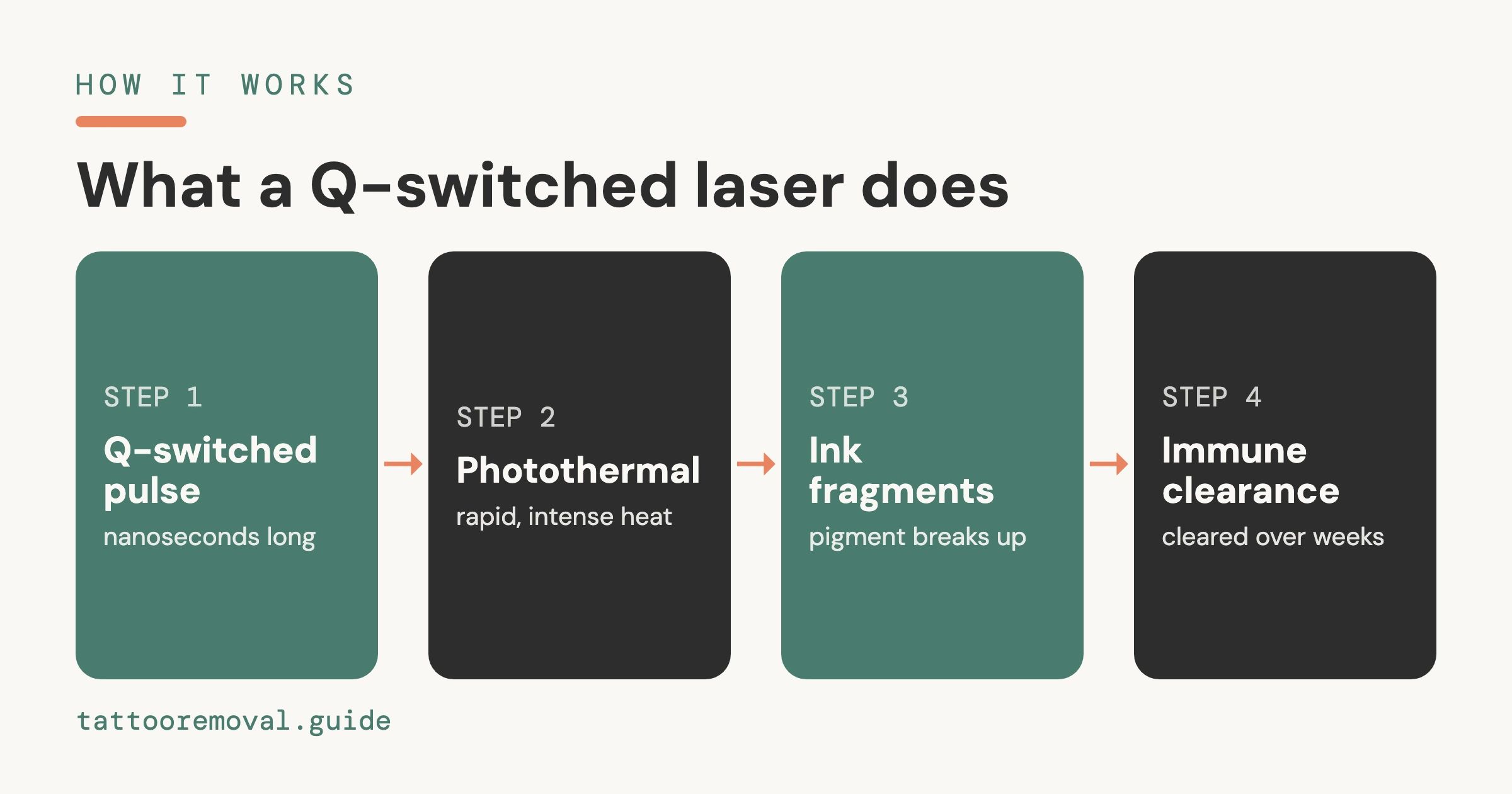
A Q-switched laser is a device that fires extremely short, high-power pulses of light measured in nanoseconds — billionths of a second — to shatter tattoo ink so the body can clear it. It has been the workhorse of laser tattoo removal for decades and remains a proven, effective, widely available technology. Q-switched Nd:YAG (1064nm) is the most common type, especially strong on black ink and the safest option for darker skin.
This guide defines what a Q-switched laser is, explains how it works, walks through the main types and wavelengths, and compares it honestly to newer picosecond lasers. Figures from the Tattoo Removal Guide directory are stamped (as of July 2026).
Key Takeaways
- A Q-switched laser is a device that delivers nanosecond pulses (billionths of a second) of intense light to fracture tattoo ink — a long-established, FDA-cleared approach.
- It works by selective photothermolysis: a pulse tuned to a wavelength the ink absorbs heats and shatters the pigment while largely sparing surrounding skin.
- The main types are defined by wavelength: 1064nm and 532nm (Nd:YAG), 694nm (ruby) and 755nm (alexandrite) — each matched to different ink colours.
- Q-switched Nd:YAG at 1064nm handles black and dark inks and is generally the safest choice for darker skin.
- Q-switched lasers are not obsolete. Picosecond lasers are newer and can help with some stubborn or coloured inks, but Q-switched remains a highly effective, cost-effective gold standard for most tattoos.
- What matters most is wavelength match to your ink and operator skill — not the pulse-duration label on the machine.
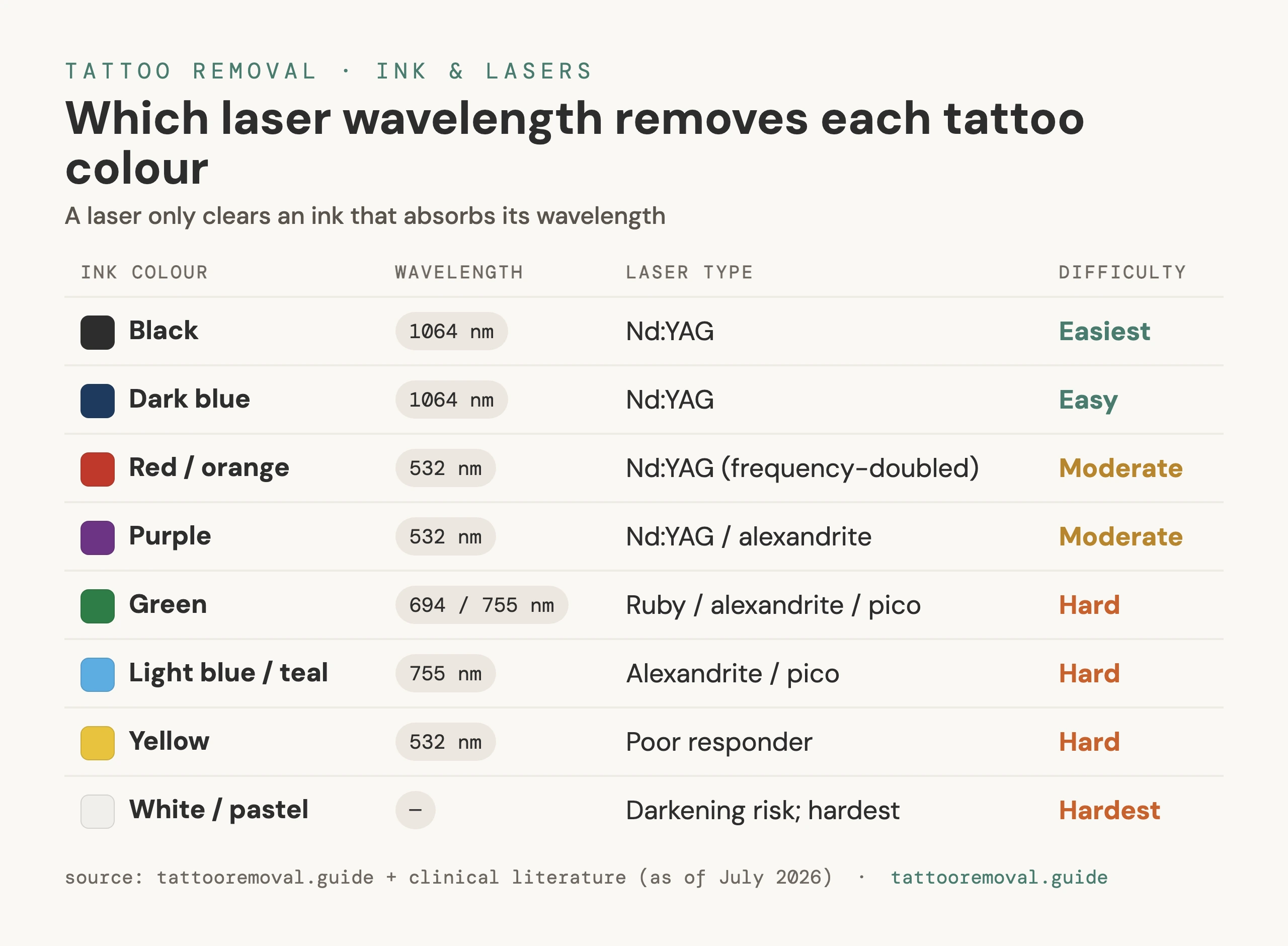 Q-switched lasers cover black, red, green and blue across their wavelengths.
What is a Q-switched laser?
A Q-switched laser is a device that stores energy inside its optical cavity and releases it in a single, very short, very intense pulse measured in nanoseconds — billionths of a second. The name comes from "Q-switching," an engineering technique that briefly holds back the laser's output, letting energy build up, then lets it out all at once. The result is a burst of light powerful enough to fracture tattoo pigment in an instant.
That capability is why Q-switched lasers became the standard tool for tattoo removal in the first place. As the Cleveland Clinic explains, the laser breaks ink into smaller pieces that the body then absorbs and eliminates over time. The U.S. FDA's fact sheet on tattoos and permanent makeup notes that removal typically requires multiple laser sessions and that results vary — no device clears a tattoo in one visit.
Because Q-switched technology has been in clinical use for decades, its science, settings and safety profile are exceptionally well understood. That long track record is a feature, not a weakness: clinicians know precisely how these lasers behave on different inks and skin types.
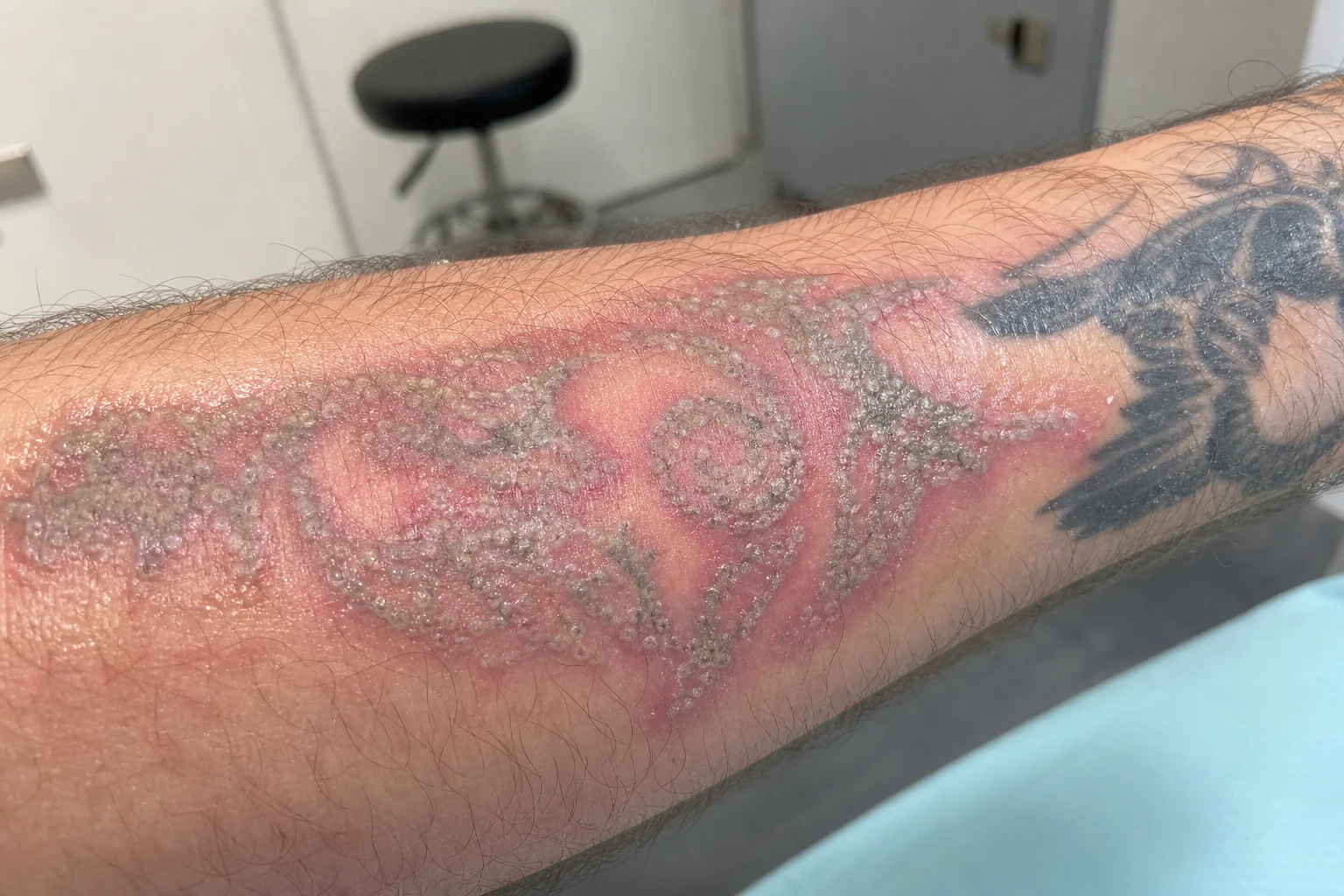 Frosting and redness immediately after a laser session.
How does a Q-switched laser work?
A Q-switched laser works through a principle called selective photothermolysis — targeting a specific colour with a specific wavelength of light delivered in a pulse so short that heat is confined to the ink and not the skin around it.
Here's the sequence:
- Absorption. The laser fires a wavelength that your tattoo's ink absorbs strongly. Ink that absorbs the light heats up; skin that doesn't absorb it is largely left alone.
- Fragmentation. The nanosecond pulse is so brief and intense that the ink particle heats and fractures almost instantly, breaking into much smaller fragments — a photomechanical effect the StatPearls clinical reference on laser tattoo removal describes as the core mechanism of laser removal.
- Clearance. Over the following weeks, your immune system carries the broken-up pigment away. This is why sessions are spaced several weeks apart and why a full course takes multiple visits rather than one.
The reason a Q-switched laser can shatter ink without destroying skin is that ultra-short pulse. Deliver the same energy slowly and you'd burn tissue; deliver it in a nanosecond and the ink absorbs the shock before the heat can spread. That is the whole trick.
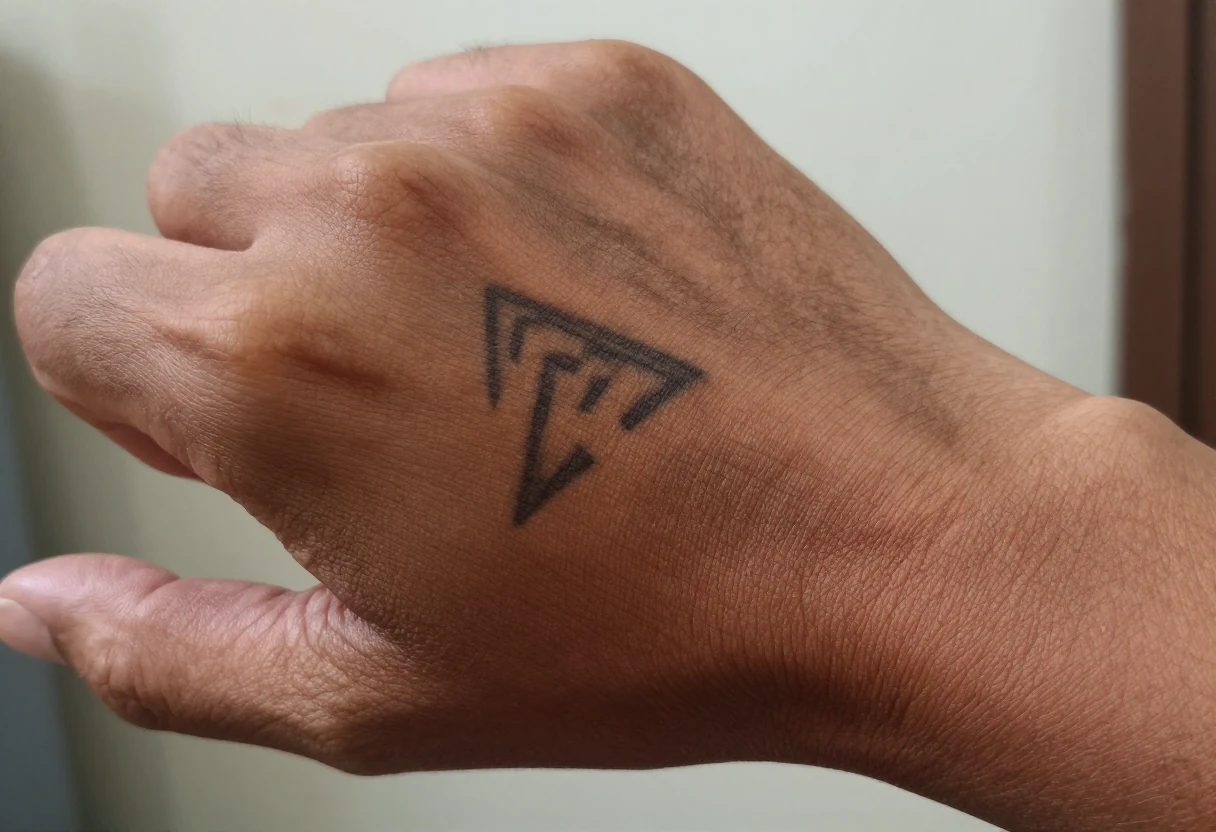 On darker skin, the Q-switched 1064nm wavelength is the safest choice.
The main types of Q-switched laser (by wavelength)
"Q-switched" describes the pulse, not the colour of light. A single clinic device may offer several wavelengths, and the wavelength is what determines which ink colours it can clear. A laser only shatters ink that absorbs its wavelength — so matching wavelength to ink is the single most important technical factor.
| Wavelength | Laser type | Best for these colours | Notes |
|---|---|---|---|
| 1064nm | Q-switched Nd:YAG | Black and dark inks | The most common colour; safest wavelength for darker skin |
| 532nm | Frequency-doubled Nd:YAG | Red, orange, warm tones | Same machine as 1064nm, switched to a shorter wavelength |
| 694nm | Q-switched ruby | Blue and green | Effective on stubborn cool colours; less common; caution on darker skin |
| 755nm | Q-switched alexandrite | Blue and green | Another option for the hardest colours; not offered everywhere |
Q-switched Nd:YAG is the standout. A Q-switched Nd:YAG laser is a device that produces 1064nm light — ideal for black and dark ink — and can be frequency-doubled to 532nm for red and warm tones, giving one machine two of the most useful wavelengths. The 1064nm setting is also the safest for darker skin, because longer wavelengths are absorbed less by melanin, lowering the risk of pigment change.
Ruby (694nm) and alexandrite (755nm) lasers exist to tackle the colours everything else struggles with — blue and green. They're less common in the average clinic, which is one reason green tattoos have a reputation for being hard to remove: the right wavelength simply isn't in the room everywhere.
Why Q-switched lasers are still a gold standard
It's tempting to assume that because picosecond lasers are newer, Q-switched lasers must be outdated. That's not how the technology works.
Q-switched lasers have removed tattoos successfully for decades, are FDA-cleared, and remain some of the most widely used and best-understood devices in the field. They are frequently the right, safe, cost-effective choice — particularly for the most common case of all, black ink on a settled tattoo. The American Academy of Dermatology points out that Q-switched lasers are the established tools dermatologists have long used for this exact job.
Their maturity brings real advantages: predictable behaviour, well-documented settings for different skin types, broad availability, and typically a lower cost per session than newer equipment. For many people, a well-run Q-switched laser will clear their tattoo just as completely as anything else on the market.
How does a Q-switched laser compare to a picosecond laser?
A picosecond laser fires pulses measured in picoseconds — trillionths of a second — roughly a thousand times shorter than a Q-switched (nanosecond) pulse. The theory is that an even shorter pulse produces a stronger photomechanical shockwave, fragmenting ink into finer particles that may clear faster, sometimes with less heat in the skin.
That can help with certain resistant or coloured inks, and occasionally means fewer sessions. But it is not a universal upgrade:
| Factor | Q-switched (nanosecond) | Picosecond |
|---|---|---|
| Pulse duration | Nanoseconds — billionths of a second | Picoseconds — trillionths of a second |
| Track record | Decades of clinical use; extremely well understood | Newer; growing but shorter evidence base |
| Best for | All inks; especially strong and proven on black | Can help with green, blue, and resistant inks |
| Sessions | Effective across the board | Sometimes fewer for certain colours — not guaranteed |
| Cost tendency | Often lower per session | Often higher per session (newer equipment) |
| Availability | Common and widely offered | Less common |
The honest bottom line: a picosecond laser is not categorically better than a Q-switched one. For plain black ink, studies often find the practical difference is modest. What consistently matters more than pulse duration is whether the device delivers the correct wavelength for your ink, and whether a skilled operator is running it. A well-trained clinician on a Q-switched Nd:YAG will out-perform an inexperienced one on the priciest picosecond system every time.
For a full side-by-side, see our deep-dive on picosecond vs Q-switched laser tattoo removal.
What the directory actually shows
If Q-switched lasers were truly obsolete, they'd have vanished from clinic listings. They haven't. Of the 5,700 clinics we track across 1,043 cities, about 15% (880) publicly list a Q-switched laser (as of July 2026).
Read that number carefully: it counts clinics that publicly list a Q-switched device in their profile — a floor, not a true adoption rate. Most clinics don't specify their laser type at all, so the real share running Q-switched technology is higher than 15%. The practical takeaway is not "Q-switched is fading" — it's that you can't tell what a clinic actually has from its marketing. You have to ask.
The questions to ask a clinic
Because the device label tells you so little on its own, go into a consultation with a short, specific list:
- What wavelengths do your lasers deliver? (Match them to your ink colours — this matters more than nano vs pico.)
- Is your device Q-switched, picosecond, or both? (Many clinics run more than one system.)
- For my skin tone, which wavelength will you use and why? (For darker skin, 1064nm Nd:YAG is usually safest.)
- Roughly how many sessions — and what's the realistic range? (Expect a range, never a guarantee.)
- Who operates the laser, and what's their training? (Operator skill is the biggest single variable.)
A clinic that answers these clearly is worth more than one that simply advertises the trendiest laser name.
This is general information, not medical advice. Laser tattoo removal is a medical procedure with real risks, including blistering, temporary or lasting pigment change, and scarring. Which laser and wavelength suit you, how many sessions you'll need, and your likely outcome all vary by person and tattoo — consult a licensed provider for advice about your specific situation.
Find out what's actually in the room
A Q-switched laser is a proven, effective, still-mainstream tool for removing tattoos — a long-standing gold standard, especially for black ink and for darker skin at 1064nm. Picosecond lasers are newer and can help in some cases, but they're not universally better; the wavelength match to your ink and the skill of the operator decide your result.
So find out what's actually in the room. Compare tattoo-removal clinics in your city to see which lasers, wavelengths and prices they list side by side, or start with a dense market like tattoo removal in Melbourne to see how listings stack up. For the underlying science of how the light shatters ink, read our pillar guide on how laser tattoo removal actually works.
Frequently asked questions
What is a Q-switched laser?
A Q-switched laser is a device that stores energy and releases it as an extremely short, high-power pulse measured in nanoseconds — billionths of a second. In tattoo removal, that intense burst shatters ink into tiny fragments the body can then clear. Q-switched lasers have been the workhorse of tattoo removal for decades and remain effective and widely used.
How does a Q-switched laser work on tattoo ink?
It works by selective photothermolysis. The laser fires a nanosecond pulse tuned to a wavelength the ink absorbs; the ink heats and fractures almost instantly while surrounding skin is largely spared, and your immune system gradually removes the broken-up pigment over the following weeks. It usually takes several sessions spaced weeks apart.
What is a Q-switched Nd:YAG laser used for?
A Q-switched Nd:YAG laser produces 1064nm light for black and dark inks — the most common tattoo colours — and is often considered the safest choice for darker skin tones. The same device can be frequency-doubled to 532nm to target red and warm colours. It's the most widely used Q-switched configuration in tattoo removal.
What wavelengths do Q-switched lasers use?
The main Q-switched wavelengths are 1064nm (Nd:YAG) for black and dark ink, 532nm for red and warm tones, and 694nm (ruby) and 755nm (alexandrite) for blue and green. A laser only clears ink that absorbs its specific wavelength, so matching the wavelength to your ink colour matters more than the brand of machine.
Is a Q-switched laser as good as a picosecond laser?
For many tattoos, yes. Picosecond lasers use a shorter pulse and can sometimes help with stubborn or coloured inks in fewer sessions, but Q-switched lasers are proven, effective and still mainstream — a long-standing gold standard that has removed tattoos for decades. Neither is universally better; the right wavelength for your ink and the operator's skill matter more than the pulse label.
Is a Q-switched laser safe for darker skin?
The Q-switched Nd:YAG 1064nm laser is generally considered the safest option for darker skin tones because longer wavelengths are absorbed less by melanin, lowering the risk of pigment change. That said, safety depends heavily on operator skill and correct settings. Always choose a provider experienced in treating your skin type, and expect a patch test.
How common are Q-switched lasers at removal clinics?
Of the 5,700 clinics we track across 1,043 cities, about 15% (880) publicly list a Q-switched laser (as of July 2026). That's a floor, not an adoption rate — most clinics don't specify their device in their listing at all, so the true share using Q-switched technology is higher. You have to ask a clinic what it actually runs.
Related guides
Related Guides
- How It Works
What Is a Picosecond Laser for Tattoo Removal? (2026)
What is a picosecond laser? It fires in trillionths of a second to shatter tattoo ink. How it works, the colours it helps, and why it's not always better.
- How It Works
What Affects How Fast a Tattoo Fades? 8 Factors in Removal Speed
What affects tattoo removal speed? Ink colour, depth, age, body location, skin type, your health, smoking, and cover-ups all matter.
- How It Works
How Long Between Tattoo Removal Sessions? The 6–8 Week Clearing Window
How long between tattoo removal sessions? Most clinics wait 6–8 weeks. Why the clearing window exists, why sooner won't help, and when a longer gap is better.