What Is a Picosecond Laser for Tattoo Removal? (2026)
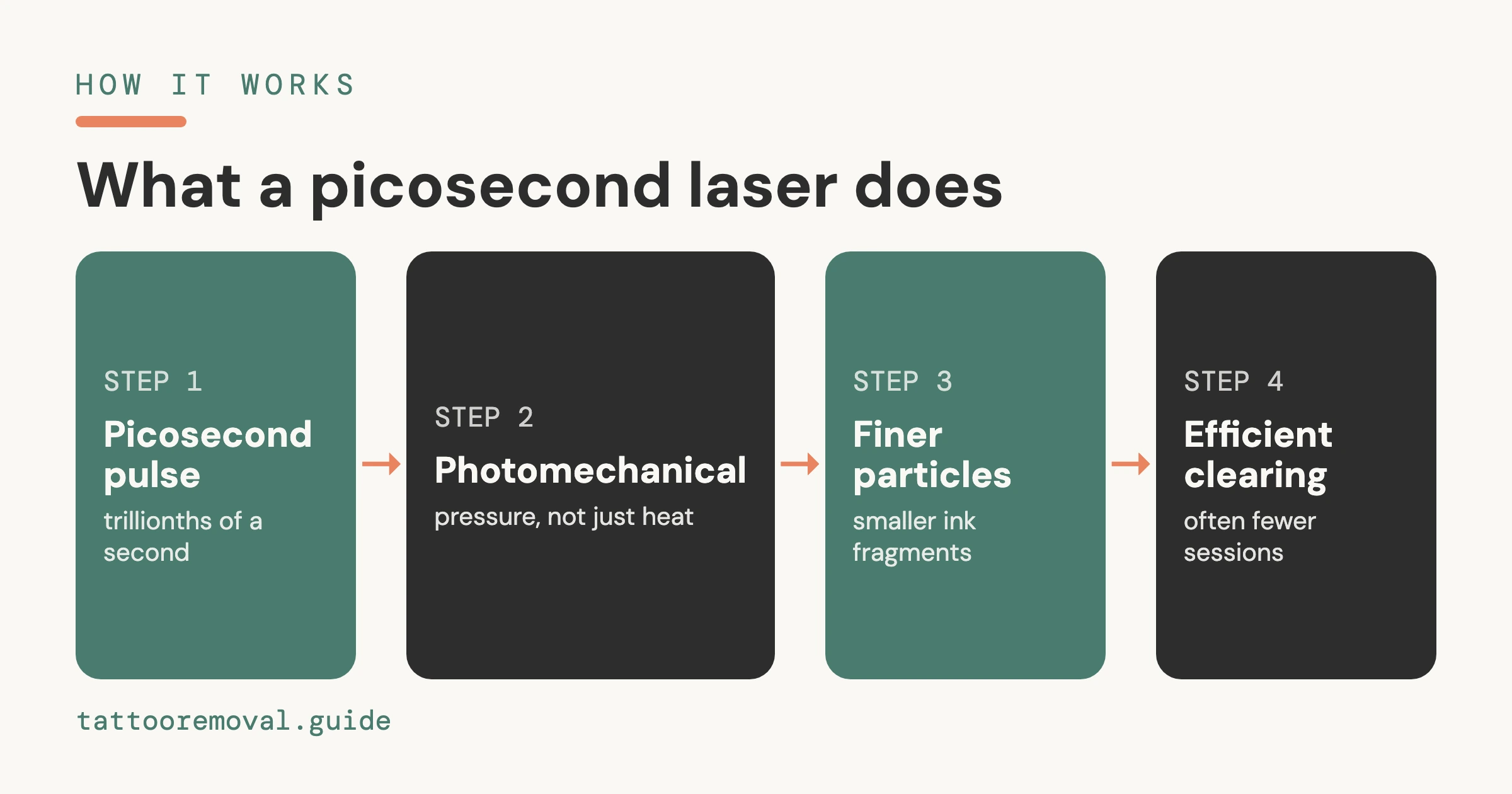
What is a picosecond laser? A picosecond laser is a tattoo-removal device that fires light pulses measured in picoseconds — trillionths of a second — roughly a thousand times shorter than a Q-switched (nanosecond) pulse. That ultra-short burst acts more as a mechanical shockwave than as heat, which can shatter certain inks into finer particles. It can help with some stubborn or coloured tattoos, but it is not categorically better than Q-switched.
This guide defines the picosecond laser, explains how the short pulse actually works, covers the common wavelengths and which colours they help, and gives the honest evidence picture — using figures from the Tattoo Removal Guide directory, stamped (as of July 2026).
Key Takeaways
- A picosecond laser fires pulses in trillionths of a second — about a thousand times shorter than a Q-switched (nanosecond) laser.
- The short pulse leans on a photomechanical (shattering) effect rather than the more photothermal emphasis of slower pulses, which can fragment some inks more finely.
- Common picosecond wavelengths — 1064nm, 532nm, and 755nm — target different ink colours; a laser only clears ink that absorbs its wavelength.
- Picosecond can mean fewer sessions for some inks and skin, but it is not a guaranteed win and not categorically superior. A well-matched Q-switched laser in skilled hands can outperform a poorly-matched pico.
- Of the 5,700 clinics we track across 1,043 cities, about 18% (1,009) publicly list a picosecond laser (as of July 2026) — a floor, not an adoption rate.
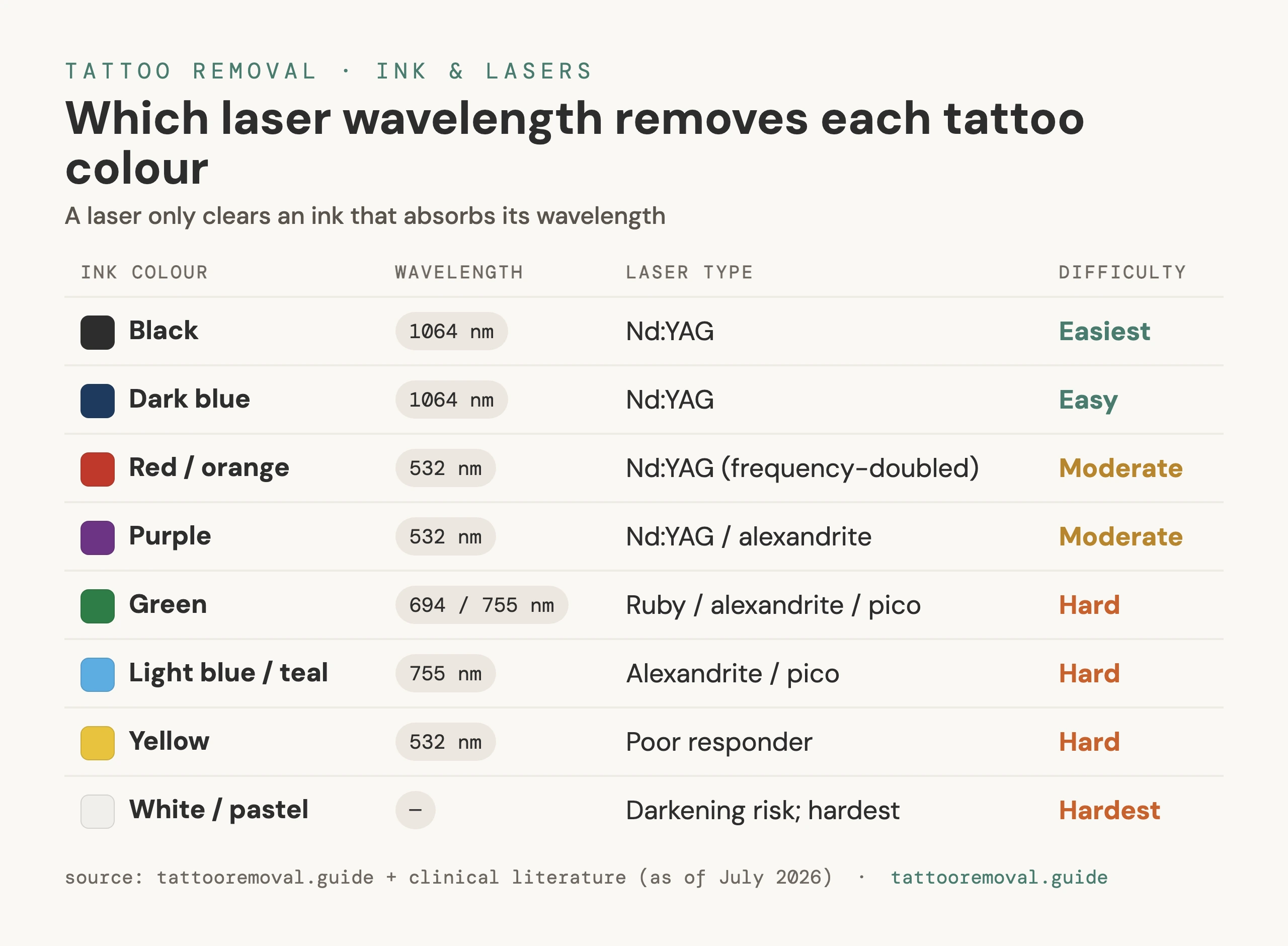 Picosecond lasers come in several wavelengths for different colours.
What is a picosecond laser?
A picosecond laser is a tattoo-removal device that delivers light in pulses lasting picoseconds — trillionths of a second. For scale: one picosecond is to one second as one second is to about 31,700 years. The name simply describes that pulse duration. Brands you may have seen advertised, such as PicoSure or PicoWay, are picosecond lasers — "pico" in a clinic's marketing refers to this pulse length, not to a separate category of treatment.
The comparison point is the Q-switched laser, the long-established workhorse of tattoo removal, which fires in nanoseconds — billionths of a second. A picosecond pulse is roughly a thousand times shorter than that. Both are FDA-regulated devices used to break up tattoo ink so the body can carry it away, and both rely on the same fundamental idea: hit the ink with light it absorbs, shatter it, and let your immune system clear the fragments over the following weeks.
 Multicolour work fades unevenly, colour by colour.
How does a picosecond laser work?
Both laser types shatter ink, but the way they deliver energy differs, and that is the whole point of a shorter pulse.
A nanosecond (Q-switched) pulse has a stronger photothermal emphasis — more of its effect comes from rapid heating that stresses and fractures the ink particle. A picosecond pulse delivers the same kind of energy in a fraction of the time, so it leans harder on a photomechanical effect: it acts more like a mechanical shockwave than like heat. As the StatPearls clinical reference on laser tattoo removal describes, this photomechanical fragmentation is the mechanism both lasers use — the picosecond simply does it faster and, in theory, more forcefully.
The practical hope is twofold. First, a more violent, faster shatter can break ink into finer particles, which the immune system may clear more readily. Second, because less of the energy arrives as sustained heat, there can be less thermal energy left in the surrounding skin per pass. As the Cleveland Clinic explains, once the ink is broken down, the body absorbs and eliminates it gradually — which is why removal always takes multiple sessions spaced weeks apart, whichever laser is used. The shorter pulse changes how finely the ink breaks; it does not skip the biology of clearance.
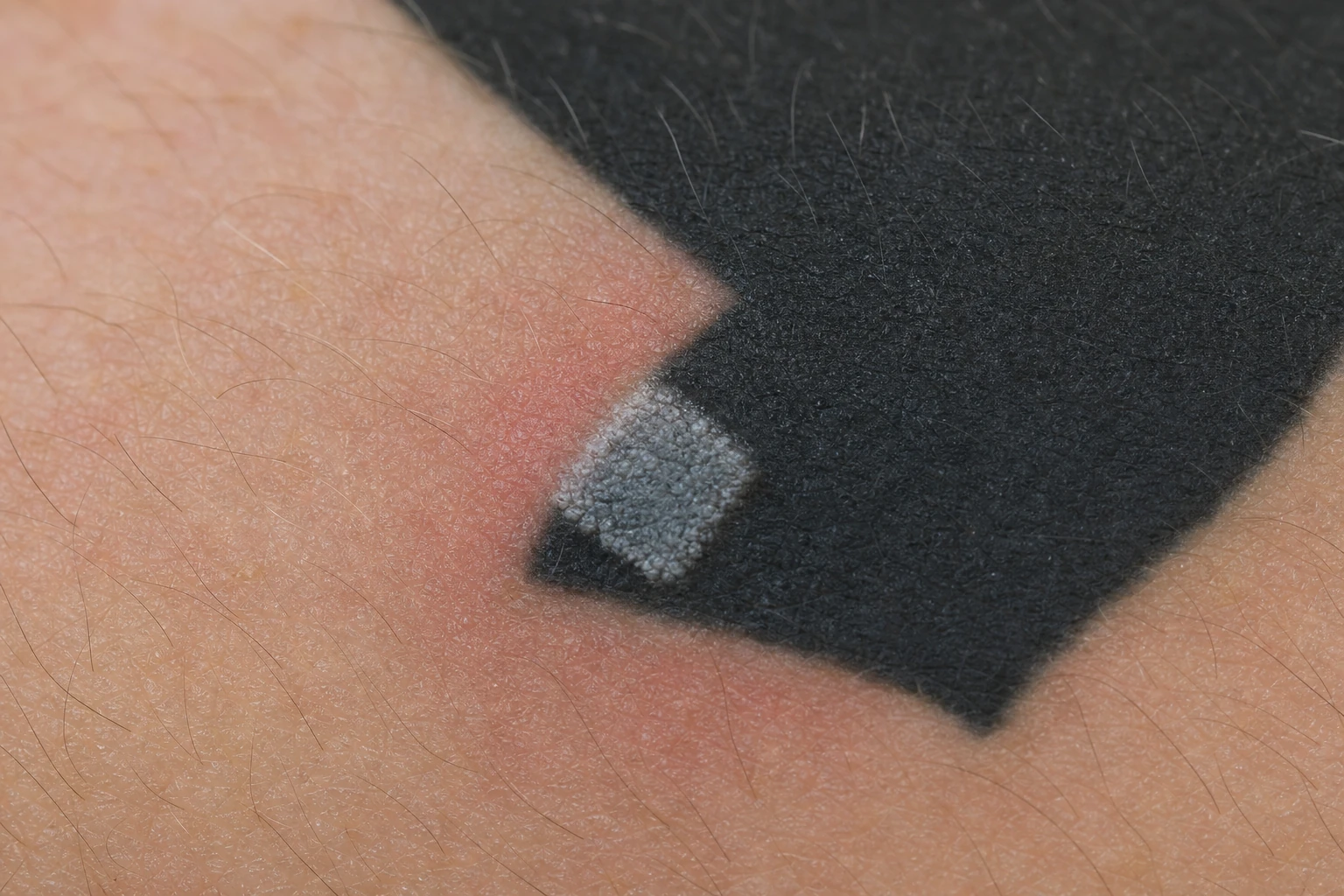 A forearm tattoo during removal.
Which colours do picosecond wavelengths help?
A laser only shatters ink that absorbs its specific wavelength, so a picosecond laser is only as versatile as the wavelengths it actually offers. Most picosecond systems provide one or more of these:
| Wavelength | Best for these colours | Notes |
|---|---|---|
| 1064nm | Black and dark inks | The most common ink; clears well with pico and Q-switched |
| 532nm | Red, orange and warm tones | Often paired with 1064nm on the same device |
| 755nm (or 785nm) | Blue and green | The historically stubborn colours; a key reason clinics buy pico |
Picosecond systems earned much of their reputation on blue and green, which have long been the hardest colours to shift. A picosecond 755nm can help here — but so can the right nanosecond wavelength. The lesson is that the wavelength matters more than the pulse-duration label: a picosecond machine that only offers 1064nm will not clear a green tattoo efficiently, and no amount of "pico" in the brochure changes that.
Is a picosecond laser better than Q-switched?
Here is the honest verdict, because it is the most-asked and most-oversold question in tattoo removal: a picosecond laser is not categorically better than a Q-switched laser. It can have a genuine edge in specific situations, and it can be irrelevant or even worse in others.
| Factor | Picosecond | Q-switched (nanosecond) |
|---|---|---|
| Pulse duration | Picoseconds — trillionths of a second | Nanoseconds — billionths of a second |
| Main mechanism | More photomechanical (shattering shockwave) | More photothermal (heat-driven fracture) |
| Potential benefit | Finer ink fragmentation; sometimes fewer sessions for stubborn/coloured inks; potentially less heat per pass | Proven, well-understood; excellent on black; long safety track record |
| Honest verdict | Both effective — match the laser to your case | Both effective — match the laser to your case |
Where picosecond can help: resistant tattoos, previously-treated tattoos that plateaued, and certain coloured inks — sometimes in fewer sessions, sometimes with less heat in the skin. Where it often doesn't matter much: plain black ink, where studies find the practical difference is frequently modest. The American Academy of Dermatology stresses that outcomes depend on the tattoo and the person — colour, depth, density, age of the ink, and skin type — and that no responsible provider guarantees a result in advance.
Crucially, a good older Q-switched laser in skilled hands can outperform a poorly-matched picosecond system. A clinician who sets the correct fluence, chooses the right spot size, reads the skin's response, and spaces sessions properly will beat a newer machine used carelessly or aimed at the wrong wavelength. Device-to-ink-and-skin match and operator skill are the real levers — not the number of zeros in the pulse duration. For a deeper side-by-side, see our full comparison of picosecond vs Q-switched laser tattoo removal.
What the directory actually shows
It's easy to assume picosecond lasers have taken over, because "pico" is the headline clinics love to advertise. The listings tell a more grounded story. Of the 5,700 clinics we track across 1,043 cities, about 18% (1,009) publicly list a picosecond laser (as of July 2026), while about 15% (880) list a Q-switched laser.
Read those numbers carefully. They count clinics that publicly list a given laser in their profile — a floor, not a true adoption rate. Most clinics don't specify their laser type at all, so the real share using each technology is higher than these figures suggest, and the gap between "pico" and "Q-switched" clinics is narrower than the raw percentages imply. The takeaway isn't "pico is winning." It's that you cannot tell what a clinic has, or whether it suits your ink, from the marketing alone — you have to ask.
Don't buy the "pico" headline — ask what's in the room
Because "picosecond" on a clinic's website tells you so little about your own case, treat it as a prompt for questions, not proof of a better result. Walk into a consultation with a short, specific list:
- What wavelengths does your laser actually deliver? (Match them to your ink colours — this matters more than pico vs nano.)
- Is the device picosecond, Q-switched, or both? (Some clinics run several systems.)
- Does this laser suit my ink and skin type? (A green tattoo needs a wavelength a 1064nm-only machine can't provide.)
- Who operates it, and what's their training? (Operator skill is the single biggest variable.)
- Based on my tattoo, what's a realistic session range? (Expect a range, never a guarantee.)
A clinic that answers these clearly is worth more than one that simply advertises the trendiest laser name.
This is general information, not medical advice. Laser tattoo removal is a medical procedure with real risks, including blistering, temporary or lasting pigment change, and scarring. Whether a picosecond or Q-switched laser suits you, how many sessions you'll need, and your likely outcome all vary by person and tattoo — consult a licensed provider for advice about your specific situation.
Compare the lasers near you, not the brochure
A picosecond laser is a real, FDA-cleared tool with a genuine mechanism — an ultra-short pulse that can shatter some inks more finely and sometimes clear them in fewer sessions. But it is not a magic wand and not categorically superior to Q-switched. The wavelength and the operator decide your result, so the smartest move is to find out what's actually in the room before you book.
The best way to do that is to compare clinics near you and see which lasers, wavelengths and prices they list side by side. Compare tattoo-removal clinics in your city to check what's available, or start with a dense market like tattoo removal in Melbourne to see how listings and equipment stack up. For the underlying science of how the light shatters ink in the first place, read our pillar guide on how laser tattoo removal actually works.
Frequently asked questions
What is a picosecond laser?
A picosecond laser is a tattoo-removal device that fires light pulses measured in picoseconds — trillionths of a second — roughly a thousand times shorter than a Q-switched nanosecond pulse. The ultra-short burst acts more as a mechanical shockwave than as heat, which can shatter certain tattoo inks into finer particles the body clears more easily.
How does a picosecond laser work?
A picosecond laser delivers energy so quickly that it fragments ink through a mainly photomechanical (shattering) effect rather than the more photothermal emphasis of a slower nanosecond pulse. The finer particles are then absorbed and removed by your immune system over the weeks between sessions, the same underlying process both laser types rely on.
Is a picosecond laser better than a Q-switched laser?
Not categorically. A picosecond laser can sometimes clear stubborn or coloured inks in fewer sessions with potentially less heat, but Q-switched lasers remain highly effective and widely used, especially for black. Device-to-ink match, available wavelengths, and operator skill matter more than the pulse-duration label, so neither type wins outright.
What wavelengths do picosecond lasers use?
Common picosecond wavelengths are 1064nm for black and dark inks, 532nm for red and warm tones, and 755nm for stubborn blue and green. A laser only clears ink that absorbs its specific wavelength, so the wavelengths a clinic actually offers matter more than whether the machine is branded picosecond or Q-switched.
Does a picosecond laser remove tattoos in fewer sessions?
Sometimes, but not always, and never guaranteed. For some inks — particularly green, blue, and previously resistant tattoos — picosecond lasers may reduce the number of sessions. For plain black ink the difference is often small. Session count depends on ink colour, density, depth, your skin, and the operator, so no clinic can promise an exact number in advance.
How many clinics have a picosecond laser?
Among the 5,700 clinics we track across 1,043 cities, about 18% (1,009) publicly list a picosecond laser as of July 2026, and about 15% (880) list a Q-switched laser. Those are floors, not adoption rates — most clinics don't specify their laser type in their listing at all, so the true share using each is higher.
Is a picosecond laser safe?
Picosecond lasers are FDA-cleared and widely used, and carry the same category of risks as other tattoo lasers — blistering, temporary or lasting pigment change, and scarring if aftercare is poor. Safety depends far more on operator training, correct settings, and laser eye protection than on which laser type is chosen. Consult a licensed provider about your situation.
Related guides
Related Guides
- How It Works
What Is a Q-Switched Laser for Tattoo Removal? (2026)
A Q-switched laser fires nanosecond pulses to shatter tattoo ink. Here's how Q-switched Nd:YAG, ruby and alexandrite lasers work, and why they're still a gold…
- How It Works
What Affects How Fast a Tattoo Fades? 8 Factors in Removal Speed
What affects tattoo removal speed? Ink colour, depth, age, body location, skin type, your health, smoking, and cover-ups all matter.
- How It Works
How Long Between Tattoo Removal Sessions? The 6–8 Week Clearing Window
How long between tattoo removal sessions? Most clinics wait 6–8 weeks. Why the clearing window exists, why sooner won't help, and when a longer gap is better.