Can You Remove a Tattoo Completely? The Honest Answer (2026)

Yes — many tattoos can be removed completely or near-completely with a full course of laser sessions, but some leave a faint residual shadow called "ghosting" or a subtle skin-tone change, and no honest clinic can guarantee 100% clearance. How close you get depends mostly on ink colour, depth and density, your skin tone, and the laser used. Black and dark-blue ink clears best; green, yellow and white are the hardest.
That honest answer is the whole article in one paragraph — but the details are what let you set a realistic expectation before you spend the time and money. This guide explains what "complete" actually means, defines ghosting, lays out what predicts full clearance versus a residual trace, and separates ghosting from two things people confuse it with: scarring and hypopigmentation. Figures from the Tattoo Removal Guide directory are stamped (as of July 2026).
Key Takeaways
- Complete removal is common but not guaranteed. Many tattoos fade to clear or near-clear; some leave faint "ghosting" or a subtle tone change.
- Ghosting is a faint residual shadow of leftover pigment — usually far fainter than the original tattoo, sometimes only visible if you know it's there.
- Ink colour is the biggest predictor: black and dark blue clear best; green and blue are stubborn; yellow, white and fluorescents are hardest.
- Depth, density, skin tone, the laser used and sessions completed all move the odds — which is why a session count can't be promised upfront.
- Ghosting, scarring (a texture change) and hypopigmentation (a lightened patch) are different things with different causes — don't lump them together.
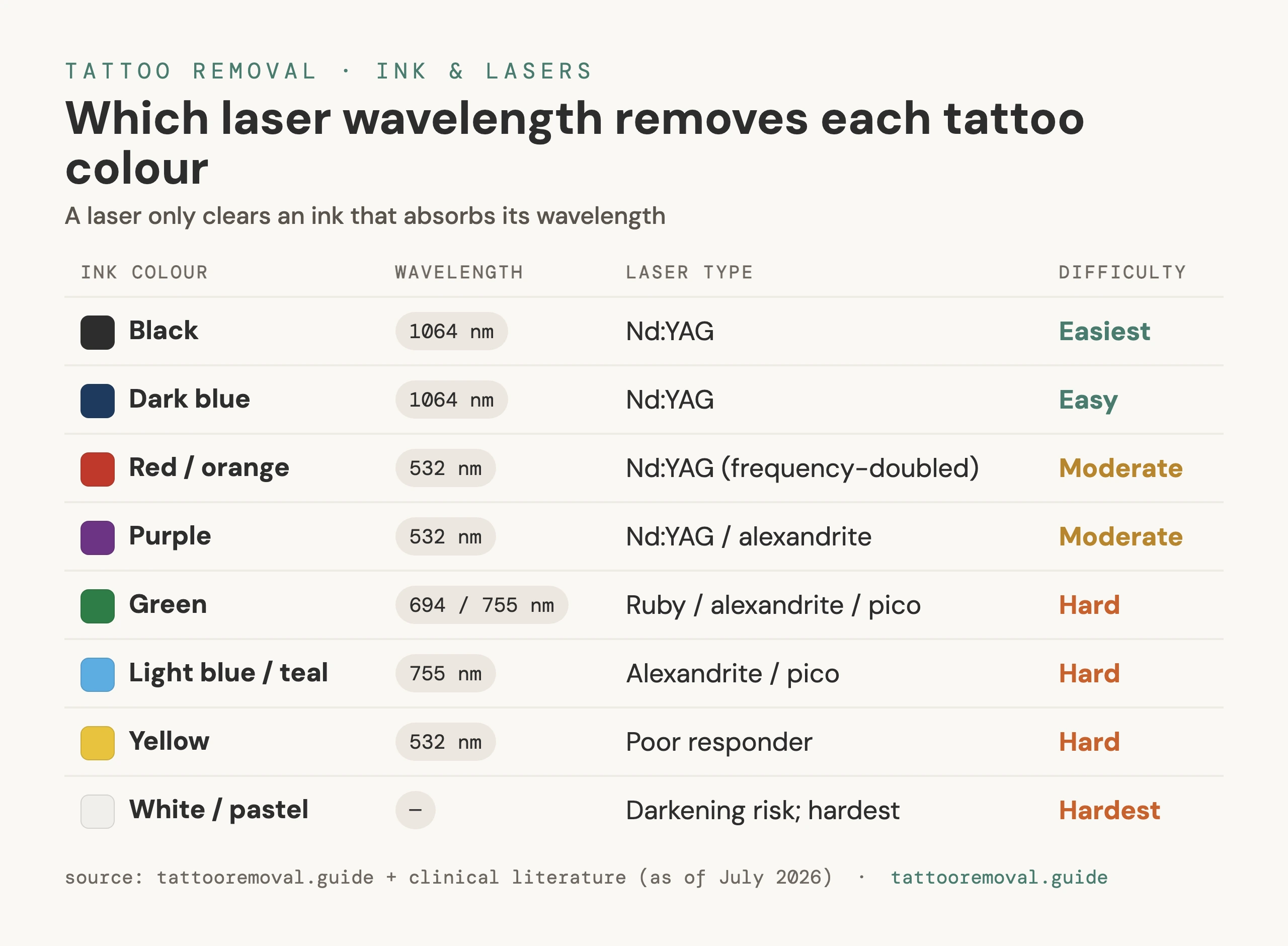 A laser only clears an ink that absorbs its wavelength.
What does "completely removed" actually mean?
Laser removal doesn't erase ink like an undo button — the laser shatters the ink and your immune system carries the fragments away over the following weeks. "Complete" removal means the immune system has cleared enough shattered pigment that the tattoo is no longer visible to the naked eye. For a large share of tattoos, that's an achievable outcome.
But "no longer visible" and "not a single pigment particle left" aren't the same thing. Some tattoos reach a point where a faint trace remains — the design is gone, but a shadow of it lingers. As the American Academy of Dermatology notes, complete removal isn't always possible, and some colours are far harder to clear than others. An honest result is best described as "clear or near-clear," not a blanket promise of perfection.
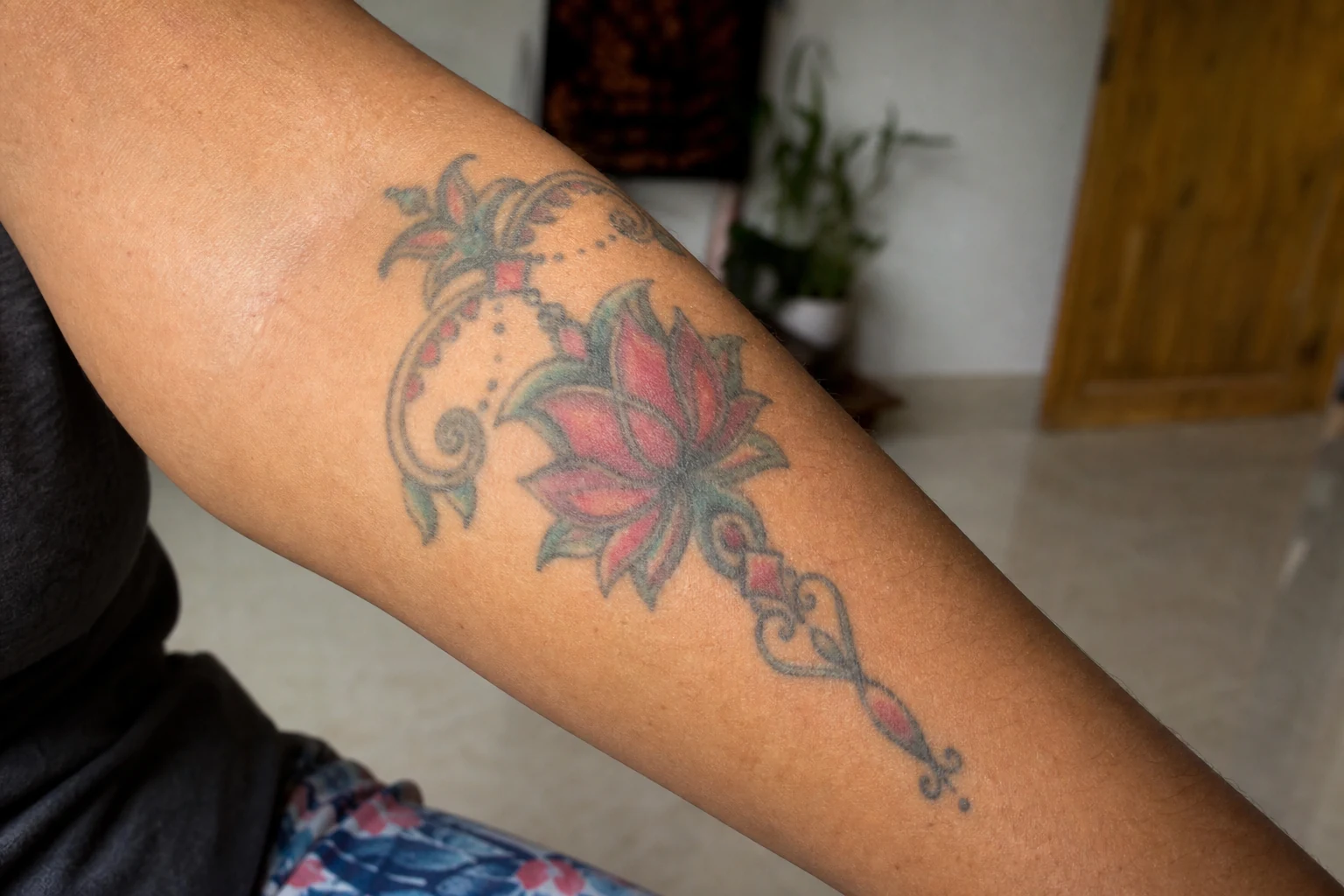 A forearm tattoo during removal.
Tattoo removal ghosting is the residual shadow
Ghosting is a faint residual shadow or trace of a tattoo that remains after laser removal, even once most of the visible ink has cleared. It's leftover pigment the immune system hasn't fully carried away, sometimes combined with a subtle change in skin texture or tone where the ink used to be.
Ghosting is usually dramatically fainter than the original — often a pale grey or shadow-like outline rather than a defined image. Many people find it acceptable or barely noticeable; others want it gone entirely. The key thing to understand is that ghosting is residual ink, not damage. It can keep fading for months after your final session as clearance continues, and in some cases a laser session targeting the specific stubborn colour can improve it further.
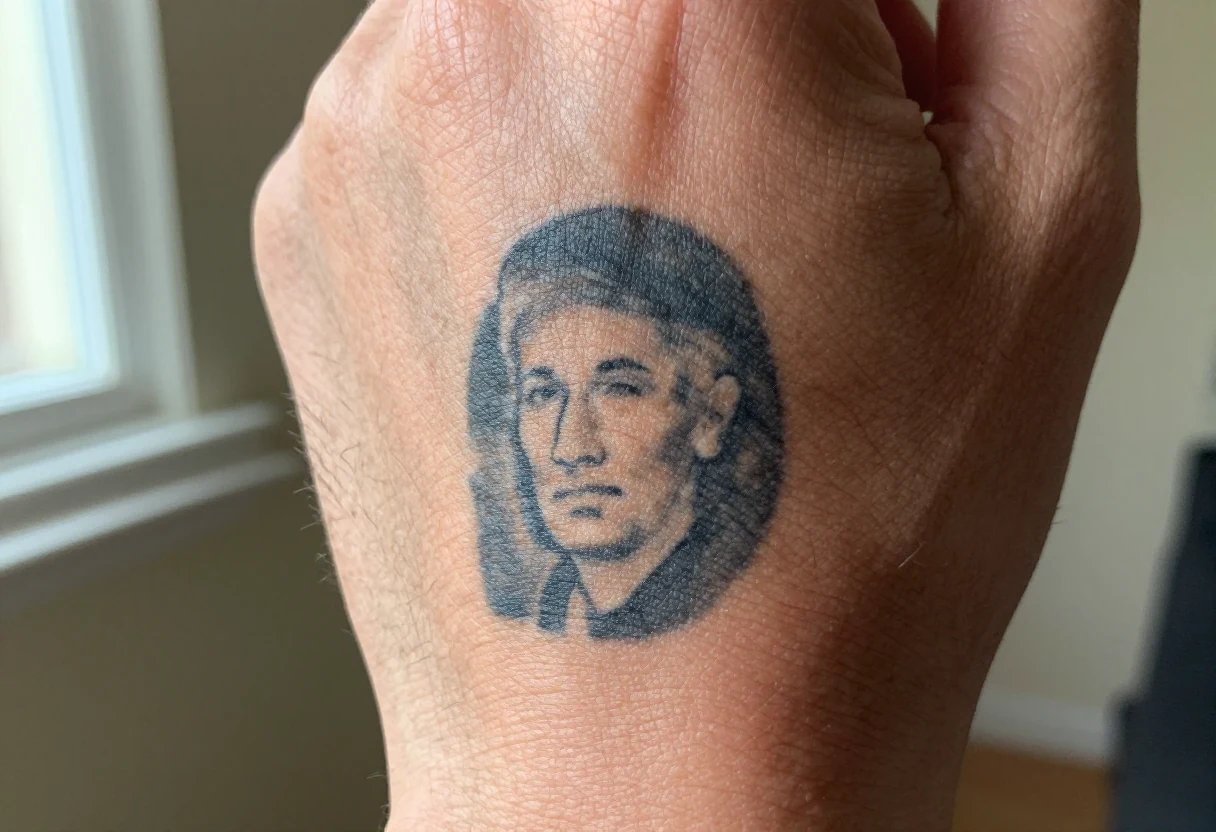 A forearm tattoo during removal.
What predicts complete removal vs a residual trace
Whether a tattoo clears fully or leaves ghosting comes down to a handful of factors — the same ones that, taken together, form the validated Kirby-Desai scale clinicians use to estimate session counts.
- Ink colour. The single biggest factor. Black and dark blue absorb laser light efficiently and clear most readily. Green and blue are stubborn and need specific wavelengths. Yellow, white and some fluorescent inks are the hardest to fully remove and the most likely to leave a trace. (More detail: the hardest tattoo colours to remove.)
- Ink depth and density. Deeply deposited or heavily saturated ink — dense professional work, cover-ups, and layered or reworked tattoos — holds more pigment to shatter and shield, lowering the odds of a flawless finish.
- Skin tone. On darker skin, the laser must be chosen and dosed carefully so it targets the ink rather than the skin's own melanin. That protects the skin but can mean a more cautious, longer course.
- The laser used. A device offering the right wavelengths for your ink colours — and a picosecond or colour-capable laser for stubborn tones — meaningfully improves the odds on difficult ink.
- Sessions completed. Removal is staged; each session clears another layer. Stopping early is one of the most common reasons a tattoo looks "not fully removed" — it simply hadn't finished the course.
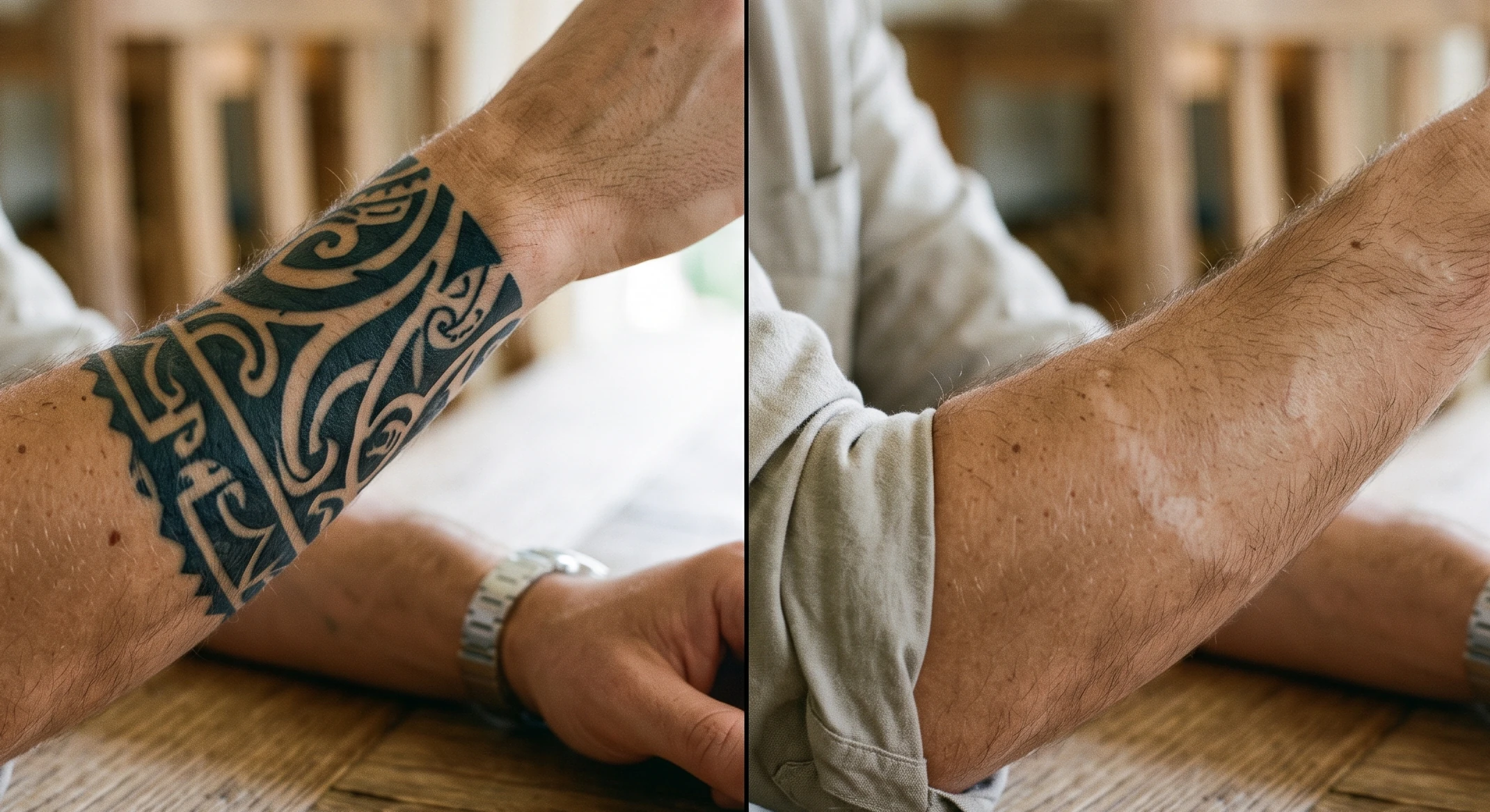 After a full course, only a faint 'ghost' — a barely-visible pale mark — may remain. Illustrative; results vary.
Ghosting vs scarring vs hypopigmentation
People often describe any imperfect result as the tattoo "not fully coming out," but three very different things can be at play. They have different causes and different management, so telling them apart matters.
| Outcome | What it is | Typical cause | Colour / texture |
|---|---|---|---|
| Ghosting | Faint residual ink pigment | Stubborn colour, dense/layered ink, or clearance not yet complete | A pale shadow of the design; skin texture usually normal |
| Scarring | A change in skin texture — raised or indented | Pre-existing scarring from the original tattoo, or over-treatment / picking scabs | Raised, thickened or pitted tissue; may trace the design |
| Hypopigmentation | A lightened patch of skin | Loss of natural pigment from laser treatment, more common on the extremities | Skin lighter than surrounding area; texture usually normal, often improves over months |
The practical difference: ghosting is leftover ink and may keep fading or respond to more sessions; scarring is a texture change that removal won't smooth away; hypopigmentation is a tone change in the skin itself, which often recovers gradually. A clinician who examines the area is the only reliable way to know which you're looking at — and what, if anything, can improve it.
Why an honest clinic won't promise 100%
Because removal is a biological process with too many variables to guarantee. The StatPearls clinical reference describes the sequence — selective absorption by the pigment, fragmentation, then immune-mediated clearance — and every step of that depends on your specific ink, skin and physiology. As the Cleveland Clinic puts it, results vary and some tattoos don't disappear entirely.
So a clinic that promises "completely gone" sight-unseen is guessing. A responsible one assesses your tattoo, gives a realistic range of sessions, and tells you upfront that a faint residual trace is possible — especially on stubborn colours or dense work. That's not a lack of confidence; it's honesty about a process no one can fully control. Realistic expectations set by someone who has actually looked at your tattoo beat a before-and-after photo of someone else's every time.
This is general information, not medical advice. Laser tattoo removal is a medical procedure with real risks including blistering, scarring and pigment change. Outcomes, session counts and the chance of complete clearance vary by person and tattoo — consult a licensed provider for advice about your specific situation.
The laser matters — so compare before you commit
Because ink colour and the laser used are two of the biggest factors in whether a tattoo clears completely, the clinic you choose genuinely changes your odds. A clinic with a colour-capable or picosecond laser can improve results on the stubborn greens, blues and light inks that otherwise leave ghosting — while a clinic without the right wavelengths may plateau on exactly those colours.
Across the Tattoo Removal Guide directory, about 18% of the 5,700 clinics we track note picosecond lasers and 15% note Q-switched (as of July 2026) — both are effective, and the note is a floor, not a full picture, since most listings don't specify their laser at all. The point isn't that one label is superior; it's that matching the laser to your ink is worth checking before you book.
Compare tattoo-removal clinics in your city to see which lasers and wavelengths are on offer near you, or start with a dense market like tattoo removal in Melbourne — where we track 215 listed clinics and typical pricing of $50–$200 per session (as of July 2026) — to see how listings, lasers and pricing stack up side by side.
Frequently asked questions
Can you remove a tattoo completely?
Often, yes — many tattoos fade to clear or near-clear with a full course of laser sessions. But complete clearance cannot be guaranteed. Some tattoos leave a faint residual shadow called ghosting, or a subtle change in skin tone. Black and dark-blue ink clears best; green, yellow and white are the hardest to fully remove.
What is tattoo removal ghosting?
Ghosting is a faint residual shadow or trace of a tattoo that remains after laser removal, even once most of the visible ink has cleared. It is leftover pigment the immune system has not fully carried away, sometimes combined with a slight texture or tone change in the skin. Ghosting is usually much fainter than the original tattoo and can be hard to notice unless you know it is there.
Will laser tattoo removal remove it completely?
Laser removal clears many tattoos to near-invisible, but not every tattoo reaches 100%. The odds of complete clearance are highest for older, black, sparse professional or amateur tattoos on well-circulated skin, and lowest for green, yellow, white, heavily layered or cover-up ink. An honest clinic sets a realistic expectation after assessing your specific tattoo rather than promising total removal upfront.
What is the difference between ghosting, scarring and hypopigmentation?
Ghosting is faint leftover ink pigment. Scarring is a change in skin texture — raised or indented tissue — that can come from the original tattoo or from over-treatment. Hypopigmentation is a lightened patch where the skin has lost some of its natural colour. All three can look like an "incomplete" result, but they have different causes and different management, which is why a clinician's assessment matters.
Why won't a clinic promise 100% tattoo removal?
Because removal is a biological clearance process with too many variables to guarantee. Ink colour, depth, density, your skin tone, the laser used and how your immune system responds all affect the outcome. A clinic that promises complete removal sight-unseen is guessing. A responsible clinic gives a realistic range after examining the tattoo and explains that a faint residual trace is possible.
Which tattoo colours are hardest to remove completely?
Black and dark-blue ink absorb laser light well and clear most readily. Green and blue are more stubborn and need specific wavelengths, while yellow, white and some fluorescent inks are the hardest of all to fully remove and are the most likely to leave a residual trace. Multi-coloured tattoos often clear unevenly, with the warm and light colours lagging behind the black.
Can ghosting be improved after removal?
Sometimes. A faint residual shadow may continue to fade for months after your final session as the immune system keeps clearing shattered pigment. If it persists, additional sessions — ideally with a laser that targets the specific stubborn colour — can improve it further. Because outcomes vary, ask a clinician whether more treatment is likely to help your particular ghosting before committing.
Related guides
Related Guides
- How It Works
What Is a Q-Switched Laser for Tattoo Removal? (2026)
A Q-switched laser fires nanosecond pulses to shatter tattoo ink. Here's how Q-switched Nd:YAG, ruby and alexandrite lasers work, and why they're still a gold…
- How It Works
What Is a Picosecond Laser for Tattoo Removal? (2026)
What is a picosecond laser? It fires in trillionths of a second to shatter tattoo ink. How it works, the colours it helps, and why it's not always better.
- How It Works
What Affects How Fast a Tattoo Fades? 8 Factors in Removal Speed
What affects tattoo removal speed? Ink colour, depth, age, body location, skin type, your health, smoking, and cover-ups all matter.