Hardest Tattoo Colours to Remove: Ink & Laser Guide
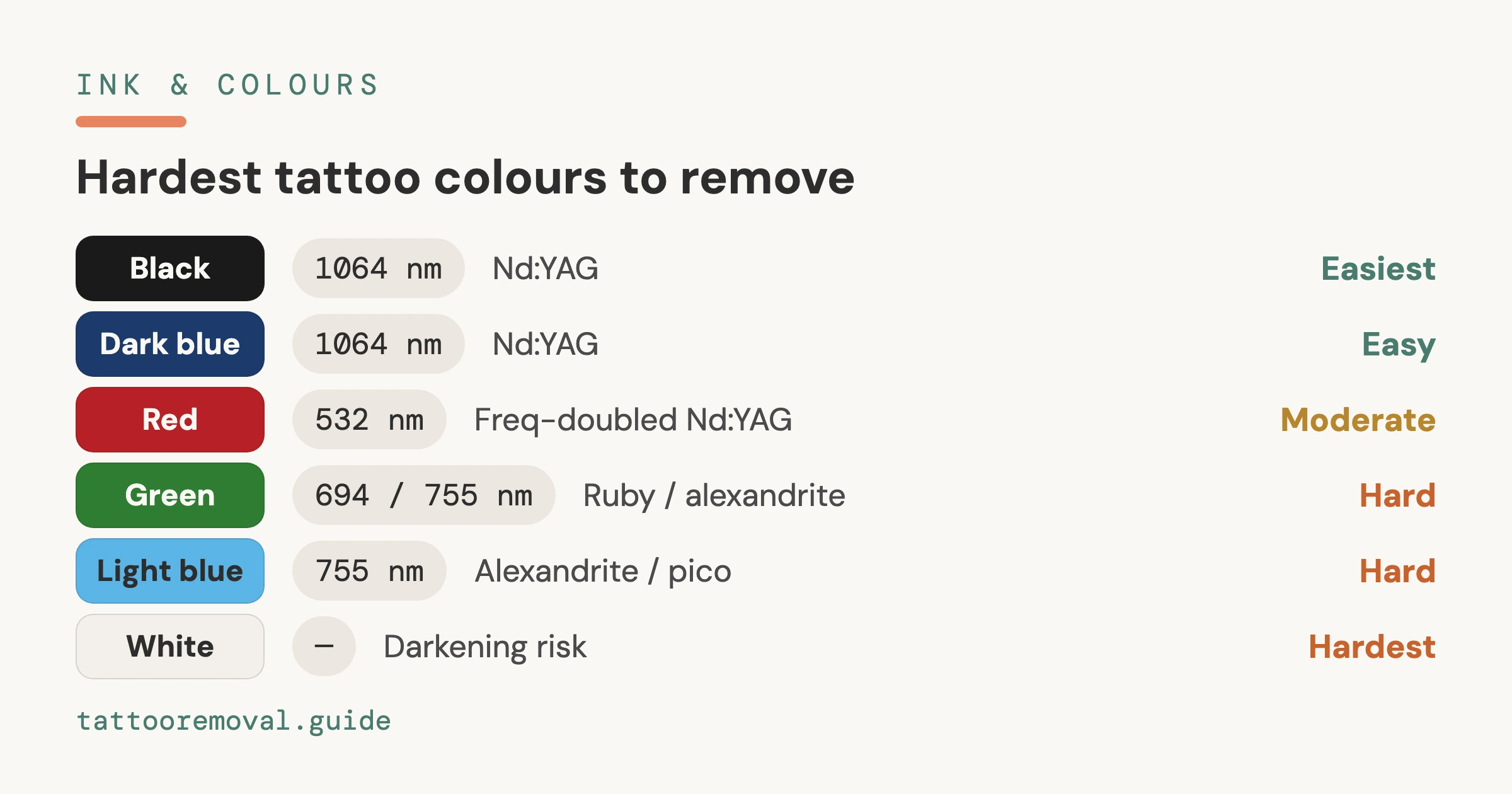
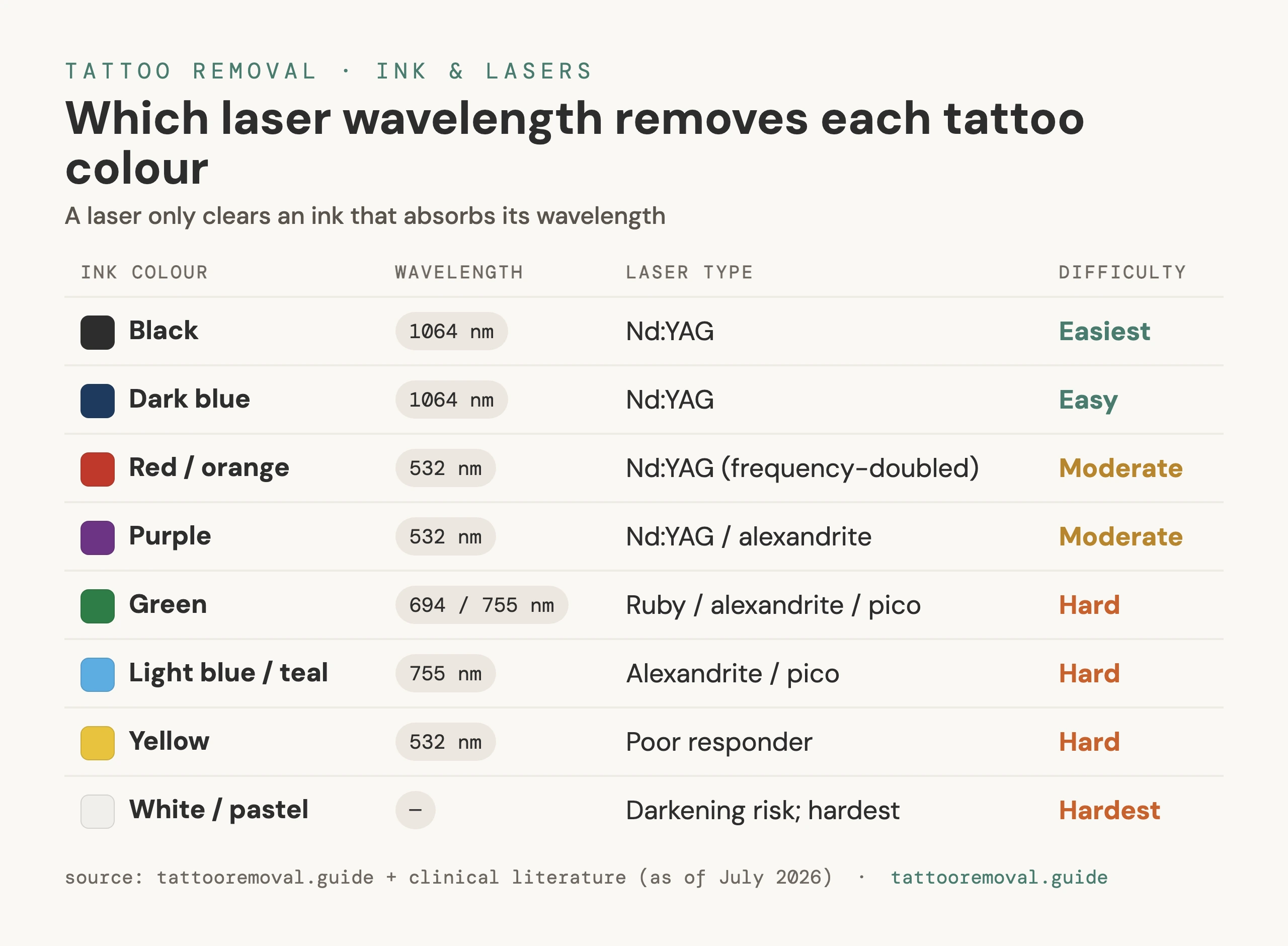 A laser only clears an ink that absorbs its wavelength — which is why green and white are the hardest colours to remove.
Key Takeaways
Black is the easiest tattoo color to remove; green and light blue are the hardest. The reason is not effort or luck — it is physics. A laser can only clear an ink that absorbs a wavelength the laser emits, and most clinics run a laser tuned for black, not for green. Below is the full color-difficulty ranking, the wavelength-to-color map that explains it, the paradoxical-darkening warning for white and pastel inks, and how to find a clinic whose equipment can actually finish the job.
The hardest tattoo colors to remove are green, light blue, teal, yellow, purple, and pastel or white ink — in that rough order of stubbornness — while black, dark blue, and brown are the easiest. Green and light blue top the difficulty list because they reflect the near-infrared light that the most common laser emits, so the beam passes straight through them. Clearing those colors needs a different wavelength, which not every clinic owns.
If an artist ever told you "green won't come out," they were half right and half wrong. Green resists the laser that most clinics reach for first. But there is a specific wavelength — red light, around 694 to 755 nanometres — that green ink absorbs well. The problem is rarely the ink. It is the machine.
The one-sentence mechanism: absorption is everything
Laser tattoo removal works on a single principle: a laser only clears an ink that absorbs a wavelength the laser emits. The light energy is absorbed by the pigment, shatters it into fragments small enough for your immune system to carry away, and leaves the surrounding skin largely untouched. If a pigment does not absorb the wavelength being fired at it, the light simply passes through and nothing happens.
That is the whole story of color difficulty. Black absorbs virtually every wavelength, so almost any laser works on it. Green absorbs only a narrow band of red light, so it needs a laser that emits red light. Everything else — session counts, cost, "stubborn" colors — flows from this one fact. The U.S. Food and Drug Administration notes that removal is generally harder for multi-colored tattoos and certain pigments, which is the consumer-facing version of the same physics.
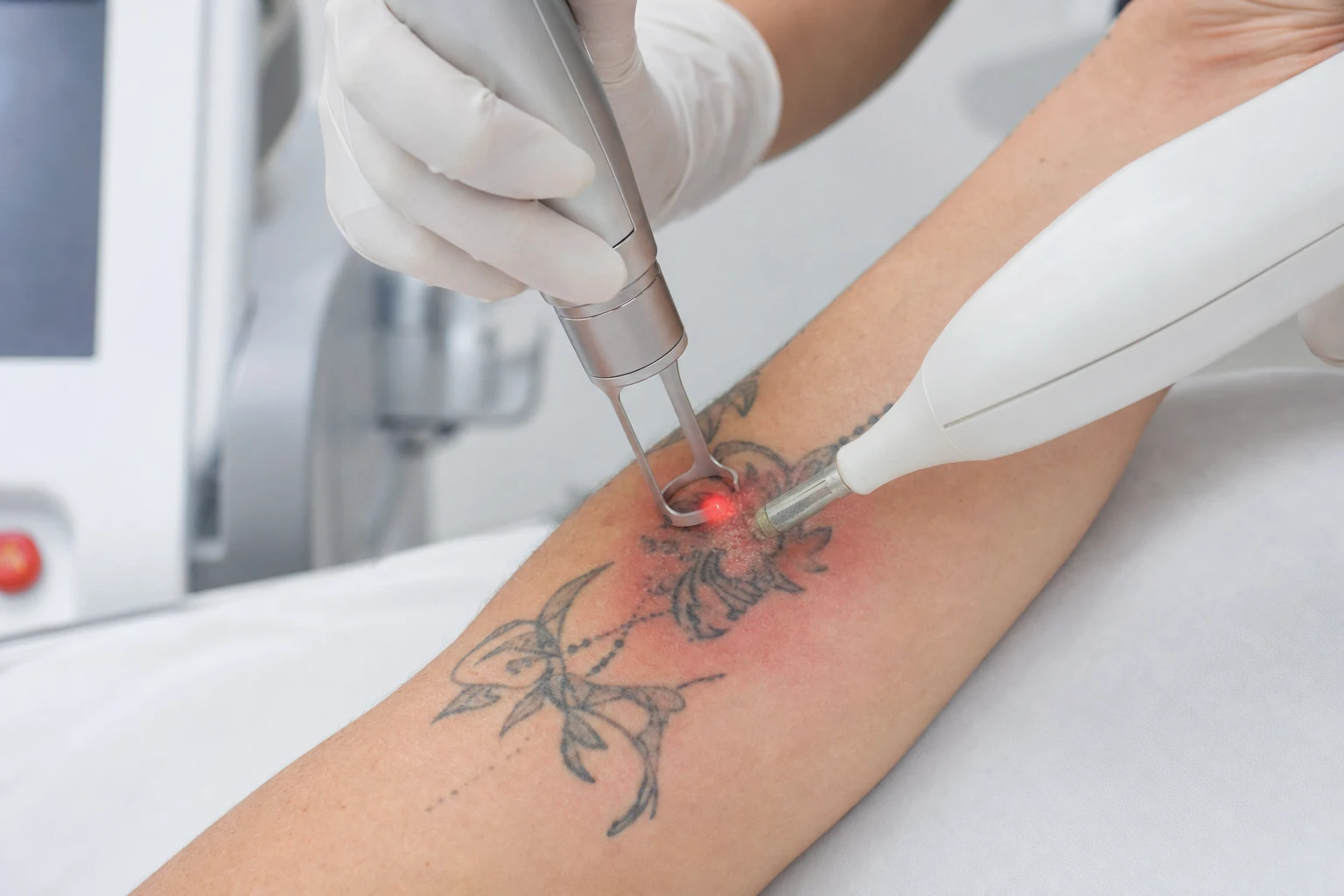 A laser tattoo removal session in progress.
The full color-difficulty ranking
Here is how tattoo colors rank from easiest to hardest to remove, and the wavelength each one needs. Treat this as a map, not a promise — individual inks vary by brand and depth, and only a test on your own tattoo tells the real story.
| Difficulty | Color | Why | Wavelength it responds to |
|---|---|---|---|
| Easiest | Black | Absorbs essentially all wavelengths | 1064 nm (and any other) |
| Easy | Dark blue, brown | Absorb near-infrared well | 1064 nm |
| Moderate | Red, orange | Absorb green light | 532 nm |
| Moderate–hard | Purple, violet | Sits between red and blue absorption | 532 nm + red-light lasers |
| Hard | Green | Reflects near-infrared; absorbs red light | 694 nm ruby / 755 nm alexandrite |
| Hard | Light blue, teal | Pale, reflects most common wavelengths | 694 nm / 755 nm red-light lasers |
| Very hard | Yellow | Weak absorption at common wavelengths | 532 nm, partially; often stubborn |
| Hardest (+ risk) | White, flesh-tone, pastel, cosmetic | Poor absorption and darkening risk | Test spot first — see below |
Two patterns to notice. First, the difficulty tracks how far a color sits from the wavelengths most clinics own. Second, the bottom of this table is not just "slow" — white, flesh-tone and pastel inks carry a specific hazard that we cover below.
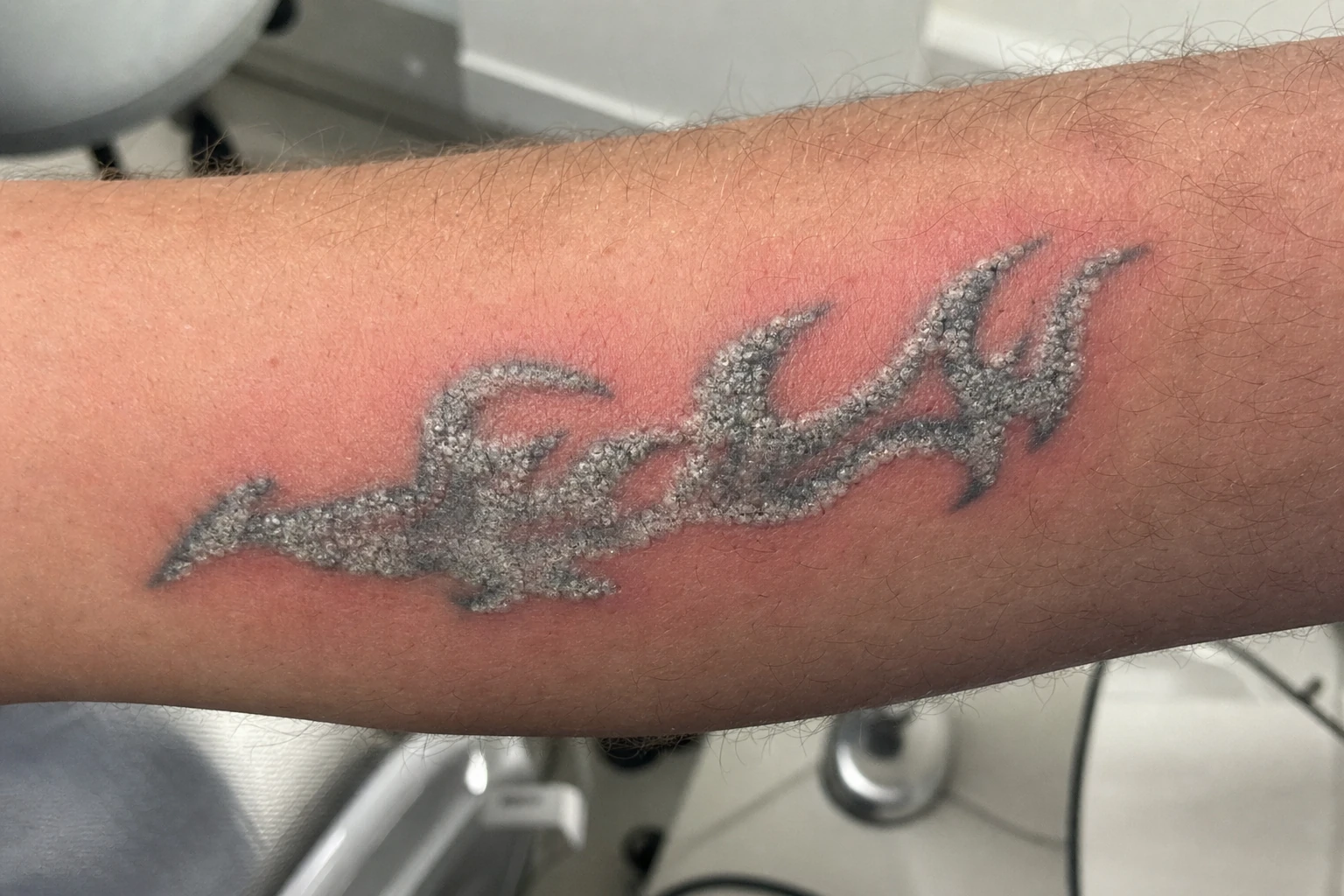 The temporary white 'frosting' seconds after a laser pulse.
The wavelength → color map (the reference no one owns)
This is the single most useful table in tattoo removal, and it is oddly hard to find stated plainly for consumers — the good versions live in clinical references or in laser-manufacturer marketing aimed at clinics, not at you. Here it is, neutral and vendor-free.
| Laser wavelength | Laser type | Colors it clears best |
|---|---|---|
| 1064 nm | Nd:YAG (near-infrared) | Black, dark blue, brown |
| 532 nm | Frequency-doubled Nd:YAG / KTP (green light) | Red, orange, some yellow |
| 694 nm | Ruby (red light) | Blue, green, black |
| 755 nm | Alexandrite (red light) | Blue, green |
The clinical logic behind this map — matching each pigment to the wavelength it absorbs — is laid out in the National Library of Medicine's StatPearls chapter on laser tattoo removal and summarised for patients by DermNet. Read the two tables together and the difficulty ranking stops being mysterious: green and blue sit opposite the wavelengths a typical clinic owns.
A quick way to read it: a color is cleared by the wavelength that is its opposite on the color wheel. Green ink absorbs red light (694/755 nm). Red ink absorbs green light (532 nm). Black, being the absence of reflected color, absorbs everything — which is why it is the pushover of the group.
Why green and blue are notorious
Most clinics run a dual-wavelength Nd:YAG: 1064 nm for dark ink and 532 nm for warm colors like red and orange. That covers a lot of tattoos. What it does not cover well is green and light blue, because neither of those colors absorbs 1064 nm or 532 nm efficiently. The 1064 nm beam is near-infrared; green reflects it. The 532 nm beam is green light; a green pigment reflects green light almost by definition.
Green and blue absorb red light — roughly the 630–760 nm band. That is the territory of the 694 nm ruby laser and the 755 nm alexandrite laser, and of picosecond systems built with those wavelengths. A clinic without one of those tools can fire session after session at a green tattoo and see stubbornly little change, because the light is passing through the ink. This is the real reason behind the folk wisdom that "green never comes out." It comes out — at the right wavelength.
This is also why a multi-color tattoo can look half done after a course of treatment: the black outline and red accents fade on schedule while the green leaf or the teal wave barely moves. The tattoo isn't resisting removal. The clinic's laser is missing one color.
The paradoxical-darkening warning (white, pastel, and cosmetic ink)
There is one situation where the laser does something worse than nothing: it can turn a pale tattoo darker. White, flesh-tone, pastel and many cosmetic or permanent-makeup inks contain titanium dioxide or iron oxide as a whitener or base. When a Q-switched or picosecond laser hits these compounds, they can undergo a chemical reduction that shifts the pigment to a grey, black, or greenish tone almost instantly. Dermatologists call this paradoxical darkening.
It is well documented. A review of laser tattoo removal in Seminars in Plastic Surgery, archived in the National Library of Medicine's PMC collection, describes darkening of white and cosmetic inks after Q-switched laser treatment as a recognised complication driven by titanium dioxide and iron oxide reduction. The darkening can usually be treated with further laser sessions, but that is more time, more cost, and more uncertainty than the patient signed up for.
The practical rule is simple and non-negotiable: for any white, flesh-tone, pastel, or cosmetic tattoo, a reputable clinic tests a small hidden spot first and watches it before treating the whole area. If a clinic offers to laser your permanent eyeliner or a pale-inked cover-up without a test patch, that is a reason to walk. This is general information, not medical advice — always raise darkening risk directly with a licensed provider before treatment.
Session counts and cost by color
Because color decides how much light your ink actually absorbs, it also drives how many sessions you are likely to need — and therefore what the whole course costs.
- Black and dark blue absorb strongly, so they tend to clear in the fewest sessions.
- Red and orange are moderate, responding to the 532 nm wavelength most clinics also carry.
- Green, light blue, teal and yellow typically need more sessions, and sometimes a second laser, which is where costs climb.
- White and pastel are unpredictable and carry the darkening risk above.
Clinical references, including StatPearls and the American Academy of Dermatology, commonly cite that most tattoos take several sessions spaced roughly six to eight weeks apart to fade substantially — but the honest answer is that nobody can promise a number in advance. Ink type, ink depth, your skin, the tattoo's age, and above all the clinic's equipment all move it. No clinic can guarantee a session count, and you should be sceptical of one that tries.
Here is where color quietly becomes a money problem. Per-session prices swing widely even within one city — in Melbourne, for example, the typical session runs $50–$200 (about a 3.9× spread, n=89 priced clinics, as of July 2026), per the Tattoo Removal Guide directory. Now multiply that per-session gap across the extra sessions a green or blue piece demands, and the total cost of removing a colorful tattoo at the wrong clinic — one that lacks the right wavelength and needs more visits to get nowhere — can dwarf the cost of doing it once, correctly, somewhere equipped for color.
The resolution: find a color-capable clinic
Here is the part your artist could not tell you. Most clinics are set up for the easy colors. Across the 5,700 specialist clinics in the Tattoo Removal Guide directory, about 18% note picosecond capability and about 15% note Q-switched (as of July 2026) — and many of those Q-switched systems are the dual 1064/532 nm Nd:YAG that stalls on green and light blue. A large share of clinics simply do not advertise the red-light wavelength your green tattoo needs.
So the search is specific. To remove green, teal or light-blue ink, you want a clinic that lists one of these:
- a picosecond laser (often multi-wavelength, and better at shattering stubborn pigment per pulse), or
- a 694 nm ruby or 755 nm alexandrite laser (the red-light wavelengths that green and blue absorb).
A clinic that only lists a "dual-wavelength Nd:YAG" or "1064/532" can still be excellent for a black or red tattoo — but ask directly whether it can treat your colors before you book, because that machine is the one that stalls on green.
The fastest way to check is to compare what clinics near you actually run. Compare tattoo-removal clinics in your city and filter for the ones that publish their laser type, or start with a dense market like Melbourne, then take one question into every consultation: "Which wavelengths does your laser emit, and which of my colors do they clear?" The answer sorts the clinics that can finish your tattoo from the ones that will only fade half of it.
This article is general information, not medical advice. Laser tattoo removal outcomes, session counts, and risks vary by individual — consult a licensed provider before treatment, and insist on a test spot for any white, pastel, or cosmetic ink. Directory figures are a point-in-time snapshot (as of July 2026) and drift as clinics update their listings.
Related guides
Related Guides
- Ink & Colours
Selective Tattoo Removal: Erasing Part of a Tattoo (2026)
Selective tattoo removal targets one part of a tattoo — a name, a figure, one colour — while leaving the rest.
- Ink & Colours
Removing an Ex-Partner's Name Tattoo: Your Options in 2026
Removing an ex's name tattoo? A partner's name is one of the most-removed tattoos — and small black lettering is among the quickest and cheapest to clear.
- Ink & Colours
Name & Lettering Tattoo Removal
Name and lettering tattoos are usually small and black, so per-unit they're among the easier tattoos to remove — but dense, deep script needs patience.