Removing an Ex-Partner's Name Tattoo: Your Options in 2026

Removing an ex-partner's name tattoo is one of the most common requests laser clinics see — and the good news is it's usually one of the easier jobs: small, black, fine-line lettering holds very little ink, and black is the colour that responds best to laser, so a name often clears in fewer sessions than a large or colourful piece. Exact counts vary and can't be guaranteed, but the path is well-trodden.
If you're reading this, you've probably already made peace with the decision — or you're getting there. This guide lays out your options honestly, with the real numbers and medical sources, and no pressure. Regret is normal, removal is routine, and there's no clock running.
Key Takeaways
- A partner's name is among the most commonly removed tattoos — you are far from alone, and regret is normal.
- Small, black, fine-line lettering is among the quickest and cheapest tattoos to clear — often a handful of sessions rather than the 8–15+ a dense colour piece can take.
- You have three main options: full laser removal, fade-then-cover-up, or selective removal (erase just the name, keep the rest).
- Sessions are spaced 6–8 weeks apart; no clinic can guarantee an exact count before assessing your tattoo.
- There's no rush — a name tattoo stays removable whenever you're ready. When you are, compare clinics rather than booking the first one you find.
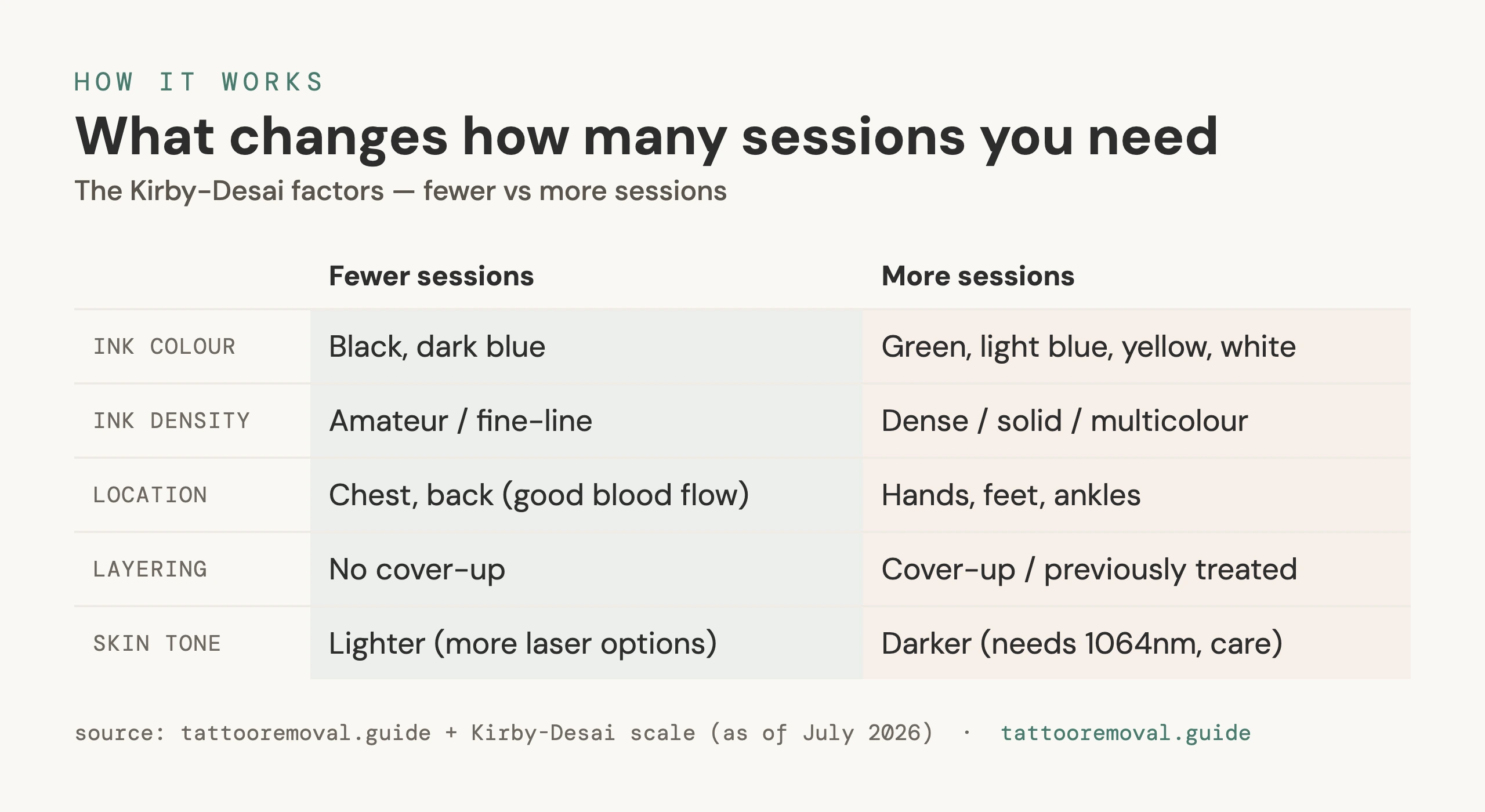 The factors that decide how many sessions you'll need.
Regret is normal — you're not the only one
First, the reassuring part. Roughly a quarter of tattooed adults say they regret at least one of their tattoos — 24% in a 2023 Pew Research Center survey of 8,480 U.S. adults, and 26% in a dermatology-patient study where more than half of participants had tattoos of names, initials or dates referring to a loved one. Relationship and name tattoos are among the designs people most often change their minds about, and clinics consistently list partner names among their most-requested removals.
None of that means you did anything wrong. A tattoo made sense at the time; feelings and circumstances change. The point is simply this: wanting it gone is common, understandable, and easy for a clinic to help with — this is genuinely one of the things they see most.
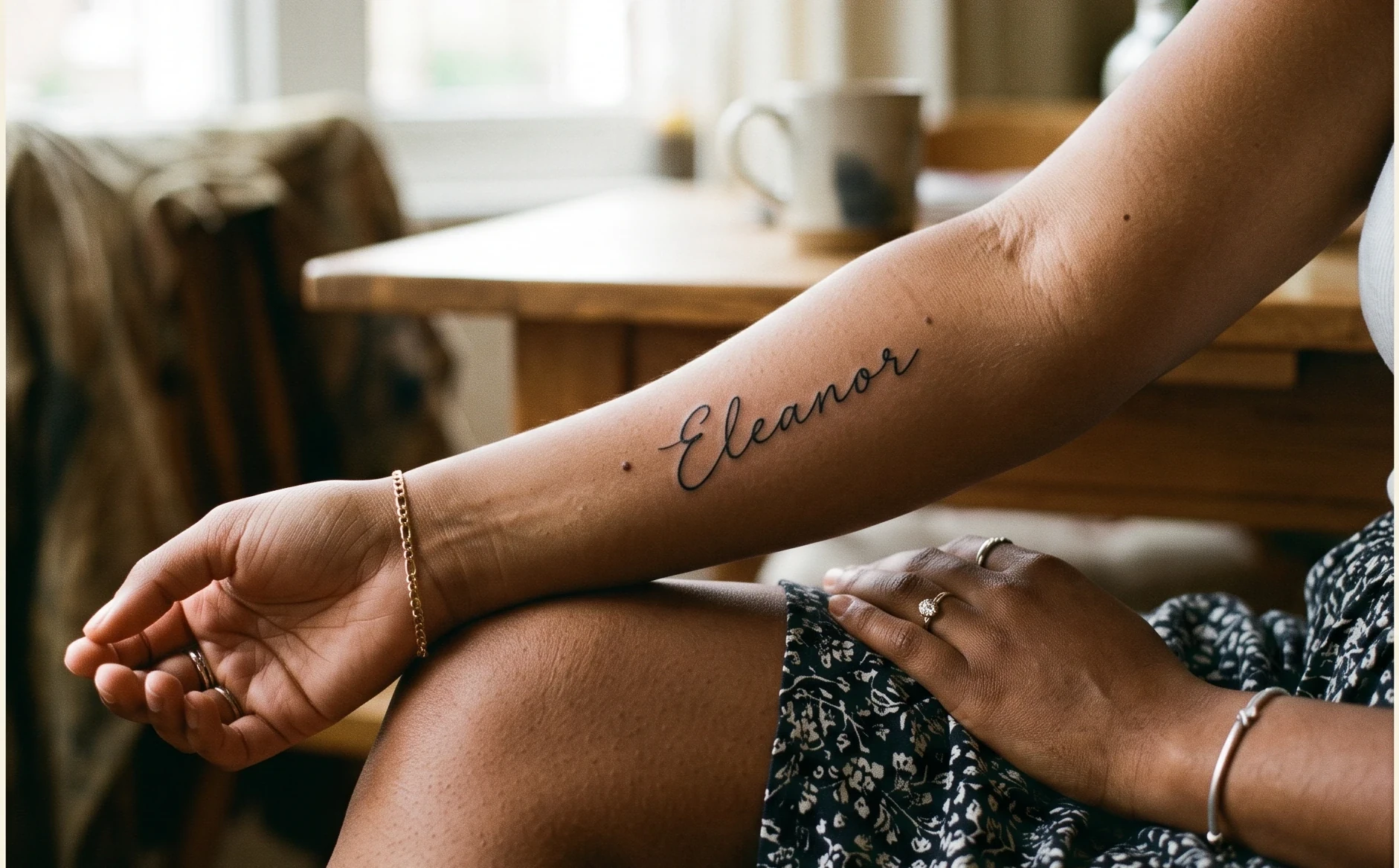 A tattoo being assessed before laser removal.
Why a name tattoo is one of the easiest to remove
Laser removal works by shattering ink into fragments small enough for your immune system to carry away — the laser breaks the ink apart, your body clears it over the following weeks, as the Cleveland Clinic explains. Selective photothermolysis is the principle that a laser can target tattoo ink while sparing surrounding skin, which is why removal is possible at all (StatPearls clinical reference).
A typical ex's-name tattoo happens to be the ideal candidate for this, for three reasons:
- It's small. Less surface area and less ink means less for your immune system to clear — and fewer sessions.
- It's usually black. Black ink absorbs the common 1064nm wavelength best and is the easiest colour to clear. Green and blue are the stubborn ones — see our guide to the hardest tattoo colours to remove.
- It's often fine-line. Thin, sparse lettering holds far less pigment than a dense, saturated design.
The American Academy of Dermatology notes that smaller, older and black tattoos generally respond most readily. So while a full sleeve can take 8–15 or more sessions, a small black name is frequently at the quick, low-cost end of the range — though, as always, no responsible clinic promises a number sight-unseen.
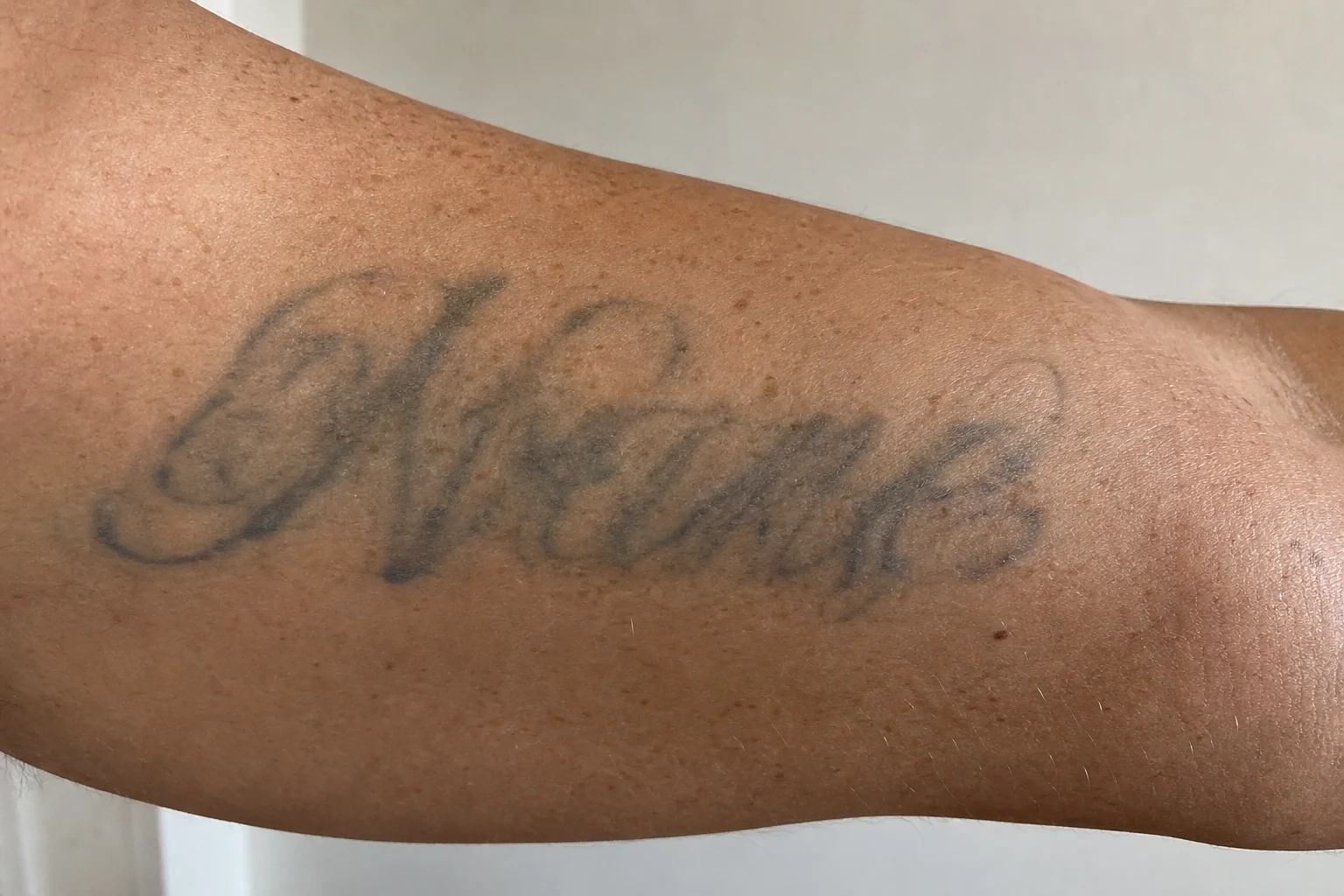 A fine-line name/script tattoo.
Your three options
There isn't one right answer — it depends on whether you want blank skin, a new design, or to keep part of what's there.
| Option | Best if you want… | What it involves |
|---|---|---|
| Full laser removal | The name completely gone, nothing in its place | A course of laser sessions until the ink clears to skin (or near-clear) |
| Fade-then-cover-up | A new tattoo where the name is | A few laser sessions to lighten the old ink, then a cover-up design by a tattoo artist |
| Selective / partial removal | To erase just the name, keep a surrounding design | A clinician lasers only the name, working carefully around the ink you're keeping |
Full laser removal is the route if you want it simply gone. Because a name is small and usually black, this is often the fastest and cheapest of the three.
Fade-then-cover-up suits people who'd rather replace the memory than erase it. You don't always need the old tattoo fully removed first — most artists just want it faded enough that the old ink won't ghost through the new design. A few laser sessions usually does that. Our guide to cover-up tattoo removal walks through how fading-for-a-cover-up differs from full removal.
Selective and partial removal are worth defining, because people use the terms loosely:
- Partial removal means clearing a portion of a tattoo — for example, removing the lower half of a piece while keeping the top.
- Selective removal is more precise: the clinician targets the laser only at specific elements — like a single name or word — while deliberately preserving the design around it.
If your ex's name is woven into a larger tattoo you otherwise still like, selective removal can lift out just the name. It's finicky work and can take extra sessions to protect the surrounding lines, so choose a clinic experienced in it.
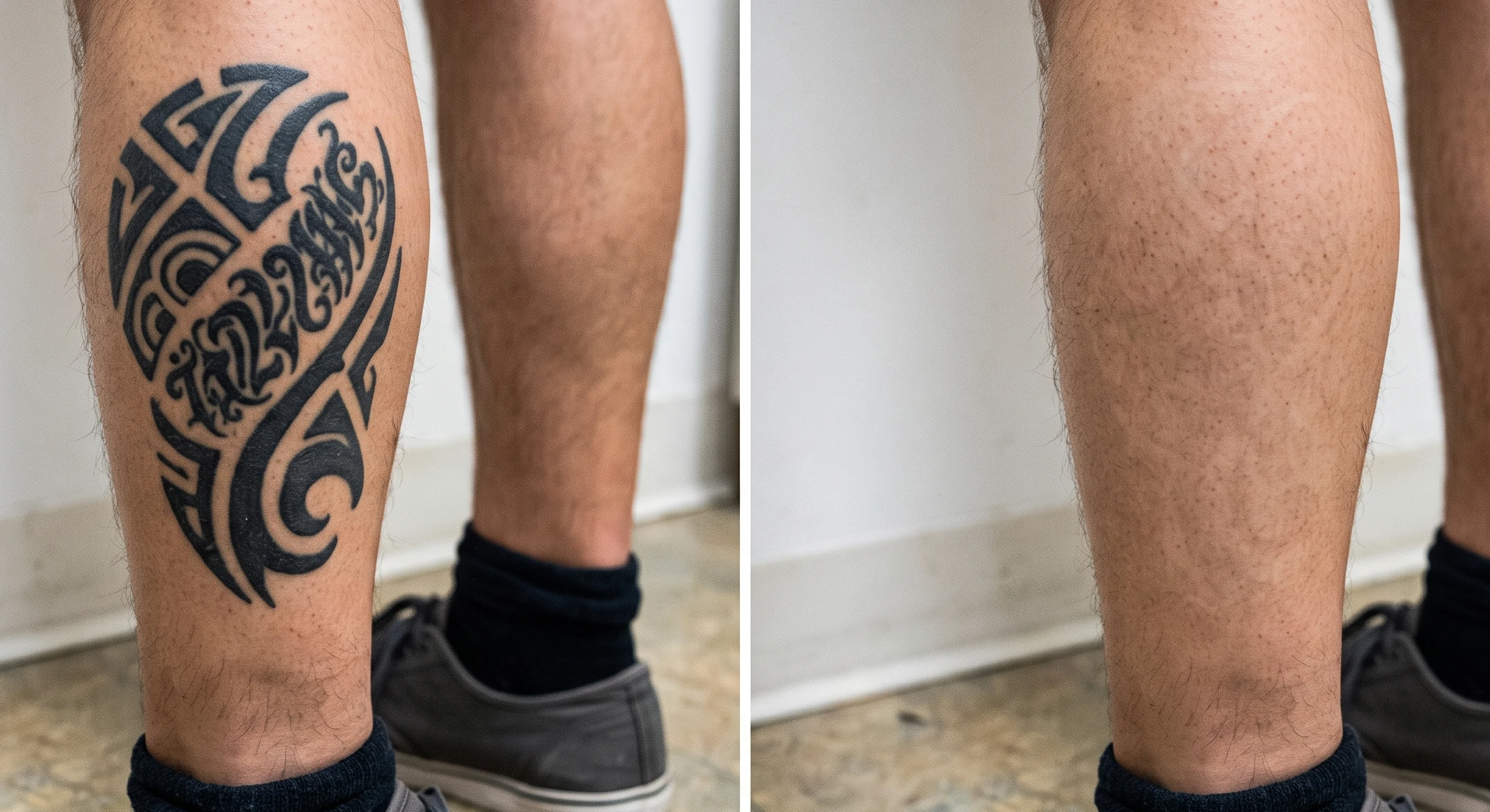 After a full course, only a faint 'ghost' — a barely-visible pale mark — may remain. Illustrative; results vary.
What to expect: sessions, timeline and cost
The honest ranges for a small black name:
| What people ask | Typical answer for a small black name | Note |
|---|---|---|
| Sessions | Often a handful (fewer than a large colour piece) | Can't be guaranteed; a consult narrows it |
| Time between sessions | 6–8 weeks | The healing-and-clearing window — non-negotiable |
| Session length | Well under a few minutes | Small area = short session |
| What it feels like | A hot rubber-band snap, repeated | Cooling or numbing is common |
| Cost driver | Amount of ink + number of sessions | A small name is at the low end |
On price: it varies enormously by city and clinic, and many clinics don't publish rates at all — of the 5,700 clinics we track across 1,043 cities, only about 38% publicly list a price (as of July 2026). Where prices are shown, the same-city spread is real: in Melbourne, for instance, listed per-session pricing typically runs $50–$200 (as of July 2026). For a small name, you're paying for a short session and only a few of them — the cheapest end of removal — but it's still worth comparing a few local clinics rather than assuming.
Don't rush the decision — but when you're ready
There's no medical urgency here, which is oddly freeing: the tattoo will be just as removable in three months as it is today. If the wound is fresh, you don't have to decide anything this week. Give yourself the space to be sure whether you want it gone (removal), replaced (cover-up), or partly kept (selective removal).
When you are ready, the single most useful step is to compare clinics near you — for lasers, pricing and experience with small lettering and selective work — rather than booking the first result you find. A short consultation costs little (many clinics offer one free), sets realistic expectations for your specific tattoo, and confirms your skin is a good candidate before any laser touches it.
This is general information, not medical advice. Laser tattoo removal is a medical procedure with real risks (blistering, scarring, pigment change). Session counts, timelines and outcomes vary by person and tattoo — consult a licensed provider about your specific situation.
When you're ready, compare your options
Because sessions, available lasers and price all vary from clinic to clinic, comparing is the highest-leverage thing you can do before booking.
Compare tattoo-removal clinics in your city to see who's near you, or start with a dense market like tattoo removal in Melbourne to see how listings and pricing stack up side by side. Leaning toward a fresh start instead? Read cover-up tattoo removal for how fading works before a new design.
Frequently asked questions
Can you remove an ex-partner's name tattoo?
Yes. A name tattoo is one of the most commonly removed tattoos, and small black lettering is among the easiest to clear because it holds little ink and black responds well to laser. Full laser removal is realistic; exact session counts vary by size, ink and skin, so a clinician should assess yours.
How many sessions does it take to remove a name tattoo?
Small, black, fine-line lettering often clears in fewer sessions than a large or colourful piece — frequently a handful, spaced 6–8 weeks apart. No honest clinic guarantees a count in advance, because ink depth, age, location and skin type all affect it. A consultation gives you a realistic range for your tattoo.
Is it cheaper to remove a name tattoo than a big tattoo?
Usually, yes. Cost tracks the amount of ink and the number of sessions, and a small name has far less of both than a large piece. Per-session pricing still varies widely by city and clinic. Of the 5,700 clinics we track, about 38% publicly list a price (as of July 2026) — compare a few before booking.
Can I remove just the name and keep the rest of the tattoo?
Often, yes — this is called selective removal. A clinician targets the laser only at the name or word you want gone while leaving the surrounding design intact. It's more precise and can take extra sessions to protect the edges, so it needs a practitioner experienced in selective work.
Should I remove the tattoo or cover it up?
It depends on what you want. Choose full laser removal if you want the name gone and nothing there. Choose fade-then-cover-up if you want a new design in its place — most artists ask for several laser sessions first to lighten the old ink so the new tattoo isn't shadowed. Both are common paths.
Does removing a name tattoo hurt?
Each laser pulse feels like a hot rubber-band snap against the skin, and a small name is treated in well under a few minutes. Because the area is small, sessions are short. Clinics commonly use cooling air or numbing to reduce discomfort. Some redness, swelling or blistering afterwards is normal and settles in days.
How long should I wait before removing an ex's name tattoo?
There's no medical deadline, so there's no need to rush the decision emotionally. The tattoo will still be removable whenever you're ready. When you do decide, book a consultation rather than acting on impulse — a clinician can set realistic expectations and confirm your skin is a good candidate before any laser work begins.
Related guides
Related Guides
- Ink & Colours
Selective Tattoo Removal: Erasing Part of a Tattoo (2026)
Selective tattoo removal targets one part of a tattoo — a name, a figure, one colour — while leaving the rest.
- Ink & Colours
Name & Lettering Tattoo Removal
Name and lettering tattoos are usually small and black, so per-unit they're among the easier tattoos to remove — but dense, deep script needs patience.
- Ink & Colours
Multicolour Tattoo Removal: Why Mixed-Colour Ink Takes More Sessions
Multicolour tattoos take more sessions because each colour absorbs a different laser wavelength and fades at its own rate. Why mixed ink clears unevenly, explained.