Multicolour Tattoo Removal: Why Mixed-Colour Ink Takes More Sessions
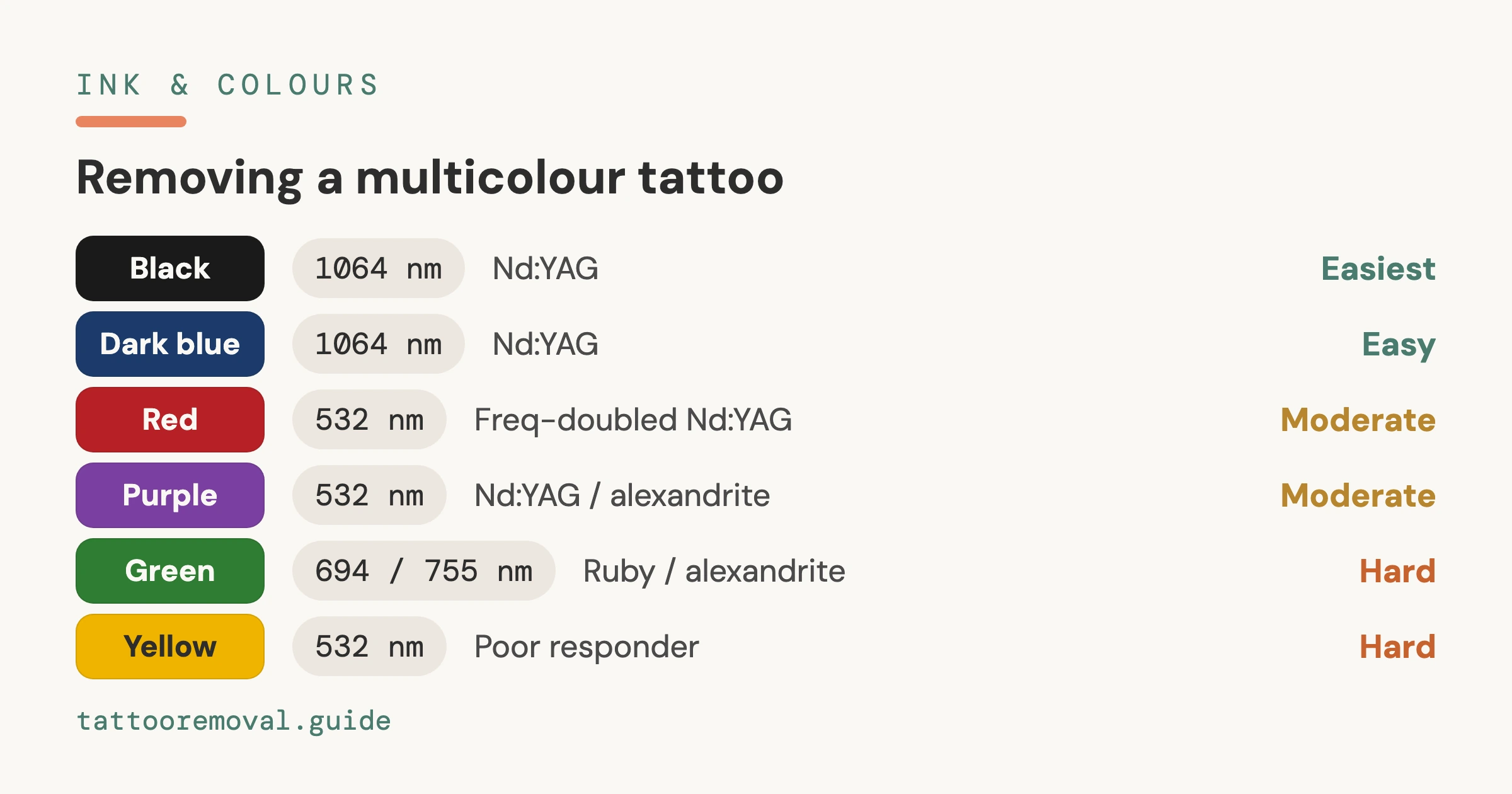
Multicolour tattoos take more sessions to remove than single-colour ones because each ink colour absorbs a different laser wavelength and breaks down at its own rate — so a mixed-colour piece is effectively several removal jobs on one patch of skin, and the slowest colour sets the timeline. Expect a multicolour tattoo to fade unevenly and to need more sessions — often with more than one laser wavelength — than an all-black design of the same size.
This guide explains why that happens, maps the common fade order, shows which colours are the stubborn holdouts, and sets honest expectations for a consultation — using medical sources and figures from the Tattoo Removal Guide directory, stamped (as of July 2026).
Key Takeaways
- Multicolour = multiple jobs. Each colour absorbs a different wavelength and shatters at a different rate, so the piece clears in patches and the slowest colour governs how long it takes.
- More than one wavelength is often needed — roughly 1064nm for black, 532nm for red and warm tones, and 694nm or 755nm for stubborn green and blue.
- Uneven fading is normal, not a failed treatment: strong absorbers clear first, leaving a partial image while poor absorbers catch up.
- Yellow, white and flesh tones are the stubborn ones and may fade only partially.
- No session count can be guaranteed. Across the 5,700 clinics we track, about 18% publicly list a picosecond laser and 15% list a Q-switched laser (as of July 2026) — both are effective; the wavelengths a clinic offers matter more than the device label.
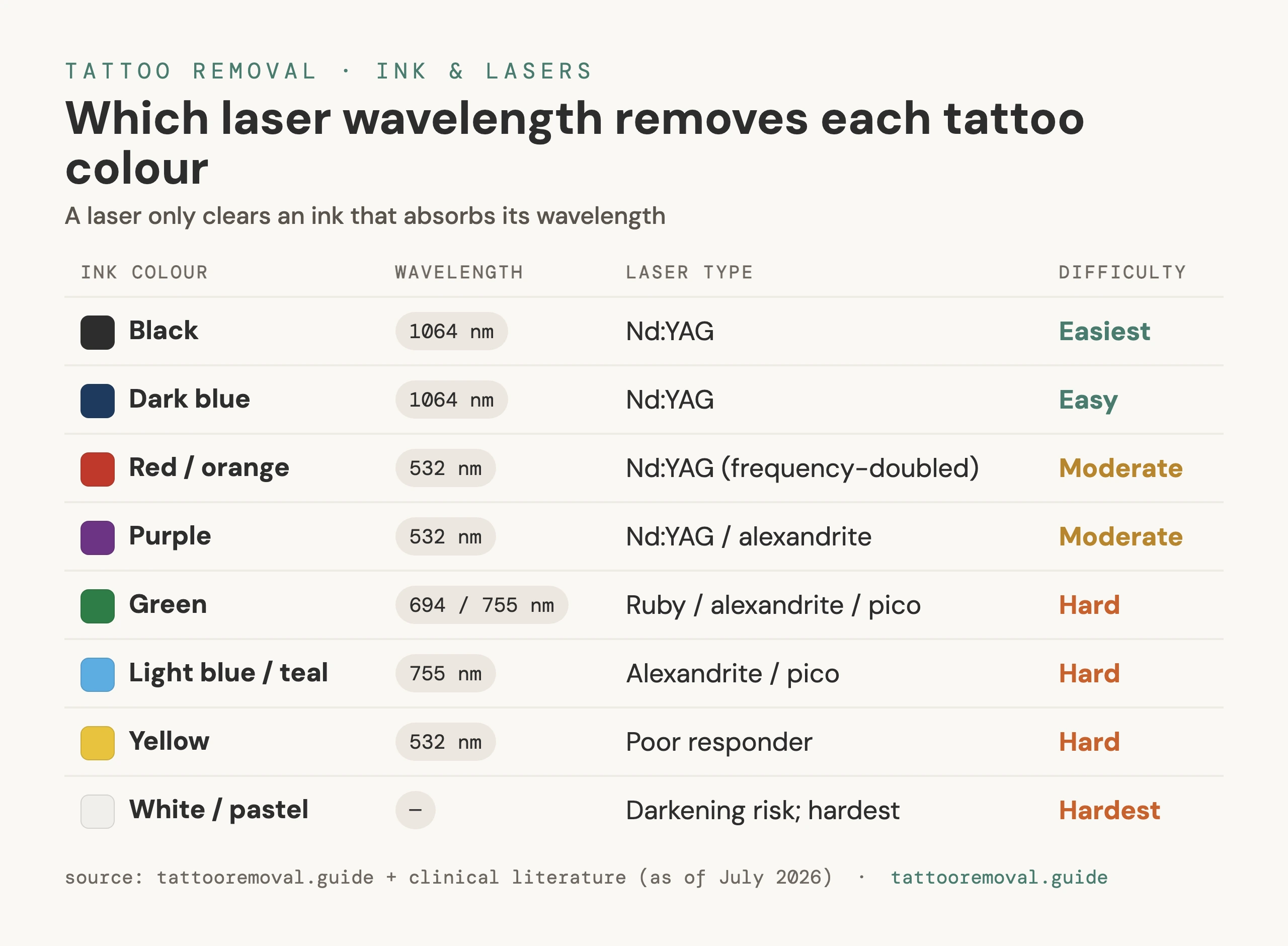 Different colours absorb different wavelengths — which is why a multicolour piece often needs more than one laser.
Why multicolour ink takes more sessions
Laser tattoo removal works by selective photothermolysis: the laser fires ultra-short pulses that are absorbed by the ink, which heats and shatters into fragments small enough for your immune system to carry away over the following weeks. As the Cleveland Clinic explains, the laser breaks the ink into smaller pieces that the body gradually absorbs and eliminates.
The catch is in the word absorbed. Selective photothermolysis is the principle that a specific colour of laser light is preferentially absorbed by a specific colour of ink — and only absorbed light does any work. A pigment that reflects the laser's wavelength simply bounces the energy away and does not break down. Every laser device outputs a fixed set of wavelengths, so whether a colour is easy or hard depends on whether an available wavelength matches what that pigment absorbs.
In a single-colour black tattoo, one wavelength (usually 1064nm) does the whole job because black absorbs nearly every wavelength. A multicolour tattoo is different: the black lines, the red flowers, the green leaves and the yellow highlights each want a different wavelength. The clinic often has to switch wavelengths across the same session, and each colour progresses on its own clock. Because your immune system needs weeks to clear each round of shattered pigment, sessions are spaced roughly 6–8 weeks apart — and the colour that responds slowest is the one that decides when you are finished. The StatPearls clinical reference describes the same mechanism: selective absorption by the pigment, fragmentation, then immune-mediated clearance, colour by colour.
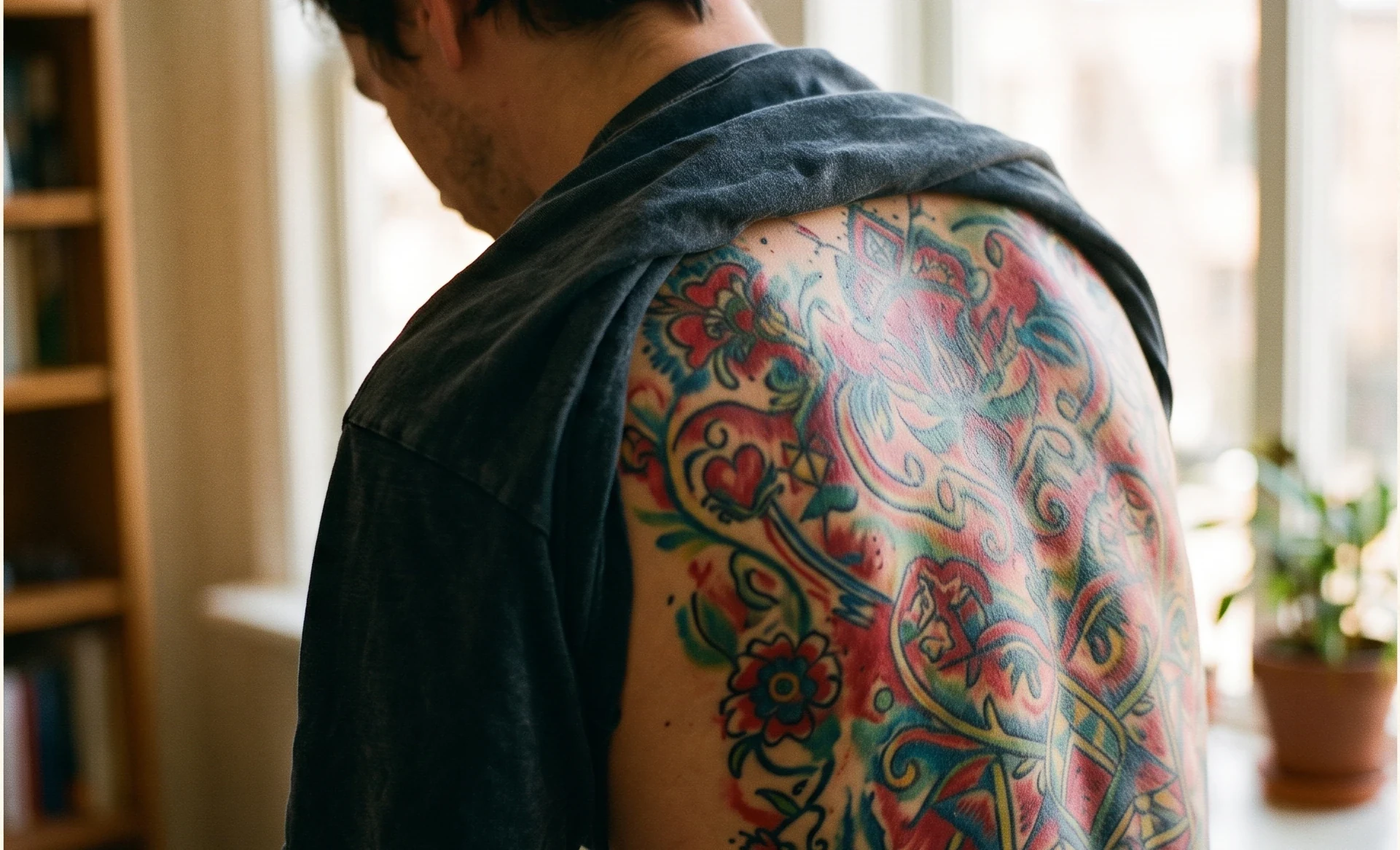 Multicolour work fades unevenly, colour by colour.
Colour-to-wavelength: why one laser rarely does it all
Different inks absorb different wavelengths, which is why coloured removal often needs more than one laser. Here is how the main colour families line up against the wavelengths clinics actually use:
| Ink colour | Best available wavelength | Typical response |
|---|---|---|
| Black / dark brown | 1064nm | Absorbs nearly all wavelengths — usually the easiest and fastest |
| Red / orange / warm tones | 532nm (green light) | Warm tones absorb green light well — generally respond at a sensible pace |
| Green | 694nm or 755nm (ruby / alexandrite) | Needs a longer wavelength than many clinics stock — often stubborn |
| Blue | 694nm, 755nm or 1064nm | Usually responds, but may need a wavelength not every clinic has |
| Yellow / white / flesh tones | 532nm (weak absorption) | Poor absorbers — may fade only partially and lag well behind |
A single Q-switched or picosecond device may offer only one or two of these wavelengths, which is exactly why a multicolour tattoo can stall on one colour while the rest disappear. A clinic that carries multiple wavelengths can treat each colour on its own best setting. The American Academy of Dermatology notes that some colours are simply harder to remove than others — and the FDA's tattoo fact sheet confirms that complete removal without scarring can be difficult and that results vary with ink colour and depth. This is why the equipment a clinic actually owns matters so much for coloured ink — a question worth asking before you commit.
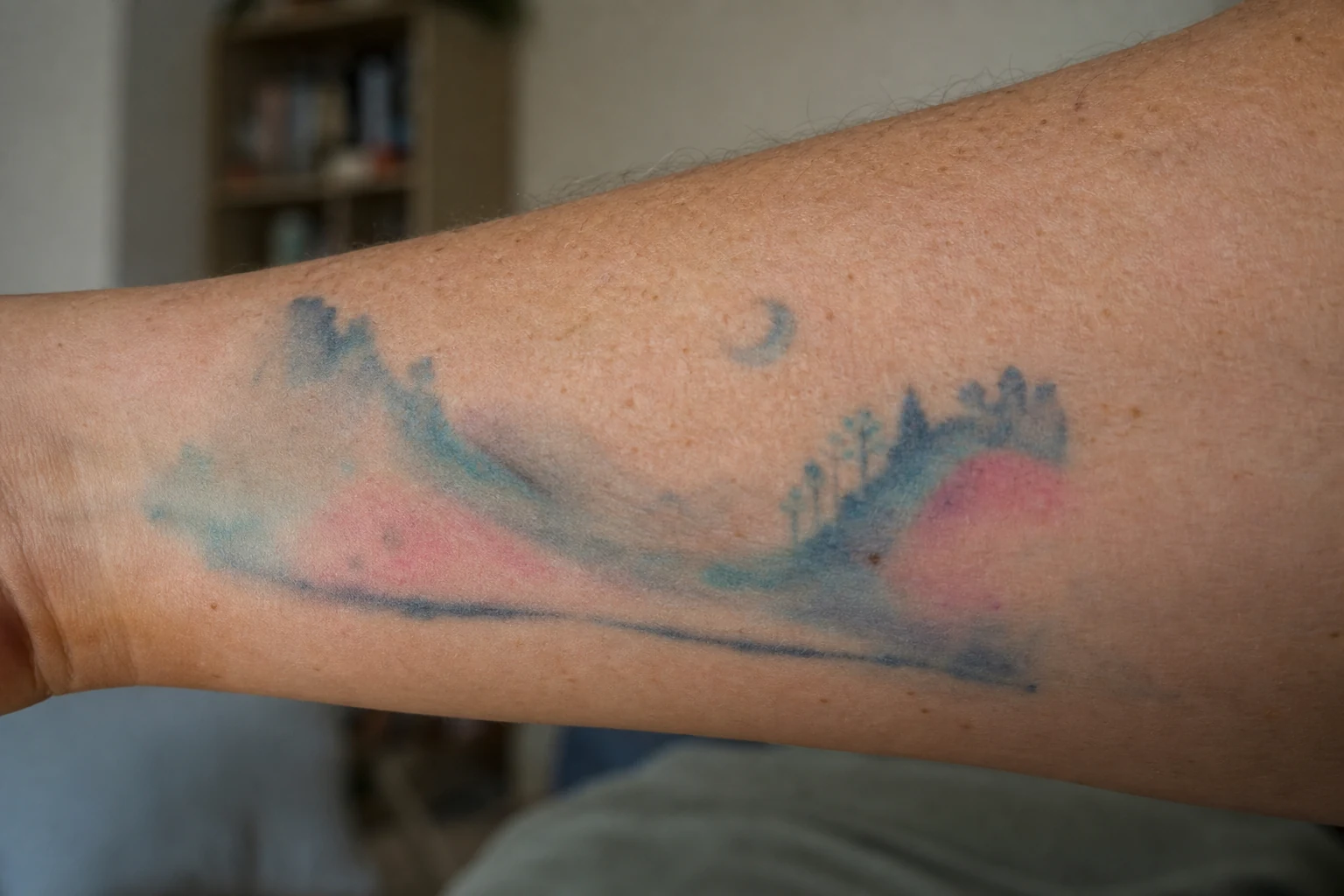 Blended pastel inks add yellows and whites — the stubborn end of the spectrum.
The fade order — and why the image goes patchy first
If your tattoo mixes colours — common in floral, watercolour, old-school and Japanese-style work — expect it to fade in patches rather than all at once. A widely seen general pattern is that green and black respond earlier, blue and red follow, and yellow is usually last — though the exact order depends on the specific pigments and the wavelengths your clinic has, so treat it as a rough expectation, not a schedule.
The practical consequence is that a multicolour piece often looks worse before it looks better. The strong absorbers clear first, leaving a partial image — the black outline gone but the yellow accents still glowing, or the leaves faded while the flowers hang on. This uneven, mid-course "ghost" of the design is completely normal and reflects the physics of absorption, not a treatment going wrong. Yellow, white and flesh tones are the classic holdouts: they absorb laser light poorly, so little energy reaches the pigment, and they may fade substantially but leave a faint residual tint rather than clearing completely. Fluorescent or neon inks are the most stubborn of all.
You can compare clinics in your city to see which list the specific lasers and wavelengths your colours will need — the single most useful step before booking coloured work.
Setting honest expectations at consultation
Multicolour removal rewards patience and honesty over promises. Session counts depend on the colours involved, ink density and depth, your skin type and immune response, and — critically — the wavelengths available. Because multicolour pieces are governed by their slowest colour, they generally sit at the higher end of any range, and complete clearance of every colour cannot be guaranteed. Factors like these are captured in clinical scoring tools such as the Kirby-Desai scale, but only a clinician who has seen your tattoo can give a meaningful estimate.
At a consultation, ask three things: which wavelengths the clinic has and which ones your colours need; whether they expect any colours (yellow especially) to only fade partially; and roughly how many sessions and how much spacing to plan for. A clinic that answers with a range and flags the stubborn colours up front is a better sign than one that promises a bright, multicolour piece "gone in a fixed number of sessions" without seeing it — treat that as a red flag.
This is general information, not medical advice. Laser tattoo removal is a medical procedure with real risks (blistering, scarring, pigment change). Colours, session counts and outcomes vary by person and ink — consult a licensed provider about your specific tattoo, and use protective eyewear during every session.
Compare clinics before you commit
Because multicolour ink lives or dies on which wavelengths a clinic offers, comparing your options is the highest-leverage move you can make. For the full picture of which colours resist and why, read our pillar guide to the hardest tattoo colours to remove, and for the toughest single case, see can green tattoos be removed.
When you're ready, compare tattoo-removal clinics in your city to check which lasers and wavelengths they list, or start with a dense market like tattoo removal in Melbourne to see how equipment and pricing stack up side by side.
Frequently asked questions
Why do multicolour tattoos take more sessions to remove?
Each ink colour absorbs a different laser wavelength and shatters at its own rate, so a multicolour tattoo is really several removal jobs on one piece of skin. The clinic often has to treat different colours with different wavelengths, and the slowest colour sets the timeline. That is why mixed-colour work typically needs more sessions than an all-black tattoo, though the exact number varies by pigment, density and skin.
In what order do tattoo colours fade during removal?
A common general pattern is green and black respond earlier, blue and red follow, and yellow is usually last — but fade order varies by the specific pigments used and the wavelengths a clinic has. Black absorbs nearly every wavelength, so it usually moves well; yellow, white and flesh tones absorb laser light poorly and tend to be the stubborn holdouts. Treat any order as a rough expectation, not a schedule.
Is it normal for a colour tattoo to fade unevenly?
Yes. Patchy, uneven fading is the expected result with multicolour ink, not a sign of a failed treatment. Colours that match the laser's wavelengths clear first, leaving a partial image for a while, while poor absorbers like yellow linger. It can look alarming mid-course, but it reflects the physics of absorption. Full clearance timelines vary widely and cannot be guaranteed.
Do I need more than one laser for a multicolour tattoo?
Often, yes. Different inks absorb different wavelengths — roughly 1064nm for black, 532nm for red and warm tones, and 694nm or 755nm for stubborn green and blue — so a single wavelength rarely clears every colour efficiently. A clinic with multiple wavelengths can treat each colour on its best setting. Ask which wavelengths a clinic offers before booking coloured work.
Which tattoo colours are hardest to remove?
Yellow, white and flesh tones are generally the most resistant because they absorb laser light poorly, so little energy reaches the pigment to break it apart. Fluorescent or neon inks are especially stubborn. These colours may fade substantially but leave a faint residual tint rather than clearing completely, which is why a responsible clinic sets honest expectations up front.
How many sessions does a multicolour tattoo removal take?
There is no fixed number — it depends on the colours, ink density, ink depth, your skin type and immune response, and the wavelengths available. Multicolour pieces generally sit at the higher end of the range because the slowest colour governs the timeline. A responsible clinic gives an estimate only after assessing your specific tattoo, and never guarantees a session count sight-unseen.
What should I ask at a consultation for a colour tattoo?
Ask which laser wavelengths the clinic has and which ones your specific colours need, whether they expect any colours to only fade partially, and roughly how many sessions and how much spacing to plan for. A clinic that gives a range and flags the stubborn colours honestly is a better sign than one that promises full clearance in a fixed number of sessions.
Related guides
Related Guides
- Ink & Colours
Selective Tattoo Removal: Erasing Part of a Tattoo (2026)
Selective tattoo removal targets one part of a tattoo — a name, a figure, one colour — while leaving the rest.
- Ink & Colours
Removing an Ex-Partner's Name Tattoo: Your Options in 2026
Removing an ex's name tattoo? A partner's name is one of the most-removed tattoos — and small black lettering is among the quickest and cheapest to clear.
- Ink & Colours
Name & Lettering Tattoo Removal
Name and lettering tattoos are usually small and black, so per-unit they're among the easier tattoos to remove — but dense, deep script needs patience.