Is Laser Tattoo Removal Safe? Risks & Side Effects

Two clinics can hold the same laser and give you very different results, so "is it safe?" is really a question about the provider, your skin and your ink — not just the machine.
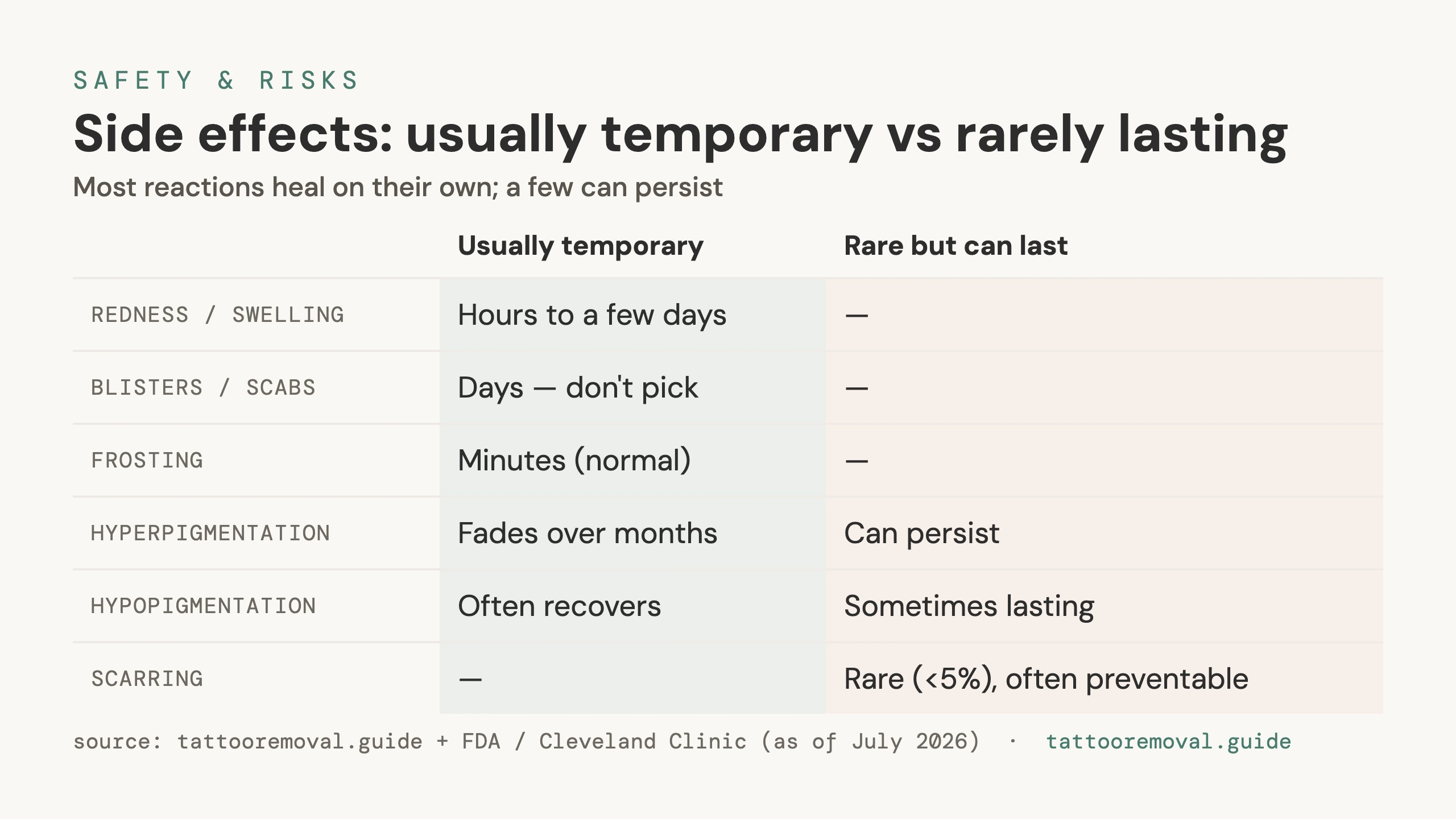 Most side effects heal on their own; a few — like scarring or pigment change — are rare but can last.
Key Takeaways
For most healthy adults, laser tattoo removal performed by a trained provider is considered safe, and lasers are the method health regulators point to as the standard approach. The common side effects — redness, swelling, blistering and scabbing — are temporary and settle within days to weeks. The effects that can last, mainly skin lightening or darkening and rare scarring, are uncommon but real, and your risk depends heavily on your skin tone, your health history and who holds the laser.
That verdict comes with a caveat we repeat throughout this page: no honest source can guarantee a safe outcome or "no scarring." What follows is a complete, plain map of the risks, the evidence behind the headlines, who should think twice, and the checklist that lowers your odds — so you can walk into a consultation asking sharper questions.
This is general information, not medical advice. Always consult a licensed medical provider about your own situation.
The short answer, in context
Laser tattoo removal works by sending very short pulses of light into the skin. The light shatters ink particles into fragments small enough for your immune system to carry away over the following weeks. Because the energy is tuned to the ink rather than the surrounding tissue, the surface skin is largely spared — which is why lasers, not acid or excision, are the mainstream approach. The U.S. Food & Drug Administration lists laser removal as the standard method and specifically warns against unregulated DIY creams and home devices, which carry their own risks of scarring and reaction (FDA).
The two laser families in wide use are Q-switched and picosecond systems. Both are effective and FDA-cleared; the difference is pulse duration, not one being categorically better. Across the Tattoo Removal Guide directory, about 18% of the 5,700 specialist clinics we track note a picosecond laser and about 15% note a Q-switched laser (as of July 2026). Those figures count only clinics that publicly state their laser type in their listing — most don't specify it at all, which is itself a reason to ask directly rather than assume. Equipment varies clinic to clinic, so the machine in the room is a question worth asking.
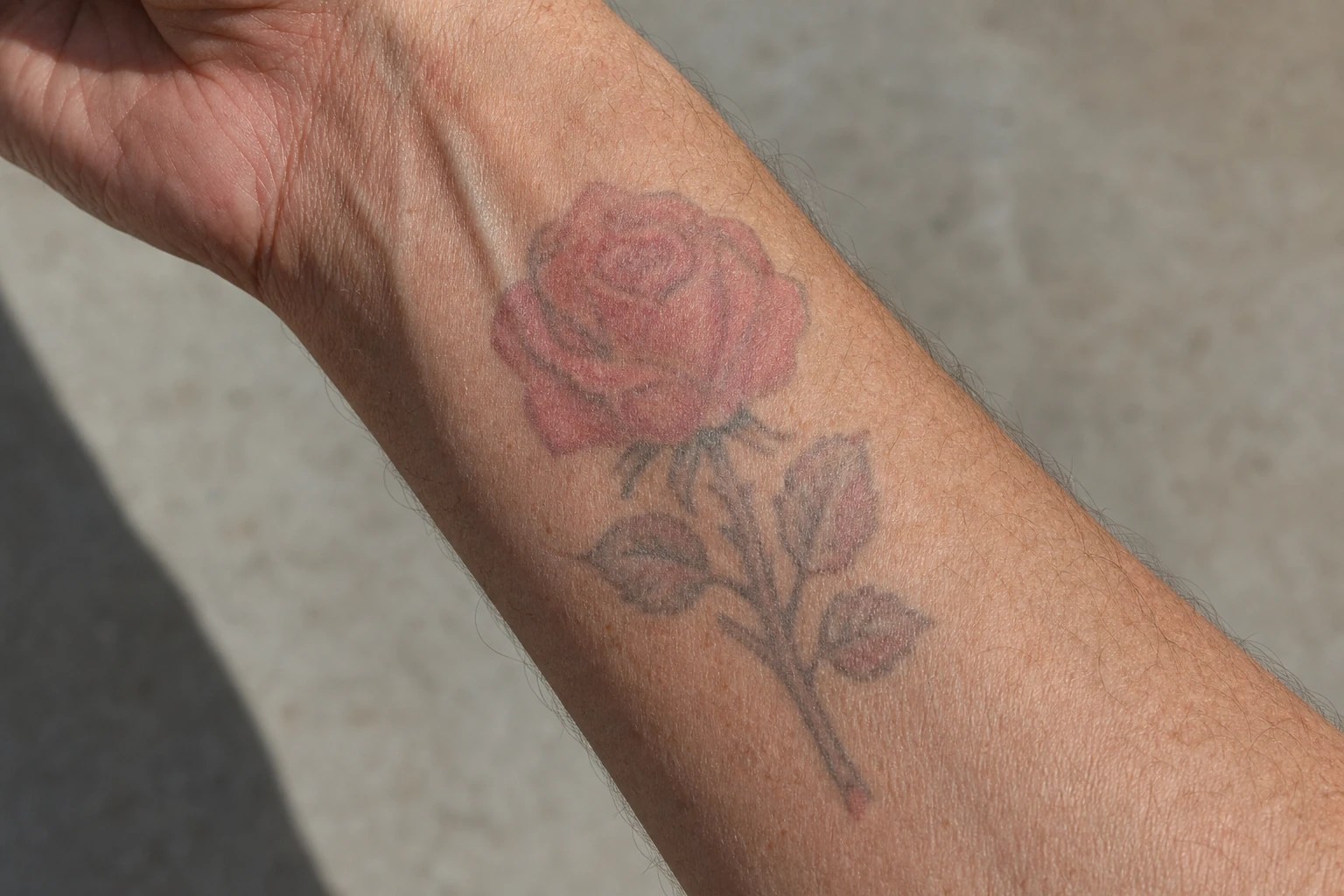 An aged red-ink tattoo — red responds best to a 532nm laser.
Laser tattoo removal side effects: the complete table
Most people experience some of the effects in the top rows and none of the ones lower down. "How common" describes typical experience for healthy adults treated correctly; it is not a promise about your case.
| Side effect | How common | Temporary or permanent | What causes it | How to reduce the risk |
|---|---|---|---|---|
| Redness & swelling | Very common (most sessions) | Temporary — hours to a few days | Normal inflammatory response to the laser energy | Cold compress, follow aftercare; expected and self-resolving |
| Frosting (immediate white bloom) | Very common, during treatment | Temporary — fades in minutes | Rapid release of gas as ink particles absorb light | Normal, expected reaction; no action needed |
| Blistering | Common | Temporary — days to ~2 weeks | Heat and fluid separating skin layers | Keep clean and covered, do not pop; let it heal |
| Scabbing & crusting | Common | Temporary — 1–2 weeks | Part of normal skin healing after treatment | Do not pick or scratch — picking is a leading cause of scarring |
| Hyperpigmentation (darkening) | Less common; higher in darker skin | Often fades over months; can persist | Melanin over-responding to the laser | Correct wavelength for your skin tone; strict sun protection |
| Hypopigmentation (lightening) | Less common; higher in darker skin | Can be long-lasting or permanent | Laser affecting melanin-producing cells | Appropriate laser/settings; patch test first |
| Scarring (incl. textural change) | Uncommon | Can be permanent | Excess energy, infection, or picking scabs | Trained provider, correct settings, disciplined aftercare |
| Infection | Uncommon | Temporary if treated | Bacteria entering broken or blistered skin | Sterile technique, clean aftercare; see a provider if it worsens |
| Allergic reaction | Rare | Varies | Immune response to fragmented ink (notably red pigment) | Disclose past ink reactions; patch test; medical review |
Sources for these mechanisms and frequencies include the Cleveland Clinic, NCBI StatPearls, and the American Academy of Dermatology. The single behaviour most within your control is aftercare: picking a scab or bursting a blister is one of the most avoidable routes to a lasting mark.
 Warm yellow/orange ink — among the stubborn colours.
Does it hurt? (the pain question, in brief)
Discomfort is a normal, expected part of removal rather than a risk in itself. Most people describe each pulse as a hot elastic-band snap, and sessions are short — often a few minutes for a small tattoo. Clinics commonly offer topical numbing, cooling air or an ice pack, and pain does not indicate damage. Pain tolerance is individual and can't be promised in advance. We cover technique-by-technique comfort in a dedicated pain guide (see does laser tattoo removal hurt?, a companion spoke to this page).
Risk by skin tone: Fitzpatrick IV–VI and laser choice
This is where "is it safe?" has the most skin-specific answer. The laser has to distinguish ink from your natural melanin. In lighter skin (Fitzpatrick I–III) that contrast is easy. In darker skin (Fitzpatrick IV–VI), melanin competes with the ink for the laser's energy, which raises the risk of hypopigmentation (lightening) and hyperpigmentation (darkening) if the wrong wavelength or settings are used.
The practical rule providers use: a 1064nm Nd:YAG laser is generally the safer wavelength for deeper skin tones, because that wavelength is absorbed less by melanin and reaches ink with less collateral effect on surrounding pigment. Older ruby (694nm) and shorter-wavelength lasers sit near melanin's absorption peak and are usually avoided on darker skin. This isn't a reason to skip removal — it's a reason to ask one specific question before you book: which laser and wavelength will you use on my skin? A clinic that can answer clearly, ideally with a patch test, is signalling the right kind of care.
Because equipment differs from clinic to clinic, matching the laser to your skin is a filtering step, not a leap of faith. You can compare clinics and filter by laser type on the directory so you're only consulting places that actually run the wavelength suited to you.
The 2024 lymphoma study, explained neutrally
In 2024 a research team at Lund University in Sweden published a large cohort study in eClinicalMedicine (part of The Lancet Discovery Science) examining whether having tattoos was associated with malignant lymphoma. It's the study behind a wave of "do tattoos cause cancer?" headlines, so it deserves a straight reading (Nielsen et al., 2024).
What it found: people with tattoos had a modestly higher rate of lymphoma than people without, after adjusting for factors like smoking. What it did not prove: that tattoos cause lymphoma. This was an observational study, and the authors themselves were explicit that it shows an association, not causation, that the increased risk estimate came with statistical uncertainty, and that the finding needs replication. It also studied having tattoos, not tattoo removal.
The biological hypothesis worth understanding is the azo-amine one. Many tattoo pigments are azo compounds. When ink is broken down — by sunlight, by the immune system, or by a laser — those compounds can, in theory, release aromatic amines, some of which are known to be problematic in other contexts. That's a plausible mechanism to investigate, not evidence of harm in people from removal. The mainstream dermatology view remains that professional laser tattoo removal is a low-risk procedure, that the lymphoma signal is preliminary and unconfirmed, and that it does not change the standard safety guidance. If this concern is on your mind, it's a good, legitimate thing to raise with a licensed provider who can weigh it against your history.
Who should not get laser tattoo removal (contraindications)
Some situations call for delaying treatment or getting medical clearance first. Providers commonly advise caution if you:
- Are pregnant or breastfeeding. Removal is typically postponed as a precaution — there's little safety data, so most clinics wait.
- Have an active infection, open wound, or cold sore at the treatment site. Treat the infection first; lasering broken or infected skin raises the risk of scarring and spread.
- Recently took isotretinoin (e.g. for acne). Many providers still ask you to wait — often around 6 months — though updated dermatology consensus (an American Society for Dermatologic Surgery expert panel, 2017) finds non-ablative lasers like tattoo removal are generally safe on or soon after isotretinoin. Ask your provider where they stand and why.
- Have a history of keloid or hypertrophic scarring. You can often still be treated, but the scarring risk is higher, so this needs an honest, cautious conversation and possibly a test spot.
- Have very tanned, sunburned, or recently sun-exposed skin. Higher melanin at treatment time raises the pigment-change risk; providers usually wait for a tan to fade.
- Have permanent makeup or a cosmetic tattoo in the area. Cosmetic inks often contain iron oxide or titanium dioxide, which a laser can instantly turn black — paradoxical darkening — and make far harder to remove. These need a test spot and a clinician experienced with cosmetic pigment (see our permanent makeup removal guide).
Certain medications (including some that cause photosensitivity), autoimmune and skin conditions, and a history of ink allergy also matter. None of these is automatically disqualifying — the point is that they change your personal risk, which is exactly what a proper consultation exists to assess. Disclose your full medical history; a provider who rushes past it is a red flag.
Reduce your risk: the clinic-vetting checklist
Most of the safety of tattoo removal isn't decided by the technology — it's decided by the person operating it and the care you take afterward. The variables above (skin tone, wavelength, aftercare, medical history) are all things a good clinic manages and a rushed one ignores. Before you book, run this list:
- Licensed, experienced provider. Confirm who performs the treatment and their training. Tattoo removal is a medical procedure, not a walk-in extra.
- FDA-cleared laser, matched to you. Q-switched or picosecond, with the right wavelength for your skin tone and ink colours. Ask them to name it.
- Proper laser eye protection. A reputable clinic gives you wavelength-specific laser safety shields — not ordinary sunglasses — because a stray or reflected beam can cause permanent eye injury. If they don't protect your eyes, leave.
- A real consultation and patch test. A test spot checks how your skin reacts before committing your whole tattoo.
- Honest expectations. Beware anyone promising a guaranteed session count or "no scarring." Reputable providers talk in ranges and factors, because outcomes genuinely vary.
- Clear aftercare and follow-up. You should leave knowing exactly how to care for the area and when to call if something looks wrong.
- Clean, transparent facility. Sterile technique and straight answers about risks are the baseline.
The simplest way to apply all of this is to line up a few options rather than booking the first result. You can compare tattoo-removal clinics in your city side by side — laser type, transparency and reviews — before you consult, so the safety questions are answered before a laser ever touches your skin. That comparison step is the whole reason an independent directory is useful: no clinic pays us to rank higher, so the vetting is yours to do.
The honest bottom line
Laser tattoo removal is, for most healthy adults treated by a competent provider, a well-established and low-risk procedure — the method regulators and dermatologists point to as the standard. Its common side effects are temporary; its lasting risks, mainly pigment change and rare scarring, are uncommon but real and skew higher for darker skin tones and for people who skip aftercare. The recent lymphoma research is worth knowing about and worth raising with a professional, but as of now it shows an association, not a cause, and doesn't change standard guidance. Safety here is less about the machine and more about the match between your skin, your history, your aftercare and the skill of the person holding the laser — which is exactly what the right clinic, and a bit of comparison, is for.
This article is general information, not medical advice. It cannot account for your individual health, and no outcome can be guaranteed. Consult a licensed medical provider before starting or stopping any treatment. Directory figures are a point-in-time snapshot (as of July 2026) and drift as clinics update their listings.
Frequently asked questions
Is laser tattoo removal safe?
For most healthy adults, laser tattoo removal by a trained provider is considered safe, and lasers are the method regulators like the FDA point to as the standard approach. Most side effects are temporary — redness, swelling, blistering and scabbing that settle in days to weeks. Scarring and permanent pigment change are uncommon but possible.
What are the side effects of laser tattoo removal?
Common, temporary effects include redness, swelling, blistering, scabbing and an immediate white "frosting" that fades in minutes. Less common effects are hyperpigmentation (darkening) or hypopigmentation (lightening) of the skin, which can be long-lasting, plus small risks of infection, allergic reaction and scarring. A consultation assesses your individual risk.
Can laser tattoo removal cause scarring?
Scarring is uncommon when a trained provider uses correct settings, but it is possible — more likely if blisters or scabs are picked, if the area gets infected, or if you have a history of keloids. Most texture change is temporary. There is no way to guarantee zero scarring, which is why aftercare and provider skill matter.
Is laser tattoo removal safe for darker skin (Fitzpatrick IV–VI)?
It can be, but darker skin carries a higher risk of hypopigmentation or hyperpigmentation because melanin competes with tattoo ink for the laser's energy. A 1064nm Nd:YAG laser is generally the safer wavelength for deeper skin tones; older ruby (694nm) lasers are usually avoided. Ask which laser a clinic uses before booking.
Does laser tattoo removal cause cancer?
There is no established evidence that laser tattoo removal causes cancer. A 2024 Swedish study linked having tattoos to a modestly higher rate of lymphoma, but it found an association, not proof of cause, and did not study removal. Mainstream dermatology still regards professional laser removal as low-risk. Discuss any concerns with a licensed provider.
Who should not get laser tattoo removal?
Providers generally advise caution or delay if you are pregnant or breastfeeding, have an active skin infection or cold sore at the site, recently took isotretinoin (often a 6-month wait), have a history of keloid scarring, or have very tanned or sunburned skin. Some medications and conditions also matter — disclose your full history at consultation.
How can I reduce my risk during tattoo removal?
Choose a licensed, experienced provider using FDA-cleared Q-switched or picosecond lasers, insist on a patch test and consultation, confirm the laser suits your skin tone and ink, follow aftercare exactly (don't pick scabs), and protect the area from sun. Comparing several clinics before booking is the simplest way to vet skill and equipment.
Ready to vet a clinic properly? Compare tattoo-removal clinics in your city — filter by laser type and see who's transparent before you book a consultation.
Related guides
Related Guides
- Safety & Risks
Why a Patch Test Matters Before Tattoo Removal (2026)
Why does a patch test matter before laser tattoo removal? It reveals how your skin and ink react — blistering, pigment change, rare reactions — before a full…
- Safety & Risks
Who Should Not Get Laser Tattoo Removal? The Contraindications
Who should not get laser tattoo removal? Most adults are candidates. The full contraindications checklist — when to wait and when to discuss carefully.
- Safety & Risks
Tattoo Removal While Pregnant or Breastfeeding
Can you get tattoo removal while pregnant? Most providers say wait — not from proven harm, but because the safety isn't studied.