How to Choose a Tattoo Removal Clinic (12 Questions)

Choosing a tattoo removal clinic comes down to four things: a trained operator working under medical supervision, a laser matched to your ink colour and skin tone, a mandatory patch test before the first full session, and honest, no-guarantee expectations. Get those right and the rest is detail. This guide gives you the exact questions to ask and the red flags that should stop you.
Here's the awkward truth the industry rarely says out loud: a clinic has every incentive to tell you it's the right choice. It can't neutrally tell you how to shop its competitors. An independent directory can — so this checklist is built to be used across clinics, and each check maps to something you can pre-screen before you ever walk in.
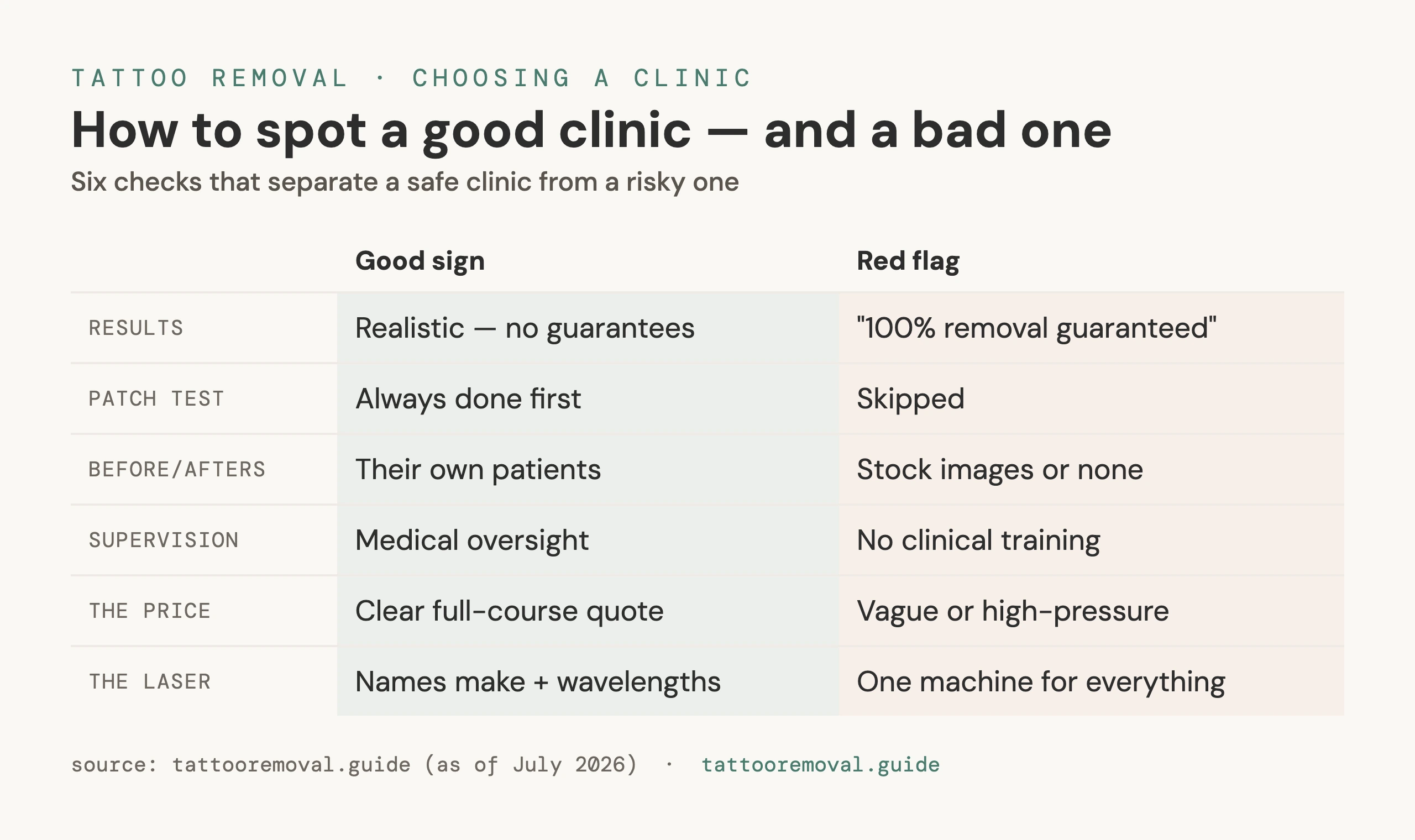 Six checks that separate a safe, credible clinic from a risky one.
Key Takeaways
- The four things that matter most: a medically supervised, trained operator; the right laser for your ink and skin tone; a patch test; and realistic, no-guarantee expectations.
- Ask for the total cost of a full course, not just the per-session price — and remember only about 38% of clinics publish any price at all (as of July 2026).
- Red flags: "100% removal guaranteed", no patch test, refusing to show their own photos, pressure to sign on the spot, no medical oversight.
- Pre-screen on laser type, ratings and review counts before you book — then compare a few clinics in your city, not just the first quote.
The 12 questions to ask before you book
Bring these to a consultation. You're not being difficult — a good clinic will welcome them, and how they answer tells you as much as what they answer.
- Who performs the treatment, and what's their training? You want a trained laser operator — often a nurse, dermatologist, or a technician who has completed accredited laser-safety training — not someone learning on your skin. The American Academy of Dermatology recommends choosing a qualified provider for laser tattoo removal.
- Is there medical oversight? Ask whether a doctor or registered nurse supervises treatments and manages any adverse reactions. Laser tattoo removal is a medical procedure; medical supervision matters if something goes wrong.
- What laser make and wavelengths do you use? Different ink colours respond to different wavelengths. A clinic should be able to name its device and confirm it has the wavelengths your colours need (more on matching laser to ink in our methods comparison).
- Do you have experience with my skin tone? Darker skin tones carry a higher risk of pigment changes and need careful settings. Ask directly whether the operator routinely treats skin like yours.
- Do you have experience with my ink colours? Black clears most predictably; greens, blues and some reds are harder. A clinic that's candid about which of your colours are stubborn is being honest, not negative.
- Will you run a patch test first? A patch (or test-spot) treatment on a small area checks your skin's reaction before you commit. Dermatology guidance supports test spots — a clinic that skips this is skipping a basic safety step.
- What's a realistic session estimate for a tattoo like mine? Expect a range, not a promise. Most tattoos take multiple sessions spaced weeks apart, and the honest answer includes "it depends on how your skin responds."
- Will you tell me plainly that removal can't be guaranteed? The right answer is yes. The U.S. FDA notes that complete removal is not guaranteed and that some tattoos may not fully clear.
- Can I see your own before-and-after photos? Their real patients, ideally with tattoos and skin tones like yours — not stock images or manufacturer marketing shots.
- What's the price for a full course, not just per session? Because removal takes several sessions, a low per-session figure can still add up. Ask for the total, and what happens if you need more sessions than estimated.
- What aftercare and support do you provide? You want written aftercare instructions and a point of contact if you have a reaction between sessions.
- What happens if my tattoo stops fading? Plateaus happen. A good clinic explains how it adjusts spacing or settings, or when it would recommend pausing — rather than just selling you more sessions.
 A consultation is where the plan, risks and realistic expectations get set.
Red flags: when to walk away
Some answers should stop you in your tracks. If you see these, slow down and compare other clinics.
| Red flag | Why it's a problem | What good looks like |
|---|---|---|
| "100% removal guaranteed" | No provider can guarantee complete clearance — results depend on ink, skin and immune response | Honest ranges and a clear "no guarantees" |
| No patch test offered | Skips a basic step to check how your skin reacts | Patch/test spot before the first full session |
| Won't show their own before-and-afters | Real results are the strongest proof; stock photos aren't | Their own patients, including skin tones like yours |
| Pressure to sign a package on the spot | Urgency tactics discourage comparison and reflection | Time to think, and a written quote you can take away |
| No medical supervision | Laser removal is a medical procedure with real risks | A doctor or registered nurse overseeing treatment |
| Suspiciously cheap with no explanation | Can signal untrained operators or outdated equipment | A clear reason for the price (tattoo size, market) |
| Vague about the laser or its wavelengths | May not have the right device for your ink colours | Names the device and confirms the wavelengths |
None of these on its own proves a clinic is unsafe — but each is a reason to ask more questions, and several together are a reason to look elsewhere.
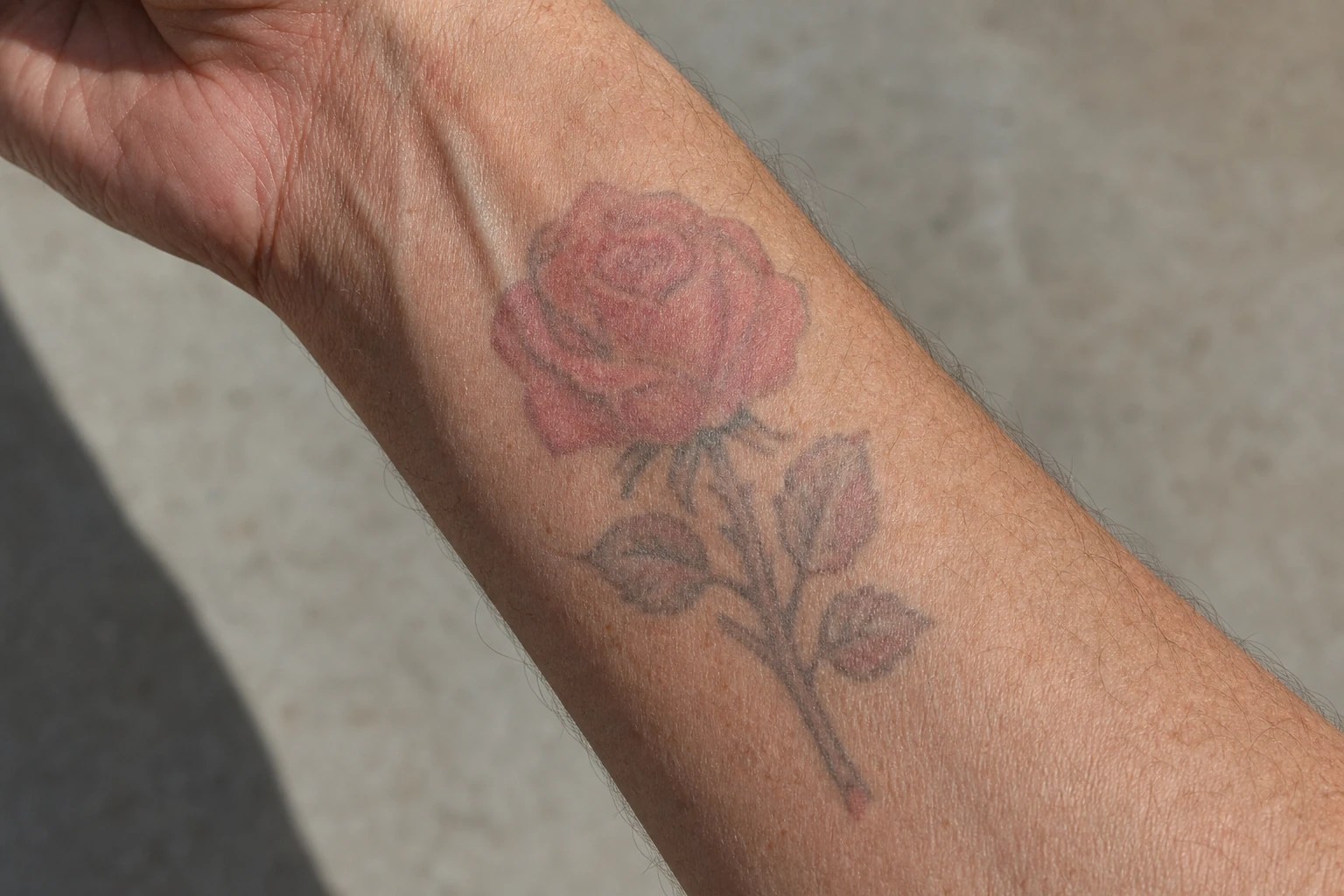 An aged red-ink tattoo — red responds best to a 532nm laser.
How to read a low price honestly
A cheap quote isn't automatically a bad one. Price transparency in this market is genuinely patchy: only about 38% of the clinics in our directory publish any price at all (as of July 2026), and where they do, per-session prices start from around $50. So a low headline number often just reflects a small tattoo, a local market with lower operating costs, or a clinic that lists a "from" price for its simplest case.
Cheap becomes a concern only when it travels with the red flags above — no patch test, no medical oversight, a "guarantee", or equipment the clinic won't name. The move isn't "avoid the cheapest"; it's "understand why it's cheap." Ask what the price includes, whether it's per session or a course, and what a realistic total looks like for your tattoo. For how session count and colour drive the real number, see our guide on whether laser tattoo removal is safe and what affects results.
Pre-screen before you book — that's what a directory is for
Every question above is easier to answer when you've already narrowed the field. That's the practical advantage of an independent directory over a single clinic's website: it shows you laser type, ratings and review counts side by side, so you can shortlist two or three clinics that already clear the basics before you spend an afternoon on consultations.
Because per-session prices and equipment vary widely even within one city, comparing is worth the time. Compare tattoo removal clinics in your city to pre-screen on what matters, or start with a busy market like Melbourne to see the spread in one place. No clinic pays to rank higher here, and no leads are sold — the listings are a map, not an endorsement.
This is general information, not medical advice. Choices about laser tattoo removal — including whether it's suitable for your skin and ink — should be made with a licensed provider who has examined your tattoo.
Frequently asked questions
How do I choose a good tattoo removal clinic?
Prioritise four things: a trained operator working under medical supervision, a laser matched to your ink colour and skin tone, a mandatory patch test before your first full session, and honest, no-guarantee expectations. Ask to see the clinic's own before-and-after photos, and compare a few clinics before you book rather than taking the first quote.
What questions should I ask a tattoo removal clinic?
Ask about the operator's training and medical oversight, the laser make and wavelengths they use, their experience with your skin tone and ink colours, whether they run a patch test, a realistic session estimate, the total cost for a full course (not just per session), and what happens if your tattoo stops fading. A clinic that answers all of these plainly is a good sign.
What are the red flags of a bad tattoo removal clinic?
Major red flags include a promise of "100% removal guaranteed", no patch test offered, refusing to show their own before-and-after photos, high-pressure sales or a contract signed on the spot, no medical supervision, and a price that is unusually cheap without a clear reason. Any one of these is a reason to slow down and compare other clinics.
Should a tattoo removal clinic do a patch test first?
Yes. A patch (or test) spot treats a small area of the tattoo to check how your skin reacts before committing to full sessions. Dermatology guidance supports test-spot treatment, and a clinic that skips it is skipping a basic safety step. It is a reasonable thing to ask for and a reasonable reason to choose one clinic over another.
Is a cheaper tattoo removal clinic worse?
Not necessarily. Only about 38% of the clinics in our directory publish any price at all (as of July 2026), with per-session prices starting from around $50, so a low headline figure can simply reflect a smaller tattoo or a local market. Cheap becomes a concern when it comes with no patch test, no medical oversight, or a "guarantee" — judge the whole picture, not the number alone.
Can a tattoo removal clinic guarantee my tattoo will be completely removed?
No. Reputable providers and dermatology bodies are clear that complete removal cannot be guaranteed — results depend on ink colours, ink depth, your skin tone, the tattoo's age and your immune response. Any clinic advertising "guaranteed 100% removal" is overstating what the technology can promise, which is itself a warning sign.
How many tattoo removal clinics should I compare before booking?
There is no fixed number, but comparing at least two or three clinics in your city is sensible, because per-session prices and laser equipment vary widely even within one city. An independent directory lets you pre-screen on laser type, ratings and review counts before you spend time on consultations.
Related guides
Related Guides
- Choosing Removal
Tattoo Regret: You Have More Options Than You Think
Regret a tattoo? You're not alone — about 24% of tattooed people do. Your real options: accept, rework, cover up or remove — and why not to decide too fast.
- Choosing Removal
Tattoo Removal Methods Compared: What Works in 2026
Laser, saline, excision, dermabrasion, acid, creams — every tattoo removal method compared on sessions, cost, scarring and colour, by an independent directory.
- Choosing Removal
Surgical Tattoo Removal: When Cutting It Out Beats Laser
Surgical tattoo removal cuts out the inked skin in one or a few visits, regardless of colour — but always leaves a scar. When it beats laser, explained.