How Your Immune System Removes Tattoo Ink (2026)
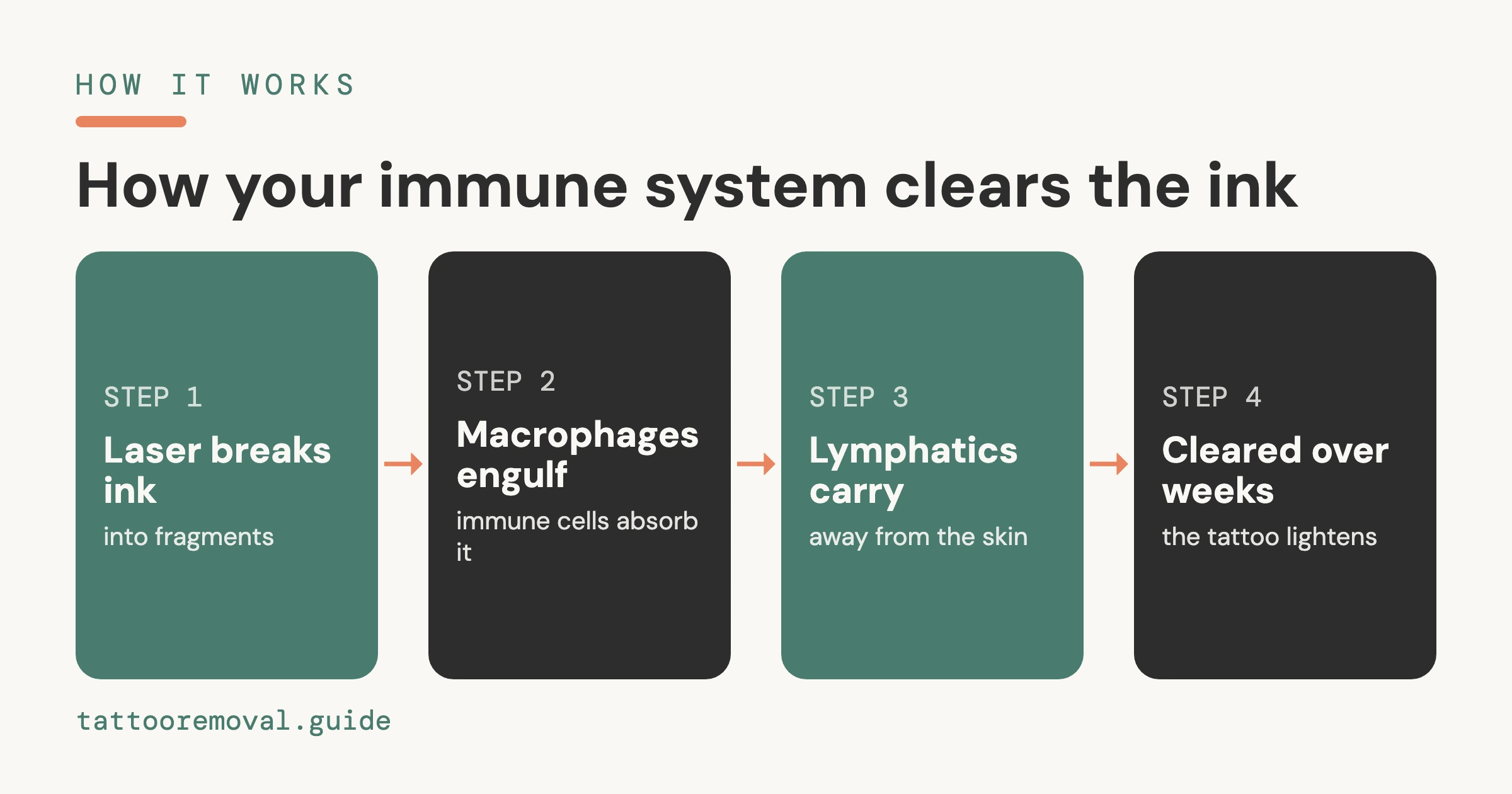
Your immune system removes tattoo ink through a two-step biological process: a laser first shatters the ink into microscopic fragments, then immune cells called macrophages engulf those fragments and carry them into your lymphatic system, which filters and clears the pigment over the following weeks. The laser never removes ink — it only breaks it small enough for your body to do the work. That single fact explains why removal is gradual and why it takes many sessions.
This guide walks through the mechanism step by step, why the biology forces sessions weeks apart, where the ink ultimately ends up, and what genuinely helps clearance — using medical sources and figures from the Tattoo Removal Guide directory, stamped (as of July 2026).
Key Takeaways
- The laser shatters ink; macrophages (immune cells) engulf the fragments and carry them into the lymphatic system for clearance. Removal is a biological process, not an erase button.
- Clearance takes time, which is why sessions are spaced 6–8 weeks apart and full removal spans months to years.
- Ink ends up filtered through the lymph nodes and gradually excreted; some pigment can remain lodged there — "gone from the skin" isn't always "gone from the body".
- Macrophage recapture — dying macrophages hand their pigment to fresh ones — is why tattoos are so stable, and why removal is a repeated shatter-and-clear cycle.
- Healthy circulation and general health support clearance; smoking and poor circulation are associated with slower fading. Across the 5,700 clinics we track across 1,043 cities (as of July 2026, average rating 4.79★), about 18% note picosecond lasers and 15% note Q-switched — both shatter ink for the same immune-driven clearance.
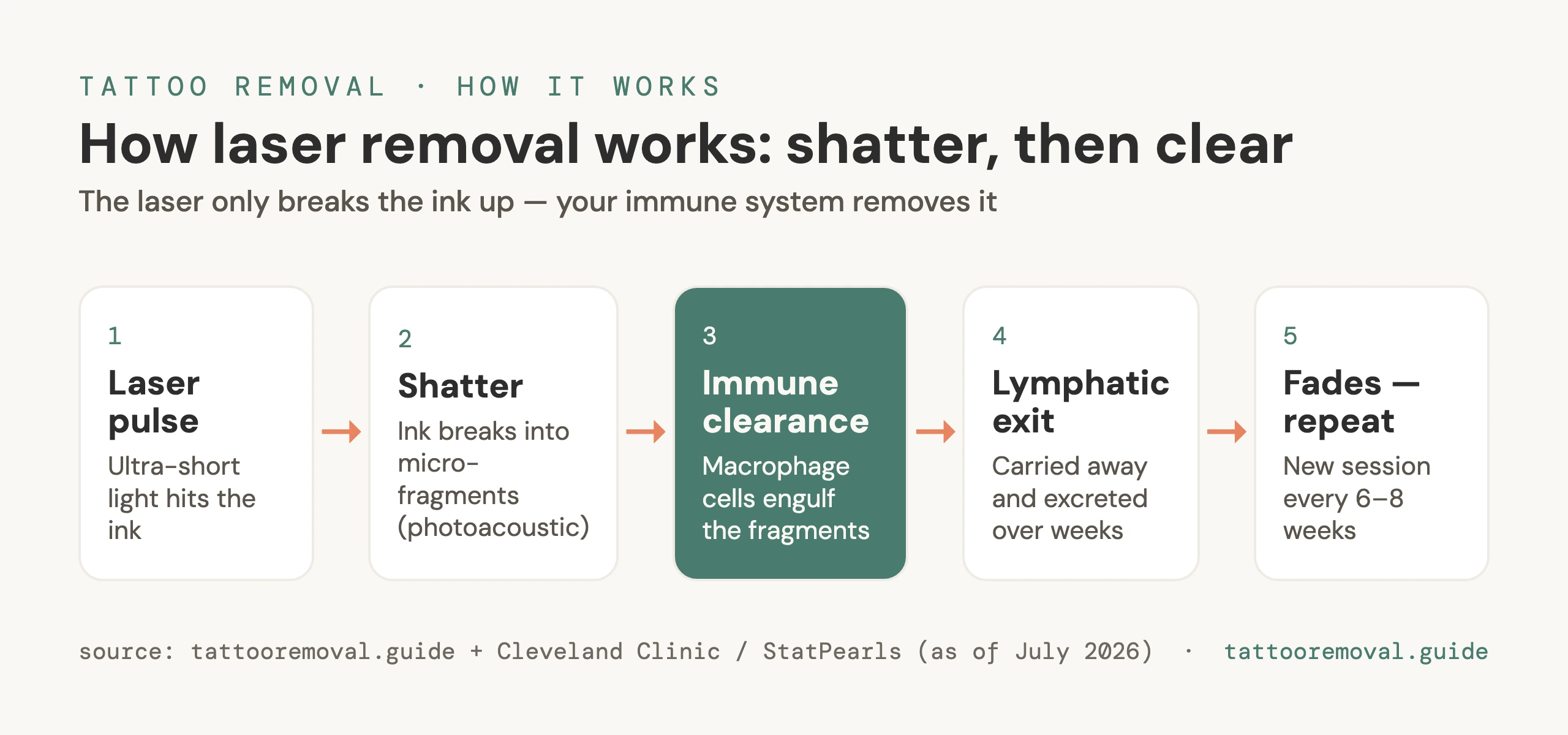 The laser shatters ink; your immune system then clears the fragments.
The mechanism: your immune system is the remover
A macrophage is a type of white blood cell whose job is to engulf and dispose of foreign particles, dead cells and debris. When you get a tattoo, ink is deposited in the dermis — the deeper skin layer. Your immune system immediately recognises the pigment as foreign and sends macrophages to clear it. They engulf what they can, but tattoo ink particles are simply too large to be carried away, so the macrophages park around them, holding the pigment in place. That standoff is exactly why a tattoo is permanent: the ink is trapped, not accepted.
Laser removal exploits this. As the Cleveland Clinic explains, the laser breaks the ink into smaller pieces that the body can then absorb and eliminate. The laser's only job is to shrink the particles to a size your macrophages can move. Once shattered, the fragments are engulfed and ferried into the lymphatic system — the network of vessels and nodes that drains fluid and filters waste — which transports them away over the following weeks. The StatPearls clinical reference describes the same sequence: selective absorption by the pigment, fragmentation, and then immune-mediated clearance between treatments.
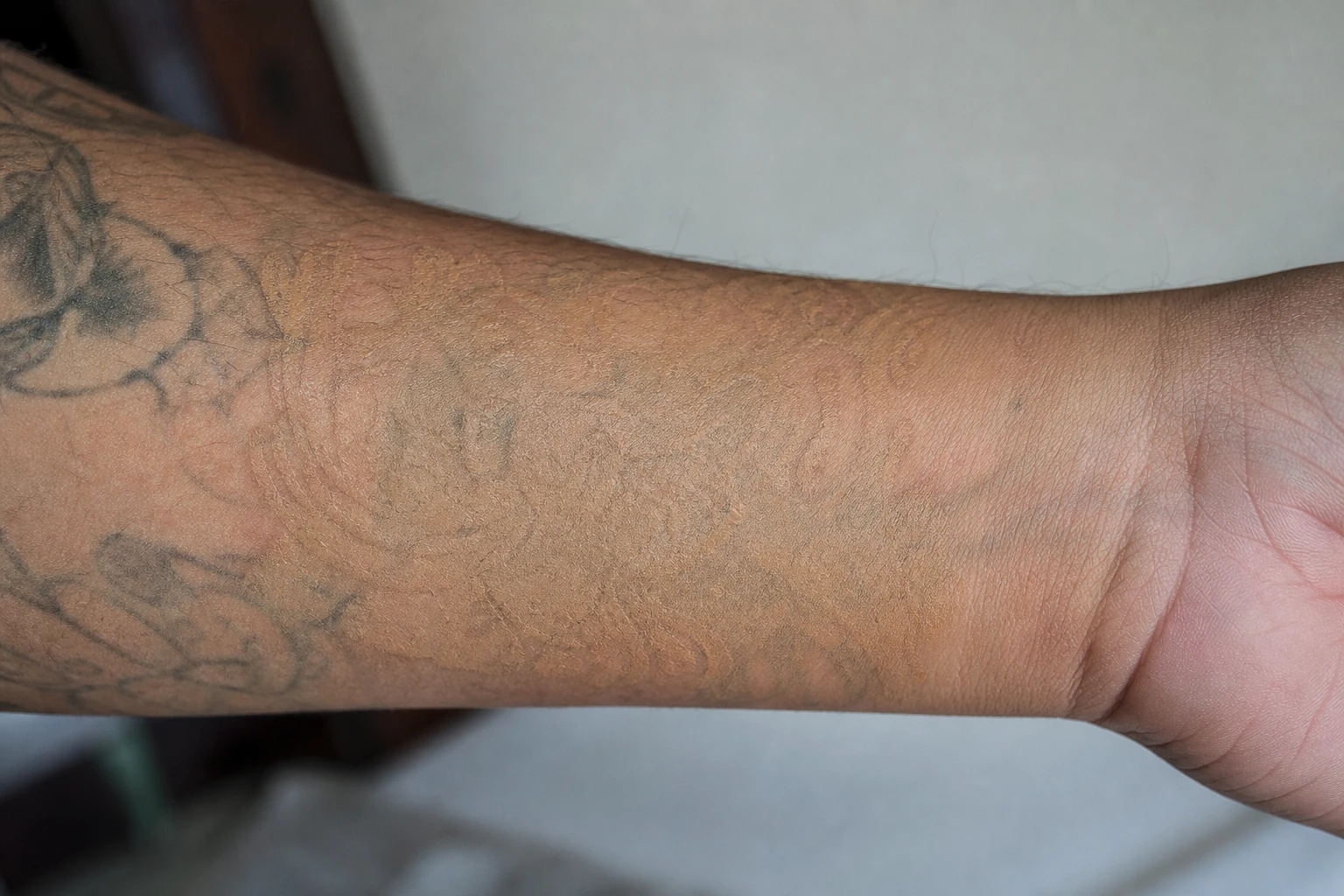 A forearm tattoo during removal.
What happens at each stage
Removal is a chain of events, each of which has to finish before the next can start. Here is the sequence for a single session:
| Stage | What happens | Roughly how long |
|---|---|---|
| 1. Laser hit | Ultra-short light pulses are absorbed by the ink and heat it instantly | A fraction of a second |
| 2. Fragmentation | The pulse arrives as a shockwave that mechanically fractures the ink into microscopic pieces (a photoacoustic effect) | Instant, during the pass |
| 3. Macrophage uptake | Immune cells recognise and engulf the now-small fragments | Hours to days |
| 4. Lymphatic transport | Ink-laden macrophages and lymph fluid carry the pigment toward the lymph nodes | Days to weeks |
| 5. Clearance | The lymph nodes filter the pigment; some is broken down and excreted over time | Weeks — the bottleneck |
Stages 1 and 2 are the laser's entire contribution, and they're over almost instantly. Everything after — stages 3 to 5 — is your immune system, and that's where the real time goes. This is why the visible fading between sessions is gradual: you are watching your lymphatic system slowly cart away the shattered ink.
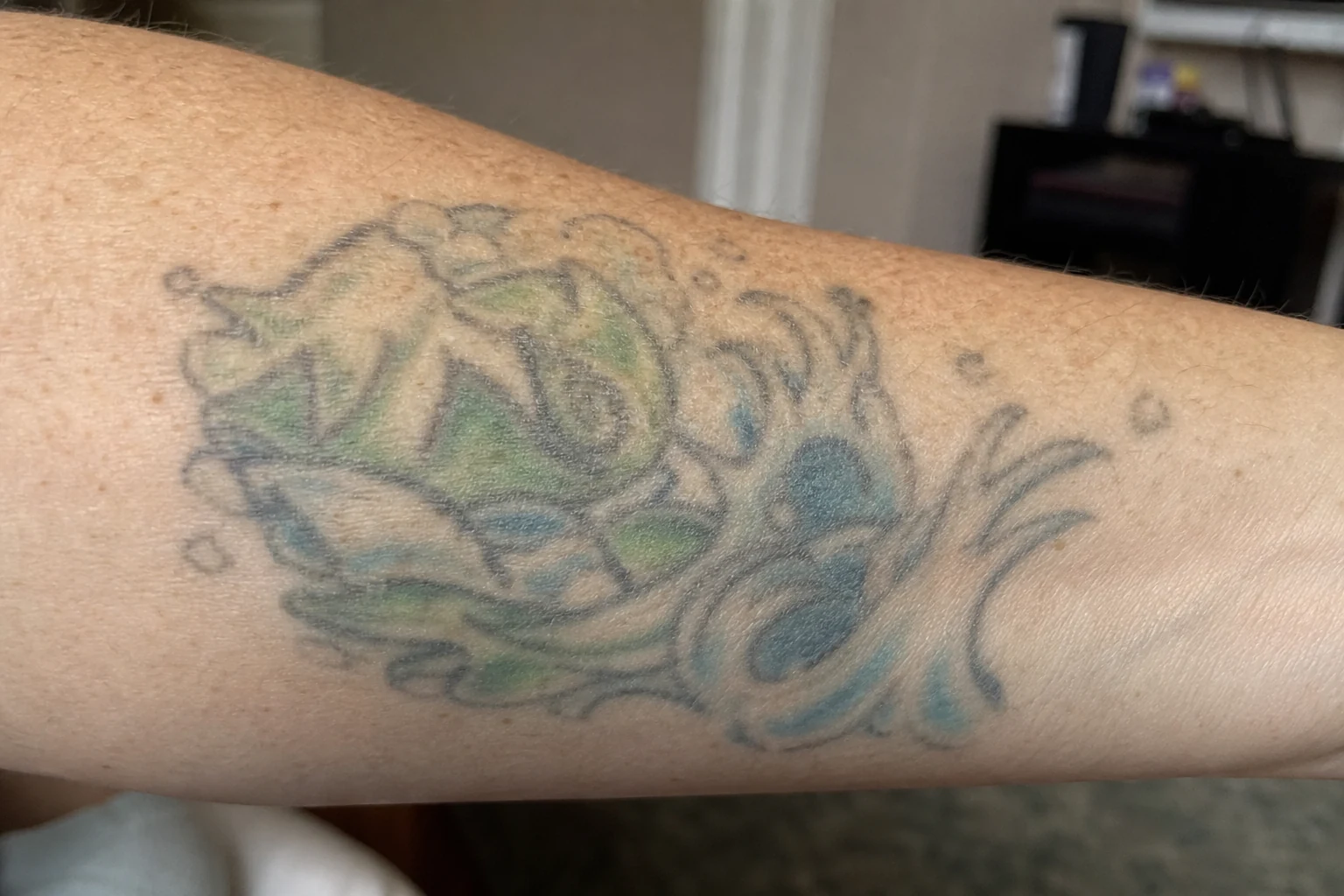 A green tattoo — one of the harder colours to clear.
Why it takes multiple sessions
If the laser shatters ink in a fraction of a second, why can't one session finish the job? Because the immune clearance in stages 3 to 5 is the rate-limiting step, not the laser.
- Each pass only reaches so far. A single treatment shatters the ink the light penetrates to. Ink layered beneath is partly shielded until the top layer has been cleared away.
- Clearance is the bottleneck. After a session, macrophages and the lymphatic system need weeks to transport the fragments out. Fire the laser again before that has happened and you're treating skin still congested with debris — more risk, no faster result.
- Healing must finish first. The skin needs to recover between passes; treating too soon raises the risk of blistering, scarring and pigment change.
The honest name for this interval is the clearing window — the roughly 6–8 weeks the skin and lymphatic system need to heal and flush shattered ink before the next pass. It's a mechanism-driven interval, not a scheduling convenience, and it's why our guide to session spacing and the clearing window treats waiting as part of the treatment, not a delay in it. Some clinicians extend the window for stubborn tattoos, because more waiting often means more clearing per session.
Macrophage recapture: why tattoos are so stubborn
There's a subtlety that explains why ink is so hard to shift. Macrophages don't live forever. When a pigment-loaded macrophage dies, it releases its ink back into the surrounding tissue — and a fresh macrophage promptly moves in and engulfs it again. Researchers call this macrophage recapture: the pigment is endlessly handed from one immune cell to the next, staying put in the skin even as the individual cells turn over. It's a major reason a tattoo looks stable for decades.
For removal, recapture is the enemy of local churn and the reason spacing matters. The goal isn't just to shatter ink but to shatter it small enough — and then give the lymphatic system enough time — that the fragments are carried out of the area rather than simply recaptured by the next macrophage in line. Each session nudges more pigment past that tipping point.
Where the ink ultimately goes
Follow the fragments far enough and they arrive at the lymph nodes, the filtering stations of the lymphatic system. Some pigment is broken down and cleared through the body's normal waste pathways over time. But not all of it leaves. Studies have detected tattoo pigment lodged in lymph nodes, which is why the honest framing is that removal makes the tattoo disappear from the skin — not necessarily from the body entirely.
This is also why both the FDA and the American Academy of Dermatology treat tattoo ink and its removal as a genuine medical matter rather than a purely cosmetic one — the pigment travels through your system. If you want the deeper detail on the lymphatic side, our companion piece on tattoo ink and your lymph nodes covers the evidence, and its limits, honestly.
What helps your body clear ink — and what doesn't
Because clearance runs on macrophage activity and lymphatic transport, general health plays a supporting role. Nothing here is a guarantee, and anyone selling a "flush your ink faster" product is overpromising — but a few things are reasonable, low-risk levers you actually control:
| Helps clearance | Slows clearance |
|---|---|
| Healthy circulation and general fitness | Smoking — associated with poorer, slower fading |
| Good hydration and skin care between sessions | Poor circulation to the treated area |
| Tattoos closer to the heart (better blood/lymph flow) | Tattoos on the extremities — ankles, fingers, feet |
| Following your clinician's spacing | Rushing sessions before clearance finishes |
The pattern is consistent: whatever supports blood and lymph flow tends to support clearance, and whatever impairs it — smoking, poor circulation, a location far from the heart — tends to slow fading. For the practical, evidence-based version of this, see our guide to safely speeding up tattoo removal, which sticks to what's actually supported rather than what's marketed.
None of this changes the core biology: removal is your immune system doing a slow, staged job, and the timeline reflects how fast your body can carry shattered ink away — not how powerful the laser is.
This is general information, not medical advice. Laser tattoo removal is a medical procedure with real risks (blistering, scarring, pigment change). How quickly your body clears ink, and your final result, vary by person and tattoo — consult a licensed provider for advice about your specific situation.
Compare clinics before you commit
The lasers a clinic actually operates — and how well they shatter your specific ink colours — directly affect how efficiently your immune system can clear the fragments, and therefore how many sessions you'll need. That makes comparing your local options one of the most useful things you can do before booking.
Compare tattoo-removal clinics in your city to see what's available near you, or start with a dense market like tattoo removal in Melbourne to see how listings, lasers and pricing stack up side by side. For the full picture of the mechanism, start with our pillar guide on how laser tattoo removal works.
Frequently asked questions
How does the immune system remove tattoo ink?
After a laser shatters tattoo ink into microscopic fragments, immune cells called macrophages engulf those fragments and carry them into the lymphatic system. The lymph fluid transports the ink-laden cells to the lymph nodes, where they are filtered, and the body gradually clears the pigment over the following weeks. The laser only breaks the ink apart — your immune system does the actual removing.
What are macrophages and what do they do in tattoo removal?
Macrophages are white blood cells whose job is to engulf and dispose of foreign particles and debris. In a fresh tattoo they surround the ink but can't move particles that are too large, so the ink stays put. Once a laser shatters those particles into small enough fragments, macrophages can engulf them and ferry them into the lymphatic system for clearance.
Why does tattoo removal take multiple sessions?
Because clearance is biological, not instant. Each laser pass shatters the ink it can reach, and your immune system then needs weeks to carry those fragments away before the next pass can work on the layer beneath. Sessions are spaced roughly 6–8 weeks apart to give the skin time to heal and the lymphatic system time to clear. Firing sooner doesn't speed clearance and raises the risk of skin damage.
Where does the tattoo ink actually go?
Shattered ink fragments are carried by macrophages and lymph fluid to the lymph nodes, which act as filters. Some pigment is broken down and excreted through normal waste pathways over time; some can remain lodged in the lymph nodes. Research has detected tattoo pigment in lymph nodes, so "gone from the skin" does not always mean "gone from the body" — the visible tattoo fades even when trace pigment persists elsewhere.
What is macrophage recapture in tattoo removal?
Macrophage recapture describes how, when a macrophage holding tattoo pigment dies, a new macrophage moves in and re-engulfs the released ink — keeping the pigment in place. It's part of why tattoos are so stable, and it means removal is a repeated cycle of shattering ink and giving macrophages time to carry the fragments away rather than simply re-capturing them locally.
Does a healthy immune system make tattoo removal faster?
It can help. Removal depends on macrophage activity and lymphatic transport, so good general health and healthy circulation support the clearance process. Factors that impair circulation or immune function — such as smoking or a tattoo located far from the heart on the extremities — are associated with slower fading. None of this is a guarantee, but supporting your body's clearance is the sensible, safe lever you actually control.
Can you speed up how fast your body clears shattered ink?
There's no proven shortcut, and you should be wary of anything sold as one. What's reasonable and low-risk: don't smoke, stay hydrated, keep the area healthy and protected between sessions, and follow your clinician's spacing. These support your immune system's clearance rather than override it. Aggressive claims about "flushing" ink faster are not supported by strong evidence.
Related guides
Related Guides
- How It Works
What Is a Q-Switched Laser for Tattoo Removal? (2026)
A Q-switched laser fires nanosecond pulses to shatter tattoo ink. Here's how Q-switched Nd:YAG, ruby and alexandrite lasers work, and why they're still a gold…
- How It Works
What Is a Picosecond Laser for Tattoo Removal? (2026)
What is a picosecond laser? It fires in trillionths of a second to shatter tattoo ink. How it works, the colours it helps, and why it's not always better.
- How It Works
What Affects How Fast a Tattoo Fades? 8 Factors in Removal Speed
What affects tattoo removal speed? Ink colour, depth, age, body location, skin type, your health, smoking, and cover-ups all matter.