TCA & Acid Tattoo Removal: Does It Work, and Is It Safe? (2026)

TCA and acid tattoo removal works by chemically burning off the upper layers of skin so that ink trapped in the damaged tissue sheds as the skin heals — not by targeting the ink itself. It can lighten some tattoos, but it is imprecise, unpredictable, and carries a high risk of scarring, permanent pigment change, and infection. DIY acid kits sold online are outright dangerous. Laser remains the medical standard.
If you have searched "does TCA remove tattoos," this guide gives you the clear-eyed answer: acid removes ink only as a side effect of wounding your skin, which is exactly why dermatologists reach for laser instead. Below, we explain what TCA is, how acid removal actually works, why it is riskier than the alternatives, and why at-home acid kits should never touch your skin. Figures from the Tattoo Removal Guide directory are stamped (as of July 2026).
Key Takeaways
- TCA (trichloroacetic acid) is a chemical peel, not an ink-targeting tool. It removes tattoos only by injuring the skin so ink sheds with the damaged tissue.
- The method is imprecise and works by controlled wounding, so scarring, hypopigmentation, hyperpigmentation, and infection are common risks — not rare ones.
- DIY acid tattoo-removal kits are dangerous and are a documented cause of chemical burns and permanent injury. Never use one.
- Laser is the medical standard because it targets ink selectively and largely spares surrounding skin — the opposite of how acid works.
- Some clinics offer acid removal (often for small or shallow work, or where laser isn't available), but the 5,700 clinics we track across 1,043 cities (as of July 2026) are overwhelmingly laser.
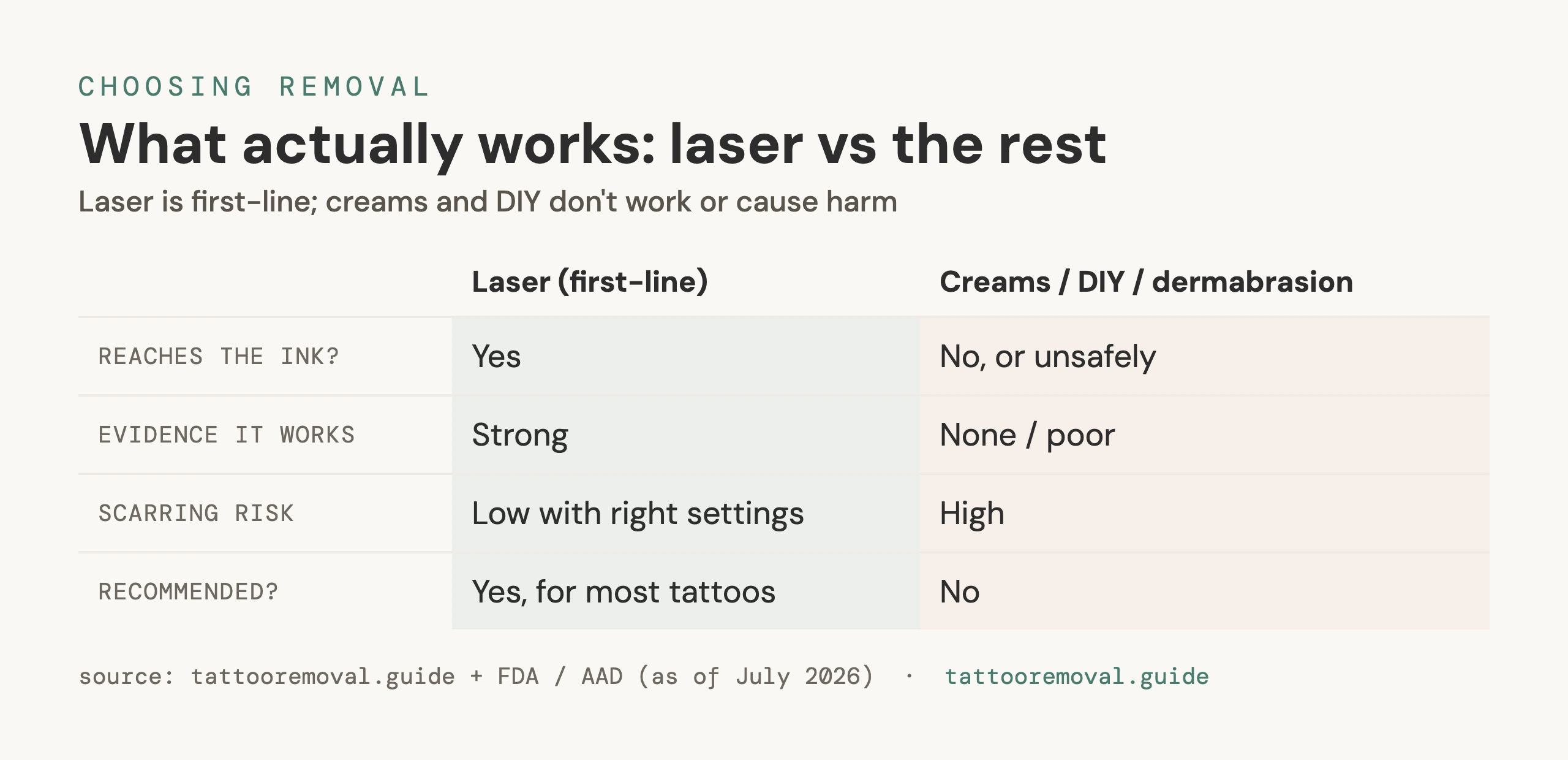 The main tattoo removal methods, side by side.
What is TCA, and how does acid tattoo removal claim to work?
TCA is trichloroacetic acid, a strong acid used in dermatology as a chemical peel — it destroys skin cells on contact, causing the treated layers to die, scab, and slough off so fresh skin regenerates underneath. At low strengths it is used cosmetically for fine lines and pigmentation; at the depths implied for tattoo work, it reaches well into the skin.
Acid tattoo removal claims to work by applying TCA (or similar acids) over a tattoo to deliberately injure the epidermis and part of the dermis where the ink sits. The theory: as that wounded tissue forms a scab and sheds over the following weeks, a portion of the trapped ink leaves with it. Repeat the process, and each round is meant to lift a little more pigment.
Notice what that mechanism is not doing. Unlike laser — which, as the Cleveland Clinic describes, breaks ink into fragments small enough for your immune system to carry away — acid does not distinguish ink from skin at all. It removes pigment purely as a by-product of destroying the tissue that holds it. That distinction is the whole story of why it is riskier.
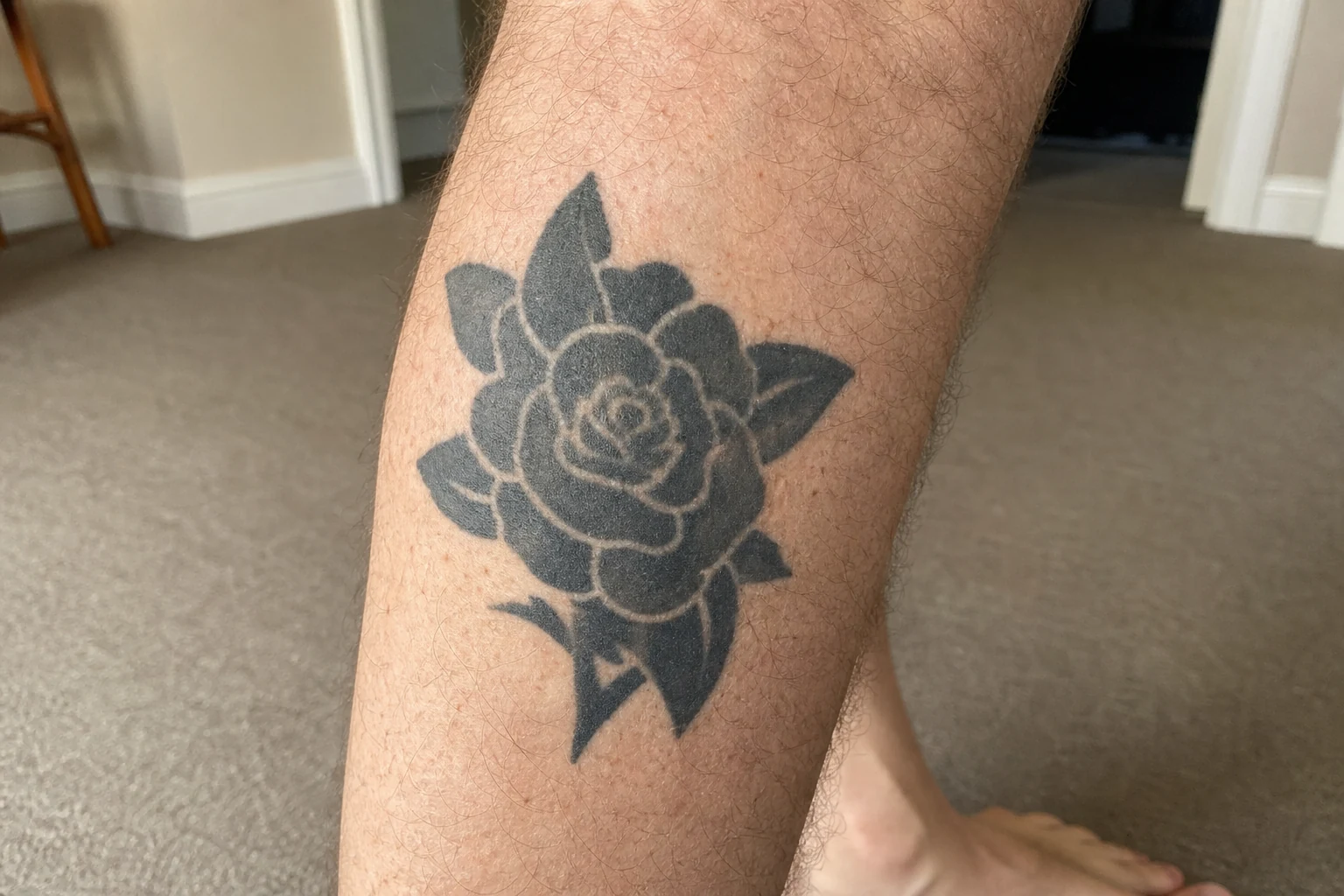 Darker skin is treated at 1064nm to protect its pigment.
The reality: imprecise, unpredictable, and high-risk
Here is the honest picture. Because acid removal relies on controlled wounding, the result depends entirely on how deep the acid bites — and skin does not respond to acid with the neat precision a laser offers. Too shallow and the ink stays; too deep and you scar. The margin between "some ink lifted" and "permanent skin damage" is narrow and hard to judge, even for a trained practitioner.
That imprecision translates into a real and elevated risk profile:
- Scarring and textural change — the most common and permanent downside, because you are intentionally injuring the dermis.
- Hypopigmentation and hyperpigmentation — the healed skin can end up lighter or darker than the surrounding area, a risk that is higher on deeper skin tones.
- Infection — any open, scabbing wound is an entry route for bacteria; the FDA links tattoo procedures to infection risk, and the same logic applies to any method that breaks the skin.
- Incomplete, patchy removal — because the acid works non-selectively, ink often lifts unevenly, leaving a faded, mottled result rather than clean skin.
None of this comes with a guarantee. No responsible provider — using any method — can promise complete removal or a scar-free outcome before assessing your specific tattoo and skin. With acid, the odds of an imperfect cosmetic result are simply higher than with laser.
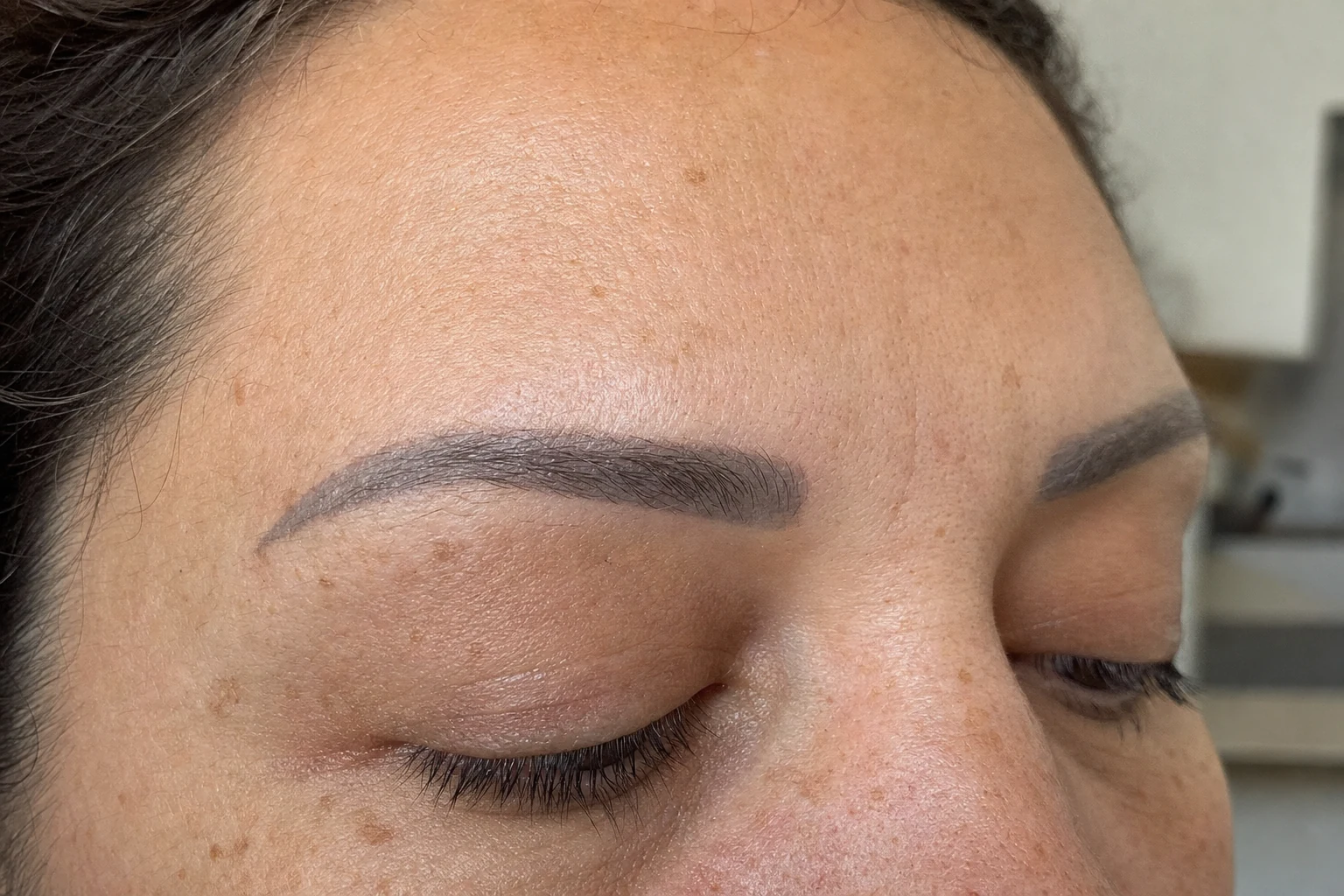 A tattoo undergoing laser removal.
TCA/acid vs laser vs saline: an honest comparison
Acid is one of three broad removal routes people encounter. They are not equivalent — they differ most in how selective they are, and selectivity is what protects your skin.
| Factor | TCA / acid removal | Laser removal | Saline removal |
|---|---|---|---|
| How it works | Chemically burns skin layers; ink sheds with the damaged tissue | Light shatters ink particles; the immune system clears them | Osmosis draws pigment up through a scab |
| Precision | Low — destroys skin indiscriminately | High — selectively targets ink, largely sparing skin | Low–moderate — lifts pigment physically |
| Scarring risk | High — works by wounding the dermis | Lower — no open wound by design | Moderate — creates a deliberate open wound |
| Best suited to | Rarely first-line; sometimes small/shallow work | All sizes, especially larger body tattoos | Cosmetic/PMU and small tattoos |
| DIY danger | Severe — home acid kits cause chemical burns | Not sold for legitimate home use | Severe — home salt abrasion scars and infects |
| Standing | Not the medical standard | The medical standard | Legitimate niche (mainly cosmetic) |
The pattern in that table is the point. Laser is preferred precisely because it is selective; acid sits at the opposite end, removing ink only by damaging everything around it. As StatPearls notes in its review of laser tattoo removal, lasers work through selective photothermolysis — targeting the ink's pigment while sparing surrounding tissue. Acid has no equivalent mechanism for sparing your skin, which is the paradox at the heart of this method: it removes ink by damaging skin, and that is exactly why dermatologists don't reach for it first.
The DIY warning: never use an acid tattoo-removal kit at home
This is not a nuance — it is a hard line. Do not buy or use at-home TCA or acid tattoo-removal kits. They are widely sold online as cheap, needle-free shortcuts, and they are one of the most dangerous removal products on the market.
Applying acid to your own skin means guessing at the concentration, the depth, and the timing — with no sterile environment and no way to stop the burn once it goes too far. The predictable results are chemical burns, permanent scarring, pigment loss, and infection, frequently with little to show for it on the actual tattoo. A faded tattoo surrounded by scar tissue is a far worse outcome than the tattoo you started with, and it is much harder to treat afterwards. If you are genuinely considering a chemical method, the only safe version is one performed by a licensed provider who can assess your skin first — never a kit you apply yourself.
Where acid removal actually shows up — and why laser wins
Some clinics do offer acid or chemical removal, most often for small or shallow work, for lightening ahead of a cover-up, or in settings where laser equipment simply isn't available. It is not a fringe impossibility; it is a legitimate-but-secondary option in specific hands.
But it remains the exception, not the rule. The American Academy of Dermatology's guidance on tattoos reflects the mainstream dermatological view that laser is the established route to remove unwanted ink safely, including colours once considered difficult. Across the 5,700 clinics we track in 1,043 cities (as of July 2026), the overwhelming majority of tattoo-removal capacity is laser — so if you want the widely recommended standard, it is also by far the most available.
TRG's stance is deliberately clear: acid removal is real, and in the right clinical hands it has a narrow place, but it is riskier and less predictable than laser, and the DIY version is genuinely unsafe. Match the method to the evidence, not to the cheapest shortcut.
This is general information, not medical advice. TCA, acid, laser, and saline tattoo removal are all procedures with real risks (chemical burns, scarring, pigment change, infection). Outcomes, session counts, and timelines vary by person, ink, and skin, and no method can guarantee complete or scar-free removal — consult a licensed provider about your specific situation.
Compare your options before you commit
Because laser is the medical standard and by far the most available method — and because acid removal is riskier and DIY acid kits are dangerous — the most useful next step is to see what laser providers exist where you live and ask each one to assess your specific tattoo.
Compare tattoo-removal clinics in your city to find providers near you, or start with a dense market like tattoo removal in Melbourne to see how services and pricing stack up side by side. For the full landscape, read our pillar on every tattoo-removal method compared, or go deeper on the non-laser routes in laser vs saline tattoo removal.
Frequently asked questions
Does TCA remove tattoos?
TCA can lighten some tattoos over multiple treatments, but it does not selectively target ink. Trichloroacetic acid is a chemical peel that burns off the upper skin layers so that ink held in the damaged tissue sheds as the skin heals. It is imprecise, unpredictable, and carries a high risk of scarring and permanent pigment change — which is why dermatologists treat laser, not acid, as the medical standard.
What is TCA tattoo removal?
TCA tattoo removal is a chemical-peel method that applies trichloroacetic acid to the skin over a tattoo to deliberately injure the epidermis and part of the dermis. As that wounded tissue scabs and sheds, some ink trapped in it leaves with it. Because the acid destroys skin indiscriminately rather than shattering ink like a laser, it removes pigment only as a side effect of wounding the skin.
Is TCA or acid tattoo removal safe?
It is higher-risk than laser removal. Even performed in a clinic, acid removal wounds the skin non-selectively, so scarring, hypopigmentation, hyperpigmentation, and infection are all common outcomes. DIY acid kits sold online are especially dangerous and cause chemical burns and permanent injury. This is general information, not medical advice — consult a licensed provider before considering any removal method.
Can I use a TCA tattoo removal kit at home?
No. Do not use at-home acid or TCA tattoo-removal kits. Applying acid to your own skin without controlled concentration, depth, or sterile technique routinely causes chemical burns, permanent scarring, pigment loss, and infection — often while barely lightening the tattoo. Home acid kits are one of the most dangerous removal shortcuts marketed online. If you are set on a chemical method, only a licensed provider should ever perform it.
Why do dermatologists prefer laser over acid?
Because laser is selective and acid is not. A laser targets ink particles with specific wavelengths and shatters them so the body clears them internally, largely sparing surrounding skin. Acid removes ink only by destroying the skin that holds it, so the damage and the result are far harder to control. That difference — selective targeting versus indiscriminate wounding — is why laser is the medical standard and acid is not.
Does acid tattoo removal leave a scar?
It often can. Because acid removal works by controlled wounding of the skin, scarring, textural change, and hypo- or hyperpigmentation are common risks rather than rare complications, especially on deeper or larger tattoos and on darker skin tones. No method can guarantee scar-free removal, but acid carries a notably higher scarring risk than laser. A licensed provider can assess your specific skin and tattoo.
Where can I get tattoo removal instead?
Laser is the widely recommended standard and the most available option. You can compare laser tattoo-removal providers in your city through the Tattoo Removal Guide directory, which tracks 5,700 clinics across 1,043 cities (as of July 2026). A consultation lets a provider assess your ink, skin, and goals and give a realistic, personalised plan rather than a one-size-fits-all promise.
Related guides
Related Guides
- Methods & Decisions
Tattoo Removal vs Cover-Up: Which Is Right for You? (2026)
Tattoo removal vs cover-up: removal wins if you want bare skin or a clean canvas; a cover-up wins if you want new art fast. Plus the hybrid path — and how to decide.
- Methods & Decisions
12 Questions to Ask at a Tattoo Removal Consultation (2026)
The 12 questions to ask at a tattoo removal consultation — on credentials, the laser, the plan, safety and cost — plus a green-flag vs red-flag answer table.
- Methods & Decisions
Laser vs Surgical Tattoo Removal: Which Is Right? (2026)
Laser vs surgical tattoo removal: laser is the standard for most tattoos (no cutting, minimal scarring); surgery is faster but always leaves a scar and only suits…