12 Questions to Ask at a Tattoo Removal Consultation (2026)

A tattoo removal consultation is your chance to check five things before you commit: who operates the laser and their training, which laser and wavelengths the clinic uses, a realistic session range for a tattoo like yours, the safety steps (patch test, numbing, aftercare), and the true cost of a full course. A good clinic answers all of these openly and in ranges — evasiveness or exact promises are the warning signs.
You are allowed to interview the clinic. Removal is a medical procedure you'll return to many times, so the consultation is a two-way assessment, not a sales pitch you have to sit through. The questions below are grouped by theme so you can bring them on your phone and work through them — and because we're an independent directory, not a clinic, this checklist is built to be used across clinics, so you can compare answers rather than take the first quote.
Key Takeaways
- Group your questions into five themes: credentials, the device, the plan, safety, and cost — and expect ranges, not guarantees.
- The best signal isn't a perfect answer; it's openness. A clinic that explains trade-offs honestly beats one that promises exact sessions or "100% removal."
- Ask for a patch test and disclose your skin tone and medications — both change the laser settings and the risks.
- Ask the cost of a full course, not just one session. In the TRG directory, 27% (1,525) of the 5,700 clinics we track advertise a free consultation (as of July 2026) — a good place to start comparing.
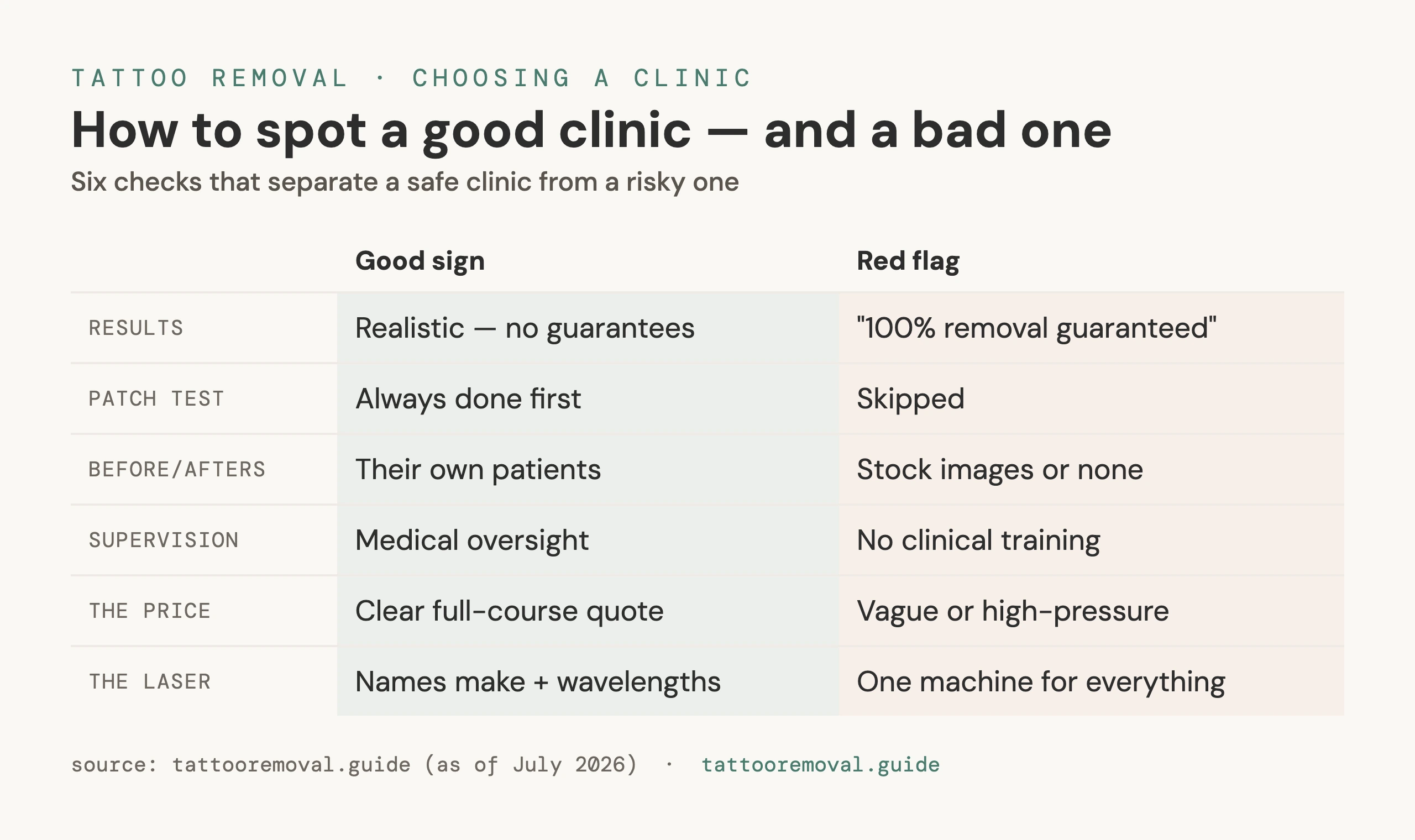 A good clinic answers openly and gives ranges, not promises.
The 12 questions, grouped by theme
Bring these to the consultation. How the clinic answers tells you as much as what it answers.
Credentials and experience (who's holding the laser)
- Who actually performs the treatment, and what's their training? You want a trained laser operator — often a nurse, doctor or a technician with accredited laser-safety training — not someone learning on your skin. The American Academy of Dermatology recommends seeing a qualified provider for laser tattoo removal.
- Is there medical oversight, and how much experience do you have with my skin tone? Darker skin tones carry a higher risk of temporary pigment change and need careful settings. Ask directly whether the operator routinely treats skin like yours — and, if your ink is cosmetic (eyebrows, lips, permanent makeup), whether they've handled PMU, which behaves differently.
- Have you treated ink colours like mine before? Black clears most predictably; greens, blues and some reds are more stubborn. A clinic that's candid about which of your colours are difficult is being honest, not negative.
The device (the right laser for your ink)
- Which laser make and wavelengths do you use — and do they cover my colours? Different colours respond to different wavelengths, so the clinic should name its device and confirm it has the wavelengths your ink needs. Laser tattoo removal is the selective breaking up of tattoo ink with short pulses of light that the body then clears over weeks — the wrong wavelength simply won't target certain colours well.
- Is that laser suited to my skin type? The same device is run at different settings for different skin tones. Ask how they'll adjust for yours, and whether they use any skin-cooling to protect the surrounding area.
The plan (realistic expectations)
- What's a realistic session range for a tattoo like mine — and how far apart? Expect a range (for example, "most tattoos like this take several sessions"), not a fixed promise. Sessions are typically spaced weeks apart to let your skin recover and the ink clear. Our sibling guide on how many sessions it takes explains what drives that number.
- What result should I realistically expect — could a faint shadow remain? An honest clinic will tell you that some tattoos fade to invisible while others leave a faint shadow or slight texture change. The FDA notes that complete removal isn't guaranteed and results vary — hearing that at the consult is a good sign, not a bad one.
- What happens if my tattoo plateaus? Fading can stall. A good clinic explains how it adjusts spacing or settings, or when it would recommend pausing — rather than simply selling more sessions.
Safety (before, during and after)
- Will you run a patch test first? A patch (or test-spot) treatment on a small area checks how your skin reacts before you commit. Cleveland Clinic describes laser removal as a medical procedure with real risks, so a test spot is a reasonable ask.
- What numbing options do you offer, and what side effects should I expect? Ask about pain management (cooling, topical or injected anaesthetic) and the normal side effects — redness, swelling, blistering, scabbing and temporary lightening or darkening of the skin.
- What do I do if I blister or react between sessions? You want written aftercare instructions and a named point of contact. A clinic that has a clear answer for "what if something goes wrong" is a clinic that has seen it before.
Practicalities (cost and the fine print)
- What's the consult fee, the full-course cost, and what happens if I need more sessions than quoted? Ask whether the consultation is free or credited, whether the quote is per session or a course, and how overruns are billed. Because removal takes several sessions, a low per-session figure can still add up — and the quote is an estimate, not a ceiling.
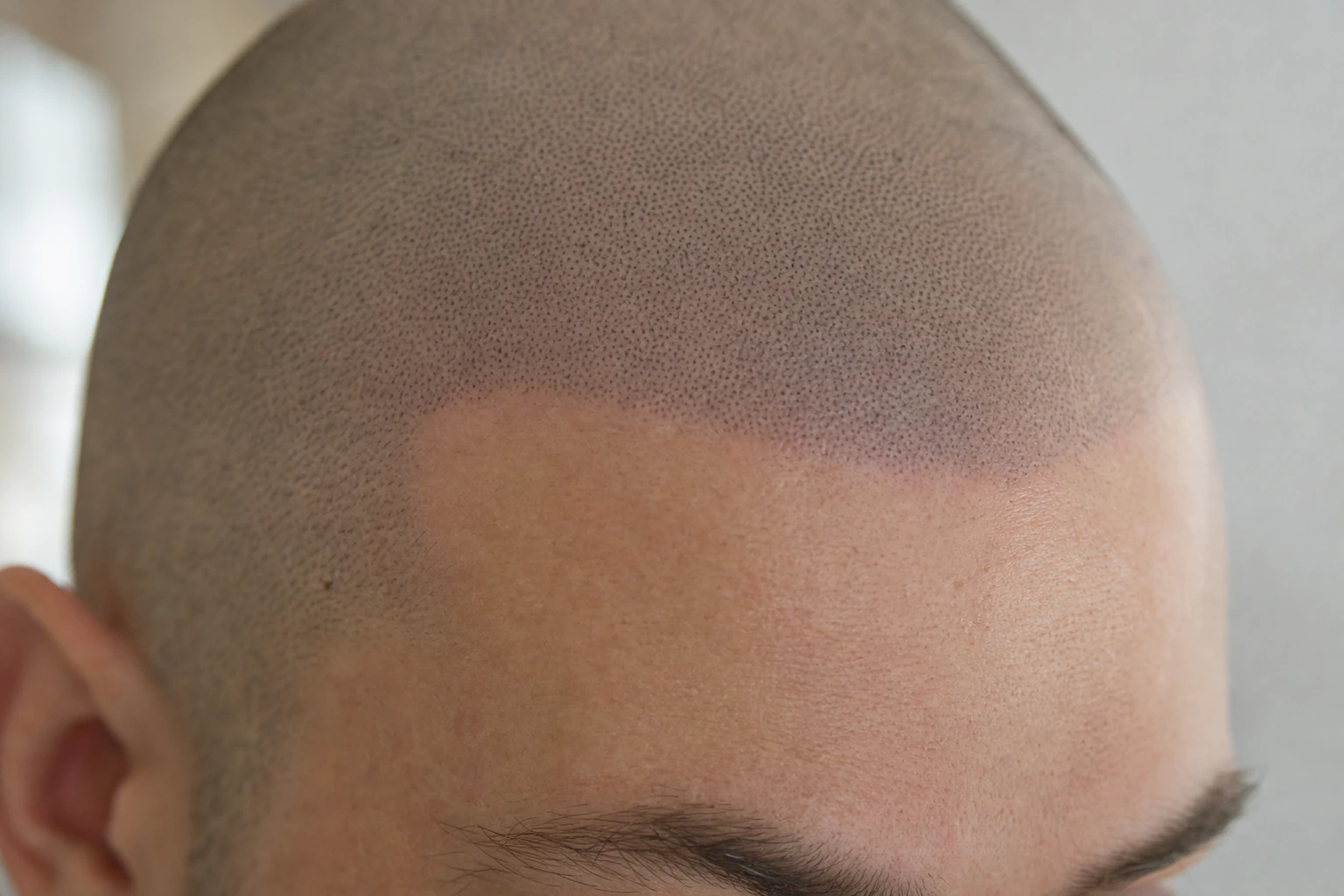 Cosmetic (permanent-makeup) tattooing on the face.
Green-flag vs red-flag answers
Use this to read the quality of an answer, not just its content. The tone and honesty of a reply often reveal more than the facts themselves.
| The question | 🟢 Green-flag answer | 🔴 Red-flag answer |
|---|---|---|
| How many sessions? | "A range — it depends on your ink, skin and how you respond" | "Exactly 5, guaranteed" |
| Will it fully clear? | "Often, but some tattoos leave a faint shadow" | "100% removal, no trace, guaranteed" |
| Which laser? | Names the device and confirms the wavelengths | Vague — "our machine removes everything" |
| Patch test? | "Yes, or here's why we'd handle it this way" | Dismisses the question or refuses |
| Medical oversight? | A doctor or registered nurse supervises | No clinical supervision at all |
| Can I see your results? | Shows their own before-and-afters | Only stock or manufacturer photos |
| Cost? | Clear on consult fee, full course and overruns | Pressure to pay for a package on the spot |
None of these on its own proves a clinic is unsafe — but each red flag is a reason to ask more, and several together are a reason to look elsewhere.
 A tattoo undergoing laser removal.
Bring the checklist, then compare
The point of asking is to compare. Every question above is easier to judge when you've seen how two or three clinics answer it — which is exactly what an independent directory is for. You can pre-screen on laser type, ratings and review counts, then walk into each consultation with the same list and see who answers openly.
Because equipment and pricing vary widely even within one city, comparing is worth the time. Compare tattoo removal clinics in your city to build a shortlist, start with a busy market like Melbourne to see the spread, or read how to choose a clinic for the red flags to weigh alongside these answers. No clinic pays to rank higher here, and no leads are sold — the listings are a map, not an endorsement.
This is general information, not medical advice. Whether laser tattoo removal is suitable for your skin and ink — and how many sessions it may take — should be decided with a licensed provider who has examined your tattoo.
Frequently asked questions
What questions should I ask at a tattoo removal consultation?
Cover five areas: credentials (who operates the laser and what training they have), the device (which laser and wavelengths, and whether it suits your ink colours and skin tone), the plan (a realistic session range, spacing, and whether a faint shadow may remain), safety (patch test, numbing, side effects and what to do if you react), and cost (the consult fee and what happens if you need more sessions than quoted). A good clinic answers all of these openly and in ranges.
What should a tattoo removal clinic tell me about results?
A realistic clinic gives you a session range, not a single guaranteed number, and explains that results depend on ink colour and depth, your skin tone, the tattoo's age and your immune response. It should also be honest that some tattoos leave a faint shadow or slight texture change rather than clearing to bare skin. A promise of exact sessions or 100% removal is a red flag, not reassurance.
Should I get a patch test before laser tattoo removal?
A patch test is a small test-spot treatment on part of the tattoo to see how your skin reacts before committing to full sessions. It is a reasonable safety step to ask for, especially on darker skin tones where the risk of pigment change is higher. A clinic that offers one, or explains why, is showing good practice; one that dismisses the question is worth a second look.
Do I need to tell the clinic my skin tone and medications?
Yes. Your skin tone affects the laser settings and the risk of temporary pigment changes, so an experienced operator will ask about it and adjust. You should also disclose medications, recent isotretinoin use, pregnancy, and any history of keloid scarring or cold sores near the site. This is general information — always confirm suitability with a licensed provider who has examined your tattoo.
How much does a tattoo removal consultation cost?
It varies. Many clinics offer a free consultation — in the TRG directory, 27% of clinics (1,525 of 5,700) advertise one as of July 2026 — while others charge a fee that may be credited toward treatment. Ask upfront whether the consult is free, whether a patch test is included, and whether the quote is per session or for a full course, so you can compare clinics on the same basis.
What are the red-flag answers at a tattoo removal consultation?
Watch for exact promises ("gone in 5 sessions", "100% removal guaranteed"), no patch test offered, vagueness about which laser or wavelengths they use, no medical oversight, pressure to pay for a package on the spot, and refusing to show their own before-and-after photos. Any single red flag is a reason to slow down; several together are a reason to compare other clinics.
What questions should I ask about the laser itself?
Ask which laser make and model they use, which wavelengths it offers, and whether those wavelengths match your ink colours — black responds broadly, but greens, blues and some reds need specific wavelengths. Also ask whether the device and settings suit your skin type. A clinic that names its equipment and explains the match is more credible than one that says "our machine removes everything."
What if I need more sessions than the clinic quoted?
Ask this directly at the consultation. Because tattoos fade at different rates, a quote is an estimate, not a ceiling. Find out whether extra sessions are charged individually, whether a course package covers overruns, and how the clinic handles a tattoo that plateaus. Clear, written answers protect you from an open-ended bill later.
Related guides
Related Guides
- Methods & Decisions
TCA & Acid Tattoo Removal: Does It Work, and Is It Safe? (2026)
Does TCA remove tattoos? Acid removal works by chemically wounding the skin so ink sheds with the damaged tissue — imprecise, high scarring risk, and dangerous as a…
- Methods & Decisions
Tattoo Removal vs Cover-Up: Which Is Right for You? (2026)
Tattoo removal vs cover-up: removal wins if you want bare skin or a clean canvas; a cover-up wins if you want new art fast. Plus the hybrid path — and how to decide.
- Methods & Decisions
Laser vs Surgical Tattoo Removal: Which Is Right? (2026)
Laser vs surgical tattoo removal: laser is the standard for most tattoos (no cutting, minimal scarring); surgery is faster but always leaves a scar and only suits…