Laser vs Surgical Tattoo Removal: Which Is Right? (2026)
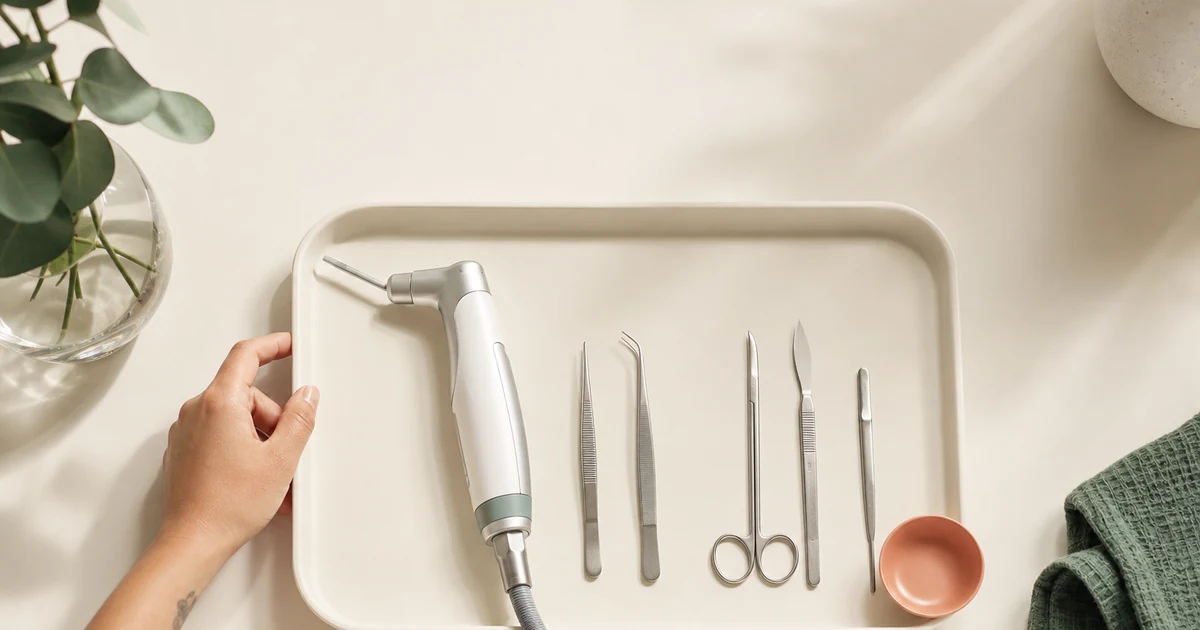
Laser tattoo removal is the standard first-line method for most tattoos: it uses focused light to break up ink with no cutting and minimal scarring when done correctly, across tattoos of any size. Surgical excision — cutting out the tattooed skin and stitching the edges — is faster but always leaves a scar and only suits small tattoos. For most people, laser wins.
This guide compares the two head-to-head — plus dermabrasion, the older non-laser option — so you can match the method to your tattoo rather than to a sales pitch. Figures from the Tattoo Removal Guide directory are stamped (as of July 2026).
Key Takeaways
- Laser is first-line for most tattoos — no cutting, works on tattoos of any size, minimal scarring when performed correctly, but needs multiple sessions over months.
- Surgical excision is faster (one or a few procedures) but always leaves a permanent scar and is only feasible for small tattoos; larger ones may need a skin graft.
- Dermabrasion is an older non-laser method that sands away skin — used rarely today because results are unpredictable and scarring risk is higher.
- Surgery is worth considering for a small tattoo, laser-resistant ink, an ink allergy, or someone who accepts a scar for a definite one-time result.
- The 5,700 clinics we track across 1,043 cities (as of July 2026) are overwhelmingly laser providers, so laser is by far the easier method to find and compare.
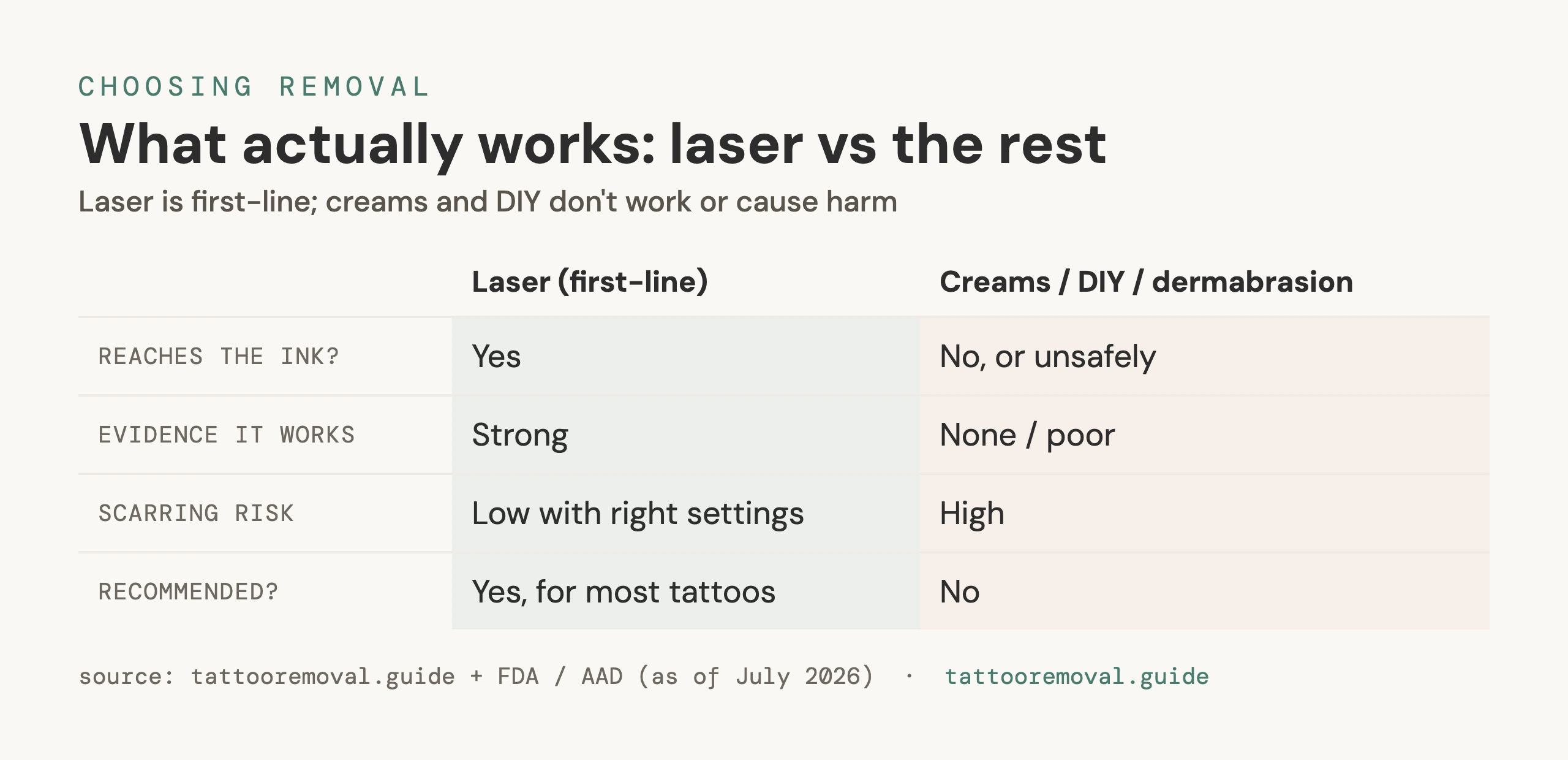 The main removal methods compared — laser is first-line for most tattoos.
What is laser tattoo removal?
Laser tattoo removal is a non-surgical method that uses very short, high-energy pulses of light to shatter tattoo ink into fragments small enough for the body's immune system to carry away. The principle is selective photothermolysis: the laser is tuned so its light is absorbed by the ink but largely spared by the surrounding skin, breaking down the pigment without cutting. The Cleveland Clinic describes how the shattered ink is then cleared internally over the following weeks.
Because nothing is cut out, laser removal leaves minimal scarring when done correctly and works on tattoos of essentially any size. The trade-off is time: ink clears gradually, so a full course takes multiple sessions — typically spaced several weeks apart to let the skin recover and the immune system flush pigment between visits. StatPearls notes that the number of treatments varies with ink colour, depth, density, and age, and complete clearance can never be guaranteed for any tattoo. This is why laser is the standard, first-line approach that dermatologists reach for first.
 Warm yellow/orange ink — among the stubborn colours.
What is surgical tattoo removal?
Surgical tattoo removal — properly called excision — is a procedure in which a surgeon cuts out the tattooed skin with a scalpel and stitches the surrounding edges back together. For a small tattoo, the whole thing can be removed in a single procedure; for a slightly larger one, it may be taken out in stages. If the area is too big to close directly, the surgeon may need a skin graft, taking skin from elsewhere on the body to cover the gap.
The appeal is speed and certainty: the ink is physically gone in one or a few procedures, not a months-long course. The unavoidable cost is a permanent scar or line where the skin was cut and stitched — excision trades a tattoo for a scar. That is why it is reserved for small tattoos and for people who have weighed that trade and accept it. It is a genuine surgical operation, with the usual wound-care, infection, and healing considerations that come with any incision.
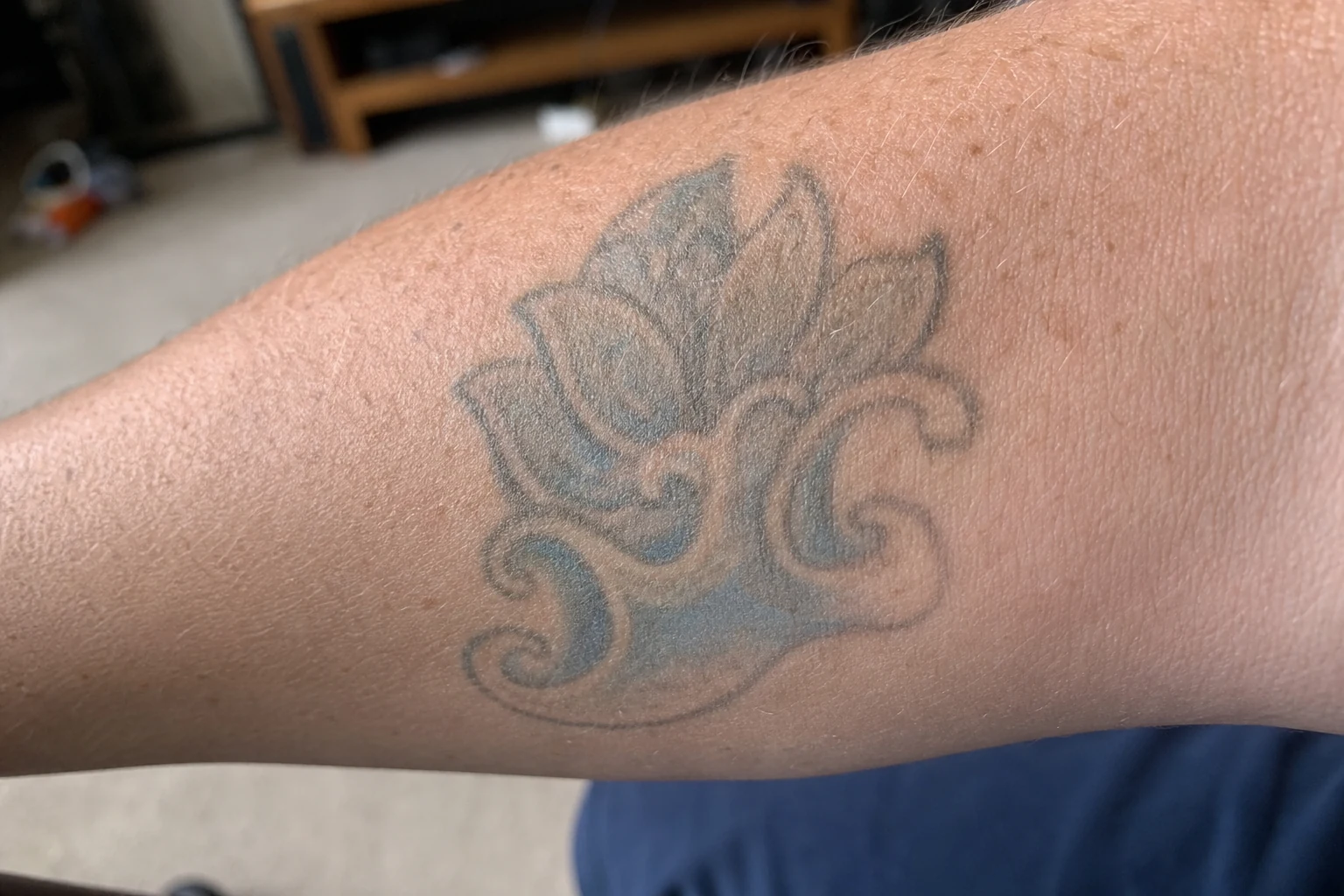 A faint white-ink tattoo.
Laser vs surgical vs dermabrasion: an honest comparison
No method is universally best — they suit different tattoos and different priorities. Here is the honest side-by-side, including dermabrasion, the older non-laser option:
| Factor | Laser removal | Surgical excision | Dermabrasion |
|---|---|---|---|
| How it works | Light shatters ink; the immune system clears it | Surgeon cuts out inked skin and stitches the edges | A rotating device sands away the skin's upper layers |
| Cutting involved | None | Yes — scalpel incision | No — abrasion |
| Typical sessions | Multiple, spaced weeks apart | One or a few procedures | One or more, with long healing |
| Scarring | Minimal when done correctly | Always leaves a scar/line | Higher, less predictable risk |
| Tattoo size it suits | Any size | Small only (grafts for larger) | Small to medium |
| Best for | Most tattoos — the standard | Small ink, laser-resistant ink, ink allergy | Rarely first choice today |
| Speed to finish | Slow (months) | Fast (one/few visits) | Variable |
The single most important row is scarring. Laser aims to remove ink without a scar, while excision removes ink by creating one. That difference — not speed or cost — is usually the deciding factor. The American Academy of Dermatology's guidance reinforces that tattoo removal is a medical procedure best handled by a qualified provider, precisely because the skin's response — scarring, pigment change, reaction — varies from person to person.
When surgical excision is worth considering
For most people, laser is the right starting point. But surgical excision earns its place in a few specific situations:
- The tattoo is small. The wound has to close, so excision is only practical for tattoos a surgeon can cut out and stitch cleanly.
- The ink resists laser. Some pigments — particularly certain colours or dense, layered cover-ups — clear slowly or incompletely with laser. If a course of laser stalls, excision can be a definitive route for a small piece.
- There is an ink allergy or reaction. If someone reacts to the tattoo pigment itself, physically removing the inked skin can resolve the reaction rather than fragmenting the ink and dispersing it, which laser does. This should be assessed by a doctor.
- You want a one-time result and accept a scar. For someone who values a definite finish over avoiding a scar, and whose tattoo is small enough, excision delivers certainty that laser's gradual, guarantee-free course cannot.
Dermabrasion sits in the background here: it was more common before modern lasers, but because it sands away living skin, results are unpredictable and scarring risk is higher, so it is rarely the first recommendation today. Lasers have largely displaced it.
Why laser is first-line for most tattoos
Put simply, laser removal offers the best balance of what most people actually want: it treats any size of tattoo, it aims to leave little or no scar, and it is available almost everywhere. The cost is patience — a full course runs over months, session count depends on the tattoo, and no clinic can promise complete removal. Surgery flips that trade: it is fast and definite, but it is size-limited and it guarantees a scar.
Availability matters too. Of the 5,700 clinics we track across 1,043 cities (as of July 2026) — averaging 4.79★ across the directory — the overwhelming majority are laser providers, while surgical excision is offered by a much smaller set of dermatology and plastic-surgery practices. So even before the clinical trade-offs, laser is far easier to find, compare, and price in your city. Excision is a conversation to have with a dermatologist or plastic surgeon, usually after weighing laser first.
This is general information, not medical advice. Laser removal, surgical excision, and dermabrasion are all medical procedures with real risks (scarring, infection, pigment change). Session counts, timelines, and outcomes vary by person, tattoo, and skin, and no method can guarantee complete removal — consult a licensed provider about your specific situation.
Compare your options before you commit
The most useful next step is to see which methods and providers are actually available near you, then ask each one directly whether laser or excision fits your specific tattoo.
Compare tattoo-removal clinics in your city to find providers near you, or start with a dense market like tattoo removal in Melbourne to see how services and pricing stack up side by side. For the full landscape, read our pillar on every tattoo-removal method compared, or go deeper on the operation itself in surgical tattoo removal.
Frequently asked questions
Is surgical tattoo removal better than laser?
Not for most tattoos. Surgical excision removes ink in one or a few procedures, but it always leaves a permanent scar or line and only works on small tattoos. Laser removal treats tattoos of any size with minimal scarring when done correctly, which is why it is the standard first-line method.
What is surgical tattoo removal?
Surgical tattoo removal, or excision, is a procedure in which a surgeon cuts out the tattooed skin and stitches the surrounding edges back together. Larger tattoos may require a skin graft. It removes ink in one or a few sessions but always leaves a scar, so it suits small tattoos only.
Does surgical tattoo removal leave a scar?
Yes. Surgical excision always leaves a permanent scar or line because the surgeon cuts out and stitches the skin. This is the main trade-off versus laser removal, which usually leaves little or no scarring when performed correctly. Anyone considering excision should accept a scar in exchange for a faster result.
When is surgical tattoo removal a good option?
Surgical excision is worth considering for a small tattoo, ink that resists laser treatment, or an ink allergy, and for someone who accepts a scar in exchange for a definite one-time result. For most people with medium or large tattoos, laser removal remains the more practical and lower-scarring choice.
Is laser or surgical tattoo removal cheaper?
It depends on the tattoo. Laser removal is charged per session and needs several visits, so a full course adds up over months. Surgical excision is fewer procedures but is a surgical operation with a surgeon's fee. Neither is universally cheaper; a consultation gives a realistic estimate for your specific tattoo.
What is dermabrasion for tattoo removal?
Dermabrasion is an older non-laser method that sands away the skin's upper layers with a rotating device so inked skin is gradually removed as the area heals. It is used far less today because results are unpredictable and scarring risk is higher, and lasers have largely replaced it as the standard approach.
Can any tattoo be removed surgically?
No. Surgical excision is only practical for small tattoos, because the surgeon must be able to close the wound after cutting out the inked skin. Larger tattoos would need a skin graft or staged excisions, which most people and surgeons avoid. Laser removal is the realistic option for medium and large tattoos.
Related guides
Related Guides
- Methods & Decisions
TCA & Acid Tattoo Removal: Does It Work, and Is It Safe? (2026)
Does TCA remove tattoos? Acid removal works by chemically wounding the skin so ink sheds with the damaged tissue — imprecise, high scarring risk, and dangerous as a…
- Methods & Decisions
Tattoo Removal vs Cover-Up: Which Is Right for You? (2026)
Tattoo removal vs cover-up: removal wins if you want bare skin or a clean canvas; a cover-up wins if you want new art fast. Plus the hybrid path — and how to decide.
- Methods & Decisions
12 Questions to Ask at a Tattoo Removal Consultation (2026)
The 12 questions to ask at a tattoo removal consultation — on credentials, the laser, the plan, safety and cost — plus a green-flag vs red-flag answer table.