Saline Tattoo Removal: Does It Work, and Is It Better Than Laser?
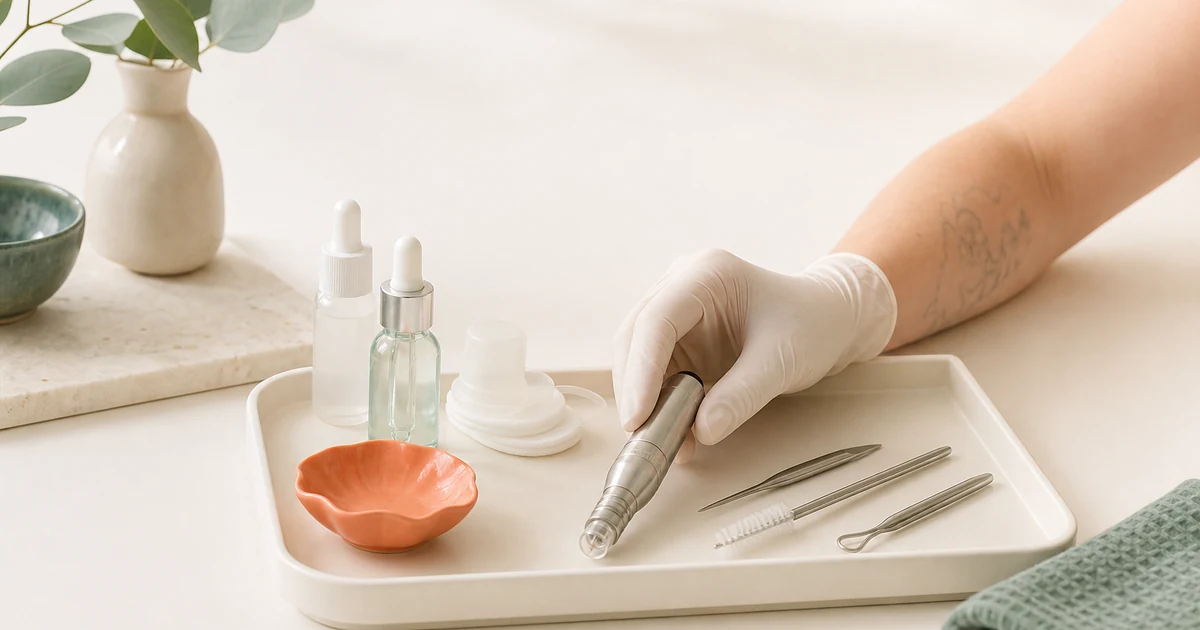
Saline tattoo removal is a real, non-laser method — a technician tattoos a concentrated salt solution into the skin to draw pigment up and out as it scabs and heals — but it is not automatically gentler than laser. It suits cosmetic/PMU work (brows, lip blush, eyeliner), small tattoos, and some cases on darker skin, and it removes colour-independently. The trade-off: it is slower, creates an open wound that scabs over roughly 8–10 weeks, and carries its own infection and scarring risk.
That last point is where saline gets oversold. Many cosmetic-tattoo studios market it as the "natural," "no-laser," gentle alternative — but an open, scabbing wound is not inherently safer than a laser pulse. This guide lays out how saline actually works, an honest pros-and-cons comparison with laser, when each genuinely wins, and the DIY warning that matters most. Figures from the Tattoo Removal Guide directory are stamped (as of July 2026).
Key Takeaways
- Saline removal lifts pigment out through a scab by osmosis — it works regardless of ink colour, which is its biggest advantage over laser for cosmetic inks.
- It is best for PMU (brows, lip, eyeliner), small tattoos, and lightening a tattoo before a cover-up — not large, dense body pieces.
- It is slower and creates an open wound healing over ~8–10 weeks per session, with real infection and scarring risk. It is not "gentler" by default.
- Never attempt salt or saline removal at home — DIY salt abrasion is a documented cause of scarring and infection.
- Saline is a niche service from cosmetic-tattoo studios; the 5,700 specialist clinics we track across 1,043 cities (as of July 2026) are overwhelmingly laser, so you'll compare a smaller pool for saline.
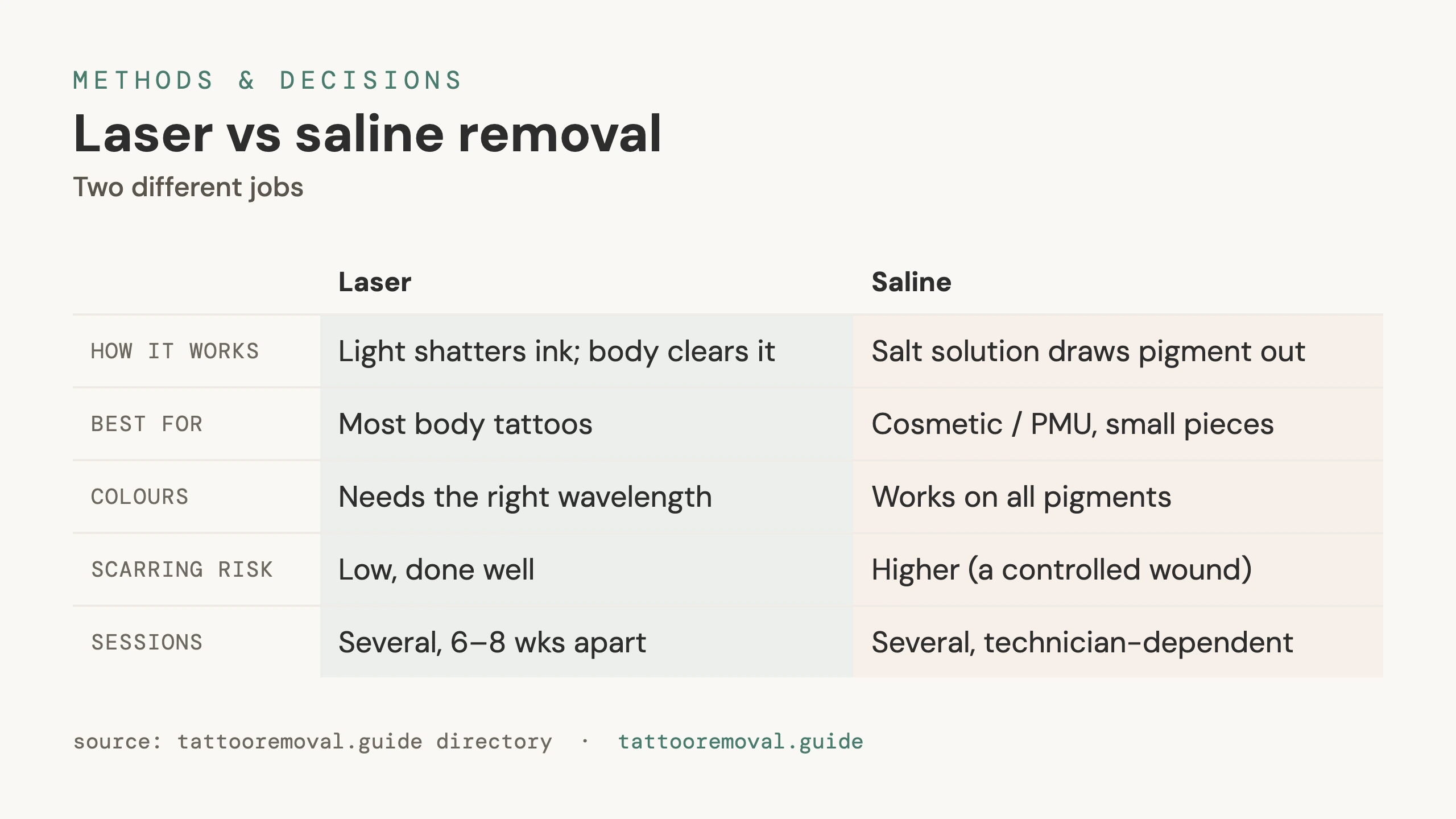 Two different jobs — laser for body ink, saline for cosmetic.
What is saline tattoo removal, and how does it work?
Saline tattoo removal is a method in which a technician uses a tattoo machine to implant a concentrated salt (saline) solution into the same dermal layer that holds the ink. It relies on osmosis: water moves across the skin's semi-permeable membrane toward the higher salt concentration, and as fluid rises toward the surface, some pigment is carried along with it. A scab forms over the treated area, locking in the lifted pigment — and as that scab heals and sheds over the following weeks, a portion of the pigment leaves with it.
Repeat the process, and each round lifts a little more. It is the mirror image of laser removal: instead of shattering ink so your immune system can clear it internally (the mechanism the Cleveland Clinic describes for lasers), saline physically draws pigment out through the skin's surface. Because it doesn't depend on a colour absorbing a specific wavelength of light, it works the same way on black, colour, and pale cosmetic inks alike.
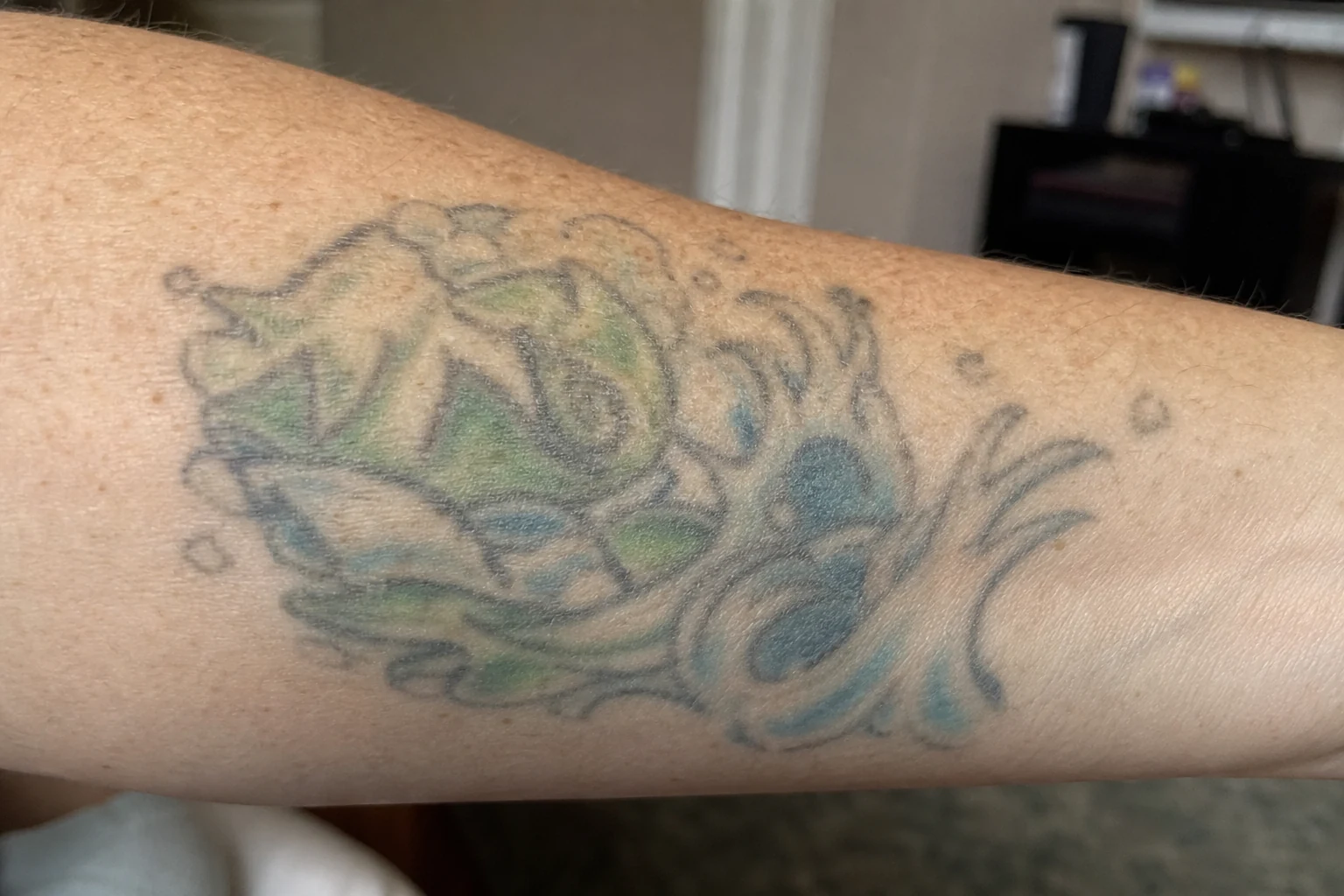 A green tattoo — one of the harder colours to clear.
Saline vs laser: an honest comparison
Neither method is universally superior — they solve different problems. Here is the honest side-by-side:
| Factor | Saline removal | Laser removal |
|---|---|---|
| How it works | Osmosis draws pigment up through a scab | Light shatters ink; your immune system clears it |
| Colour dependence | Works on any colour, including white/flesh-tone PMU | Colour-dependent; green and blue are hardest |
| Best suited to | PMU, small tattoos, cover-up lightening | All sizes, especially larger body tattoos |
| The wound | Deliberate open wound; scabs ~8–10 weeks per session | No open wound by design; blistering/scabbing can occur, heals in days–weeks |
| Speed over a large area | Slow; limited area treated per session | Faster over large areas |
| Paradoxical darkening risk | Avoids it (no light-driven oxidation) | Possible with iron/titanium flesh-toned PMU inks |
| Main risks | Infection, scarring, hyperpigmentation | Blistering, scarring, pigment change |
| Typical sessions | ~3–6 for PMU; more for body ink | Typically several, spaced 6–8 weeks apart |
The single most important line in that table is paradoxical darkening. The FDA warns that flesh-coloured, white, and permanent-makeup pigments are especially tricky to remove because the pigment can oxidise when hit by a laser — turning grey or black — and oxidised pigment may then be untreatable by laser. That is exactly the scenario where saline earns its place: because it lifts pigment physically rather than heating it, it sidesteps that darkening risk entirely.
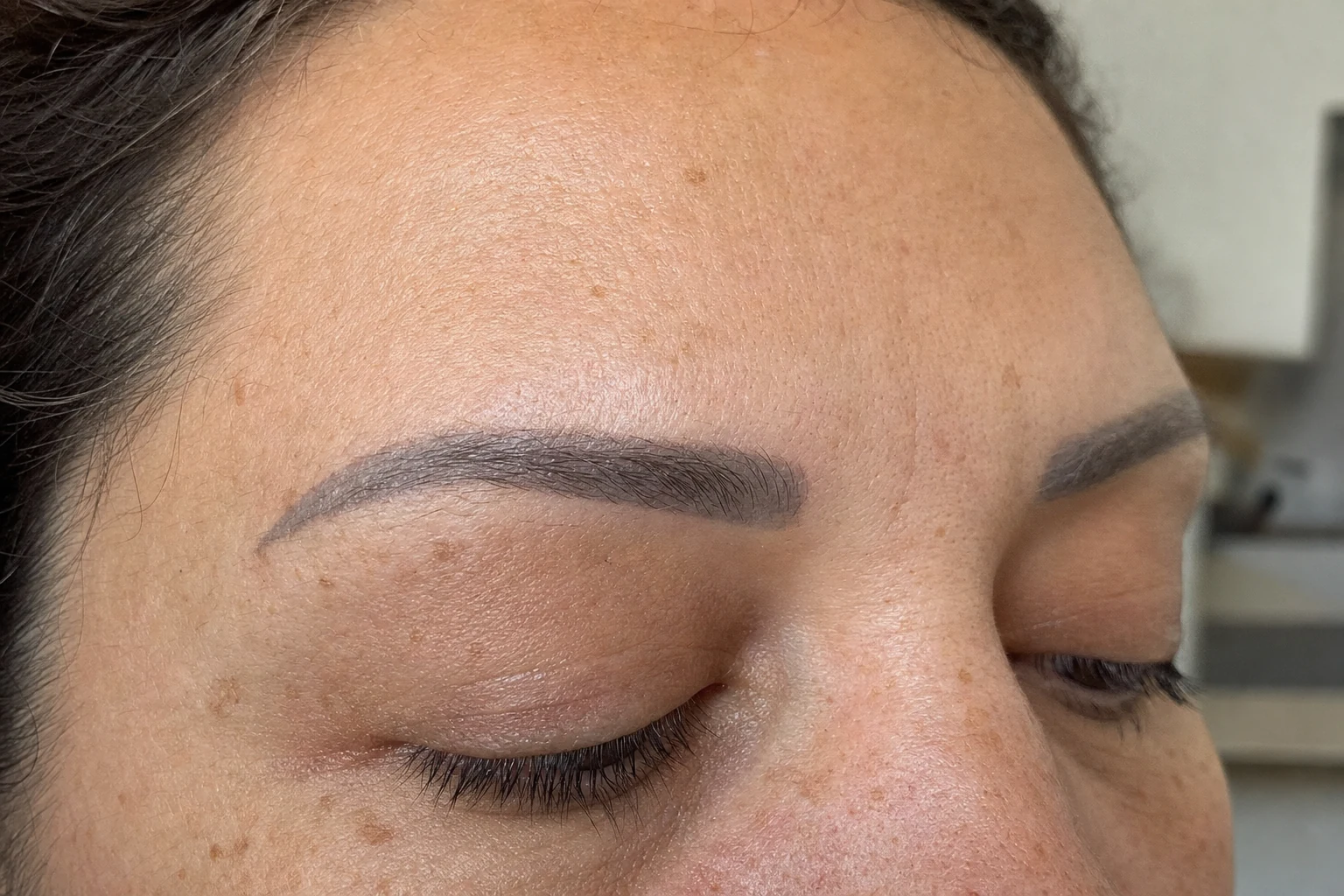 Cosmetic brow tattoos are a common saline-removal case.
When saline genuinely wins — and when laser is better
Saline is the stronger choice when:
- The work is cosmetic/PMU — microbladed or powdered brows, lip blush, or eyeliner — where laser risks oxidising flesh-toned pigment darker.
- The tattoo is small and pigment removal, not speed, is the priority.
- You want to lighten a tattoo before a cover-up rather than erase it completely.
- The ink is a colour or shade a laser struggles to target, or you specifically want to avoid laser on a particular pigment.
Laser is usually the better tool when:
- The tattoo is large, dense, or professional — saline treats too little area per session to be practical at scale.
- You want the fastest, best-studied route. The American Academy of Dermatology's position is blunt: lasers have largely replaced other removal methods and today remove ink more safely and effectively, including colours once considered difficult.
- The tattoo is on thin or delicate skin where repeated open scabbing raises the scarring stakes.
TRG's stance is deliberately neutral: saline is a legitimate method with a real niche, but the "natural, gentler, laser-free" marketing around it oversells a procedure that still wounds the skin. Match the method to the tattoo, not to the sales pitch.
Realistic sessions and cost
Cosmetic and PMU removals commonly take around 3–6 saline sessions, though heavily saturated or older pigment can need more; body tattoos with far more ink take many more still. Sessions are spaced roughly 6–8 weeks apart so the skin fully heals between rounds — the same heal-first logic that governs laser spacing. As with every method, no responsible clinic guarantees a session count, a timeline, or complete removal before assessing your specific tattoo, and the FDA notes that any removal procedure may scar or fail to remove a tattoo completely.
On price, saline is typically charged per session, and because it needs several visits, the total can rival a course of laser despite a lower per-visit sticker. TRG's directory tracks laser clinics rather than saline studios, so we don't publish a saline price index — treat quoted per-session prices as the start of the conversation, and ask how many sessions the studio realistically expects for your tattoo.
The DIY warning: never remove a tattoo with salt at home
This one is not a nuance — it is a hard line. Do not attempt saline or salt tattoo removal at home. Professional saline removal implants a controlled solution at a controlled depth in a clean environment; the at-home versions circulating online — rubbing salt into abraded skin, "salt scrubbing," or DIY needling — are abrasion and chemical injury, not removal. They routinely cause infection, permanent scarring, and pigment change while barely touching the ink. The open wound any salt method creates is also an infection route, and unsterile technique is precisely how the FDA links tattoo procedures to infection risk. If saline is the right method for you, have a trained, licensed technician do it.
This is general information, not medical advice. Saline and laser tattoo removal are both procedures with real risks (infection, scarring, pigment change). Session counts, timelines, and outcomes vary by person, ink, and skin — consult a licensed provider about your specific situation.
Compare your options before you commit
Because saline and laser suit different tattoos — and because saline is offered by a much smaller set of cosmetic-tattoo studios than laser is — the most useful next step is to see what's actually available where you live and ask each provider which method fits your ink.
Compare tattoo-removal clinics in your city to find providers near you, or start with a dense market like tattoo removal in Melbourne to see how services and pricing stack up side by side. For the full landscape, read our pillar on every tattoo-removal method compared, or go deeper on the head-to-head in laser vs saline tattoo removal.
Frequently asked questions
Does saline tattoo removal work?
Yes, saline removal genuinely works, but slowly and best on small or cosmetic tattoos. A concentrated salt solution is tattooed into the skin, drawing pigment upward so it lifts out as a scab forms and sheds. It usually takes several sessions spaced weeks apart, and complete removal cannot be guaranteed for any method.
What is saline tattoo removal?
Saline tattoo removal is a non-laser method in which a technician uses a tattoo machine to implant a concentrated salt solution into the same skin layer as the ink. By osmosis, it pulls fluid and pigment toward the surface; a scab forms, and as it heals and sheds over several weeks, some pigment leaves with it.
Is saline removal better than laser?
Neither is universally better. Saline can suit cosmetic/PMU work, small tattoos, and inks lasers struggle with, and it avoids the paradoxical darkening laser can cause in flesh-toned pigments. Laser is faster and better studied for larger body tattoos. The right choice depends on the tattoo, the ink, and your skin — a consultation decides.
Is saline tattoo removal safe?
Performed by a trained technician, saline removal is generally low-risk, but it is not risk-free. It deliberately creates an open wound that scabs over roughly 8–10 weeks, so infection, scarring, and pigment change are all possible. Never attempt salt or saline removal at home — DIY salt scrubbing is a known cause of serious scarring and infection.
How many sessions does saline tattoo removal take?
Cosmetic and PMU work such as brows or lip blush often takes around 3–6 saline sessions, while body tattoos with more ink can take many more. Sessions are spaced roughly 6–8 weeks apart to let the skin fully heal between rounds. No clinic can guarantee an exact number before assessing your specific tattoo.
Can saline remove coloured or white tattoos?
Saline removal works colour-independently because it lifts pigment physically rather than targeting a colour with light. That can help with lighter, warmer, or white cosmetic inks that lasers struggle with — and it sidesteps the risk of laser oxidising flesh-toned or white pigment darker. Results still vary by ink depth, saturation, and skin.
Related guides
Related Guides
- Choosing Removal
Tattoo Regret: You Have More Options Than You Think
Regret a tattoo? You're not alone — about 24% of tattooed people do. Your real options: accept, rework, cover up or remove — and why not to decide too fast.
- Choosing Removal
Tattoo Removal Methods Compared: What Works in 2026
Laser, saline, excision, dermabrasion, acid, creams — every tattoo removal method compared on sessions, cost, scarring and colour, by an independent directory.
- Choosing Removal
Surgical Tattoo Removal: When Cutting It Out Beats Laser
Surgical tattoo removal cuts out the inked skin in one or a few visits, regardless of colour — but always leaves a scar. When it beats laser, explained.