Blackwork Tattoo Removal: Easiest Ink, Hardest Job

Blackwork tattoo removal works, and the good news is counter-intuitive: black is the easiest ink to remove per unit of pigment, because it absorbs every laser wavelength and responds especially well to the 1064nm Nd:YAG laser most clinics own. The hard part is volume. A dense solid fill or a blackout sleeve packs so much ink over so large an area that it routinely needs 10–15 or more sessions — well above the ~5–12 typical for an ordinary tattoo.
That paradox — easiest colour, hardest job — is the whole story of blackwork removal. This guide covers the physics, honest session numbers, why big solid areas fade blotchy before they fade clear, and why the operator matters as much as the machine. Figures from the Tattoo Removal Guide directory are stamped (as of July 2026).
Key Takeaways
- Black is the easiest colour to remove per unit of ink — it absorbs all wavelengths and clears well with the common 1064nm Nd:YAG laser. Difficulty scales with quantity, not colour.
- Dense blackwork and blackout tattoos take many sessions — commonly 10–15+, spaced 6–8 weeks apart, because there is simply a lot of pigment to shatter and clear.
- Heat is the real risk. So much dark pigment absorbs so much energy that pushing a large solid area too fast raises the risk of blistering and scarring — careful clinicians treat less per session, not more.
- Big solid fills fade patchy before they fade clear — a normal, temporary mottling as denser patches lag behind thinner ones.
- Of the 5,700 clinics we track, about 18% list a picosecond laser and 15% a Q-switched laser (as of July 2026) — both remove black effectively; the operator's skill matters as much as the machine.
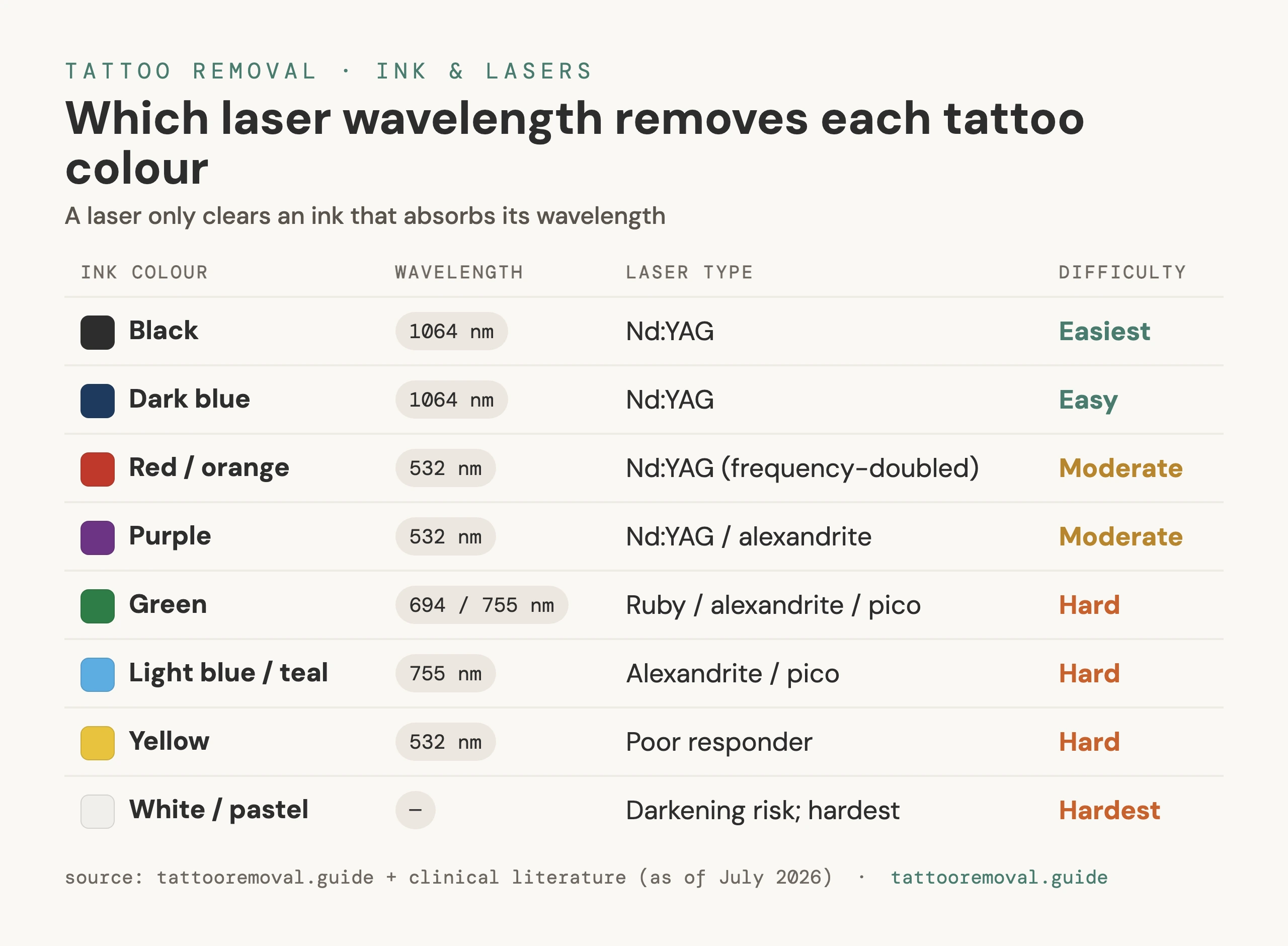 A laser only clears an ink that absorbs its wavelength.
Why black ink is the easiest colour to remove
Every laser removal device works by firing light that the ink absorbs and is shattered by. A colour is only clearable if it absorbs the wavelength you point at it — and this is exactly why green and blue are stubborn (they reflect the common wavelengths). Black is the opposite: it absorbs across essentially the entire spectrum. As the Cleveland Clinic notes, black responds to the widest range of laser wavelengths, which is why almost any removal laser can treat it and why it is considered the easiest colour to clear.
The workhorse for black is the 1064nm Nd:YAG wavelength, which black pigment absorbs strongly while sparing more of the surrounding skin — particularly useful on darker skin tones. So on a per-particle basis, black gives up more readily than any other colour. Hold that thought, because the difficulty of blackwork has nothing to do with the colour and everything to do with how much of it there is.
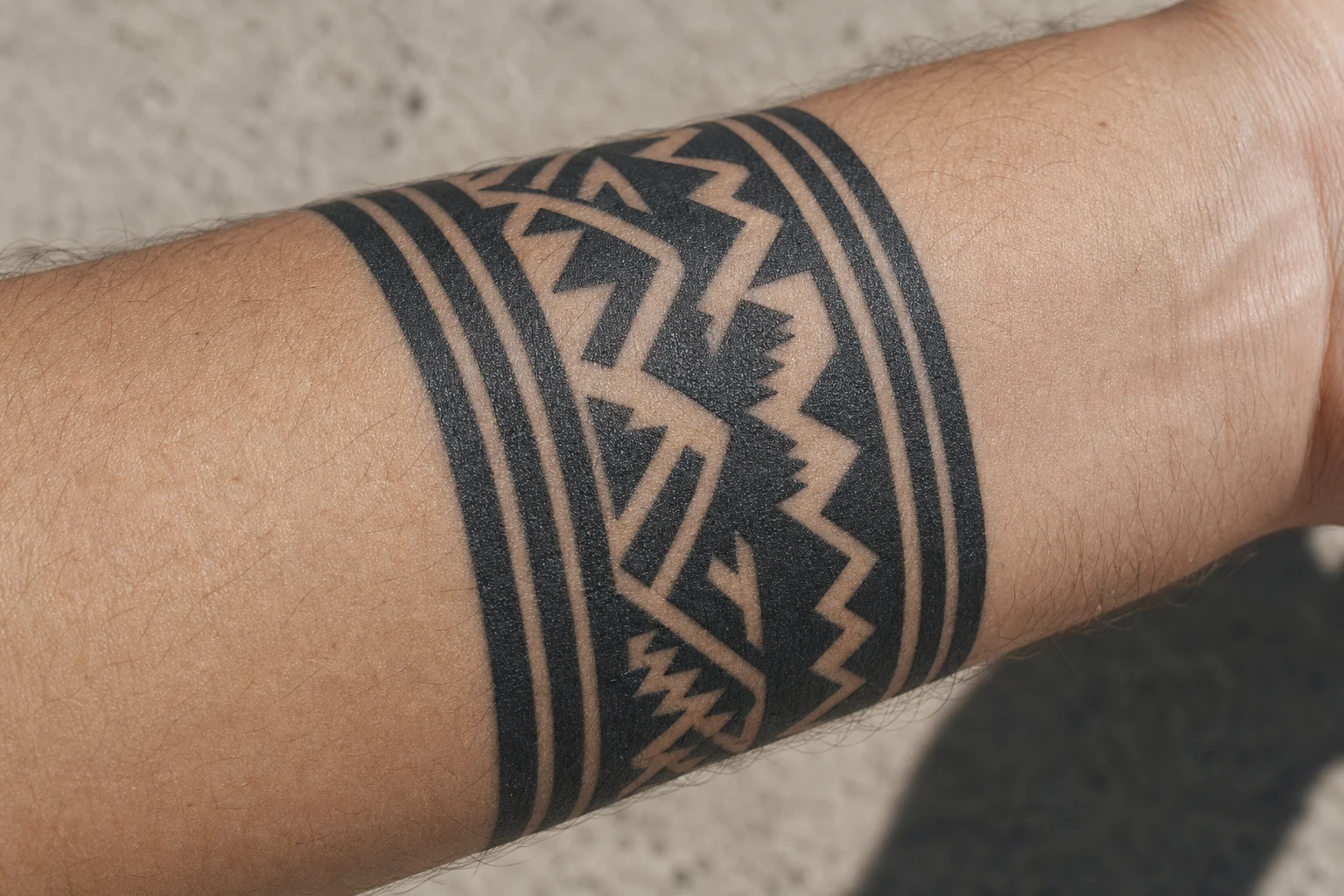 Dense blackwork before treatment — solid black absorbs 1064nm well, though density sets the pace.
Selective photothermolysis: the principle behind it
Selective photothermolysis is the principle that a laser can destroy a specific target — here, tattoo ink — by matching its wavelength and pulse duration to that target, so the ink absorbs the energy and is shattered while the surrounding tissue is largely spared. First described for dermatology in the 1980s and still the foundation of modern devices (StatPearls clinical reference), it is why choosing the right wavelength matters. For black, almost any wavelength qualifies as "selective" because black absorbs them all — which is the mechanistic reason black is so cooperative. The laser shatters the pigment into fragments; your immune system then clears them over the following weeks.
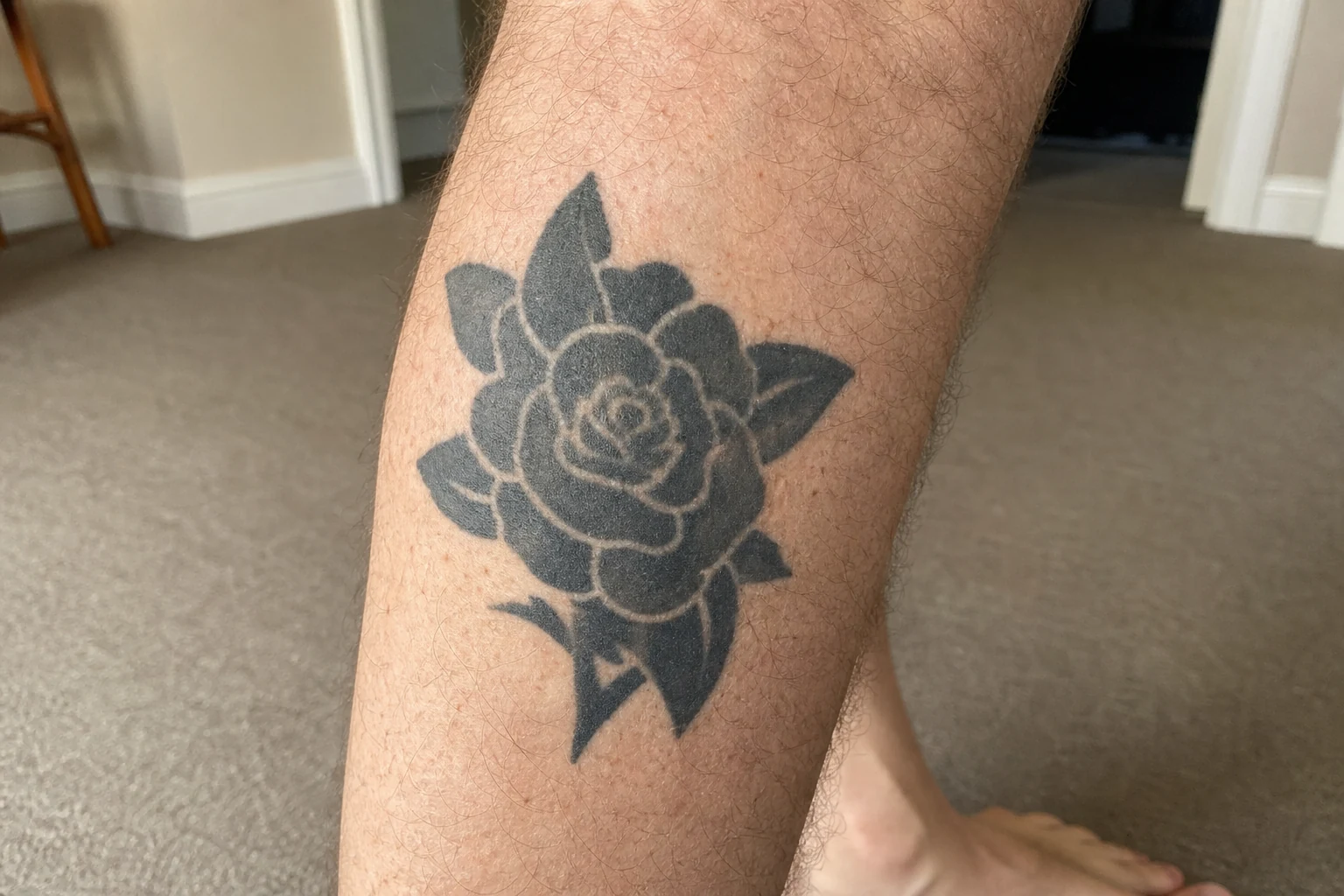 A solid blackwork piece before removal — black is the easiest colour to clear.
So why does dense blackwork take so many sessions?
If black clears easily, why do blackwork pieces drag on? Three reasons, all about volume rather than colour:
- There is simply more pigment to move. Solid fills and blackout designs deposit far more ink than a fine-line piece. Each laser pass only shatters what it reaches, and your immune system needs weeks to carry those fragments away, so more ink means more cycles of shatter-clear-heal.
- Ink is layered and deep. Heavy blackwork is often built up in dense, overlapping layers; the Kirby-Desai scale, a validated predictor of session count, treats both ink density and layering as factors that push the number up.
- Area limits how much can be treated at once. A large solid area can't safely be blasted in one go (see heat, below), so clinicians often work it in stages — extending the timeline further.
How many sessions? A realistic frame
There is no guaranteed number, only ranges that scale with how much solid black you're clearing. As the American Academy of Dermatology stresses, session counts vary by the individual tattoo. Here is an honest frame:
| Blackwork type | Typical sessions | Key considerations |
|---|---|---|
| Small solid-black tattoo (e.g. a filled symbol) | ~5–10 | Straightforward black; volume is modest, so mostly a matter of spacing |
| Dense blackwork (large fill, heavy black-and-grey) | ~10–15+ | A lot of pigment and layering; expect blotchy interim fading; heat management matters |
| Blackout sleeve / large blackout | ~15+ and up | Among the most demanding jobs; treated in stages; full clearance not guaranteed |
Two honest caveats. First, these are ranges, not promises — anyone quoting an exact count sight-unseen is guessing. Second, sessions are spaced 6–8 weeks apart minimum to let skin heal and the immune system clear shattered ink, so 15 sessions is a two-to-three-year commitment, not a quick fix.
Why big solid areas fade patchy and mottled
Expect a large blackwork piece to look worse before better in the middle of a course — patchy, mottled, unevenly grey. This is normal. Ink saturation, depth and how evenly the original artist packed the black all vary across a big fill, and the laser's energy reaches some patches more effectively than others. Denser or deeper spots lag; thinner edges clear first. The result is a blotchy interim stage that later sessions gradually even out. It is a feature of clearing a large solid area, not a sign something has gone wrong — though, as always, final results vary by person.
Heat management: the real safety point
This is where blackwork removal earns its "hardest job" label. Because black absorbs so much light, a large solid area absorbs a large amount of energy, which becomes heat in the skin. Push a big blackout area too hard or too fast and you raise the risk of blistering, scarring and pigment change. A careful clinician manages this by treating a limited area per session, respecting the healing interval, using cooling, and not chasing speed. Proper laser eye protection for everyone in the room is standard. The safe path through blackwork is patient and staged — a clinician who wants to "get it done fast" on a large solid area is a red flag, not a bargain.
Can picosecond lasers help — and does the machine decide it?
Picosecond lasers (shorter pulses than the older Q-switched nanosecond systems) can be efficient on dense black and sometimes clear it in fewer sessions. But Q-switched Nd:YAG lasers also remove black very effectively — black is the one colour nearly every device handles well. Across the directory, about 18% of the 5,700 clinics we track list a picosecond laser and 15% list a Q-switched laser (as of July 2026) — and because those are the clinics that publicly list a device (a floor, not a ceiling), many others simply don't specify. Neither figure means a clinic can't treat black; most can. For dense blackwork, the operator's experience with large solid areas and their heat management often matter as much as the badge on the machine.
So the real task with blackwork isn't finding a laser that removes black — almost all of them do — it's finding a clinic with the experience to work a large, dense, heat-loaded area safely and the honesty to set realistic expectations about sessions and final clearance.
This is general information, not medical advice. Laser tattoo removal is a medical procedure with real risks — blistering, scarring and pigment change are more likely on large, dense black areas. Session counts and outcomes vary by person and tattoo; consult a licensed provider about your specific situation.
Compare clinics before you commit
Because blackwork rides on the operator as much as the device, the most useful thing you can do is compare the clinics near you and ask directly how they stage large solid areas and manage heat. Compare tattoo-removal clinics in your city to see what's available, or start with a dense market like tattoo removal in Melbourne to see how listings and lasers stack up side by side.
For the wider picture, see our pillar on the hardest tattoo colours to remove — where black sits at the easy end — and our guide to how many sessions it takes to remove a tattoo.
Frequently asked questions
Can blackwork tattoos be removed?
Yes. Black ink is the easiest colour to remove per unit of pigment because it absorbs every laser wavelength and responds especially well to the 1064nm Nd:YAG laser most clinics own. The challenge with blackwork is volume, not colour — dense solid areas hold so much ink that clearing them takes many sessions over a long timeline.
How many sessions does it take to remove a blackwork tattoo?
A small solid-black tattoo often clears in about 5–10 sessions, while dense blackwork or a blackout sleeve commonly needs 10–15 or more, spaced 6–8 weeks apart. No clinic can guarantee a count in advance — the total depends on ink density, saturation, layering, location and your skin, so a clinician should assess the specific piece.
Is black ink easy or hard to remove?
Black ink is the easiest colour to remove per unit of pigment because it absorbs light across the whole laser spectrum, so almost any device can shatter it. The difficulty with blackwork is quantity, not colour — solid fills and blackout designs pack an enormous amount of pigment into a large area, which multiplies the number of passes needed.
Why do large black tattoos fade patchy or blotchy?
Big solid areas rarely fade evenly because ink saturation, depth and the laser's energy delivery vary across the surface. Denser or deeper patches clear slower than thinner edges, so mid-treatment a solid fill can look mottled or blotchy. This is a normal, temporary stage; later sessions even it out, though final results still vary by person.
Can a blackout tattoo be removed?
A blackout tattoo can usually be faded significantly, but full removal is not guaranteed and it is one of the most demanding jobs in laser removal. Blackout designs saturate a large area with heavy solid black, so they need many sessions, careful heat management to protect the skin, and realistic expectations set by an experienced clinician.
Does a picosecond laser work better on dense black ink?
Picosecond lasers can clear black ink efficiently and sometimes in fewer sessions than older nanosecond systems, but Q-switched Nd:YAG lasers also remove black very effectively. Both work on black. For dense blackwork the operator's experience and heat management often matter as much as the device type, so treat the machine as one factor among several.
Is laser removal of solid black tattoos dangerous to the skin?
Removing dense solid black carries a higher risk of blistering, scarring and pigment change than a light tattoo, because so much pigment absorbs so much energy and heat. A careful clinician manages this by limiting the area treated per session and spacing sessions to let skin heal. This is general information, not medical advice.
Related guides
Related Guides
- Ink & Colours
Selective Tattoo Removal: Erasing Part of a Tattoo (2026)
Selective tattoo removal targets one part of a tattoo — a name, a figure, one colour — while leaving the rest.
- Ink & Colours
Removing an Ex-Partner's Name Tattoo: Your Options in 2026
Removing an ex's name tattoo? A partner's name is one of the most-removed tattoos — and small black lettering is among the quickest and cheapest to clear.
- Ink & Colours
Name & Lettering Tattoo Removal
Name and lettering tattoos are usually small and black, so per-unit they're among the easier tattoos to remove — but dense, deep script needs patience.