Why Isn't My Tattoo Fading? 6 Reasons Removal Slows Down

If your tattoo seems to have stopped fading, the most likely explanation is reassuring: it's probably still clearing, just where you can't see it. Laser removal shatters ink, then your immune system carries the fragments away over weeks — so visible progress often looks stalled between sessions while clearance quietly continues beneath the surface.
That said, some tattoos genuinely do slow down or plateau, and there are six honest, physical reasons why. This guide is a plain-English diagnostic: what's normal, what's actually slowing you down, when to be concerned, and what to ask your clinic. Figures from the Tattoo Removal Guide directory are stamped (as of July 2026).
Key Takeaways
- "Stalled" usually isn't. Between sessions your immune system is still clearing shattered ink — the visible tattoo can look frozen for weeks while clearance continues underneath.
- The biggest fading happens early; deeper, denser ink resists longer, so later sessions often show smaller changes. A slowing pace is expected.
- Genuine plateaus trace to six factors: stubborn colours, dense or layered ink, a hidden cover-up, poor circulation at the site, too-short spacing, and lifestyle or immune factors.
- Ghosting — a faint residual shadow — can remain even after most pigment has gone. Complete removal is common but not guaranteed.
- If your remaining ink is green or blue, a clinic with a colour-capable or picosecond laser may help. Roughly 18% of the 5,700 clinics we track note picosecond lasers and 15% note Q-switched (as of July 2026) — both effective; the right one depends on your ink.
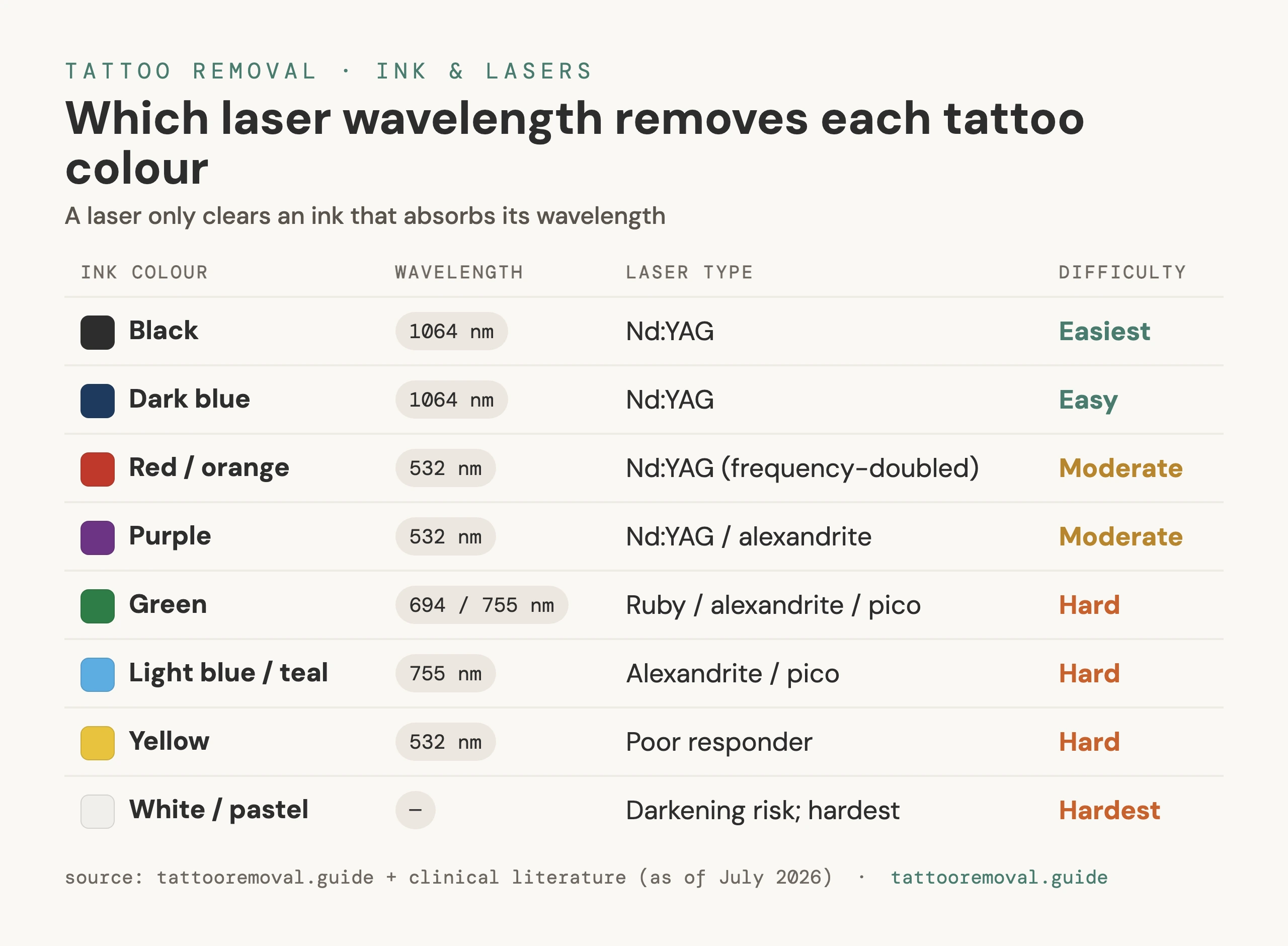 A laser only clears an ink that absorbs its wavelength.
First, the reassuring part: fading you can't see
Here's the mechanism that changes how you should read your own progress. A laser doesn't erase ink — it fractures the particles into fragments small enough for your immune system to carry off. As the Cleveland Clinic explains, the laser breaks the ink into smaller pieces that the body then absorbs and eliminates over the following weeks.
That clearance is slow and invisible. Right after a session the tattoo may even look darker or unchanged; the real fading happens gradually over the six-to-eight weeks that follow, as macrophage cells shuttle the debris into the lymphatic system. So the flat stretch you're staring at in the mirror is frequently not a failure — it's the waiting phase of a staged biological process. The StatPearls clinical reference describes the same sequence: fragmentation, then immune-mediated clearance between treatments.
There's also a pattern to the pace. The shallowest, most reachable ink clears first, which is why the earliest sessions usually deliver the most dramatic visible fading. What's left is the deeper, denser, more stubborn pigment — so a slower back half is normal, not a red flag.
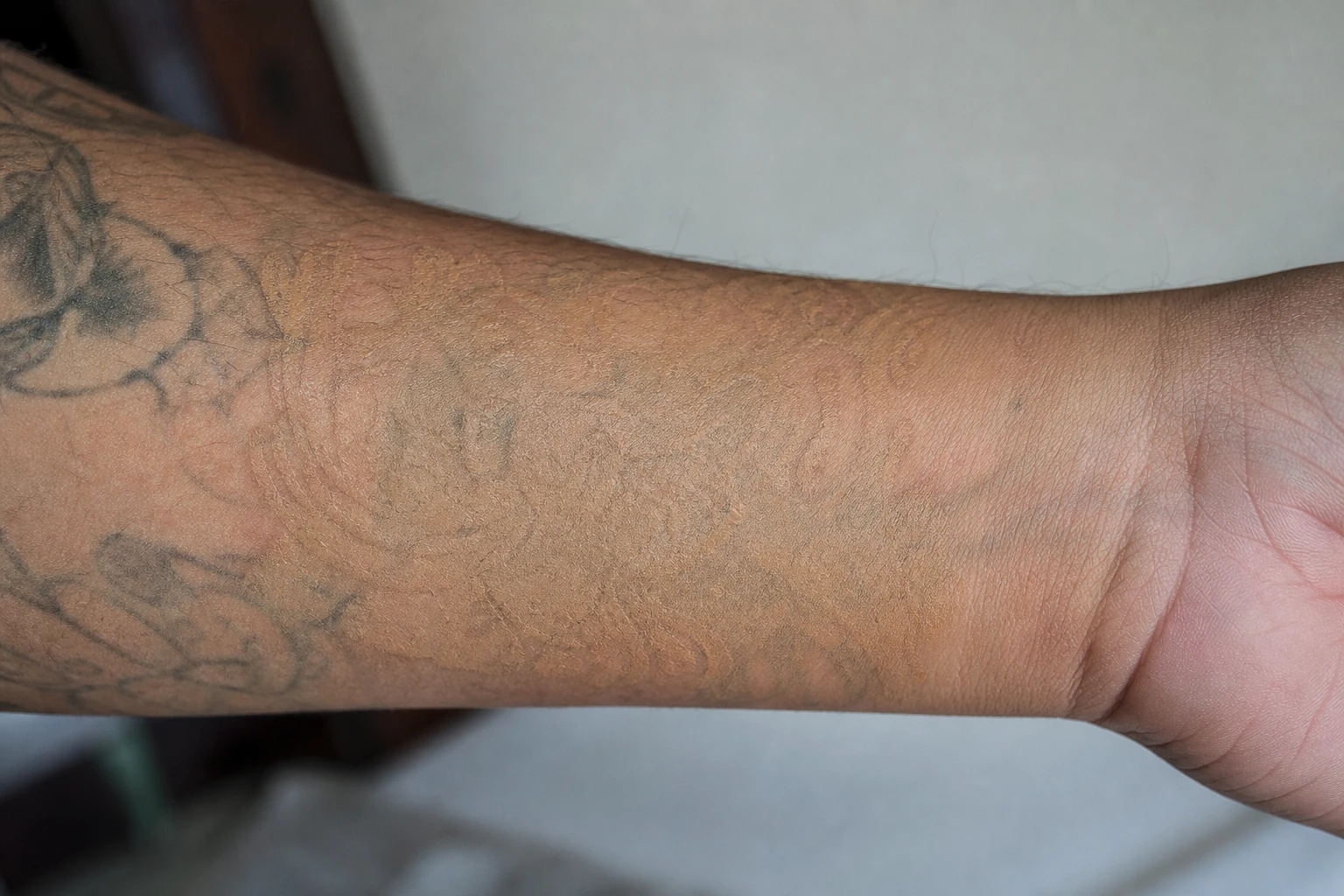 A tattoo about halfway through a course — clearly faded but still visible.
The 6 real reasons removal slows or plateaus
If progress has genuinely stalled across several correctly spaced sessions, it usually comes down to one or more of these. Use them as a diagnostic checklist.
| # | Reason it slows | What's going on | What can help |
|---|---|---|---|
| 1 | Stubborn colours (green, blue, some yellows) | These absorb laser light poorly and need specific wavelengths | A laser that delivers 694nm/755nm or a picosecond device |
| 2 | Deep, dense or layered ink | More pigment, and lower layers are shielded until upper ones clear | Patience; more sessions; sometimes higher energy |
| 3 | A cover-up underneath | Two stacked tattoos mean far more ink to shatter and clear | Realistic expectations; a longer course |
| 4 | Poor circulation at the site (hands, feet, ankles) | Slower lymphatic clearance further from the heart | Wider session spacing; general health measures |
| 5 | Too-short spacing between sessions | The immune system hasn't finished clearing the last round | Space sessions at least 6–8 weeks apart |
| 6 | Lifestyle / immune factors (smoking, dehydration, poor general health) | The body clears fragments less efficiently | Hydration, not smoking, overall health |
1. Stubborn colours — green, blue and some yellows
Colour is the single most common reason for a plateau. Black absorbs almost every wavelength and clears most readily; green and blue reflect the common wavelengths and only respond to specific ones (around 694nm or 755nm) that not every clinic owns. Some yellows and fluorescents are harder still. If your black outline vanished but a green fill is clinging on, that's textbook — see our guide to the hardest tattoo colours to remove.
2. Deep, dense or layered ink
A saturated professional piece simply holds more pigment than a fine-line tattoo, and the laser can only shatter the layer it reaches on each pass. The deeper ink stays partly shielded until the layer above has cleared, so dense work fades in slow, stacked stages.
3. A cover-up hiding underneath
If your tattoo covers an older one, you're effectively removing two tattoos in the same footprint — often with heavier, doubled-up ink. Cover-ups are one of the Kirby-Desai scale factors precisely because layered ink multiplies the sessions needed. Slow progress here is expected, not a defect.
4. Body location with poor circulation
Removal relies on your lymphatic system, and areas far from the heart with less blood flow — hands, fingers, feet, ankles, shins — clear more slowly than a chest, back or upper arm. The American Academy of Dermatology notes that location influences how tattoos respond. Same laser, same ink, slower clearance, purely because of where it sits.
5. Sessions spaced too close together
If you're being treated every two or three weeks, your immune system may not have finished clearing the previous round before the next pass. Rushing doesn't speed removal — it treats congested skin and raises the risk of side effects. The 6–8 week clearing window exists because that's how long the biology takes.
6. Lifestyle and immune factors
Because clearance is an immune job, your general health plays a supporting role. One 2013 study of laser tattoo removal found smoking was associated with lower odds of successful clearance. Dehydration and poor overall health can work against you too. These factors won't override colour or density — but they're the part you can actually influence, so hydration and not smoking are worth it.
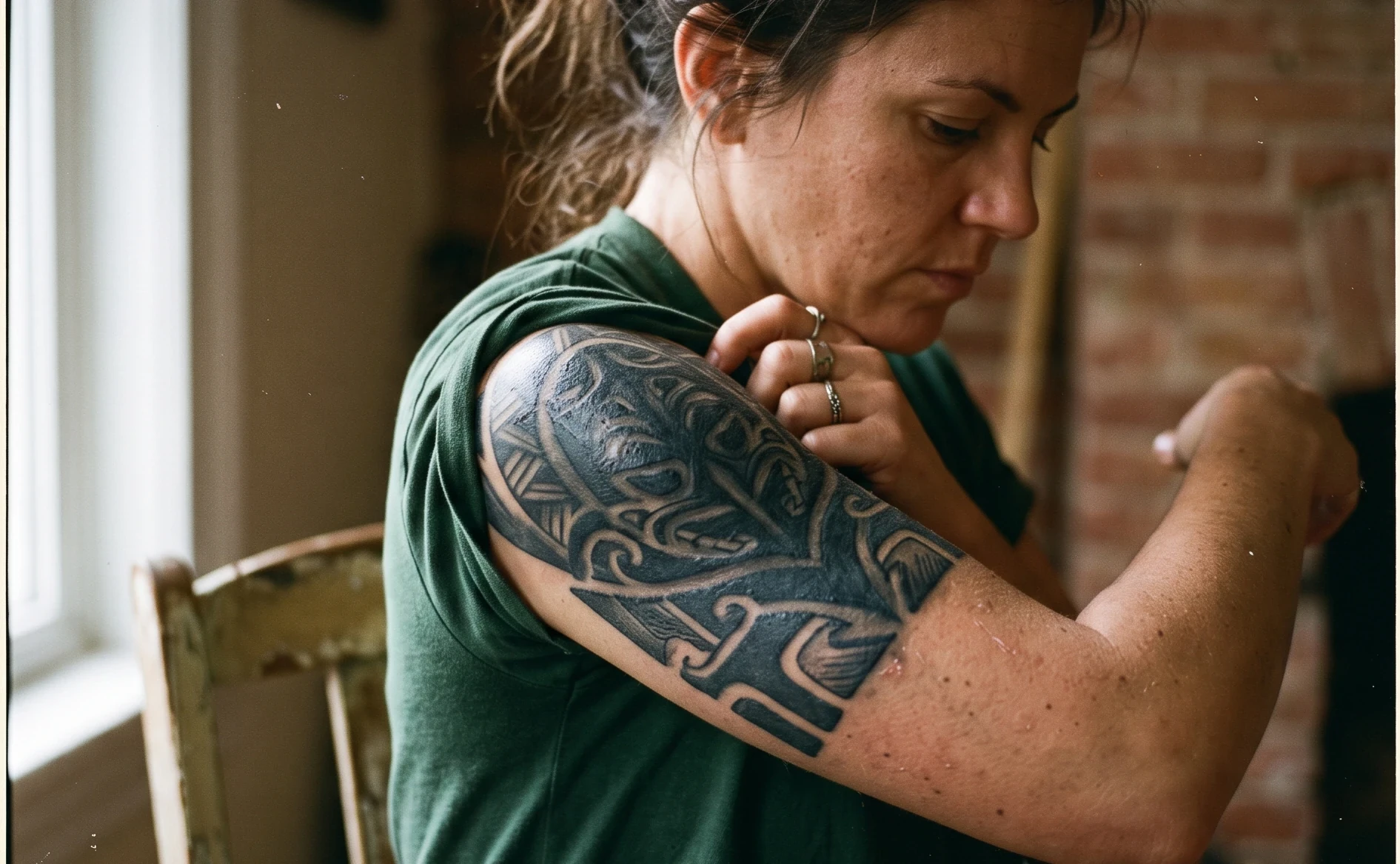 A large, dark tattoo — fading widens cover-up options.
What's normal vs when to actually be concerned
Most "why isn't it working" worries are normal biology. Use this to tell the difference.
| Usually normal | Worth raising with your provider |
|---|---|
| Little visible change between sessions | No change at all over several correctly spaced sessions |
| Fading slowing down in later sessions | Fading that reverses or the tattoo looking re-darkened long-term |
| Redness, mild blistering or scabbing for days after | Thick, raised or spreading scarring |
| A stubborn green/blue patch when black has gone | Persistent blistering, weeping or signs of infection |
| A faint residual "ghost" of the design | Lasting skin-colour change (lighter or darker patches) |
Ghosting is a faint residual shadow of the original design that can remain after the pigment itself has largely cleared. It's common with dense or heavily layered tattoos and stubborn colours, and it's a known outcome rather than a sign something went wrong. Complete removal to zero trace is frequent but cannot be guaranteed for everyone.
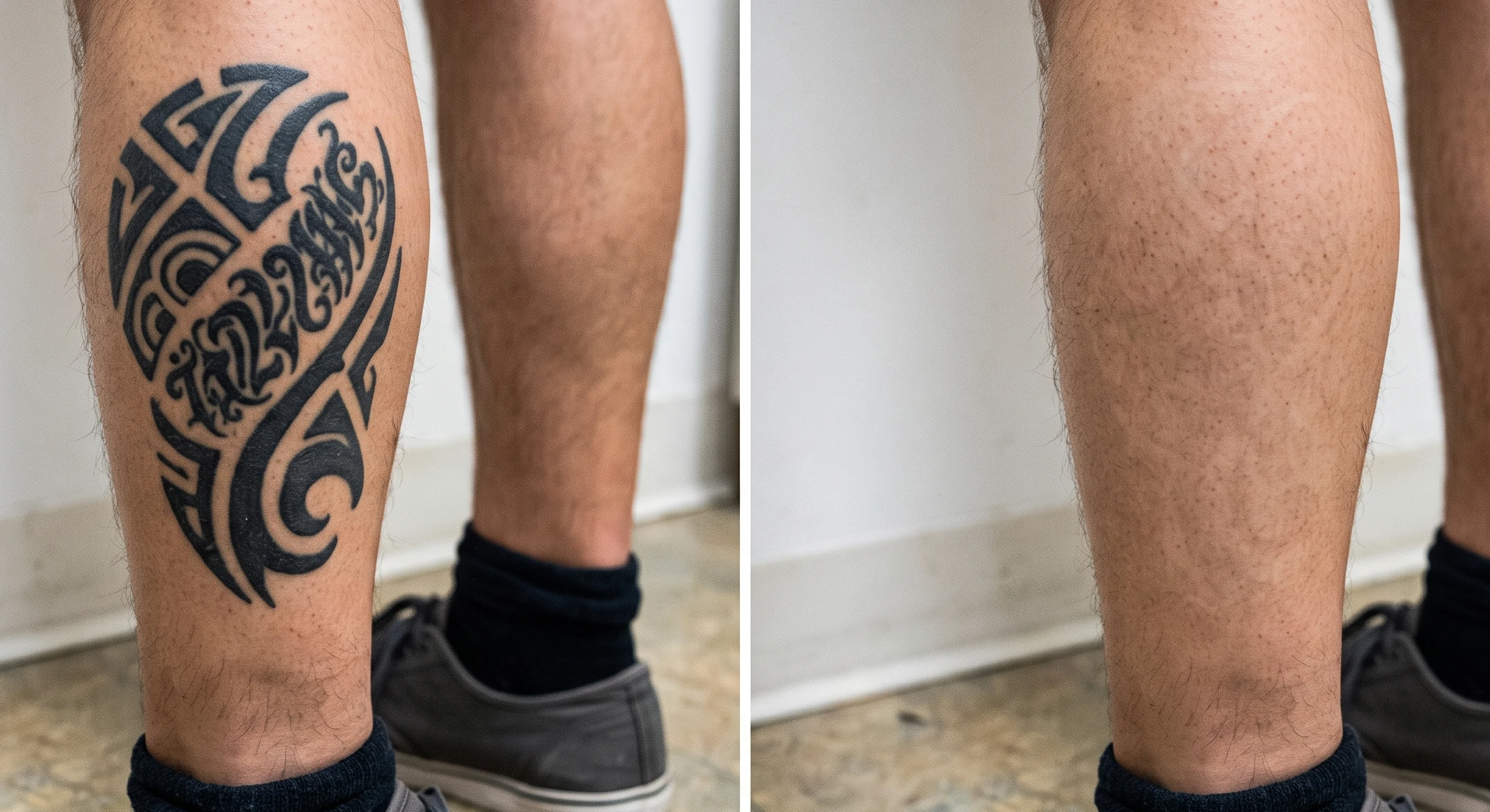 After a full course, only a faint 'ghost' — a barely-visible pale mark — may remain. Illustrative; results vary.
What to ask your clinic if you've plateaued
If you've genuinely stalled, the productive move is a specific conversation, not another identical session. Bring these questions:
- What laser wavelengths do you actually deliver? For a leftover green or blue patch, you want to know they can hit it (694nm/755nm or a picosecond device) — not just their most common black-ink setting.
- Which laser type am I being treated with, and is it right for my remaining ink? Picosecond and Q-switched lasers both work; neither is universally superior. The question is fit for your colour and skin.
- Are we using the right energy and spacing? Ask whether adjusting the settings or extending the interval between sessions could help.
- Realistically, how many sessions are left — and is 100% clearance likely for my tattoo? A straight answer, including the possibility of ghosting, is a good sign.
If your current clinic can't treat your remaining colours, another one may be equipped to. A clinic with a colour-capable or picosecond laser can genuinely change the outcome for stubborn ink — though, again, no honest clinic guarantees a result sight-unseen.
This is general information, not medical advice. Laser tattoo removal is a medical procedure and results vary by person, ink and skin. If you're concerned about slow progress, scarring, blistering or any skin change, see your provider or a licensed dermatologist for advice about your specific situation.
Compare clinics that can treat stubborn ink
If the reason your tattoo stalled is colour or equipment, the fix is often a better-matched clinic. Because the lasers on offer — and the wavelengths they cover — vary from one clinic to the next, it's worth comparing what's available near you before booking another session.
Compare tattoo-removal clinics in your city to see which list colour-capable or picosecond lasers, or browse a dense market like tattoo removal in Melbourne to see how listings and equipment stack up side by side. To understand the underlying process, start with our pillar guide on how laser tattoo removal works.
Frequently asked questions
Why isn't my tattoo fading?
Most often it is fading — just invisibly. Between sessions your immune system is still clearing shattered ink beneath the surface, so the visible tattoo can look stalled for weeks while clearance continues. Genuine slowdowns usually trace to stubborn colours, dense or layered ink, a hidden cover-up, poor circulation at the site, or too-short spacing between sessions.
Is it normal for tattoo removal to slow down after a few sessions?
Yes. The biggest, most visible fading usually happens in the first few sessions when the shallowest, most reachable ink clears. Deeper and denser layers resist longer, so later sessions often produce smaller visible changes. A slowing pace is expected and not, by itself, a sign that removal has failed.
What is a tattoo removal plateau?
A tattoo removal plateau is a stretch where the tattoo appears to stop fading despite continued sessions. It usually reflects stubborn colours, dense or layered ink, or a body site with slow circulation — not a stalled treatment. Adjusting laser wavelength, energy, or spacing at a suitably equipped clinic can sometimes restart progress.
Which tattoo colours are the hardest to fade?
Green, blue, and some yellows are the most stubborn, because they absorb laser light poorly and need specific wavelengths that not every clinic offers. Black clears most readily. If your remaining ink is green or blue, slow fading is expected — a clinic with a colour-capable or picosecond laser may help, though no result is guaranteed.
Can smoking or dehydration slow down tattoo removal?
They can. Removal depends on your immune and lymphatic system carrying shattered ink away, and one 2013 study found smoking was associated with lower odds of clearance. Staying hydrated, not smoking, and general good health support the clearance process, though they cannot override ink colour, density, or depth as the main factors.
What is ghosting in tattoo removal?
Ghosting is a faint residual shadow of the original design that can remain after the pigment has largely cleared. It is common with dense or heavily layered tattoos and stubborn colours. Ghosting is not the same as an active, fading tattoo, and complete removal to zero trace cannot be guaranteed for everyone.
When should I be concerned that my tattoo isn't fading?
Slow visible fading between sessions is usually normal. Be concerned if there is no change at all over several correctly spaced sessions, or if you notice thick raised scarring, persistent blistering, or lasting skin-colour change. Those warrant a review with your provider, who can reassess the settings, laser type, and your skin.
Related guides
Related Guides
- How It Works
What Is a Q-Switched Laser for Tattoo Removal? (2026)
A Q-switched laser fires nanosecond pulses to shatter tattoo ink. Here's how Q-switched Nd:YAG, ruby and alexandrite lasers work, and why they're still a gold…
- How It Works
What Is a Picosecond Laser for Tattoo Removal? (2026)
What is a picosecond laser? It fires in trillionths of a second to shatter tattoo ink. How it works, the colours it helps, and why it's not always better.
- How It Works
What Affects How Fast a Tattoo Fades? 8 Factors in Removal Speed
What affects tattoo removal speed? Ink colour, depth, age, body location, skin type, your health, smoking, and cover-ups all matter.