What to Expect at Your First Tattoo Removal Session (Step by Step)
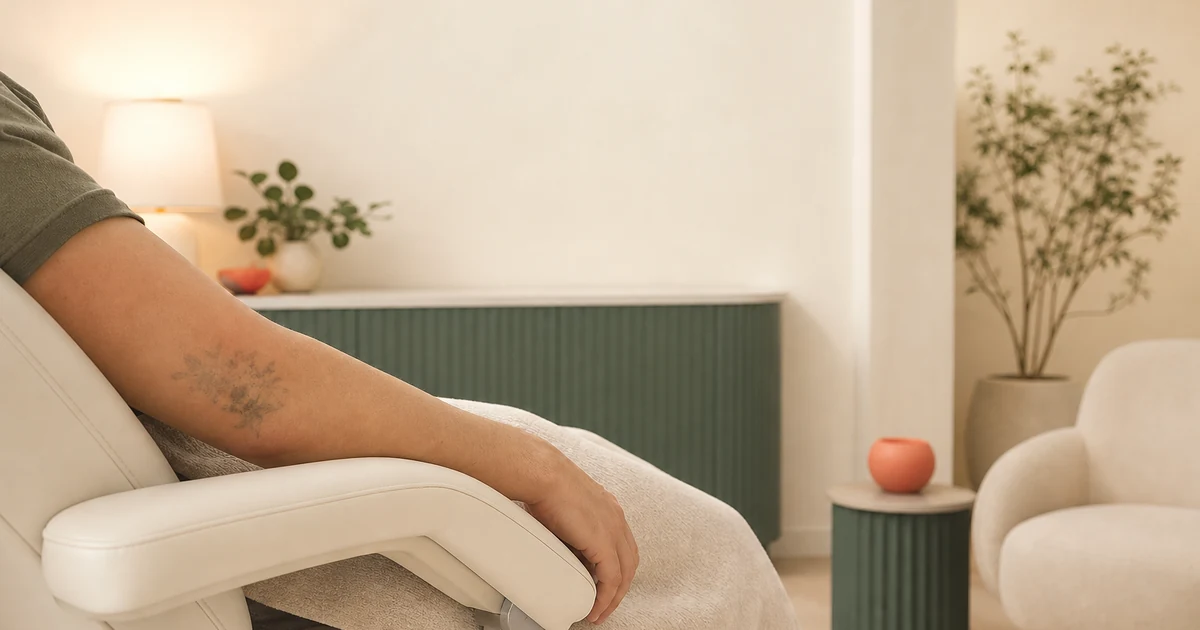
Your first laser tattoo removal session is mostly preparation and reassurance, with only a few minutes of actual laser time: expect a consultation and tattoo assessment, often a small patch test, then cleaning, protective eyewear, and the laser itself — usually under 5 minutes of pulses for a small-to-medium tattoo. You will not see your tattoo vanish that day; fading comes gradually over the weeks between sessions.
Knowing the sequence in advance takes most of the nerves out of it. This guide walks through a first visit step by step — using medical sources and figures from the Tattoo Removal Guide directory, stamped (as of July 2026) — so nothing on the day is a surprise.
Key Takeaways
- A first session is consultation → assessment → (often) patch test → clean/shave the area → protective eyewear → the laser → cooling and aftercare → book the next session.
- The laser work itself is fast (under 5 minutes for a small-to-medium tattoo); the whole visit runs longer because of the consultation and prep.
- Frosting — a temporary white bubbling of the skin — is normal and expected, not a burn.
- Do not expect visible fading straight away; it builds over the 6–8 weeks between sessions.
- Of the 5,700 clinics we track, about 27% advertise a free consultation (as of July 2026) — so an assessment often costs you nothing but time.
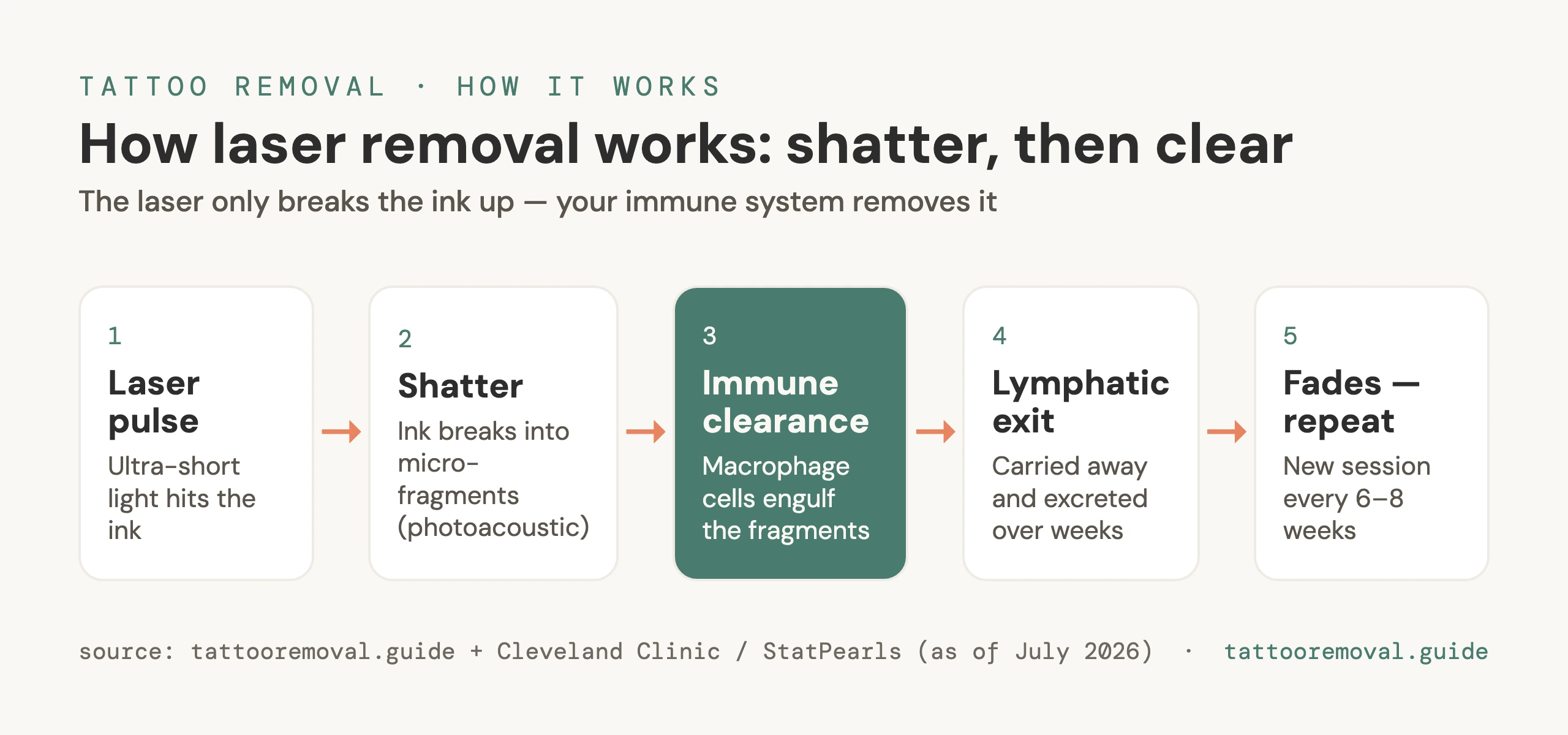 The laser breaks the ink up — your body removes it over months.
Before you go: the consultation and assessment
Most reputable clinics begin with a consultation rather than firing the laser on day one. This is where a clinician looks at your tattoo — its colours, age, density, location and your skin type — and gives you a realistic plan. Encouragingly, about 27% of the 5,700 clinics we track advertise a free consultation (as of July 2026), so getting a professional assessment often costs nothing.
Part of that assessment may use the Kirby-Desai scale. The Kirby-Desai scale is a clinical scoring system that predicts how many laser sessions a tattoo may need by scoring six factors — Fitzpatrick skin type, ink colour, amount of ink, body location, scarring and layering — and summing them. In the original 2009 study, published in the Journal of Clinical and Aesthetic Dermatology, the score correlated strongly with the number of treatments patients actually needed. It gives you an honest estimate — a range, never a guarantee.
What to bring and ask. Bring a form of ID, a list of your medications and any relevant medical history (pregnancy, recent isotretinoin/Accutane use, a history of keloid scarring, or photosensitising conditions), and questions. If you take or recently took isotretinoin, tell the clinic — the old flat "wait six months" rule is now considered outdated, and current guidance is individualised, so this is a conversation to have with your provider rather than a fixed timer.
 Warm yellow/orange ink — among the stubborn colours.
The patch test
Many clinics perform a patch test before or at your first full session. A patch test is a small trial pulse of the laser on a limited area of the tattoo, done to see how your skin responds before committing to the whole piece. It helps confirm the right laser settings and screens for adverse reactions such as excessive blistering or pigment change — a sensible precaution, especially on darker or more sensitive skin, where the American Academy of Dermatology notes the risk of pigment change is higher.
Not every clinic patch-tests routinely, and practices vary. If skin safety is a concern for you, ask whether they patch-test and how long they wait to check the result before proceeding.
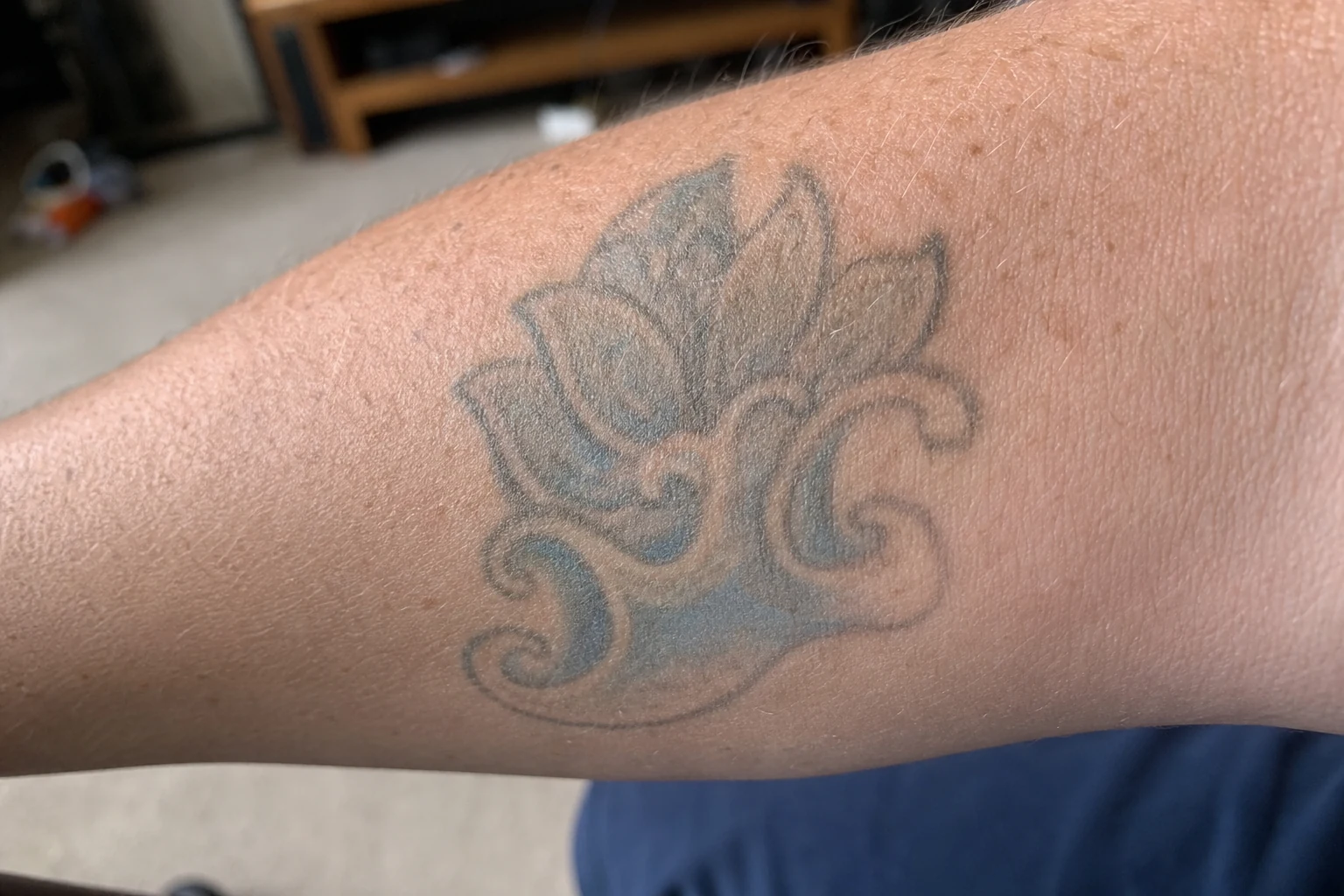 A faint white-ink tattoo.
Treatment day, step by step
Once you are cleared to proceed, a first treatment follows a predictable order:
| Step | What happens | Roughly how long |
|---|---|---|
| 1. Clean & shave | The clinician cleans the skin and shaves any hair over the tattoo so the laser reaches the ink cleanly | 1–2 minutes |
| 2. Protective eyewear | Everyone in the room — you and the operator — puts on wavelength-specific laser safety goggles | Under a minute |
| 3. Numbing (optional) | Some clinics apply cold air, an ice pack or topical numbing cream to reduce the sting | A few minutes |
| 4. The laser | The clinician passes the laser over the ink in rapid, fraction-of-a-second pulses; the tattoo frosts white | Under 5 minutes (small–medium tattoo) |
| 5. Cooling & dressing | The area is cooled and covered with a simple dressing | A few minutes |
| 6. Aftercare & rebooking | You get written aftercare instructions and book the next session ~6–8 weeks out | A few minutes |
Protective eyewear is not optional. Tattoo-removal lasers can cause permanent eye injury, so you and the operator must wear wavelength-specific goggles for the entire time the laser is on — this is a basic, non-negotiable safety step at any legitimate clinic.
The laser itself. Each pulse lasts a fraction of a second. Most people compare the sensation to a hot rubber-band snapped against the skin, repeated rapidly. Within seconds of each pass the treated area turns white — this is frosting, a harmless release of carbon dioxide gas from the shattered ink, and, as the Cleveland Clinic and StatPearls clinical reference describe, it is a normal, expected sign the laser is working. Frosting fades within about 10–30 minutes, after which the skin may look red, swollen or slightly raised. For a small-to-medium tattoo the actual laser work is usually over in under 5 minutes.
Cooling and aftercare
Immediately after, the clinic will cool the area and apply a dressing. Standard aftercare is gentle and low-effort: keep the area clean and moisturised, protect it from the sun, avoid soaking it (pools, hot tubs, long baths) for a few days, and — most important — don't pick at any scabs or blisters, since picking is the main avoidable cause of scarring. Some redness, tenderness, swelling and occasional blistering over the following days is normal healing. Your clinic should tell you which symptoms are expected and which warrant a call back.
What NOT to expect
- Instant results. You will almost certainly leave with the tattoo looking the same, or even temporarily darker and more raised while it heals. Fading is gradual.
- A one-and-done fix. Removal is staged: the laser shatters ink, then your immune system clears it over weeks before the next pass. That is why sessions are spaced.
- A guaranteed session count or outcome. A good clinician gives you a range based on your tattoo, not a promise. No one can honestly guarantee "gone in X sessions" or complete removal in advance.
Booking the next session
Before you leave, you will typically book your next session at least 6–8 weeks out. This spacing — the clearing window — gives your skin time to heal and your immune system time to carry away the shattered ink before the laser passes again. It is mechanism-driven, not a scheduling convenience, and it is why the full course stretches over months even though each session is quick. For the full science of why removal is staged, see our pillar guide, how laser tattoo removal actually works.
Questions to ask at your first visit
- How many sessions do you estimate my tattoo will need, and what's your reasoning?
- Which laser wavelengths do you use for my ink colours?
- Do you perform a patch test?
- What's the price per session, and the estimated total cost?
- Who operates the laser, and what training do they have?
- What does aftercare involve, and what side effects should I watch for?
- What results are realistic for a tattoo like mine — and what might not fully clear?
A clinic that answers these plainly, quotes a range rather than a guarantee, and takes safety steps like patch testing and eye protection seriously is showing you exactly the qualities that matter.
This is general information, not medical advice. Laser tattoo removal is a medical procedure with real risks, including blistering, scarring and pigment change. What happens at your first session, the number of sessions you need, and your results all vary by person and tattoo — consult a licensed provider about your specific situation.
Compare clinics before you book
The single most useful thing you can do before your first session is compare the clinics near you — their lasers, their pricing, whether they patch-test, and how they answer the questions above. The right clinic for your ink and skin can change your session count, your comfort and your total cost.
Compare tattoo-removal clinics in your city to see what's available near you, or start with a dense market like tattoo removal in Melbourne to see how listings and pricing stack up side by side. And before you commit, read our guide on how to choose a tattoo removal clinic — the qualities that separate a good clinic from a risky one.
Related guides
Related Guides
- How It Works
What Is a Q-Switched Laser for Tattoo Removal? (2026)
A Q-switched laser fires nanosecond pulses to shatter tattoo ink. Here's how Q-switched Nd:YAG, ruby and alexandrite lasers work, and why they're still a gold…
- How It Works
What Is a Picosecond Laser for Tattoo Removal? (2026)
What is a picosecond laser? It fires in trillionths of a second to shatter tattoo ink. How it works, the colours it helps, and why it's not always better.
- How It Works
What Affects How Fast a Tattoo Fades? 8 Factors in Removal Speed
What affects tattoo removal speed? Ink colour, depth, age, body location, skin type, your health, smoking, and cover-ups all matter.