UV & Blacklight Tattoo Removal: Why It's So Unpredictable (2026)
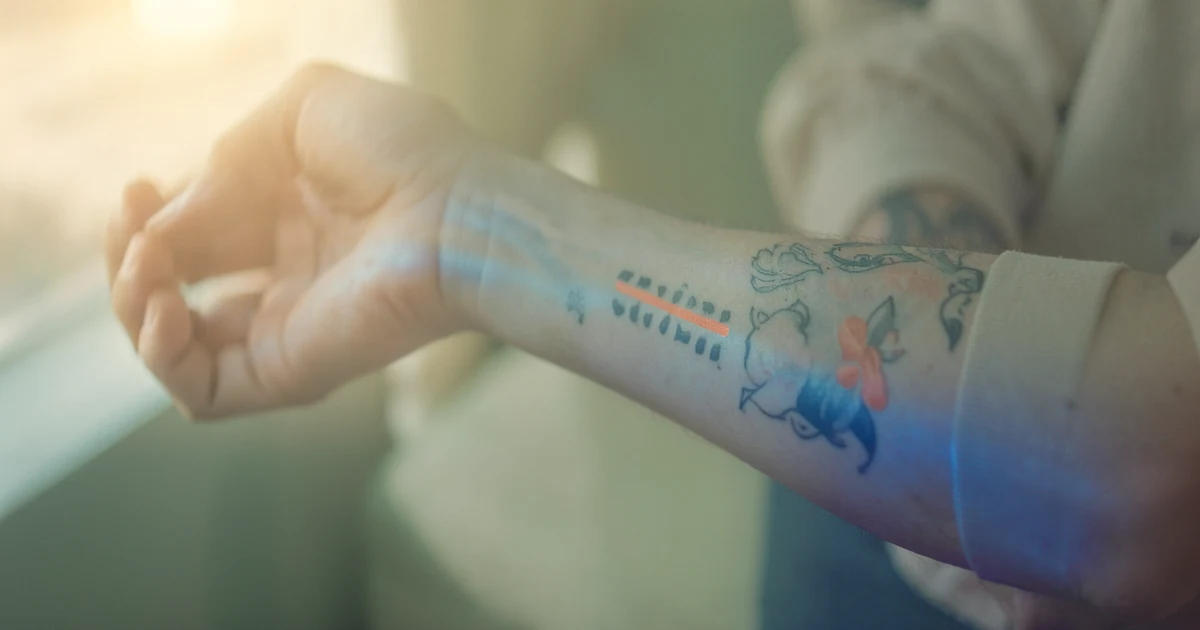
UV and blacklight tattoos are among the most unpredictable tattoos to remove, and many laser specialists are cautious about them or decline them outright. The fluorescent pigments vary widely, are often undisclosed, and don't absorb standard laser wavelengths the way carbon-based black ink does — so the response is inconsistent, published clinical data is scarce, and there is a real risk of paradoxical darkening. Removal is sometimes possible, but only with a test spot and an experienced clinician.
That uncertainty is the whole story here. This guide explains what a UV tattoo actually is (and how it differs from white ink), why the pigment makes removal so hard to predict, what paradoxical darkening means for these inks, and why finding a clinic willing to assess your specific pigment is the first real step — using medical sources and figures from the Tattoo Removal Guide directory, stamped (as of July 2026).
Key Takeaways
- A UV or blacklight tattoo is ink that fluoresces (glows) under ultraviolet light and is faint or invisible in normal daylight — a different mechanism, and different chemistry, from standard ink.
- It is not the same as a white-ink tattoo: white ink is visible and titanium-dioxide-based, UV ink is a near-invisible fluorescent dye. Both are hard to remove, for different reasons.
- UV ink is unpredictable to remove: the exact pigment is usually unknown and doesn't reliably absorb laser wavelengths, so the response is inconsistent — it may fade, resist, or paradoxically darken — and there is little published data.
- A test spot with an experienced clinician is essential before treating the full tattoo — there is no way to predict the reaction otherwise.
- Few clinics readily treat UV ink, so finding one that will assess your specific pigment matters. Across the 5,700 clinics we track across 1,043 cities (as of July 2026), about 18% note picosecond and 15% note Q-switched lasers — a floor, since most don't list their equipment at all — so the right laser is a consultation question, not a marketing label.
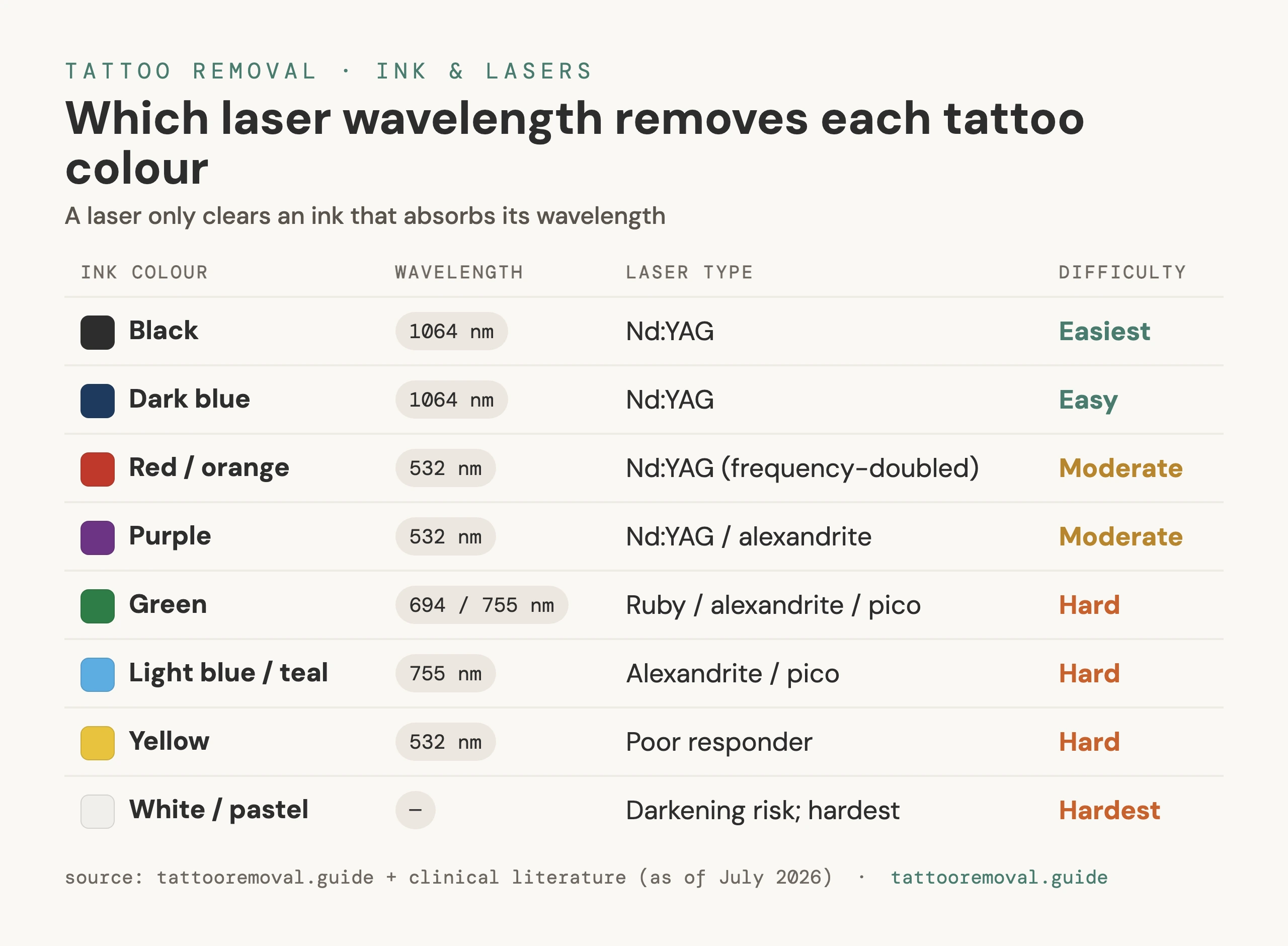 A laser only clears an ink that absorbs its wavelength.
What is a UV or blacklight tattoo?
A UV or blacklight tattoo is one made with ink that fluoresces under ultraviolet light, glowing under a blacklight while appearing faint, pale or nearly invisible in ordinary daylight. Instead of reflecting visible colour the way standard tattoo pigment does, UV ink absorbs ultraviolet light and re-emits it as a visible glow. That different optical behaviour comes from different pigment chemistry — and that is exactly what makes these tattoos so difficult to remove predictably.
There are two broad styles: fully "invisible" UV pieces that only appear under a blacklight, and standard-colour tattoos with UV-reactive highlights layered in. Both share the same removal problem, because the fluorescent pigment behaves differently under a laser than the black and coloured inks a clinic is used to.
One point of confusion worth clearing up: a UV tattoo is not the same as a white-ink tattoo. White ink is an opaque pigment — usually titanium dioxide — that you can see plainly in daylight; UV ink is a fluorescent dye that is near-invisible until a blacklight hits it. They end up in the same "hard to remove" bucket, but for different reasons, which we come back to below.
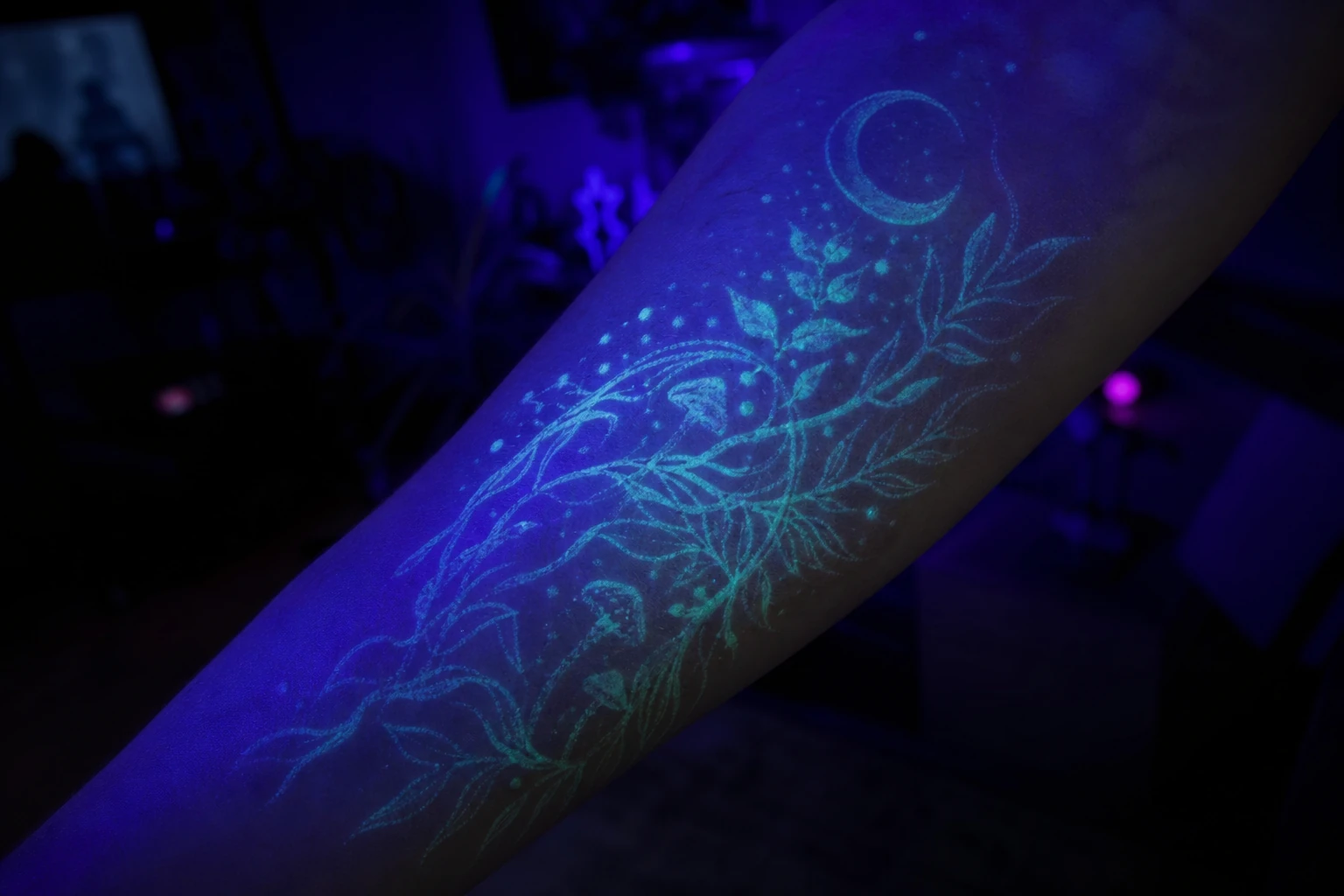 UV/blacklight inks glow under UV light and are often faint in normal light.
What UV ink is actually made of — and why that's a problem
Modern UV-reactive inks generally rely on fluorescent organic dyes — for example coumarin-based compounds, sometimes encapsulated in tiny polymer (PMMA) microspheres — rather than the ingredients in ordinary tattoo pigment. The old fear that these inks contain phosphorus is largely a myth for today's products: early novelty "glow" inks did use phosphorus and were considered toxic, but most modern UV inks have moved away from it. That doesn't make them well understood.
The honest position is that UV ink is poorly characterised and essentially unregulated. As the FDA notes in its tattoos and permanent makeup fact sheet, no tattoo inks are approved for injection into the skin — and many pigments in circulation were never intended for skin contact at all. UV pigments sit at the far end of that spectrum: formulas are often proprietary and undisclosed, some are only cleared for uses like animal identification rather than human tattooing, and there is very little published research on how they behave in the dermis.
Safety data is thin, too. Some sources report more adverse skin reactions to UV ink than to conventional ink — irritation, itching and dermatitis, with occasional documented cases of longer-term inflammation — but the overview from Medical News Today is careful to note there is little solid evidence either way. The takeaway isn't "UV ink is definitely dangerous"; it's that the chemistry is unknown enough that neither your skin's reaction nor the laser's is easy to predict.
Why UV ink is so hard to remove
Laser removal works on a narrow principle: the laser only shatters ink that absorbs its specific wavelength. As the Cleveland Clinic explains, the laser heats pigment particles and breaks them into fragments small enough for the immune system to carry away over the following weeks. Black and dark inks absorb light efficiently, which is why they respond best; that whole process depends on matching the laser to the ink.
With UV ink, that match is a guess. Fluorescent dyes don't absorb the standard removal wavelengths the way carbon-based black pigment does, and the clinician usually doesn't know the exact composition anyway — so they can't be confident which wavelength, if any, it will absorb. On top of that, an "invisible" UV tattoo can give the laser very little visible target to work against. The result is one of three unpredictable outcomes:
| Possible response | What it means |
|---|---|
| Gradual fading | The pigment absorbs the laser and clears like standard ink — the best case, but not guaranteed |
| Little or no response | The pigment doesn't absorb the wavelengths available, so it barely shifts even after several passes |
| Paradoxical darkening | The pigment reacts chemically and turns grey or black instead of fading — sometimes on the first pass |
Because you cannot know in advance which of these you'll get — and because there are so few published studies to draw on — UV removal is inherently a manage-expectations situation. A clinic that promises full, predictable clearance of a UV tattoo sight-unseen is overstating what anyone can know.
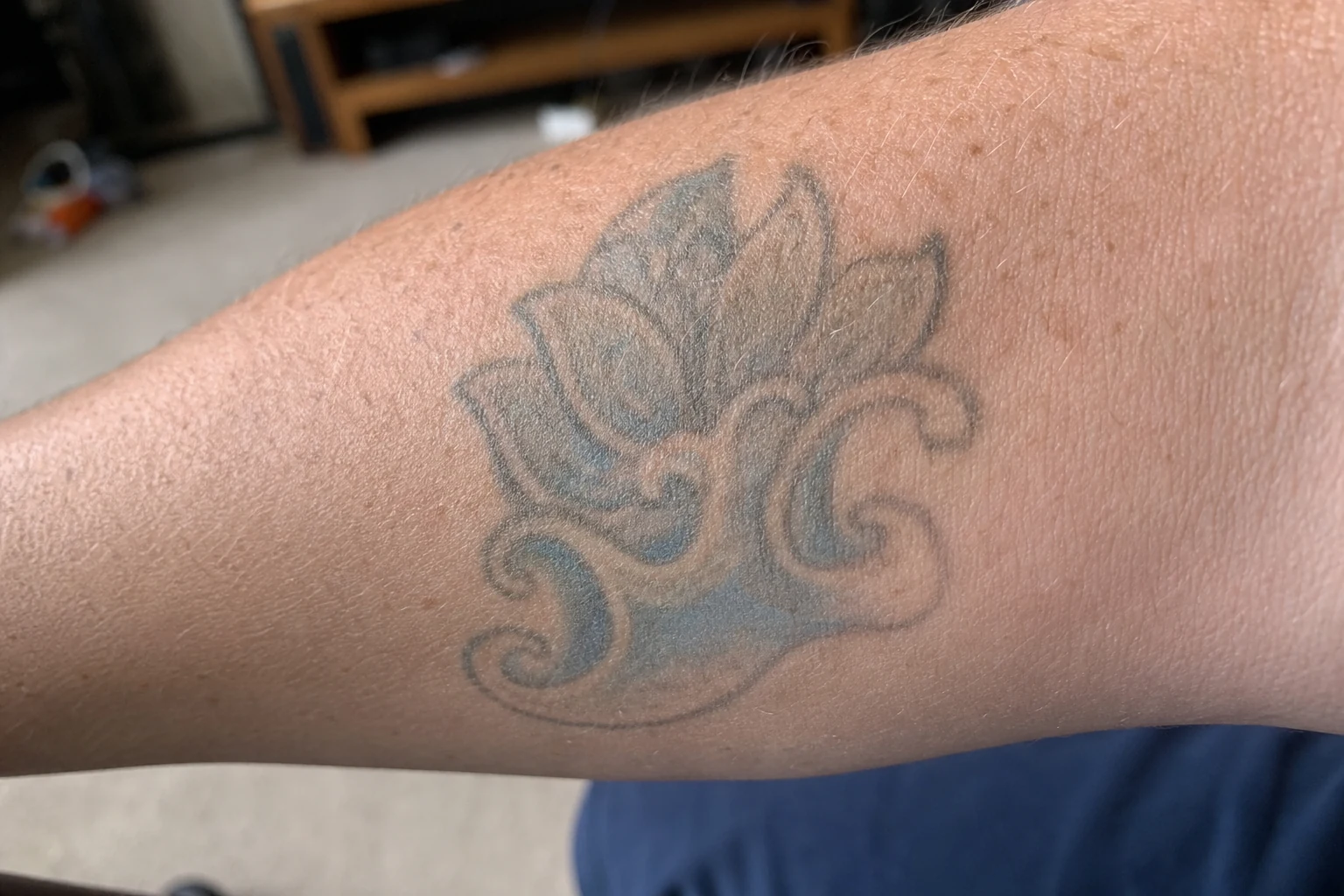 UV ink is often confused with white ink — but they're different pigments entirely.
UV ink vs conventional ink, side by side
| Conventional (black/dark) ink | UV / blacklight ink | |
|---|---|---|
| Visibility | Fully visible in daylight | Faint or invisible until under UV/blacklight |
| Typical pigment | Carbon black + known colour pigments | Fluorescent dyes (e.g. coumarin), sometimes in PMMA microspheres |
| Regulation & disclosure | Unregulated but better characterised | Unregulated, often proprietary and undisclosed |
| Laser absorption | Absorbs standard wavelengths well | Absorbs unpredictably, if at all |
| Removal difficulty | Most responsive to laser | Among the least predictable |
| Published clinical data | Extensive | Very limited |
What paradoxical darkening means for UV ink
Paradoxical darkening is when a laser pulse makes a tattoo look darker instead of lighter, because the pigment undergoes a chemical reduction reaction that shifts its colour toward grey or black. The StatPearls clinical reference on laser tattoo removal documents this with inks containing iron (ferric) oxide or titanium dioxide — compounds common in white, flesh-tone, pastel and some cosmetic inks, which can turn dark after laser treatment.
Here is where UV and white ink rejoin the same story. This is the exact mechanism that makes white ink tattoo removal so tricky. With UV ink, the risk is harder to reason about because the pigment is usually undisclosed — you often can't know whether a darkening-prone compound is present, so it can't be ruled out. Darkened ink can usually still be removed afterward — it then behaves more like dark ink and responds to the wavelengths that clear black — but it typically means more sessions, and a darkened patch you didn't want in the meantime.
The test spot and the experienced clinician
Given all that uncertainty, one safeguard is non-negotiable: a test spot. A clinician treats a small, discreet area of the tattoo, then waits several weeks to see whether the ink fades, stays put, or darkens — before committing to the whole piece. It is the only reliable way to see how your specific pigment reacts, because the ink label won't tell you, the published literature is thin, and a photo of someone else's result won't either.
Just as important is who holds the laser. UV removal calls for a clinician experienced with unpredictable and light-coloured pigments, who can adjust wavelengths and settings, recognise early darkening, and change the plan rather than push blindly ahead. The American Academy of Dermatology recommends seeking a qualified provider for laser removal generally — and that advice matters most with the inks hardest to predict.
Finding a clinic that will treat UV ink
The honest reality is that many clinics will not readily take on UV and blacklight tattoos. Faced with variable, undisclosed chemistry, an inconsistent laser response, the darkening risk, and little evidence to guide settings, cautious clinicians either decline outright or insist on a test spot first. That caution is a feature, not a red flag: it's a clinic taking the uncertainty seriously.
So the practical first step isn't booking a full course — it's finding a specialist willing to assess your specific ink and run a test spot. Because the lasers on hand and the willingness to treat difficult pigments vary from clinic to clinic, comparing your local options is the most useful thing you can do. UV ink is one of the trickiest cases in the broader story of the hardest tattoo colours to remove.
This is general information, not medical advice. Laser tattoo removal is a medical procedure with real risks (blistering, scarring, pigment change), and UV inks add extra uncertainty. Outcomes vary by person, ink and tattoo — consult a licensed provider about your specific situation.
Compare clinics before you commit
If you have a UV or blacklight tattoo you want gone, don't assume the first clinic you find will take it on — or should. Look for a specialist who will assess your specific ink and start with a test spot.
Find a clinic that will assess UV ink in your city to see what's available near you, or start with a dense market like tattoo removal in Melbourne to compare which clinics list the lasers and experience that matter for difficult pigments.
Frequently asked questions
Can UV tattoos be removed?
Sometimes, but UV and blacklight tattoos are among the most unpredictable inks to remove, and many laser specialists are cautious or decline them. The fluorescent pigments vary widely, are often undisclosed, and don't absorb standard laser wavelengths the way carbon-based black ink does — so the response is inconsistent and can include paradoxical darkening. There is very little published clinical data. A test spot with an experienced clinician is essential before any full treatment.
What is a UV or blacklight tattoo?
A UV or blacklight tattoo is one made with ink that fluoresces — glows — under ultraviolet (blacklight) light, appearing faint or invisible in normal daylight. The pigment absorbs UV and re-emits it as a visible glow rather than reflecting ordinary colour. That is a different mechanism from standard tattoo ink, which is why the chemistry differs and laser removal is harder to predict. It is not the same as a white-ink tattoo.
Are UV tattoos the same as white ink tattoos?
No. A white-ink tattoo uses opaque white pigment (usually titanium dioxide) that you can see in ordinary light. A UV or blacklight tattoo uses a fluorescent dye that is near-invisible in daylight and only glows under UV. Both are difficult to remove, but for different reasons — white ink is prone to paradoxical darkening, while UV ink is poorly characterised and gives an inconsistent laser response.
Why are UV tattoos so hard to remove?
UV inks use fluorescent pigments whose exact chemistry is often unknown, even to the clinic removing them, and those pigments don't reliably absorb the wavelengths a laser is tuned to. Because a laser can only shatter ink that absorbs its wavelength, an unknown pigment gives an unpredictable response — it may fade slowly, barely respond, or paradoxically darken. Published research on removing them is scarce, which is why many specialists treat UV ink with extra caution.
What is paradoxical darkening?
Paradoxical darkening is when a laser pulse makes a tattoo look darker instead of lighter, because certain pigments undergo a chemical reduction reaction that shifts their colour toward grey or black. StatPearls documents it with inks containing iron (ferric) oxide or titanium dioxide, common in white, flesh-tone, pastel and some cosmetic inks. It can happen on the very first pass — and because UV pigment chemistry is usually undisclosed, it can't be ruled out, which is one reason a test spot matters.
Are UV tattoo inks safe?
Their safety is not well established and the data is limited. The FDA notes that no tattoo inks are approved for injection into the skin, and UV-reactive inks are essentially unregulated. Older novelty "glow" inks used phosphorus and were considered toxic; most modern UV inks use fluorescent dyes instead, but the formulas are often proprietary and poorly studied for intradermal use. Some reports describe higher rates of skin irritation and dermatitis than conventional ink.
Do I need a test spot before removing a UV tattoo?
Yes. A test spot treats a small, discreet area first and waits several weeks to see whether the ink fades, stays the same, or darkens. Because UV pigment composition is usually unknown and its laser response is inconsistent — with little published data to fall back on — a test spot is the only reliable way to gauge how your specific ink will react before committing to the whole tattoo.
Why won't some clinics treat UV tattoos?
Many clinics decline UV and blacklight tattoos because the ink chemistry is variable and undisclosed, the laser response is inconsistent, there is a real risk of paradoxical darkening, and there is little evidence to guide settings. Rather than promise a result they can't predict, cautious clinicians either refuse or insist on a test spot first. Finding one who will assess your specific ink matters more than for a standard black tattoo.
Related guides
Related Guides
- Ink & Colours
Selective Tattoo Removal: Erasing Part of a Tattoo (2026)
Selective tattoo removal targets one part of a tattoo — a name, a figure, one colour — while leaving the rest.
- Ink & Colours
Removing an Ex-Partner's Name Tattoo: Your Options in 2026
Removing an ex's name tattoo? A partner's name is one of the most-removed tattoos — and small black lettering is among the quickest and cheapest to clear.
- Ink & Colours
Name & Lettering Tattoo Removal
Name and lettering tattoos are usually small and black, so per-unit they're among the easier tattoos to remove — but dense, deep script needs patience.