Tattoo Removal on Dark Skin: The Laser & Wavelength That Matter
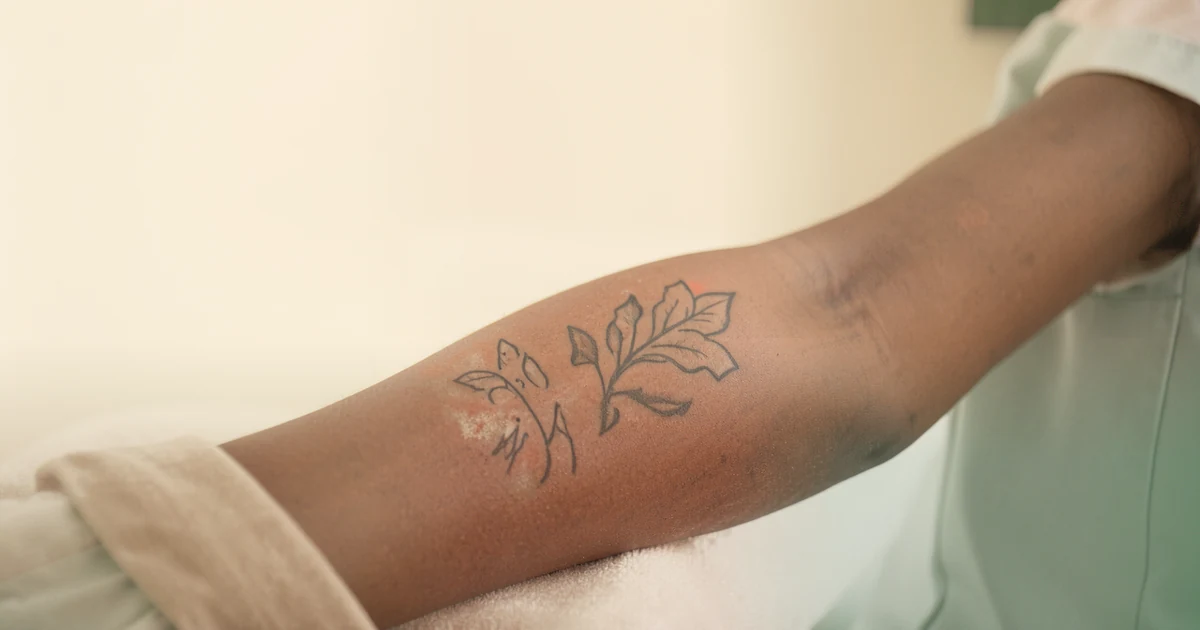
Tattoo removal on dark skin is possible and can be done safely, but skin in the Fitzpatrick IV–VI range carries a higher risk of pigment change because melanin competes with the ink for the laser's energy. The single most important factor is the wavelength: a 1064nm Nd:YAG laser is the safer choice for deeper skin tones, paired with conservative settings and a patch test.
Key Takeaways
Yes, you can remove a tattoo on dark skin — dermatologists do it routinely — but the margin for error is smaller than on fair skin. In darker skin (Fitzpatrick IV–VI), your natural melanin sits close to the surface and absorbs many of the same wavelengths that target tattoo ink. Choose the wrong laser and you risk lightening (hypopigmentation) or darkening (hyperpigmentation) the skin itself. Choose the right one — usually a 1064nm Nd:YAG, at conservative energy, with wider gaps between sessions and a patch test first — and the risk drops substantially.
The practical upshot: the machine in the room matters more for you than for almost anyone else, and the single best thing you can do is ask a clinic which wavelength they'll use on your skin before you book.
This is general information, not medical advice. Always consult a licensed medical provider about your own skin and situation.
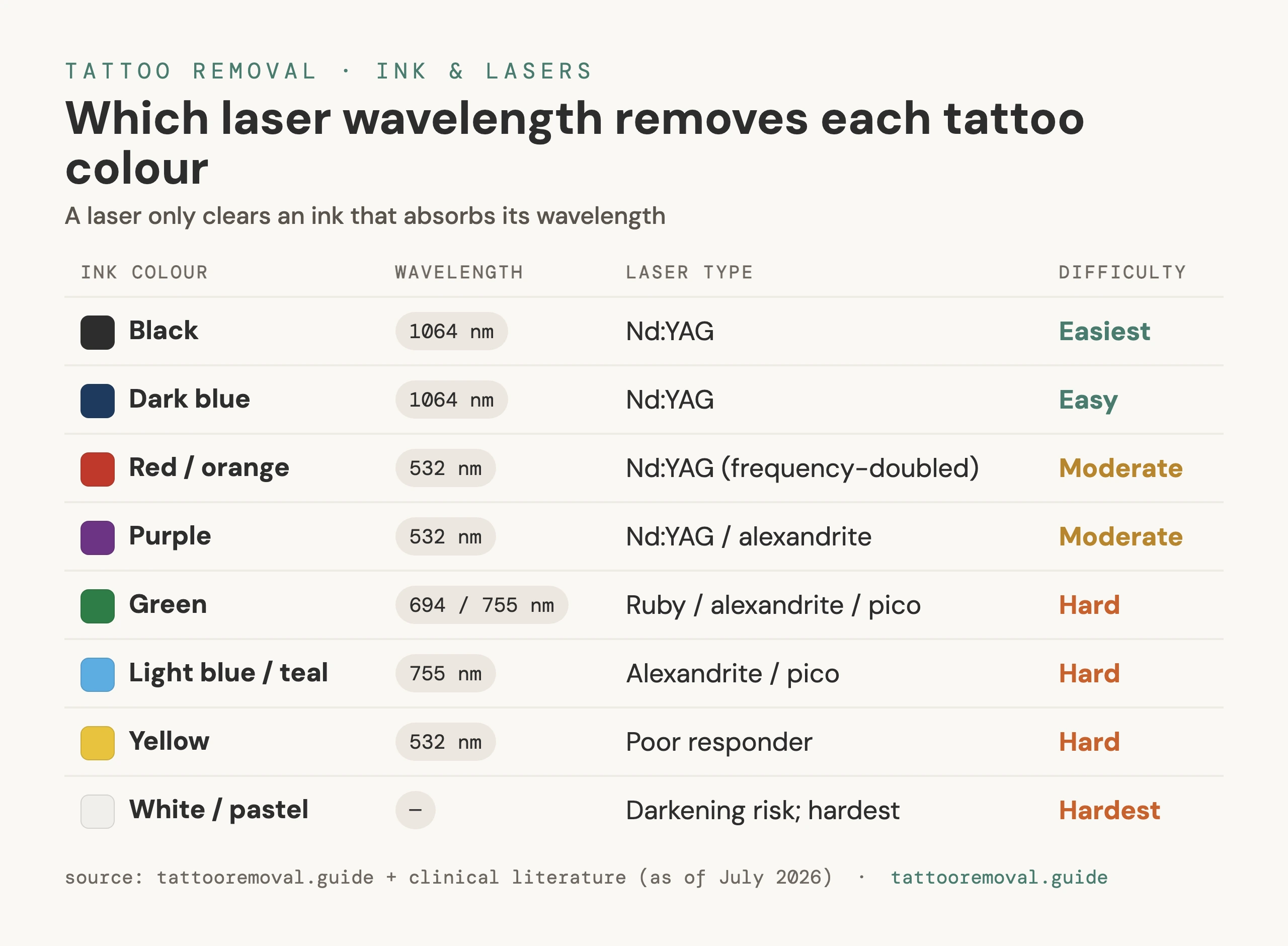 A laser only clears an ink that absorbs its wavelength.
Can you remove a tattoo on dark skin? The short answer
Yes. Laser removal is the mainstream, regulator-endorsed method for all skin tones — the U.S. Food & Drug Administration points to lasers as the standard approach and warns against DIY creams and home devices, which carry their own scarring and reaction risks (FDA). What changes with deeper skin isn't whether removal works, but how carefully it has to be done.
The reason is simple physics. Melanin is the pigment that gives skin, hair and eyes their colour, and it absorbs light strongly across much of the visible and near-infrared range — the same range lasers use to shatter tattoo ink. In fair skin there's little melanin to get in the way, so the laser's energy lands mostly on the ink. In Fitzpatrick IV–VI skin there's far more melanin near the surface, so a poorly matched wavelength heats your skin's own pigment alongside the ink. That competition is what drives the elevated risk of pigment change.
None of that makes removal off-limits. It makes wavelength selection, energy settings and provider skill the whole game.
 Dense black ink — the easiest colour to clear.
The Fitzpatrick scale, briefly
The Fitzpatrick scale is a six-point classification of skin type based on how skin reacts to sun exposure — Type I (very fair, always burns, never tans) through Type VI (deeply pigmented brown-black, never burns). Clinics use it as a shorthand for how much melanin your skin carries and, from that, how much pigment-change risk a given laser and setting present.
For tattoo removal, the meaningful dividing line is roughly Fitzpatrick IV–VI. If you tan easily and rarely burn, or have brown to deep-brown skin, you're in the range where wavelength choice stops being a technicality and becomes the safety decision. A clinic that treats a Type V patient exactly as it treats a Type II patient is a clinic to walk away from.
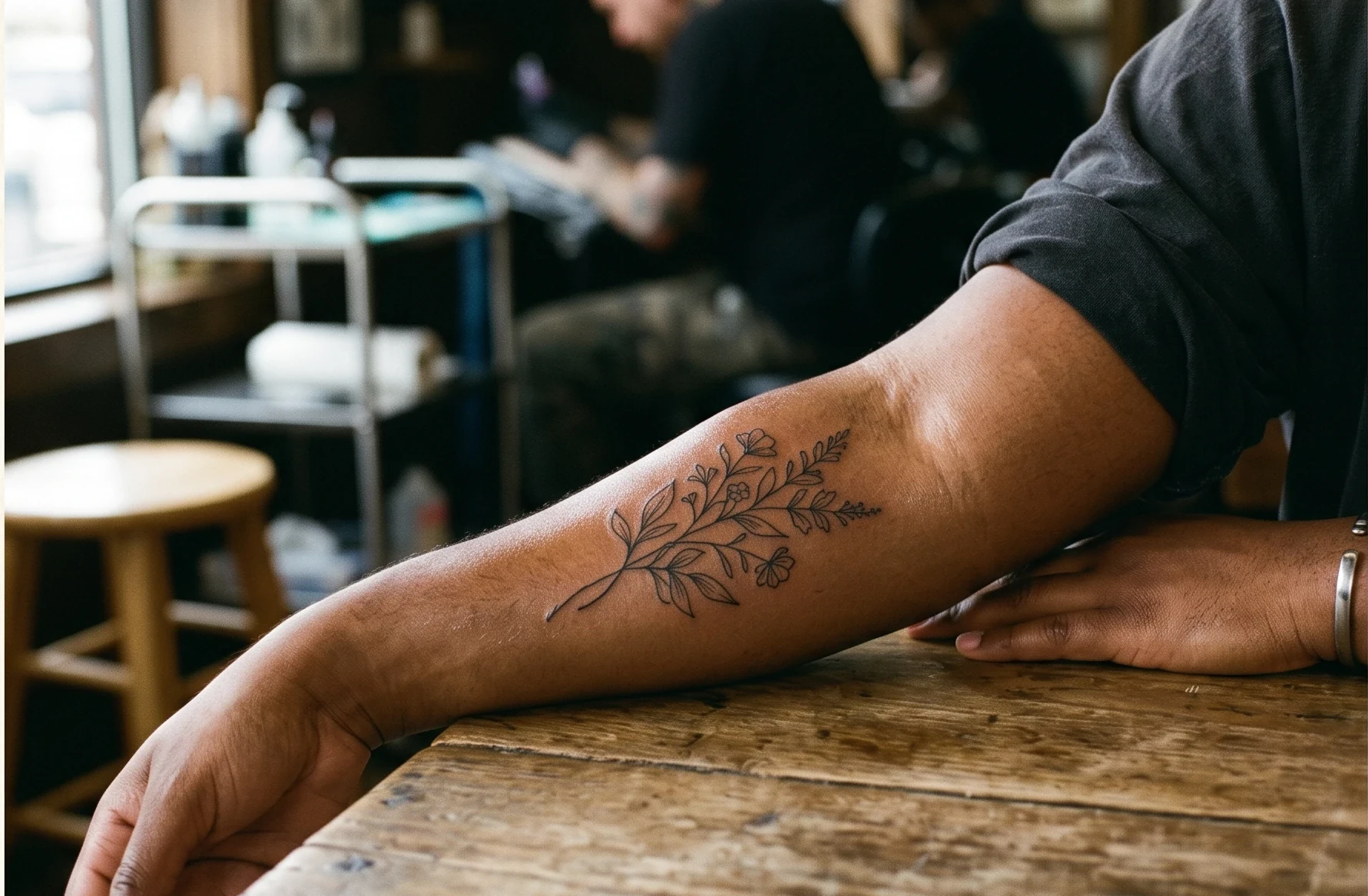 Dense black ink — the easiest colour to clear.
Which laser and wavelength for dark skin?
Different lasers emit different wavelengths, and each wavelength is absorbed differently by melanin versus ink. That's the crux of safe removal on dark skin: you want a wavelength that ink absorbs well but melanin absorbs poorly.
- 1064nm Nd:YAG — the safer default for dark skin. This near-infrared wavelength is absorbed relatively little by melanin, so it penetrates to the ink with less collateral heating of your skin's pigment. It's especially effective on black and dark-blue ink, which happen to be the most common tattoo colours. For Fitzpatrick IV–VI, this is the wavelength most dermatologists reach for first.
- Picosecond systems can help. Picosecond lasers deliver their energy in trillionths of a second rather than billionths, shattering ink more by photomechanical effect and often allowing lower fluence (energy). Used at 1064nm, a picosecond system can be a strong option for darker skin — but the wavelength still matters more than the pico-versus-Q-switched label. Both Q-switched and picosecond lasers are effective and FDA-cleared; neither is categorically superior.
- Older ruby (694nm) and green (532nm) lasers are usually avoided. These sit close to melanin's absorption peak, so on darker skin they heat skin pigment aggressively and carry a much higher risk of hypopigmentation and blistering. They still have a role for certain ink colours on fair skin, but they're generally the wrong tool for Fitzpatrick IV–VI.
Wavelength suitability for dark skin (Fitzpatrick IV–VI)
| Laser / wavelength | Melanin absorption | Best on these inks | Suitability for dark skin |
|---|---|---|---|
| 1064nm Nd:YAG (Q-switched or picosecond) | Low | Black, dark blue | Preferred — the safer default for Fitzpatrick IV–VI |
| 785nm picosecond | Low–moderate | Blue, green | Can be suitable — with caution, conservative settings |
| 755nm alexandrite | Moderate | Green, blue | Use with caution; higher pigment-change risk on deep skin |
| 694nm ruby | High | Green, blue, black | Generally avoided on dark skin |
| 532nm (frequency-doubled Nd:YAG) | High | Red, orange, yellow | Higher risk on dark skin; needs an experienced provider |
Wavelengths are absorbed differently by melanin and by ink — the goal on dark skin is high ink absorption, low melanin absorption. General guidance only; your provider decides based on your skin and ink. Colour inks like red or green may still need a higher-melanin-absorbing wavelength, which is exactly the trade-off a specialist manages.
Colour is the complication here. Reds, oranges and greens respond best to the very wavelengths (532nm, ruby, alexandrite) that are riskiest on dark skin — so a multicolour tattoo on Fitzpatrick V skin is a genuine specialist job, not a walk-in. Our guide to the hardest tattoo colours to remove explains the colour-to-wavelength map in full.
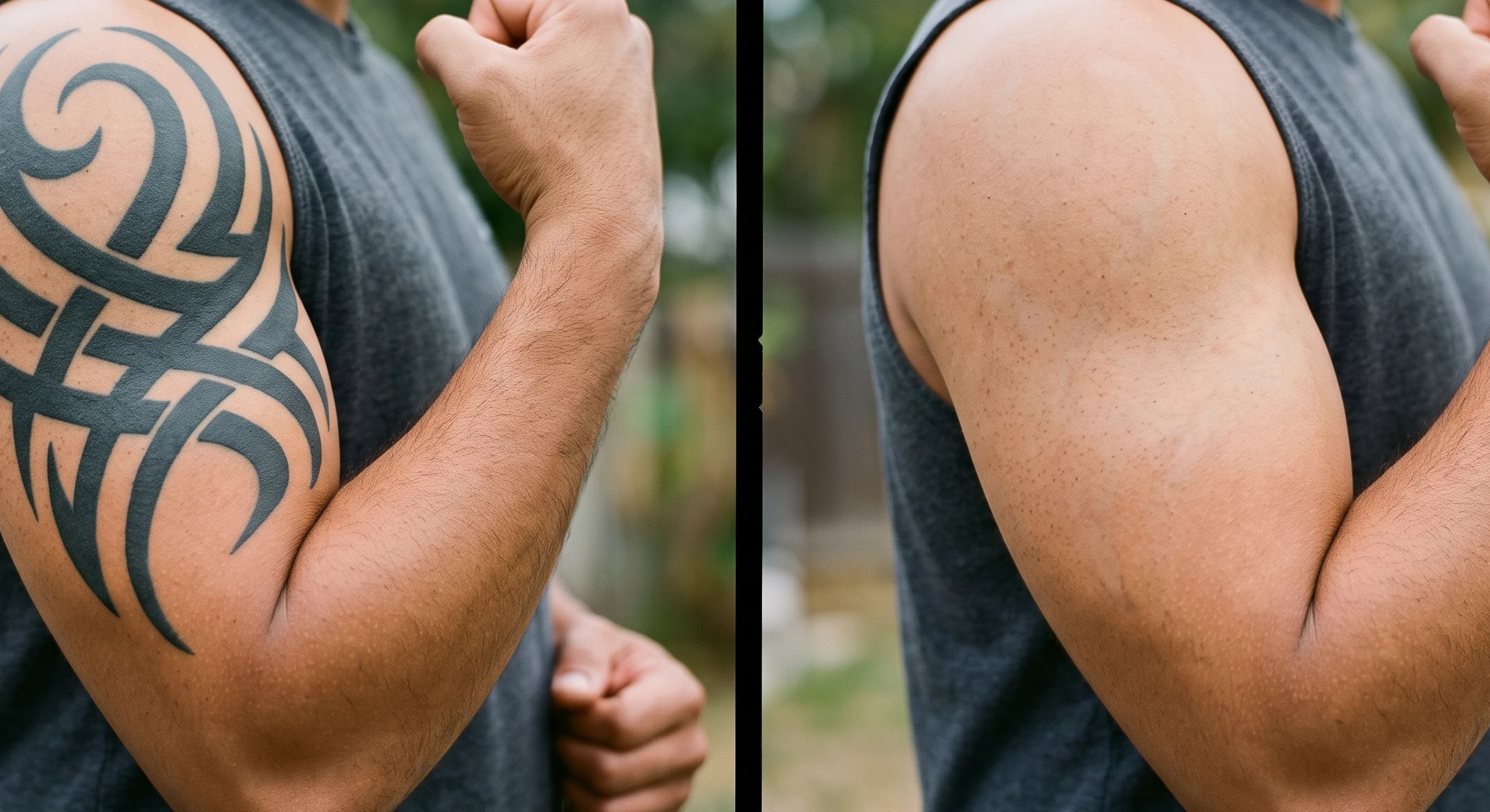 After a full course, only a faint 'ghost' — a barely-visible pale mark — may remain. Illustrative; results vary.
What "done safely" actually looks like
The right wavelength is necessary but not sufficient. On darker skin, careful providers also adjust the how:
- Conservative energy settings. Lower fluence reduces collateral heating of melanin. It may mean more sessions, but that's the trade a good clinician makes to protect your skin.
- Wider spacing between sessions. Many providers extend intervals — often to eight weeks or more — on darker skin, giving pigment time to settle and lowering the chance of stacking damage. Session counts and spacing vary by person; treat any promise of an exact number with suspicion.
- A mandatory patch test. A small test spot, watched over a few weeks, shows how your skin responds before committing the whole tattoo. On Fitzpatrick IV–VI this isn't optional politeness — it's the core safety step.
- Strict sun protection and aftercare. Tanned or sun-exposed skin has even more active melanin, which raises pigment-change risk; providers usually wait for a tan to fade and insist on diligent sun protection between sessions.
The two pigment risks to understand are hypopigmentation (the treated skin loses colour and looks lighter than the surrounding area, which can be long-lasting or permanent) and hyperpigmentation (the skin over-produces melanin and darkens, which often fades over months but can persist). Both are more common in deeper skin tones, which is precisely why the conservative approach exists. These mechanisms are described by the Cleveland Clinic, NCBI StatPearls and the American Academy of Dermatology.
Paradoxical darkening: a separate risk to know
One effect that surprises people is paradoxical darkening — when a tattoo turns darker immediately after a laser pulse instead of lightening. It happens when the laser chemically reduces certain pigments (often iron oxide or titanium dioxide, common in cosmetic, white, tan and flesh-toned inks) into a darker compound. It isn't caused by skin tone, but it's another reason a patch test matters, because darkened pigment can be harder to remove afterward. If your tattoo includes cosmetic or light "skin-tone" inks, flag it and insist on a test spot.
The one question to ask every clinic
If you take a single thing from this page, make it this: before you book, ask "Which laser and wavelength will you use on my skin tone?"
A clinic that's equipped for darker skin will answer without hesitation — naming a 1064nm Nd:YAG (or a picosecond system used at 1064nm), explaining that it'll start conservative and space your sessions out, and offering a patch test. A clinic that fumbles the question, waves it away, or doesn't know its own wavelengths is telling you something important. This is a medical procedure; the equipment isn't a detail.
Because equipment genuinely varies from clinic to clinic, matching the laser to your skin is a filtering step, not a leap of faith. Across the Tattoo Removal Guide directory, only about 18% of the 5,700 specialist clinics we track publicly note a picosecond laser and about 15% note a Q-switched laser (as of July 2026) — most listings don't state their laser type at all, which is itself the reason to ask directly rather than assume. You can compare clinics and see who lists their laser type so you only consult places that can run the wavelength suited to you, then confirm the specifics at consultation. Comparing a few clinics in your city — for example, tattoo-removal clinics in Melbourne — lets you line up equipment, transparency and reviews before a laser ever touches your skin.
The honest bottom line
Tattoo removal on dark skin is a well-established, routine procedure — not a reason to give up on removal. But the safety margin is narrower than on fair skin, and it rests almost entirely on getting the wavelength and settings right. A 1064nm Nd:YAG laser (Q-switched or picosecond), conservative energy, wider session spacing and a mandatory patch test are the pillars of doing it safely on Fitzpatrick IV–VI skin. No provider can guarantee a perfect result or zero pigment change — anyone who does is overpromising — but a clinic that can clearly explain its wavelength choice for your skin is showing you the right kind of care. Vetting that, and comparing a few options first, is the whole point of an independent directory: no clinic pays us to rank higher, so the checking is yours to do.
For the full picture on side effects, contraindications and who should wait, see our pillar guide, is laser tattoo removal safe?
This article is general information, not medical advice. It cannot account for your individual skin, health or ink, and no outcome can be guaranteed. Consult a licensed medical provider before starting treatment. Directory figures are a point-in-time snapshot (as of July 2026) and drift as clinics update their listings.
Frequently asked questions
Can you remove a tattoo on dark skin?
Yes. Laser tattoo removal can be performed safely on dark skin (Fitzpatrick IV–VI), but it carries a higher risk of pigment change because melanin competes with the ink for the laser's energy. The key is the right laser and wavelength — usually a 1064nm Nd:YAG — plus conservative settings, wider session spacing and a mandatory patch test.
What laser is best for tattoo removal on dark skin?
A 1064nm Nd:YAG laser is generally considered the safest wavelength for dark skin (Fitzpatrick IV–VI), because 1064nm light is absorbed less by melanin and reaches the ink with less collateral effect on surrounding pigment. Picosecond systems at 1064nm can add benefit. Older 694nm ruby and 532nm lasers sit near melanin's absorption peak and are usually avoided.
Is laser tattoo removal safe for black skin?
It can be safe when a trained provider uses a melanin-sparing wavelength like 1064nm Nd:YAG, conservative energy, longer intervals between sessions and a patch test first. The main risks are hypopigmentation (lightening) and hyperpigmentation (darkening), which are more common in deeper skin tones. No provider can guarantee an outcome, so vetting the clinic and equipment matters most.
What is the Fitzpatrick scale?
The Fitzpatrick scale is a six-point classification of skin type based on how skin responds to sun — from Type I (very fair, always burns) to Type VI (deeply pigmented, never burns). In tattoo removal it's used to estimate melanin levels and pigment-change risk. Fitzpatrick IV–VI skin has more melanin, which raises the risk of hypo- or hyperpigmentation.
Why does dark skin have a higher risk during tattoo removal?
Melanin, the pigment that gives skin its colour, absorbs many of the same laser wavelengths that target tattoo ink. In darker skin there is more melanin near the surface, so a poorly chosen wavelength heats the skin's own pigment as well as the ink. That competition raises the risk of hypopigmentation, hyperpigmentation and, less often, blistering or scarring.
What is paradoxical darkening?
Paradoxical darkening is when a tattoo turns darker immediately after a laser pulse instead of lightening. It happens when the laser chemically alters certain pigments — often iron oxide or titanium dioxide in cosmetic, white, tan or flesh-toned inks — creating a darker compound. It is not unique to dark skin, but it's a reason to insist on a test spot before treating the full tattoo.
What should I ask a clinic before tattoo removal on dark skin?
Ask one specific question first: "Which laser and wavelength will you use on my skin tone?" A good answer names a 1064nm Nd:YAG (or a picosecond system used at 1064nm), explains conservative settings and wider spacing for Fitzpatrick IV–VI, and offers a patch test. If a clinic can't answer clearly or dismisses the question, treat that as a reason to compare other clinics.
Ready to vet a clinic properly? Compare tattoo-removal clinics in your city — see who lists their laser type and check for the 1064nm Nd:YAG that suits deeper skin tones before you book a consultation.
Related guides
Related Guides
- Safety & Risks
Why a Patch Test Matters Before Tattoo Removal (2026)
Why does a patch test matter before laser tattoo removal? It reveals how your skin and ink react — blistering, pigment change, rare reactions — before a full…
- Safety & Risks
Who Should Not Get Laser Tattoo Removal? The Contraindications
Who should not get laser tattoo removal? Most adults are candidates. The full contraindications checklist — when to wait and when to discuss carefully.
- Safety & Risks
Tattoo Removal While Pregnant or Breastfeeding
Can you get tattoo removal while pregnant? Most providers say wait — not from proven harm, but because the safety isn't studied.