Hypopigmentation After Tattoo Removal: Why Skin Turns Lighter (2026)
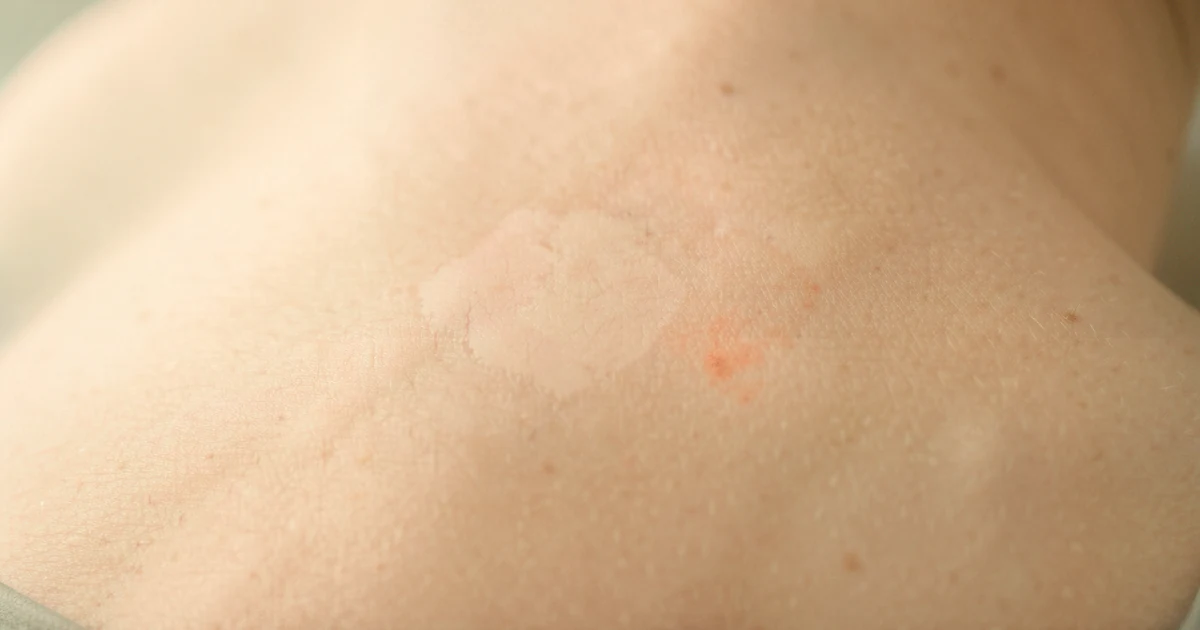
Hypopigmentation after laser tattoo removal is a lighter patch of skin left where pigment-producing cells were disrupted during treatment. It is usually temporary but can be slow to recover — often several months to a year — and in a minority of cases it lasts much longer. It is more likely on darker skin, and it is a colour change, not a scar.
If the skin where your tattoo used to be now looks paler than the skin around it, this guide explains why that happens, how it differs from hyperpigmentation (darkening), who is most at risk, and what genuinely helps — using medical sources and figures from the Tattoo Removal Guide directory, stamped (as of July 2026).
Key Takeaways
- Hypopigmentation = a lighter patch from reduced or lost melanin; it tends to recover slowly (often months to a year) and occasionally lasts longer.
- Its opposite, hyperpigmentation, is a darker patch that usually fades faster — see our sibling guide, hyperpigmentation after tattoo removal.
- It is more likely on darker skin (Fitzpatrick IV–VI) and after aggressive settings or the wrong wavelength.
- It is not a scar (a texture change) — it is a flat colour change, though the two can occur together.
- No treatment guarantees it back to normal. Good clinics lower the odds with the right wavelength, conservative settings, spacing, a patch test and sun protection. Of the 5,700 clinics we track across 1,043 cities, about 18% note picosecond lasers and 15% note Q-switched (as of July 2026) — both are effective, and the melanin-sparing choice for darker skin is usually the 1064nm wavelength either device can deliver.
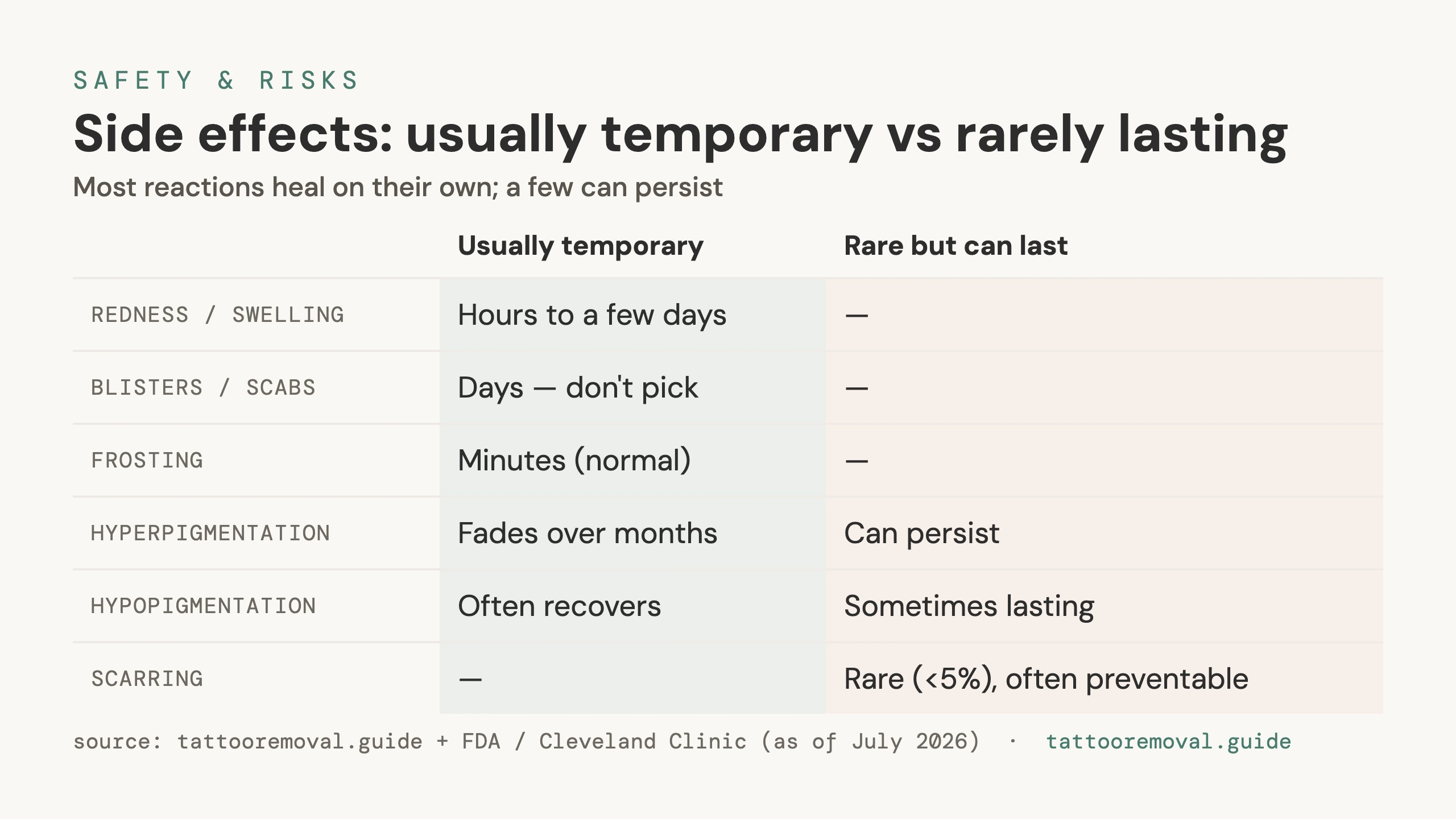 Hypopigmentation is usually temporary — occasionally longer-lasting.
What is hypopigmentation after tattoo removal?
Hypopigmentation is a lighter patch of skin caused by reduced or disrupted production of melanin — the pigment that gives skin its colour. After laser tattoo removal it appears when the treatment interferes with the melanocytes (the pigment-making cells) in the treated area, so that patch produces less pigment than the skin around it and looks paler, sometimes almost white.
It is a recognised side effect of laser removal, not a sign that something went badly wrong. The FDA's fact sheet on tattoos and permanent makeup lists skin colour changes among the known risks of removal, and the American Academy of Dermatology notes that treated skin can end up lighter or darker than the surrounding skin. In most people the melanocytes gradually recover and the patch repigments over several months to about a year. It is a pigment shift, not permanent tissue damage — though, as below, it is the pigment change more likely to linger.
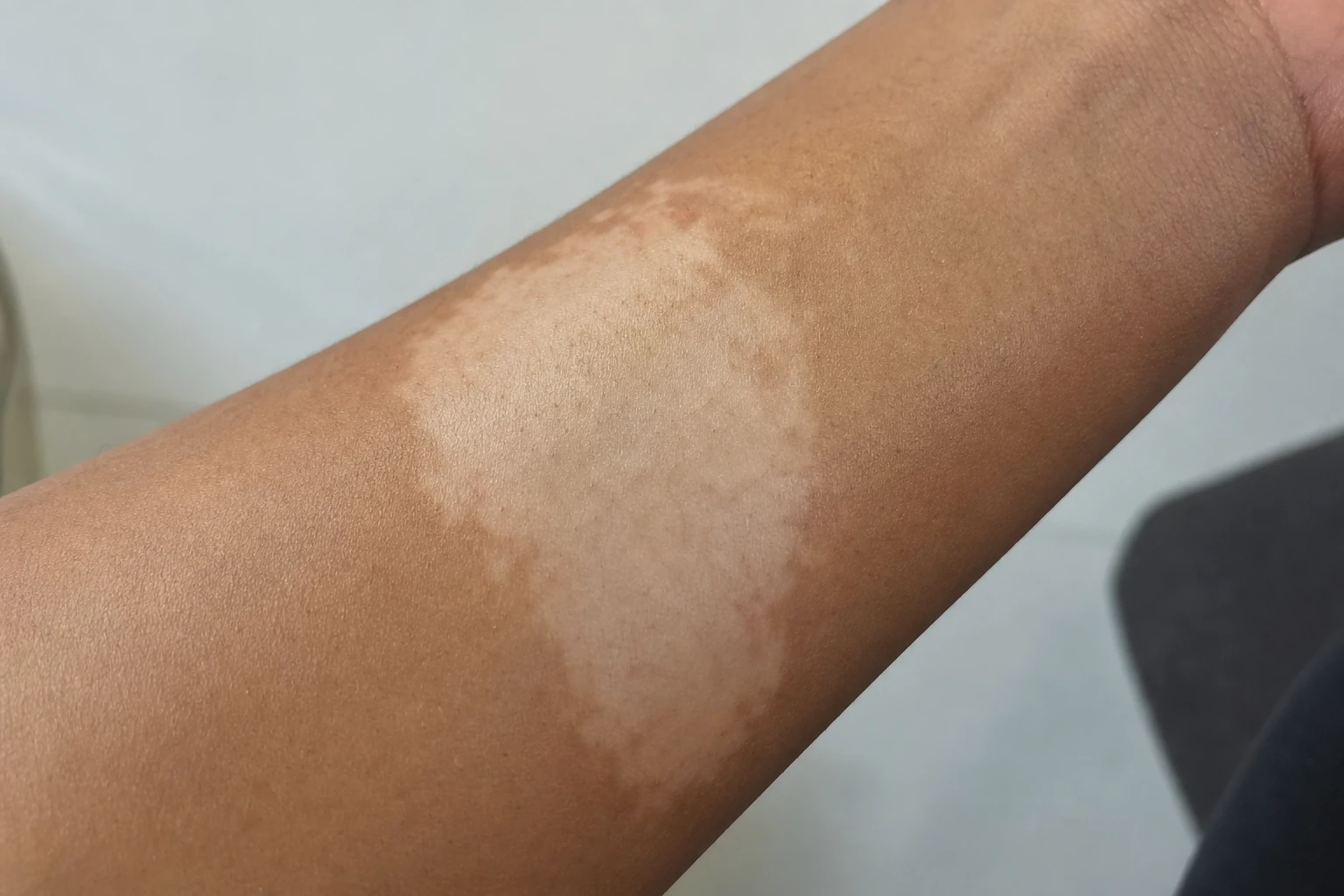 Hypopigmentation — a lighter patch where the skin lost pigment after treatment.
Hypopigmentation vs hyperpigmentation
The two pigment changes are opposites, and telling them apart matters because they behave differently. Hyperpigmentation is a darker patch from the skin over-producing melanin after irritation; hypopigmentation is a lighter patch from the skin producing too little. Hyperpigmentation usually fades over weeks to months, while hypopigmentation is typically the slower of the two to resolve.
| Hypopigmentation | Hyperpigmentation | |
|---|---|---|
| Appearance | Lighter patch (pale, sometimes near-white) | Darker patch (tan, brown, grey-brown) |
| Cause | Skin under-produces melanin; pigment cells disrupted | Skin over-produces melanin after irritation |
| Typical course | Often slower — months to a year, occasionally longer | Usually fades over weeks to months |
| Risk factors | Darker skin, aggressive settings, wrong wavelength, poor aftercare | Darker skin, sun exposure, irritation, picking scabs |
| Texture | Normal (flat) | Normal (flat) |
Both are flat colour changes — you can see them but not feel them. That is also what separates them from scarring, which is a change you can feel. For the full picture on darkening, see the sibling guide, hyperpigmentation after tattoo removal.
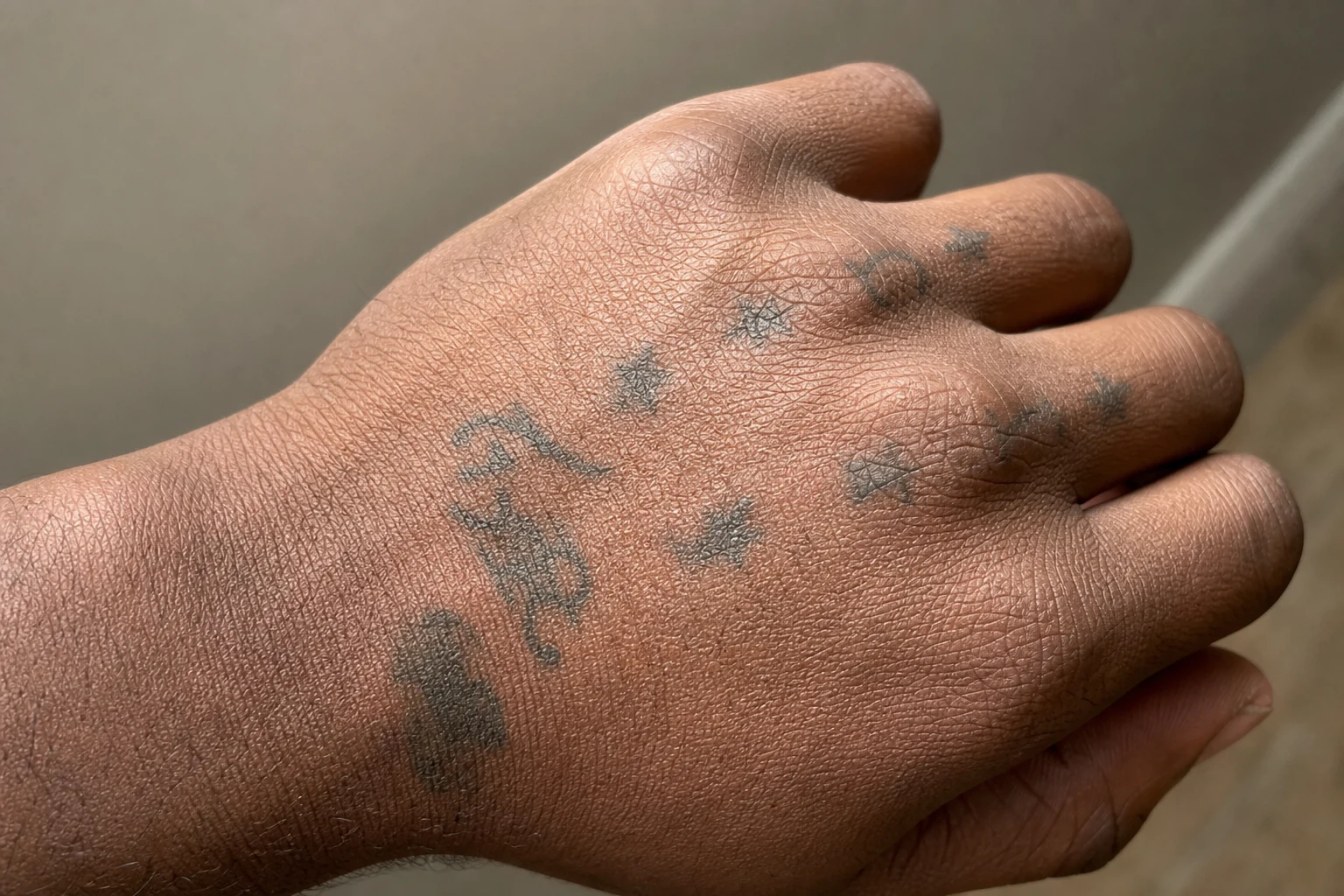 Hands and fingers clear slowly.
Why does it happen?
A tattoo-removal laser works by targeting pigment. The problem is that melanin in your skin is pigment, so the laser cannot perfectly tell tattoo ink from the pigment in the surrounding skin. When the energy is absorbed by melanocytes rather than only by ink, those cells can be damaged or temporarily switched off — and the patch they were colouring turns lighter.
The StatPearls clinical reference on laser tattoo removal describes this competition between skin melanin and tattoo ink for the laser's energy, and lists pigment change as a known complication. It becomes more likely when the settings are too aggressive (too much energy), when the wavelength is a poor match for the skin tone, or when the skin has not fully healed between sessions. In other words, it is largely driven by how the treatment is delivered — which is exactly why clinic technique matters so much.
Who is most at risk?
Hypopigmentation is not equally likely for everyone. The people and situations most at risk are:
- Darker skin tones (Fitzpatrick IV–VI). More melanin in the skin means more competition for the laser's energy, so pigment disruption is more likely. This is a risk to manage, not a reason to avoid removal.
- Aggressive, high-energy treatment. Pushing fluence too high to clear ink faster raises the chance of collateral damage to pigment cells.
- The wrong wavelength for the skin tone. Wavelengths more readily absorbed by melanin increase the risk on darker skin.
- Poor aftercare and picking scabs. Disturbing the healing skin can worsen pigment changes and invite scarring.
- Crowded sessions and sun exposure. Not letting skin fully recover between passes, or treating tanned or sun-exposed skin, both raise the odds.
Our sibling guide goes deeper on the wavelength question: tattoo removal on dark skin.
How good clinics reduce the risk
Because hypopigmentation is largely driven by technique, a careful clinic can meaningfully lower the odds. The Cleveland Clinic's overview of laser tattoo removal and standard dermatology practice point to the same levers:
| Raises the risk | Lowers the risk |
|---|---|
| Wrong wavelength for the skin tone | 1064nm (Nd:YAG) on darker skin — less absorbed by melanin |
| Aggressive, high-energy settings | Conservative fluence, adjusted to your skin and response |
| No test before full treatment | A patch test to see how your skin reacts first |
| Sessions crowded too close together | Longer spacing so skin fully heals between passes |
| Sun exposure / tanning around sessions | Strict sun protection (cover + SPF) before and after |
| Picking scabs or poor aftercare | Following aftercare exactly; never picking |
Note this is about lowering risk, not eliminating it — no clinic can promise a treated area will never lighten. A provider experienced with your skin tone, using an appropriate wavelength and cautious settings, is the single biggest factor within anyone's control. Picosecond and Q-switched devices can both deliver the melanin-sparing 1064nm wavelength; neither device is categorically superior, and the right choice depends on your skin and the ink.
What can help if it happens?
If a lighter patch appears, the honest answer is that there is no miracle cure — but several things genuinely help:
- Time. In most people the melanocytes recover and the patch repigments over months. Patience is the first-line "treatment".
- Sun protection. Keeping the area out of the sun protects the vulnerable patch and helps the surrounding skin match, so the difference is less obvious while it recovers.
- A dermatology review for patches that are widespread, spreading, or not improving after many months. A specialist can confirm it is pigment change rather than scarring and discuss options — while being realistic that results vary and some lightening can persist.
Be sceptical of any product or clinic promising to fully restore your original colour. Improvement is common; a guarantee is not credible.
This is general information, not medical advice. Laser tattoo removal is a medical procedure with real risks, including pigment change and scarring. How your skin responds depends on your skin type, the device and the settings — consult a licensed provider about your specific situation. For the wider picture, see our pillar guide, is laser tattoo removal safe?
Compare clinics before you commit
Because the risk of hypopigmentation depends so heavily on the wavelength a clinic uses and how experienced it is with your skin tone, the most useful thing you can do before booking is compare the options where you live — and ask each one which wavelengths its lasers deliver, whether it patch-tests, and how it treats darker skin.
Compare tattoo-removal clinics in your city to see what's available near you, or start with a dense market like tattoo removal in Melbourne to see how listings and equipment stack up side by side.
Frequently asked questions
Is hypopigmentation after tattoo removal permanent?
Usually not, but it can be slow. Hypopigmentation — a lighter patch where the skin's melanin was reduced — often recovers over several months to a year as pigment cells resume normal output. In a minority of cases it lasts a long time or is effectively permanent, more often after aggressive treatment or on darker skin. A dermatology review helps set expectations; there is no guaranteed cure.
Does laser tattoo removal lighten your skin?
It can lighten the treated patch, though it is not designed to. The laser targets tattoo ink, but melanin in the surrounding skin can absorb some of that energy and be temporarily disrupted, leaving a paler area. This is called hypopigmentation. It is more likely with high-energy settings, the wrong wavelength for your skin tone, or on darker skin, and it usually improves over months.
What is the difference between hypopigmentation and hyperpigmentation?
Hypopigmentation is a lighter patch caused by reduced or lost melanin, and it tends to be slower to recover. Hyperpigmentation is a darker patch caused by the skin over-producing melanin, and it usually fades faster over weeks to months. Both are flat colour changes rather than scars, and both are more common on darker skin tones.
Who is most at risk of hypopigmentation from tattoo removal?
People with darker skin (Fitzpatrick IV–VI) are most at risk, because skin melanin competes with tattoo ink for the laser's energy. Risk also rises with aggressive, high-energy settings, the wrong wavelength, sessions spaced too close together, sun exposure, and picking at scabs. An experienced clinician using a 1064nm wavelength and conservative settings lowers the odds.
Can hypopigmentation from tattoo removal be reversed?
Sometimes it improves on its own as pigment cells recover, and time plus sun protection is the first-line approach. There is no guaranteed reversal. A dermatologist may discuss options for persistent cases, but results vary and some lightening can be long-lasting. Be wary of any clinic that promises to fully restore your original skin colour.
How do clinics reduce the risk of hypopigmentation?
Good clinics match the laser wavelength to your skin tone (often 1064nm Nd:YAG for darker skin), use conservative fluence, space sessions far enough apart for full healing, and do a patch test first. Strict sun protection before and after each session and careful aftercare — never picking scabs — also lower the risk. Ask any clinic how it treats your skin type.
How can I tell hypopigmentation apart from scarring?
Hypopigmentation is a flat difference in colour — a lighter patch with normal skin texture you cannot feel. Scarring is a change in texture: raised, thickened, sunken, or shiny skin you can feel with a fingertip. The two can occur together. If you feel a texture change, or a patch keeps spreading, a provider should assess it.
Related guides
Related Guides
- Safety & Risks
Why a Patch Test Matters Before Tattoo Removal (2026)
Why does a patch test matter before laser tattoo removal? It reveals how your skin and ink react — blistering, pigment change, rare reactions — before a full…
- Safety & Risks
Who Should Not Get Laser Tattoo Removal? The Contraindications
Who should not get laser tattoo removal? Most adults are candidates. The full contraindications checklist — when to wait and when to discuss carefully.
- Safety & Risks
Tattoo Removal While Pregnant or Breastfeeding
Can you get tattoo removal while pregnant? Most providers say wait — not from proven harm, but because the safety isn't studied.