Laser Wavelengths for Tattoo Removal
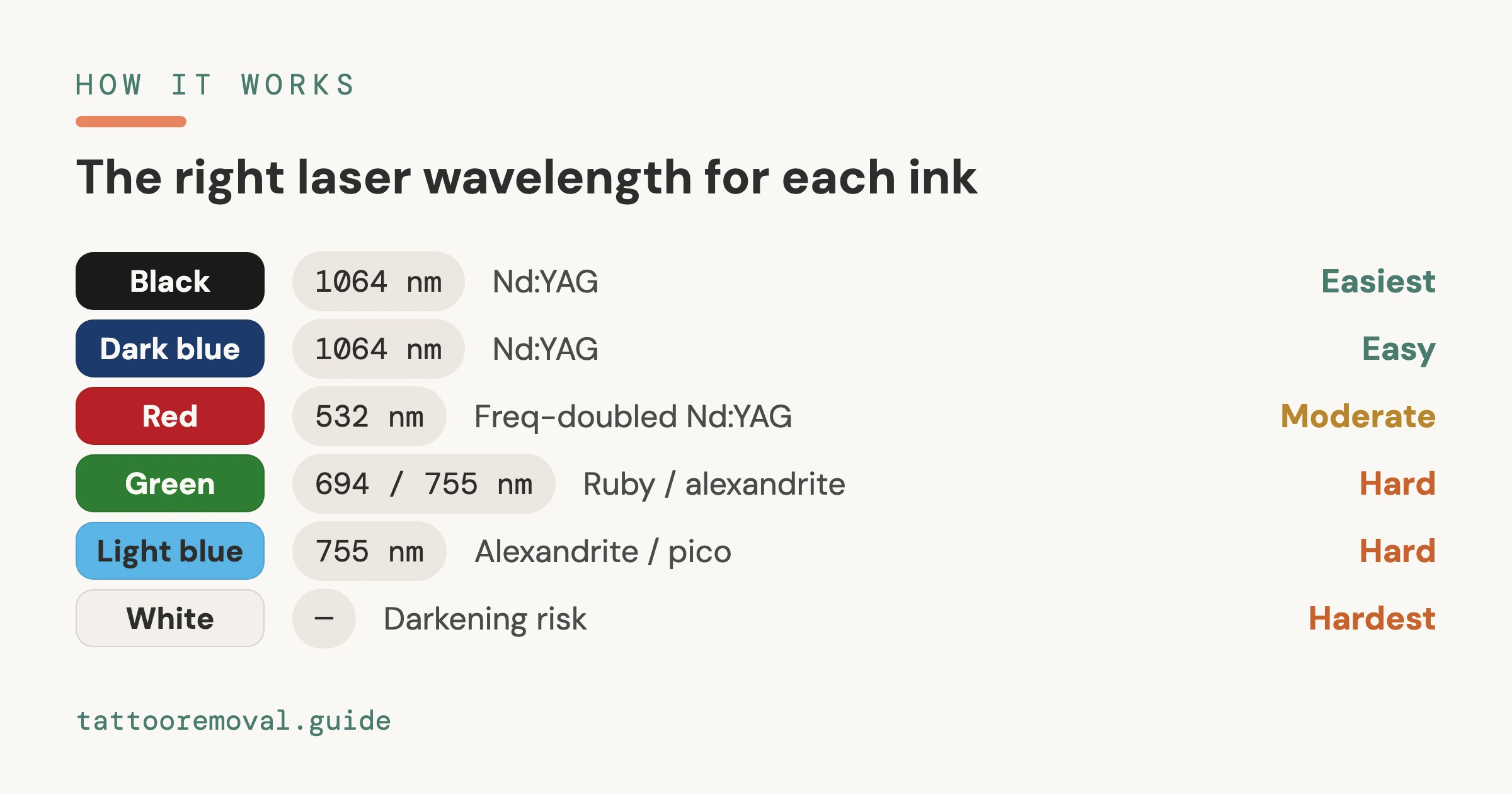
Different tattoo colours need different laser wavelengths, and no single laser clears them all. 1064nm (Nd:YAG) removes black and dark inks and is the safest wavelength for darker skin; 532nm targets red and warm tones like orange; 694nm (ruby) and 755nm (alexandrite) target green and blue. Each pigment absorbs the wavelength that is roughly its complementary colour, so a multicolour tattoo usually needs more than one wavelength to clear.
This guide maps each colour to the laser that removes it, explains why absorption — not laser power — decides what works, and sets honest expectations, using medical sources and figures from the Tattoo Removal Guide directory, stamped (as of July 2026).
Key Takeaways
- Wavelength is matched to ink colour: 1064nm for black/dark inks, 532nm for red/orange, 694nm and 755nm for green and blue.
- 1064nm is the safest wavelength for darker skin (Fitzpatrick IV–VI) because melanin absorbs it less than shorter wavelengths.
- A single-wavelength laser can't clear every colour — multicolour work needs multiple wavelengths, so the equipment a clinic owns matters.
- Picosecond vs Q-switched is about pulse duration, not wavelength — both are legitimate; neither is categorically superior.
- Eye protection is mandatory for everyone in the room, and every outcome is an estimate — no session count can be guaranteed. Across the 5,700 clinics we track, about 18% publicly list a picosecond laser and 15% list a Q-switched laser (as of July 2026) — a floor, since most listings don't specify a device at all.
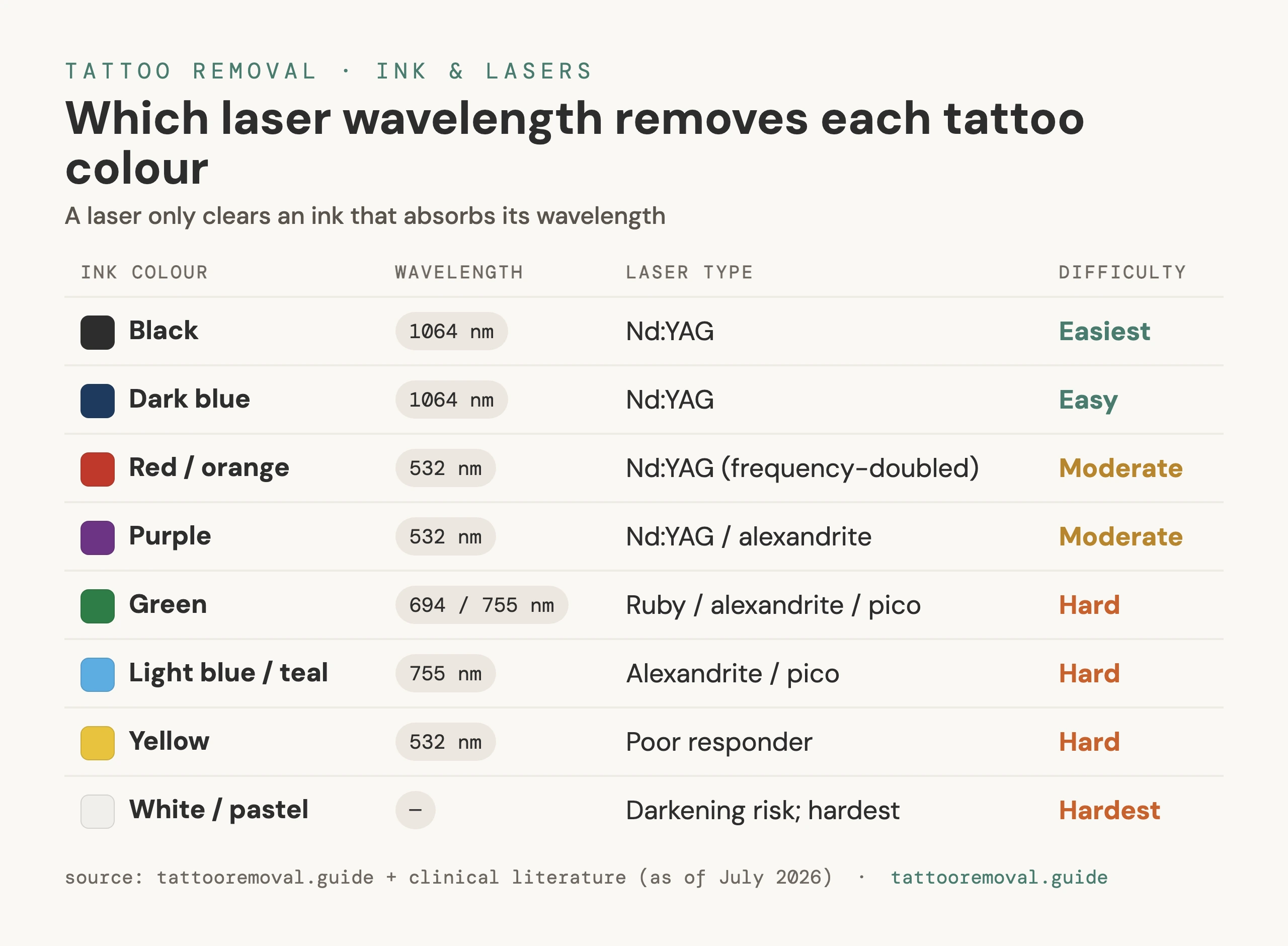 Each ink absorbs the wavelength that matches its complementary colour.
How the wavelength-to-colour match works
Laser tattoo removal works by selective photothermolysis: the laser fires ultra-short pulses that are absorbed by the ink, which heats and shatters into fragments small enough for your immune system to carry away. As the Cleveland Clinic explains, the laser breaks the ink into smaller pieces that the body then clears over the following weeks.
Selective photothermolysis is the principle that a specific wavelength of laser light is preferentially absorbed by a specific colour of ink while sparing the surrounding skin. The critical word is absorbed — only light the pigment soaks up does any work. A pigment reflects wavelengths it can't absorb, so those simply bounce away and shatter nothing.
The rule of thumb: ink absorbs the wavelength that is roughly its complementary colour. Red ink absorbs green (532nm) light; green ink absorbs red-range light (694nm or 755nm); black absorbs across the spectrum, which is why it's the easiest to clear. Every laser device outputs a fixed set of wavelengths, so a colour is easy or hard depending on whether an available wavelength happens to match its pigment. The StatPearls clinical reference describes the same chain: selective absorption by the pigment, fragmentation, then immune-mediated clearance.
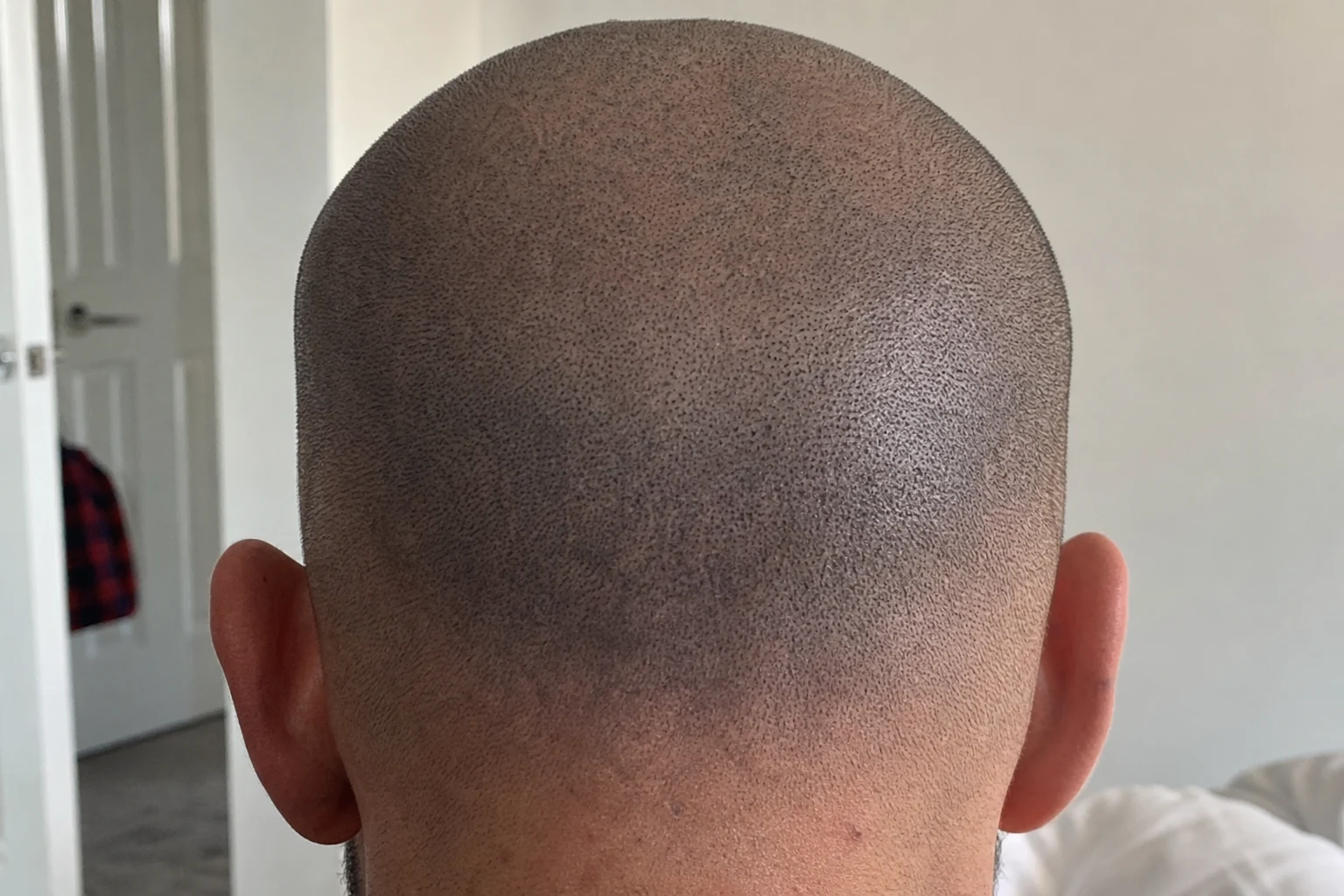 A tattoo undergoing laser removal.
The wavelength-to-colour map
Here is how the common wavelengths line up against the colours they target:
| Wavelength (laser) | Best colours | Notes |
|---|---|---|
| 1064nm (Nd:YAG) | Black, dark blue, dark inks | Penetrates deepest; the safest wavelength for darker skin (Fitzpatrick IV–VI) because melanin absorbs it less |
| 532nm (frequency-doubled Nd:YAG) | Red, orange, warm tones | Shorter wavelength; higher risk on darker skin as melanin also absorbs it |
| 694nm (ruby) | Green, some blue | Strong on green and blue; less common on clinic floors |
| 755nm (alexandrite) | Green, blue | Widely used for stubborn green and blue pigments |
A few things follow from this map. 1064nm and 532nm often come from the same Nd:YAG device — the 532nm beam is the 1064nm beam passed through a crystal that halves its wavelength ("frequency-doubled"), which is why an Nd:YAG platform covers both black and red. Green and blue are the outliers: they need the red-range 694nm or 755nm light that many single-wavelength machines don't produce, which is why green is one of the hardest colours to clear. The American Academy of Dermatology notes that some colours are simply harder to remove than others, and green and yellow are the standing examples.
Because each wavelength does a different job, no single laser clears every colour. A clinic running only a 1064nm device will lighten black readily but make little progress on a green or red piece. That's why, for anything multicolour, the wavelengths a clinic actually offers matter more than any brand name on the machine.
 A green tattoo — one of the harder colours to clear.
Why multicolour tattoos need multiple wavelengths
If your tattoo mixes colours — common in floral, watercolour and old-school designs — it can't be cleared by one wavelength. Each pigment absorbs its own matching light and ignores the rest, so a clinic has to switch wavelengths (or use a multi-wavelength platform) to work each colour on its best setting. Treat a green leaf with 755nm, a red flower with 532nm, and the black outline with 1064nm, and the piece clears; use only one of those and the other colours barely move.
This is also why multicolour pieces fade unevenly. Black and orange often clear early, while green and yellow lag — expected physics, not a failed treatment. A clinic with several wavelengths can address each colour directly, which is the single biggest reason equipment matters for coloured ink. You can compare clinics in your city to see which list the lasers and wavelengths your colours need.
Picosecond vs Q-switched: a different question
One point causes constant confusion: picosecond versus Q-switched is about pulse duration, not wavelength. Wavelength decides which colour a laser can target; pulse duration describes how fast the energy is delivered. A picosecond laser can output 1064nm, 532nm and 755nm just as a Q-switched (nanosecond) laser can — the difference is the length of each pulse.
Both are legitimate, effective technologies, and neither is categorically superior. Picosecond lasers deliver energy in shorter pulses, which can help shatter some inks and may reduce the number of sessions in some cases; Q-switched lasers remain widely used and effective, especially for common inks. Which one suits you depends on your ink, your skin and — above all — the operator's skill and how well the device's wavelengths match your colours. Don't choose a clinic on the "picosecond" label alone; ask which wavelengths it offers for the colours you actually have.
Eye safety and realistic expectations
Whatever the wavelength, laser eye protection is non-negotiable. Everyone in the treatment room wears goggles matched to the specific wavelength in use, and the patient's eyes are shielded separately — these lasers can permanently damage the retina, and goggles rated for one wavelength don't protect against another. The FDA's tattoo fact sheet underscores that removal is a medical procedure with real risks; casual eye-safety practice is a red flag.
Expectations should stay grounded too. The right wavelength makes a colour treatable, not guaranteed. Session counts depend on ink colour and density, ink depth, your skin tone and the wavelengths available — so a responsible clinic gives you a range after assessing your tattoo, never a fixed number sight-unseen. If a provider promises a green or multicolour piece "gone in five sessions" without seeing it, be sceptical.
This is general information, not medical advice. Laser tattoo removal is a medical procedure with real risks (blistering, scarring, pigment change), and risk varies with wavelength and skin tone. Wavelengths, session counts and outcomes vary by person and ink — consult a licensed provider about your specific tattoo.
Compare clinics before you commit
Because coloured ink lives or dies on which wavelengths a clinic offers, the most useful step is to compare your options before booking. For the mechanism behind all of this, read our pillar guide to how laser tattoo removal works, and for the colours that resist most, see the hardest tattoo colours to remove.
When you're ready, compare tattoo-removal clinics in your city to check which lasers and wavelengths they list, or start with a dense market like tattoo removal in Melbourne to see how equipment stacks up side by side.
Frequently asked questions
Which laser wavelength removes which tattoo colour?
1064nm (Nd:YAG) targets black and dark inks; 532nm (frequency-doubled Nd:YAG) targets red and warm tones like orange; 694nm (ruby) and 755nm (alexandrite) target green and blue. Each pigment absorbs the wavelength that is roughly its complementary colour, and a laser can only shatter ink that absorbs its light.
What laser is best for a green tattoo?
Green typically responds best to a 694nm ruby or 755nm alexandrite laser, because green pigment absorbs red-range wavelengths. Green is one of the most stubborn colours, and clinics that lack a ruby or alexandrite laser may struggle to clear it fully. Ask which wavelengths a clinic offers before booking a green piece.
Is 1064nm or 532nm better for tattoo removal?
Neither is universally better — they do different jobs. 1064nm penetrates deeper and clears black and dark inks and is the safest wavelength for darker skin. 532nm is shorter and targets red and orange but carries more risk on darker skin because melanin absorbs it too. The right choice depends on your ink colour and skin tone.
Can one laser remove every tattoo colour?
No single wavelength clears every colour. A device tuned only to 1064nm handles black well but leaves green, red or blue largely untouched. Multicolour tattoos usually need a laser (or clinic) offering several wavelengths, so each pigment can be matched to the light it actually absorbs.
What is the safest laser wavelength for darker skin?
1064nm Nd:YAG is generally the safest wavelength for Fitzpatrick IV–VI skin because it is absorbed less by melanin than shorter wavelengths, lowering the risk of pigment change and burns. Shorter wavelengths like 532nm carry higher risk on darker skin, so an experienced provider adjusts wavelength and settings accordingly.
Is picosecond better than Q-switched for coloured ink?
Neither is categorically superior — they are both legitimate. Picosecond delivers energy in shorter pulses, which can help shatter some inks and may reduce sessions in some cases, while Q-switched lasers remain effective and widely used. Pulse duration is a separate question from wavelength; matching the device to your ink and skin, and operator skill, matter more than the label.
Do I really need eye protection during laser tattoo removal?
Yes — everyone in the treatment room wears wavelength-specific eye protection, and the patient's eyes are shielded too. Laser light at these wavelengths can permanently damage the retina, and the correct goggles differ by wavelength. Reputable clinics treat this as non-negotiable; if a clinic is casual about eye safety, treat it as a red flag.
Related guides
Related Guides
- How It Works
What Is a Q-Switched Laser for Tattoo Removal? (2026)
A Q-switched laser fires nanosecond pulses to shatter tattoo ink. Here's how Q-switched Nd:YAG, ruby and alexandrite lasers work, and why they're still a gold…
- How It Works
What Is a Picosecond Laser for Tattoo Removal? (2026)
What is a picosecond laser? It fires in trillionths of a second to shatter tattoo ink. How it works, the colours it helps, and why it's not always better.
- How It Works
What Affects How Fast a Tattoo Fades? 8 Factors in Removal Speed
What affects tattoo removal speed? Ink colour, depth, age, body location, skin type, your health, smoking, and cover-ups all matter.