How to Spot a Bad Tattoo Removal Clinic: 10 Red Flags (2026)

Ten red flags mark a bad tattoo removal clinic: a guarantee of complete removal or an exact session count, no patch test offered, an unclear or untrained operator, one old laser used for every case, no real consultation or a rushed hard-sell, pressure to prepay a big package, a suspiciously cheap price, poor hygiene or no aftercare, dismissing your skin-tone concerns, and no reviews or results to show. None alone proves harm — but each is a reason to slow down.
Here's the honest part most sites won't say: a clinic has every incentive to tell you it's the right choice, and it can't neutrally point you to its competitors. We run an independent directory — we don't perform removal or sell it — so this list is built to be used across clinics. Every flag below maps to something you can ask about or pre-screen before you ever sit in the chair.
Key Takeaways
- The single biggest red flag is a guarantee — of "100% removal" or an exact session count. No one can promise either; results depend on your ink, skin and immune response.
- Safety cues to look for: a trained operator with medical oversight, a patch test, a laser whose wavelengths match your ink and skin tone, clean consumables, and written aftercare.
- "Cheap" is a value-and-safety question, not a price contest — a low price is fine unless it's achieved by skipping safeguards (untrained staff, one old laser, no patch test).
- Darker skin needs the right approach (often a 1064 nm wavelength); a clinic that dismisses your skin-tone concerns is telling you something.
- Pre-screen, then compare. Only about 38% of clinics in our directory publish any price (as of July 2026), so shortlist a few on laser type, ratings and reviews before you book.
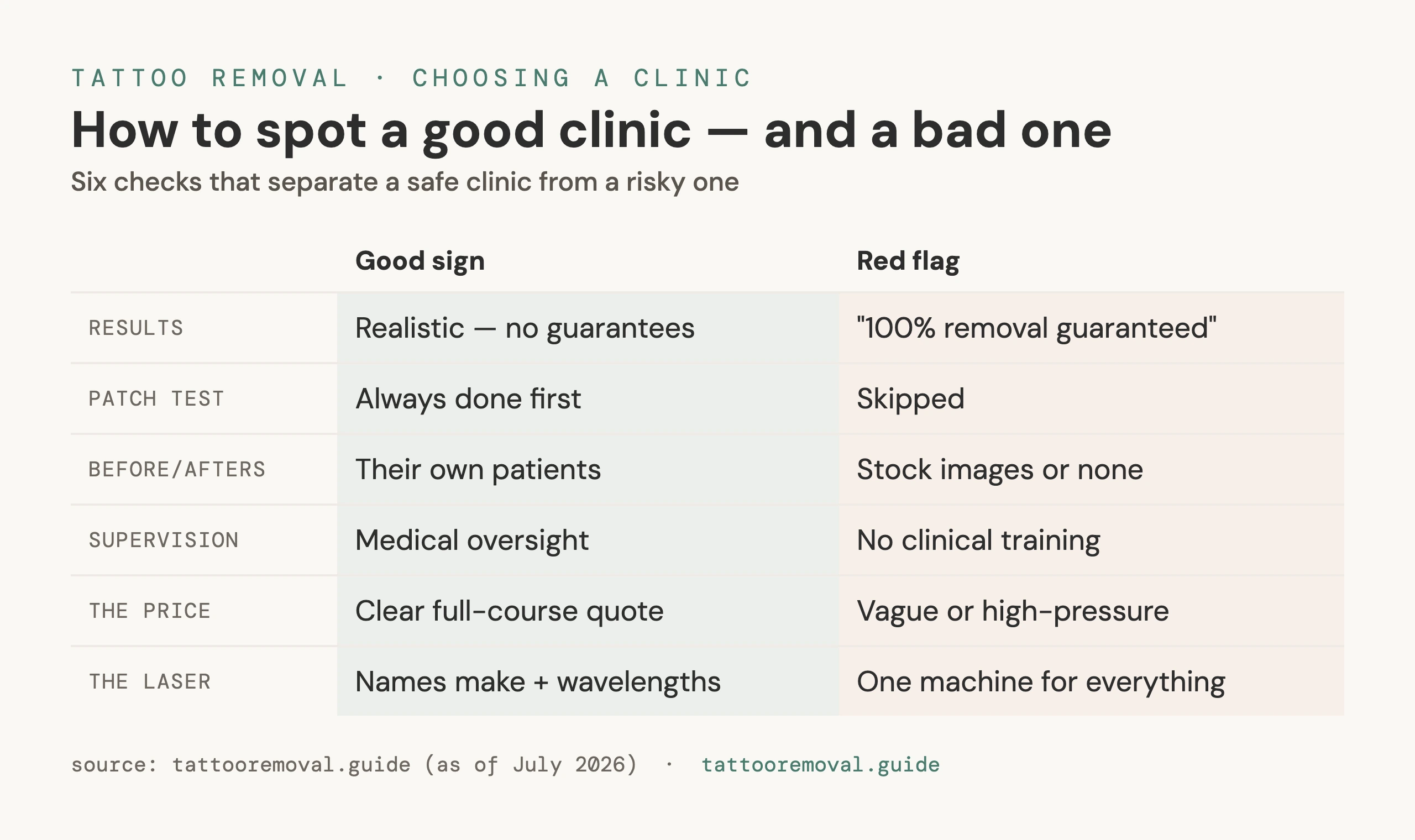 For every red flag, know what 'good' looks like instead.
The 10 red flags — and what good looks like instead
1. It promises you complete removal or an exact session count
This is the loudest warning of all. A red flag is any promise that can't be kept, and "guaranteed 100% removal" or "gone in 5 sessions" is exactly that. Complete clearance cannot be guaranteed — the U.S. FDA notes that removing a tattoo is often more complicated than expected, and outcomes vary by ink and skin. Good looks like: a range of likely sessions, an honest "it depends on how your skin responds", and a plain "we can't guarantee it will fully disappear."
2. No patch test is offered
A patch test is a small test-spot treatment done before your first full session to see how your skin reacts. Skipping it removes the earliest chance to catch a bad reaction or wrong setting. Good looks like: a patch or test spot before committing to a course — and a clinic that offers it without being pushed.
3. You can't tell who's running the laser
Laser tattoo removal is a medical procedure, and who performs it matters. If the clinic is vague about the operator's training or whether anyone medical is involved, that's a flag. The American Academy of Dermatology advises choosing a qualified, experienced provider. Good looks like: a named, trained operator — often a nurse, dermatologist or accredited laser technician — working under medical supervision that can manage a reaction if one happens.
4. One old laser for every ink colour and skin tone
Different ink colours respond to different wavelengths, and skin tone changes what's safe. A single ageing device can't match every case. As Cleveland Clinic explains, laser removal works by breaking ink into particles your body clears — and that depends on hitting the right target. Good looks like: the clinic names its device and confirms it has the wavelengths your colours need, including a 1064 nm option for deeper skin tones.
5. No consultation, or a rushed hard-sell
If you're moved straight from "hello" to "sign here" with no assessment of your tattoo, skin or history, the clinic is selling, not treating. Good looks like: a real consultation that examines your tattoo, asks about your skin and medications, and sets expectations before any money changes hands.
6. Pressure to prepay a large package today
Urgency tactics — "this price is only good today", a big multi-session package to sign on the spot — are designed to stop you comparing and reflecting. Good looks like: a written quote you can take away, the freedom to pay as you go or in smaller steps, and no penalty for thinking it over.
7. A price so cheap it likely skips safety
Cheap isn't automatically bad — but be clear on why it's cheap. The worry is a low price bought by cutting corners: an untrained operator, an outdated laser, no patch test, no medical oversight. That's a value-and-safety issue, not a bargain. Good looks like: a clear reason for the price (a small tattoo, a lower-cost local market) and a straight answer on what it includes.
8. Poor hygiene or no aftercare guidance
A clinical procedure needs a clinical standard — clean surfaces, single-use consumables, proper laser eye protection for you and the operator. Aftercare matters just as much, since the weeks between sessions are when your skin heals. Good looks like: a visibly clean treatment room, protective eyewear provided, and written aftercare plus a contact point if you react between sessions.
9. It dismisses your skin-tone concerns
Darker skin tones carry a higher risk of pigment changes (lightening or darkening), so the right wavelength and conservative settings matter. A clinic that brushes off those questions is ignoring real risk. Good looks like: a provider who treats skin like yours routinely, starts with the safer 1064 nm Nd:YAG approach where appropriate, and talks openly about pigment risk.
10. No reviews, and nothing to show
If a clinic can't point to reviews, review counts, or its own before-and-after photos, you have no evidence of experience. Manufacturer marketing shots don't count. Good looks like: genuine reviews and the clinic's own results — ideally on tattoos and skin tones similar to yours.
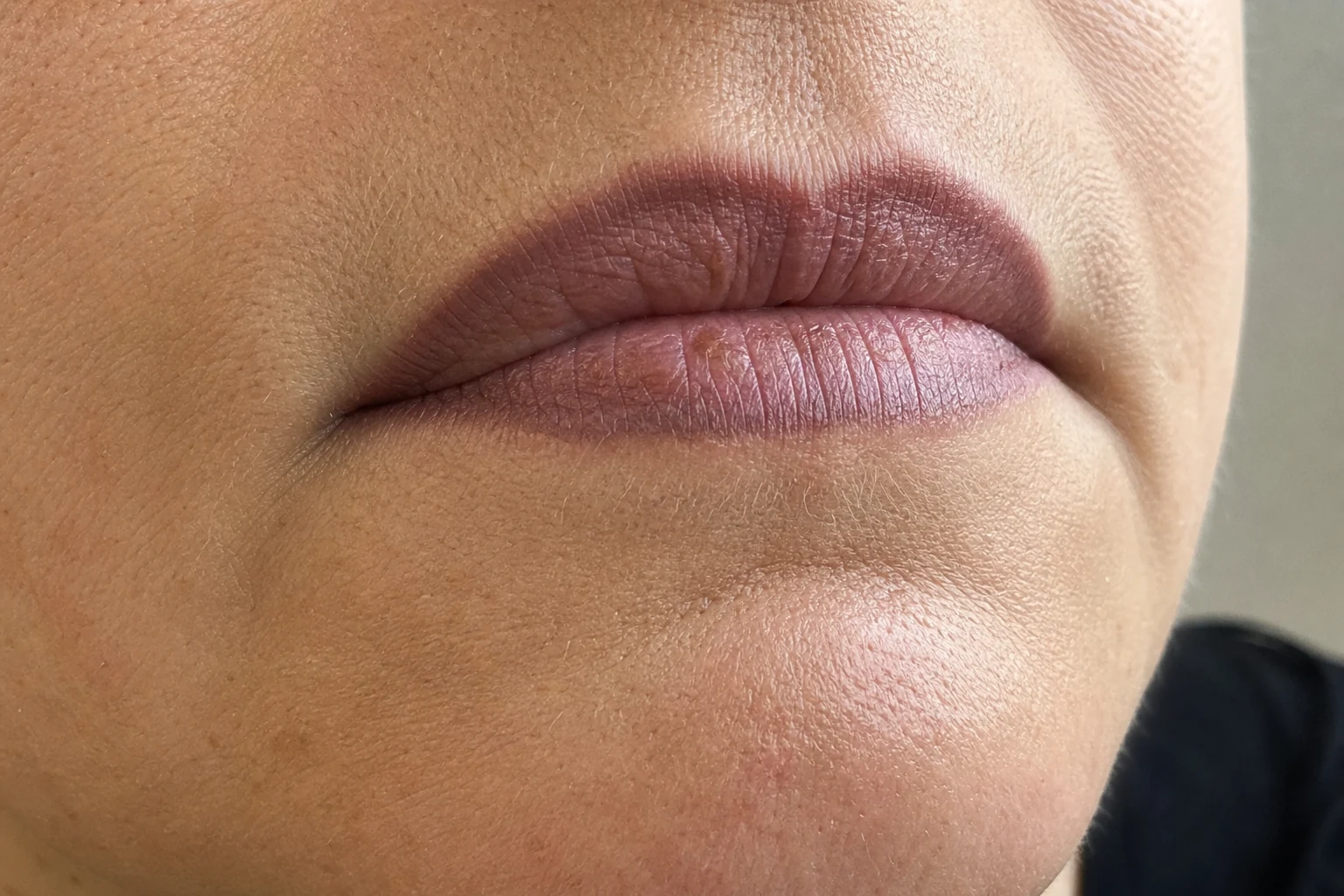 A lip-blush cosmetic tattoo.
Red flag vs green flag, at a glance
| Red flag | Why it's a problem | Green flag — what good looks like |
|---|---|---|
| "100% removal guaranteed" / exact session count | No provider can promise this; results vary by ink, skin and immune response | Honest ranges and a clear "no guarantees" |
| No patch test | Removes the earliest check on how your skin reacts | Patch/test spot before the first full session |
| Unclear who runs the laser | It's a medical procedure; training and oversight matter | A named, trained operator under medical supervision |
| One old laser for everything | Can't match your ink colours or skin tone safely | Names the device and the wavelengths it covers |
| No consultation / rushed hard-sell | Selling, not assessing your tattoo and skin | A real consultation before any money changes hands |
| Prepay a big package today | Urgency tactics discourage comparison | Written quote to take away; pay-as-you-go option |
| Suspiciously cheap, no reason given | Low price may come from cutting safeguards | A clear reason for the price and what it includes |
| Poor hygiene / no aftercare | Real infection and healing risks between sessions | Clean room, eye protection, written aftercare |
| Dismisses skin-tone concerns | Darker skin needs the right wavelength and settings | Takes skin tone seriously; 1064 nm where apt |
| No reviews or results | No evidence of experience | Genuine reviews and the clinic's own before/afters |
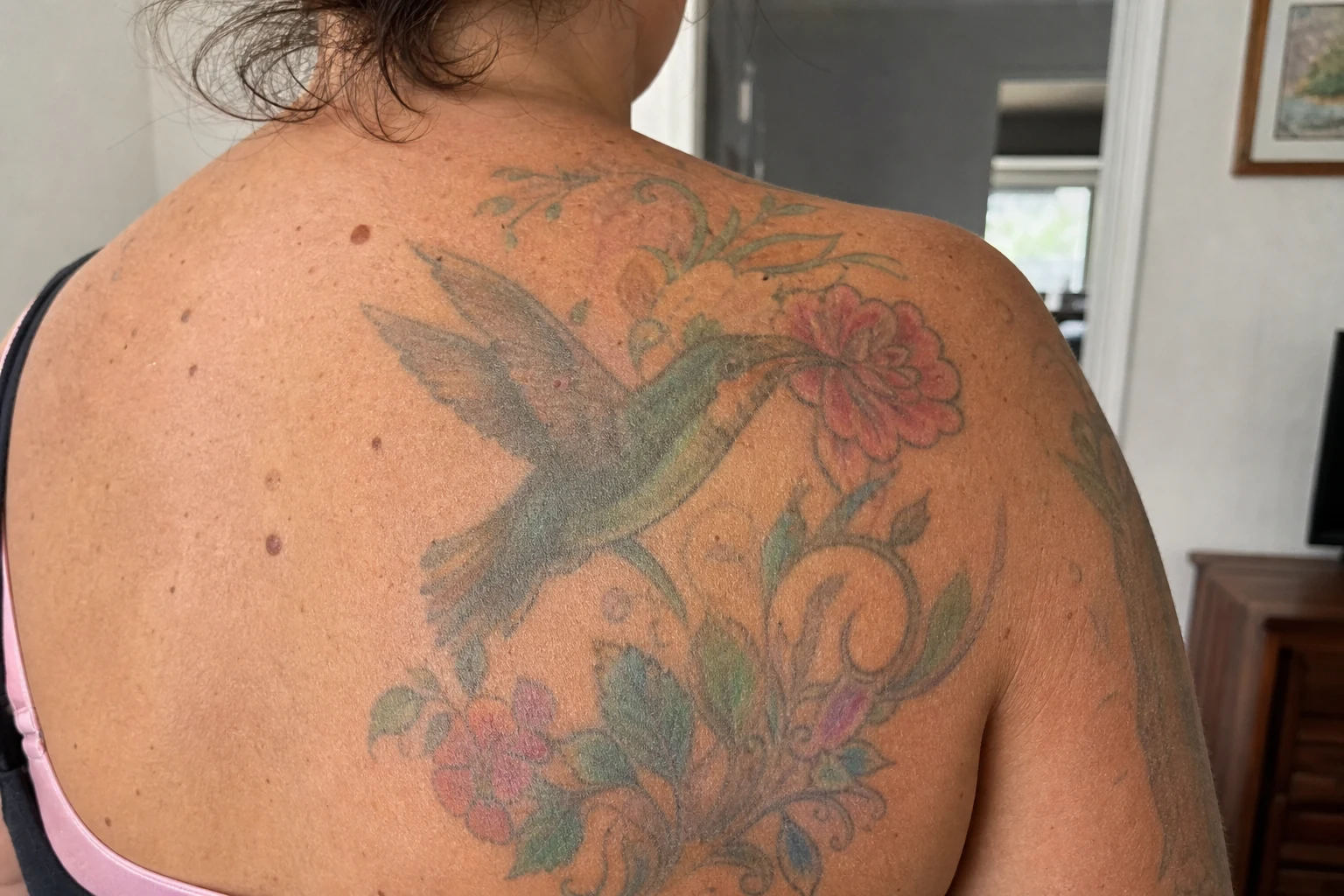 A back-piece tattoo.
How to read a low price honestly
A cheap quote isn't a verdict on its own. Price transparency in this market is genuinely patchy — only about 38% of the clinics in our directory publish any price at all (as of July 2026), and where they do, per-session prices start from around $50 with a median near $200. So a low headline figure often just reflects a small tattoo, a lower-cost local market, or a "from" price for the simplest case.
The problem isn't a low number; it's a low number bought by removing safeguards. Ask what the price includes, whether it's per session or a full course, and what a realistic total looks like for your tattoo. A clinic that answers plainly is being straight with you. One that can't — or won't name its laser — is the one to worry about. Both cheap and expensive clinics can be good or bad; the safeguards are what separate them.
This is general information, not medical advice. Whether laser tattoo removal is suitable for your skin and ink should be decided with a licensed provider who has examined your tattoo. For how the procedure itself works and its risks, see is laser tattoo removal safe.
Pre-screen before you book — that's what a directory is for
Every flag above is easier to check once you've narrowed the field. That's the practical advantage of an independent directory over any single clinic's website: it shows laser type, ratings and review counts side by side, so you can shortlist two or three clinics that already clear the basics before you spend time on consultations. Across our 5,700 clinics in 1,043 cities (4.79★ average, as of July 2026), no clinic pays to rank higher and no leads are sold — the listings are a map, not an endorsement.
For the full checklist of what to ask, start with our guide on how to choose a tattoo removal clinic. Then compare tattoo removal clinics in your city to pre-screen on what matters, or look at a busy market like Melbourne to see the spread of options in one place. The independent research consistently frames laser removal as a multi-session medical process, not a quick guaranteed fix — StatPearls' clinical overview is a good primer on why.
Frequently asked questions
What are the red flags of a bad tattoo removal clinic?
The clearest red flags are a guarantee of complete removal or an exact session count, no patch test offered, an unclear or untrained operator, a single old laser used for every ink colour and skin tone, no real consultation or a rushed hard-sell, pressure to prepay a large package, a price so cheap it likely skips safeguards, poor hygiene or no aftercare, dismissing your skin-tone concerns, and no reviews or before-and-after photos to show. Any one is a reason to slow down; several together are a reason to look elsewhere.
Is this tattoo removal clinic safe?
A safer clinic runs laser removal as a medical procedure: a trained operator working with medical oversight, a patch test before your first full session, a device whose wavelengths match your ink and skin tone, clean single-use consumables, written aftercare, and honest, no-guarantee expectations. If a clinic can plainly answer who runs the laser, what laser it is, and how it handles reactions, that is a good sign. If it dodges those questions, treat it as a warning.
Is cheap tattoo removal risky?
Not automatically — a low price can simply reflect a small tattoo or a lower-cost local market. It becomes a concern when "cheap" is achieved by cutting safeguards: an untrained operator, one outdated laser, no patch test, no medical oversight. Judge the whole picture, not the number. Ask what the price includes and why it is low; a clear, specific answer is reassuring, and a vague one is not.
Should a tattoo removal clinic offer a patch test?
Yes. A patch (or test-spot) treatment treats a small area of the tattoo to see how your skin reacts before you commit to a full course. It is a basic safety step, and a clinic that skips it is skipping a chance to catch a bad reaction early. Asking for a patch test — and being told yes — is a reasonable way to choose one clinic over another.
Can a tattoo removal clinic guarantee my tattoo will be fully removed?
No. Complete removal cannot be guaranteed, and neither can an exact number of sessions. Results depend on ink colours and depth, your skin tone, the tattoo's age and your immune response. A clinic advertising "guaranteed 100% removal" or "gone in 5 sessions" is overstating what the technology can promise, which is itself a red flag rather than a selling point.
Does darker skin need a different tattoo removal approach?
Darker skin tones carry a higher risk of pigment changes, so settings and wavelength choice matter more. A 1064 nm Nd:YAG wavelength is generally the safer starting point for deeper skin tones because it targets ink while sparing surrounding pigment. A clinic that takes your skin-tone questions seriously — rather than waving them away — is showing the care the procedure needs.
What should I check before booking a tattoo removal clinic?
Check who performs the treatment and their training, whether a patch test is offered, what laser is used and whether its wavelengths suit your ink and skin tone, whether there is medical oversight and written aftercare, and what a realistic full course looks like — in sessions and total cost. Then compare a few clinics rather than booking the first quote. An independent directory lets you pre-screen on laser type, ratings and review counts first.
Related guides
Related Guides
- Methods & Decisions
TCA & Acid Tattoo Removal: Does It Work, and Is It Safe? (2026)
Does TCA remove tattoos? Acid removal works by chemically wounding the skin so ink sheds with the damaged tissue — imprecise, high scarring risk, and dangerous as a…
- Methods & Decisions
Tattoo Removal vs Cover-Up: Which Is Right for You? (2026)
Tattoo removal vs cover-up: removal wins if you want bare skin or a clean canvas; a cover-up wins if you want new art fast. Plus the hybrid path — and how to decide.
- Methods & Decisions
12 Questions to Ask at a Tattoo Removal Consultation (2026)
The 12 questions to ask at a tattoo removal consultation — on credentials, the laser, the plan, safety and cost — plus a green-flag vs red-flag answer table.