How to Read Tattoo Removal Before-and-After Photos (Real vs Staged)
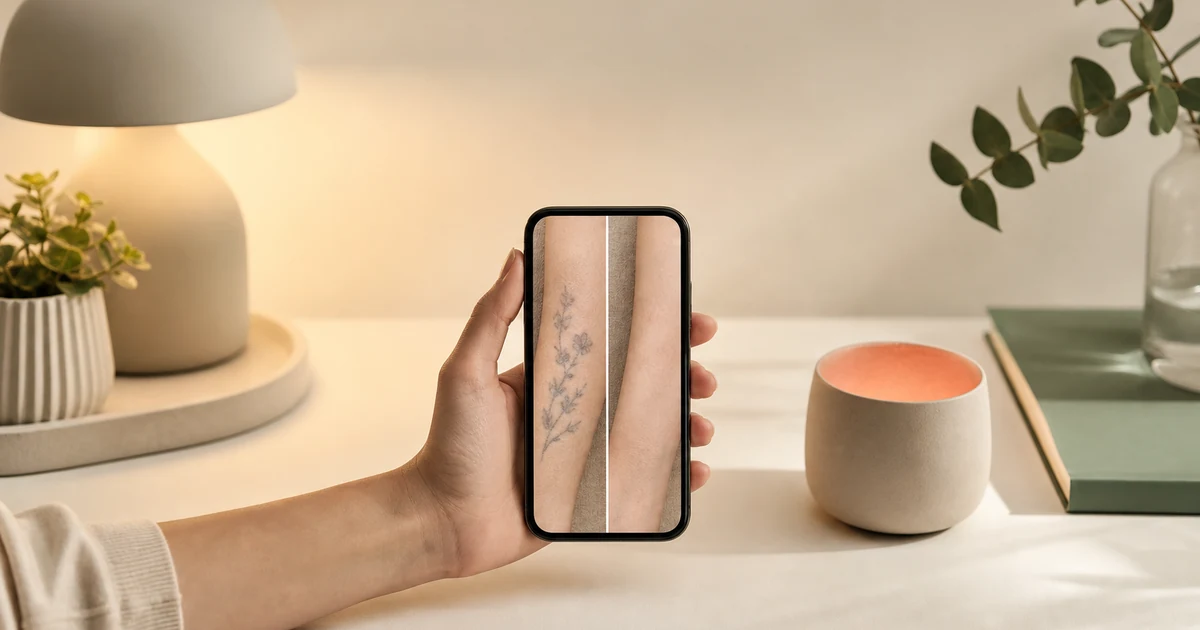
Tattoo removal before-and-after photos are usually real, but they are almost always a clinic's best cases — and a staged or cherry-picked one is easy to spot once you know the four checks: the session count and timeframe are stated, the lighting, angle and distance match, the skin tone stays consistent, and any residual "ghosting" is shown honestly. A flawless result with no information attached is the biggest red flag of all.
This guide shows you how to read those photos like a sceptic, what an honest gallery actually includes, and why — when you are choosing where to spend a year of your time — verified reviews tell you more than any single image. Figures from the Tattoo Removal Guide directory are stamped (as of July 2026).
Key Takeaways
- A before-and-after photo is a marketing artifact, not clinical evidence — clinics select their most striking clearances, so any gallery is a biased sample of easy cases.
- Four checks separate an honest result from a staged one: stated session count + timeframe, matched lighting/angle/distance, consistent skin tone, and honestly shown ghosting.
- A "perfect" after with no session count, no timeframe and no visible healing is the classic red flag — real results usually show some redness, texture or faint shadow.
- Generated or illustrative images must be labelled — a rendered "result" is not proof of an outcome.
- What beats any photo: verified ratings and reviews. Across the 5,700 clinics we track, the average rating is 4.79★ (as of July 2026) — a signal a curated gallery can never give you.
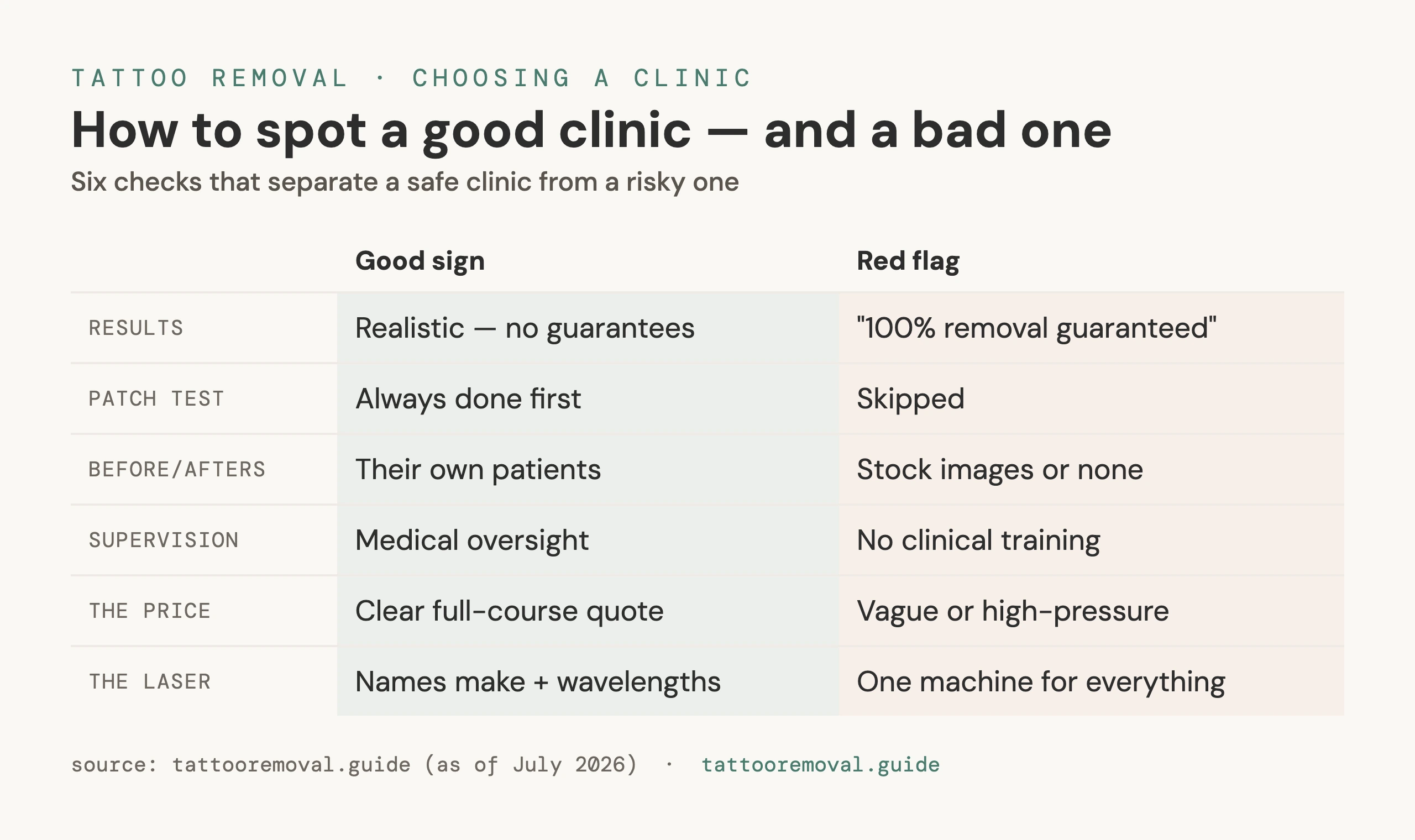 Six checks that separate a safe clinic from a risky one.
Why do clinics only show their best before-and-afters?
Because a gallery is advertising, not a clinical record. Clinics naturally pick their most dramatic clearances to win your booking, which quietly skews the images toward the easiest tattoos to remove: small, older, black-ink designs on fair skin. Those respond fastest, so they photograph best.
That selection isn't automatically dishonest — every business shows its wins. But it means one gallery is a biased sample, not a realistic average of what your tattoo will do. As the American Academy of Dermatology notes, removal results vary widely with ink colour, depth, age and skin type, and some tattoos never fully clear. A wall of flawless results hides that variation.
An honest gallery does the opposite of hiding it. It includes harder cases and partial results — a green tattoo that faded but didn't vanish, a cover-up that took fifteen sessions, a faint shadow that remained. Cherry-picking is the practice of showing only your most favourable examples while omitting the rest; the antidote is a gallery that admits its limits.
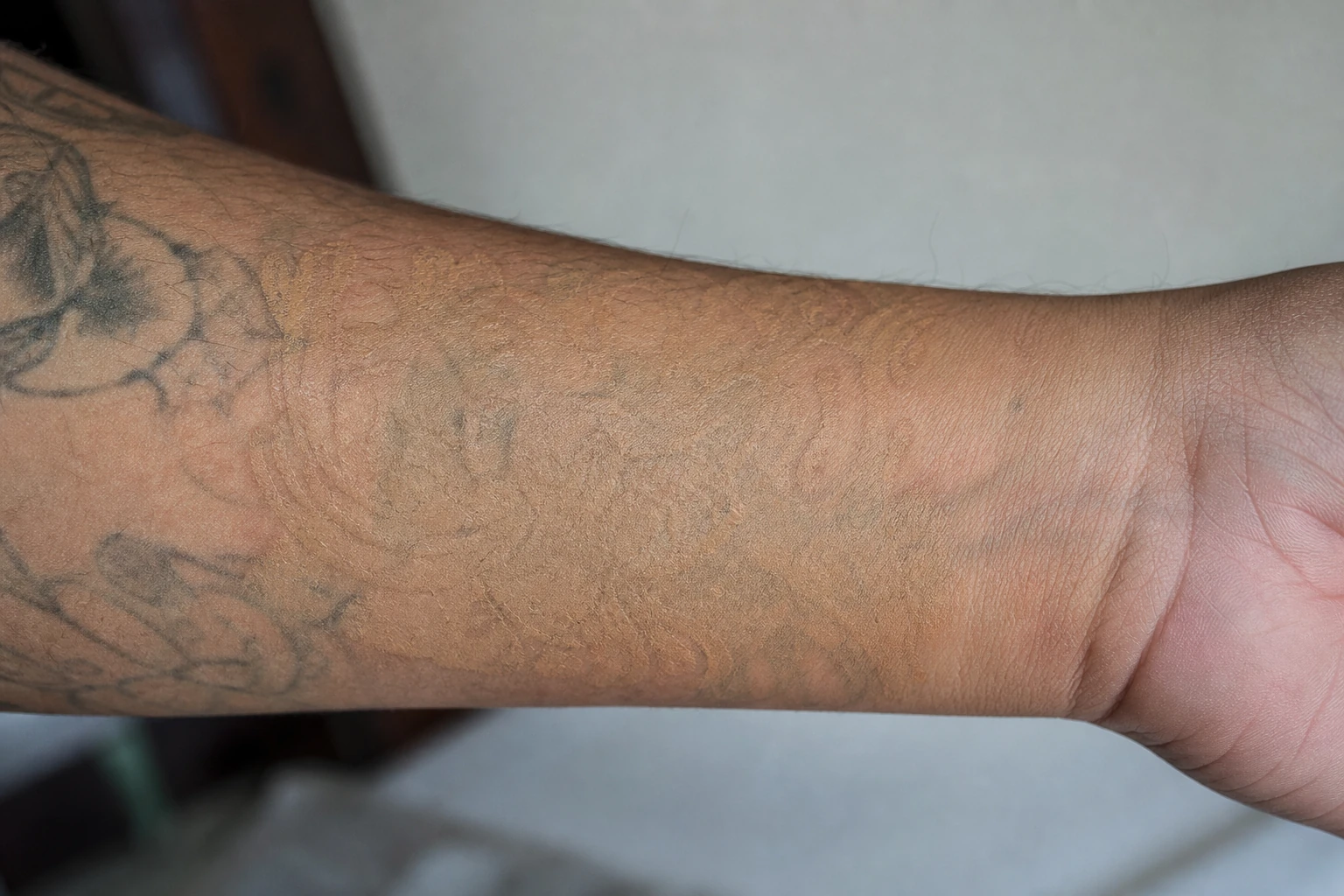 Flesh-toned cover ink can be unpredictable to remove.
How can you tell a real before-and-after from a staged one?
Four checks do most of the work. Run every photo through them.
| Check | Why it matters | What a real one looks like |
|---|---|---|
| Session count + timeframe stated | Without it, you can't tell if that "after" took 3 sessions or 15 over two years | "After 10 sessions over 18 months" printed beside the image |
| Lighting, angle & distance match | Different lighting or a closer crop can fake fading that isn't there | Both shots same brightness, same angle, same zoom |
| Skin tone consistent | A cooler white balance on the "after" can make ink look lighter than it is | Skin the same colour in both frames; only the ink changes |
| Ghosting shown honestly | Many tattoos leave a faint shadow; hiding it oversells the result | Visible faint "ghost" or texture change, not airbrushed skin |
The mechanism behind that last row is worth knowing. Removal works because the laser shatters ink and your immune system slowly clears the fragments — a staged, weeks-long biological process, as the Cleveland Clinic explains. Because clearance is gradual and imperfect, a genuine "after" photographed at a realistic point often shows some redness, texture change or residual shadow. Skin that looks like the tattoo was never there — with no healing and no ghost — is either an exceptional easy case or an over-edited one.
 A consultation is where the plan, risks and realistic expectations get set.
What are the red flags? A quick checklist
Use this the next time a clinic's gallery impresses you.
| Green flag (trust it more) | Red flag (be sceptical) |
|---|---|
| Session count and timeframe labelled | "Amazing results!" with no numbers |
| Same lighting, angle and distance | "After" is closer, brighter or differently lit |
| Consistent skin tone between shots | Skin looks paler or warmer in the "after" |
| Faint ghosting or texture shown honestly | Impossibly flawless, airbrushed-looking skin |
| A mix of easy and hard cases | Only flawless, small, black-ink tattoos |
| Same tattoo, clearly the same person | Body part, freckles or hair don't match |
| Illustrative images clearly labelled | Rendered images passed off as real results |
None of these alone proves fakery — but two or three together mean the gallery is selling, not informing.
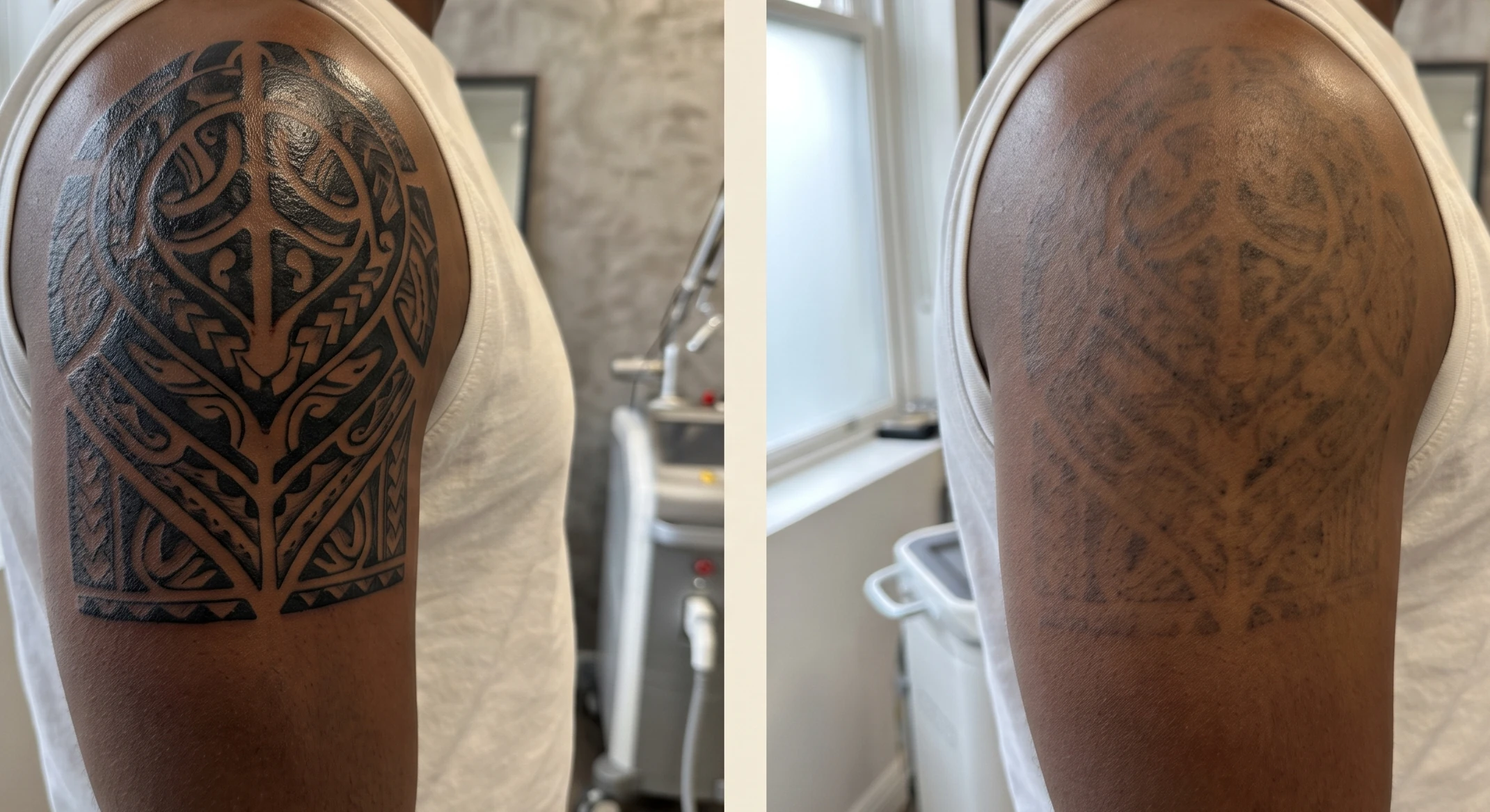 Before and after a full course. Illustrative; results vary.
What about AI-generated or illustrative images?
They're fine, if labelled. A generated or simulated image can help you picture a process, but a rendered "result" is not evidence that a real person got that outcome. The honest standard is simple: any generated, illustrative or simulated visual should be clearly marked as such.
That's the standard we hold ourselves to. On this site, illustrative visuals are labelled "illustrative," and the only real customer images used are de-identified first — a person's real result is never published to sell you something. A clinic gallery deserves the same scrutiny: if you can't tell whether an image is a real client or a render, treat it as a render.
How do I ask a clinic for cases like MY tattoo?
Because galleries skew easy, the useful move is to ask for the cases that match you. At a consultation, ask to see before-and-afters that share your tattoo's hardest features:
- Colour: "Do you have results for green, blue or other colours, not just black?"
- Size and density: "Can I see a tattoo about this size and this saturated?"
- Skin tone: "Do you have results on skin like mine?" — this matters for safety, not just optics. The StatPearls clinical reference notes that darker skin needs more careful wavelength and setting choices to avoid pigment change.
- Session count: "How many sessions did that specific result take, and over how long?"
A confident clinic will happily show you comparable, honestly labelled cases and give you a realistic range — never a guaranteed outcome or exact session count sight-unseen. If they only show flawless strangers and promise perfection, that's your answer.
This is general information, not medical advice. Tattoo removal outcomes, session counts and timelines vary by person, tattoo and skin type — no photo can predict your result. Consult a licensed provider for an assessment of your specific tattoo.
Why verified reviews beat any before-and-after
A photo captures one flattering moment. Verified ratings and reviews capture the pattern — consistency across many clients, honesty about expectations, how the clinic handled aftercare when a result was slower than hoped. That's the signal a curated gallery structurally can't give you.
It's also why comparing clinics on reviews, not just images, is the stronger move. Across the 5,700 clinics we track, the average rating is 4.79★ (as of July 2026) — which means a merely "good" rating is ordinary, and the real information is in the reviews themselves. Compare tattoo-removal clinics in your city on verified ratings and reviews, or start with a dense market like tattoo removal in Melbourne to see how clinics stack up side by side.
For the bigger picture on choosing well, see our pillar on every removal method compared and our guide to how to choose a tattoo removal clinic.
Frequently asked questions
Are tattoo removal before and afters real?
Most are real photos, but they are almost always a clinic's best cases, and lighting or angle can flatter them. A before-and-after is trustworthy when it states the session count and timeframe, keeps the lighting, angle and distance consistent, and shows any residual ghosting honestly rather than hiding it.
How can you tell if a tattoo removal photo is staged or fake?
Look for mismatches: different lighting, angle, distance, focus or skin tone between the two shots is a red flag, as is a flawless result with no session count or timeframe stated. Genuine results usually show some redness, texture change or faint ghosting — a perfectly clean "after" with no context deserves scepticism.
What should an honest tattoo removal before-and-after show?
An honest before-and-after states how many sessions and over what timeframe, uses matching lighting, angle and distance, keeps skin tone consistent, and shows realistic outcomes including any residual ghosting. The best galleries include harder cases and partial results, not only flawless clearances, so your expectations stay realistic.
How many sessions do before and after photos usually represent?
Often more than the photo implies. A dramatic "after" can represent 8–15 sessions spaced 6–8 weeks apart over one to two years, not a quick fix. If a gallery does not state the session count and timeframe beside each image, you cannot judge whether the result is realistic for your tattoo.
Why do clinics only show their best results?
Because galleries are marketing. Clinics naturally select their most striking clearances to attract clients, which means the images skew toward easy cases — small, older, black-ink tattoos on fair skin that respond well. That is not necessarily dishonest, but it makes any single gallery a biased sample rather than a realistic average.
Should tattoo removal photos be labelled if they are AI-generated?
Yes. Any generated, illustrative or simulated image should be clearly labelled as such, because a rendered result is not evidence of a real outcome. On this site, illustrative visuals are labelled "illustrative" and only de-identified real photos are used as references — a standard any trustworthy clinic gallery should meet too.
What matters more than before and after photos when choosing a clinic?
Verified ratings and reviews from real clients. A photo shows one flattering moment; reviews across many clients reveal consistency, honesty about expectations and aftercare. Comparing clinics on verified reviews — the average across the 5,700 clinics we track is 4.79★ (as of July 2026) — tells you far more than a curated gallery.
Related guides
Related Guides
- Choosing Removal
Tattoo Regret: You Have More Options Than You Think
Regret a tattoo? You're not alone — about 24% of tattooed people do. Your real options: accept, rework, cover up or remove — and why not to decide too fast.
- Choosing Removal
Tattoo Removal Methods Compared: What Works in 2026
Laser, saline, excision, dermabrasion, acid, creams — every tattoo removal method compared on sessions, cost, scarring and colour, by an independent directory.
- Choosing Removal
Surgical Tattoo Removal: When Cutting It Out Beats Laser
Surgical tattoo removal cuts out the inked skin in one or a few visits, regardless of colour — but always leaves a scar. When it beats laser, explained.