Does Tattoo Removal Leave Scars? The Honest Risk, and How to Avoid It

Permanent scarring from modern laser tattoo removal is uncommon — well under roughly 5% of cases when a suitable laser is used at conservative settings — and most of the scarring that does happen is preventable. It usually traces to an outdated laser, over-treatment, or picked scabs, not the procedure itself. This guide covers the real causes, how scarring differs from pigment change, and the clinic checklist that lowers your risk.
Across the Tattoo Removal Guide directory, about 18% of the 5,700 clinics we track note picosecond lasers and 15% note Q-switched lasers (as of July 2026) — both are effective, and matching the right device and energy to your ink is exactly the choice that keeps risk low. Figures are dated (as of July 2026) and drawn from medical sources plus our directory.
Key Takeaways
- Permanent scarring is uncommon with modern lasers and proper technique — well under ~5% — and is largely preventable and provider-dependent.
- The three real causes: an outdated/wrong laser + over-treatment, picking scabs / poor aftercare, and pre-existing scarring baked into the original tattoo.
- Scarring ≠ pigment change. Scarring is a lasting texture change; hyper- and hypopigmentation are colour changes that are usually temporary.
- Keloid-prone skin carries higher risk and needs conservative settings, a patch test, and an experienced provider.
- The biggest lever on your risk is vetting the clinic — right laser, conservative fluence, 6–8 week spacing, patch test, aftercare.
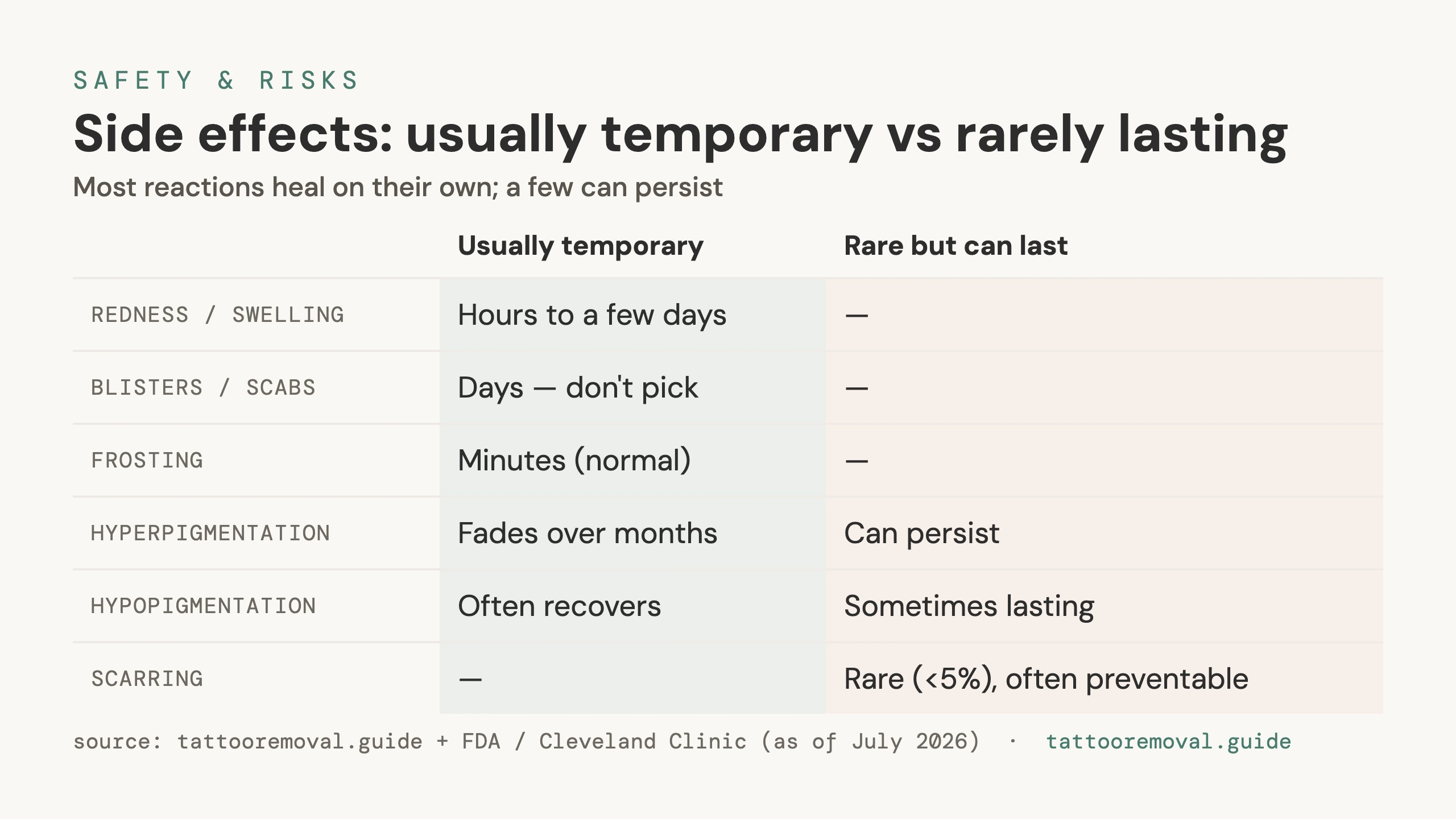 Most side effects heal on their own; a few — like scarring — are rare but can last.
Does tattoo removal leave scars?
Scarring is a change in the skin's texture — raised (hypertrophic or keloid) or sunken (atrophic) tissue that does not return to normal. That is different from the ink simply fading. When laser removal is done well, the ink clears while the skin's texture is left intact, which is why permanent scarring is the exception rather than the rule.
The honest framing: risk is real but low, and it is mostly in the provider's hands, not luck. The U.S. FDA notes that removal can cause scarring and skin-colour changes, and the American Academy of Dermatology makes the same point: with a trained provider using appropriate technology, most patients avoid significant scarring. The variables that push risk up — device, energy, spacing, aftercare, skin type — are largely controllable.
 A tattoo being assessed before laser removal.
The 3 real causes of scarring
Almost every case of laser-removal scarring comes from one of three sources. Two are avoidable; the third pre-dates the laser entirely.
- Outdated/wrong laser + over-treatment. The most common avoidable cause. Older or mismatched lasers, or correct lasers pushed to too-high energy (fluence), deliver more heat than the skin can shrug off. Excess heat — rather than the clean photoacoustic shattering a modern Q-switched or picosecond laser produces — is what burns tissue and leaves a scar. The StatPearls clinical reference ties scarring risk to excessive energy and inadequate healing time between sessions.
- Picking scabs / poor aftercare. After each session the area may blister and scab as it heals. Picking, scratching or peeling those scabs early interrupts healing and is a leading avoidable cause of scarring — the same way picking any wound scars it. Sun exposure and infection compound the risk.
- Pre-existing scarring from the original tattoo. This one is not caused by the laser at all. If the tattoo was applied heavily, reworked, or done by an inexperienced artist, the skin may already be scarred beneath the ink. Removing the pigment can reveal that texture change — but the laser did not create it. Distinguishing laser-caused scarring from the tattoo's own scar matters when you judge a result: the Cleveland Clinic notes that scarring present before removal will still be there once the ink is gone.
A note on skin type: people whose skin is keloid-prone — who form raised, spreading scars after minor trauma — carry higher baseline risk from any skin procedure, removal included. It rarely rules treatment out, but it makes conservative settings, a patch test and an experienced provider essential. Always tell your clinician if you have ever formed a keloid.
 Fine line-work is among the easier to remove without a mark.
Scarring vs. pigment change: two different outcomes
People often report "scarring" when what they actually have is a temporary colour change. They are not the same thing, and the distinction affects how worried you should be.
Hyperpigmentation is a darkening of the treated skin caused by the area over-producing melanin as it heals — the skin texture is normal, only the colour has shifted, and it usually fades over months. Hypopigmentation is the opposite: a lightening of the skin where melanin production is temporarily suppressed; it can take longer to recover and occasionally lingers. Neither is a scar. Both are more likely, and slower to resolve, on darker skin tones — which is precisely why correct wavelength and conservative energy matter more, not less, for medium-to-deep skin.
| Effect | What it is | Texture changed? | Typical course |
|---|---|---|---|
| Hyperpigmentation | Darkening of treated skin | No | Usually temporary; fades over months |
| Hypopigmentation | Lightening of treated skin | No | Usually temporary; can linger |
| Redness / swelling | Normal short-term reaction | No | Days |
| Blistering / scabbing | Normal healing response | No (unless picked) | 1–2 weeks |
| Permanent scar | Raised or sunken tissue | Yes | Lasting — uncommon with proper technique |
The takeaway: the common effects are colour changes and normal healing, which pass. A true, permanent scar is a distinct and much rarer outcome — and the one the clinic-vetting checklist below is designed to prevent.
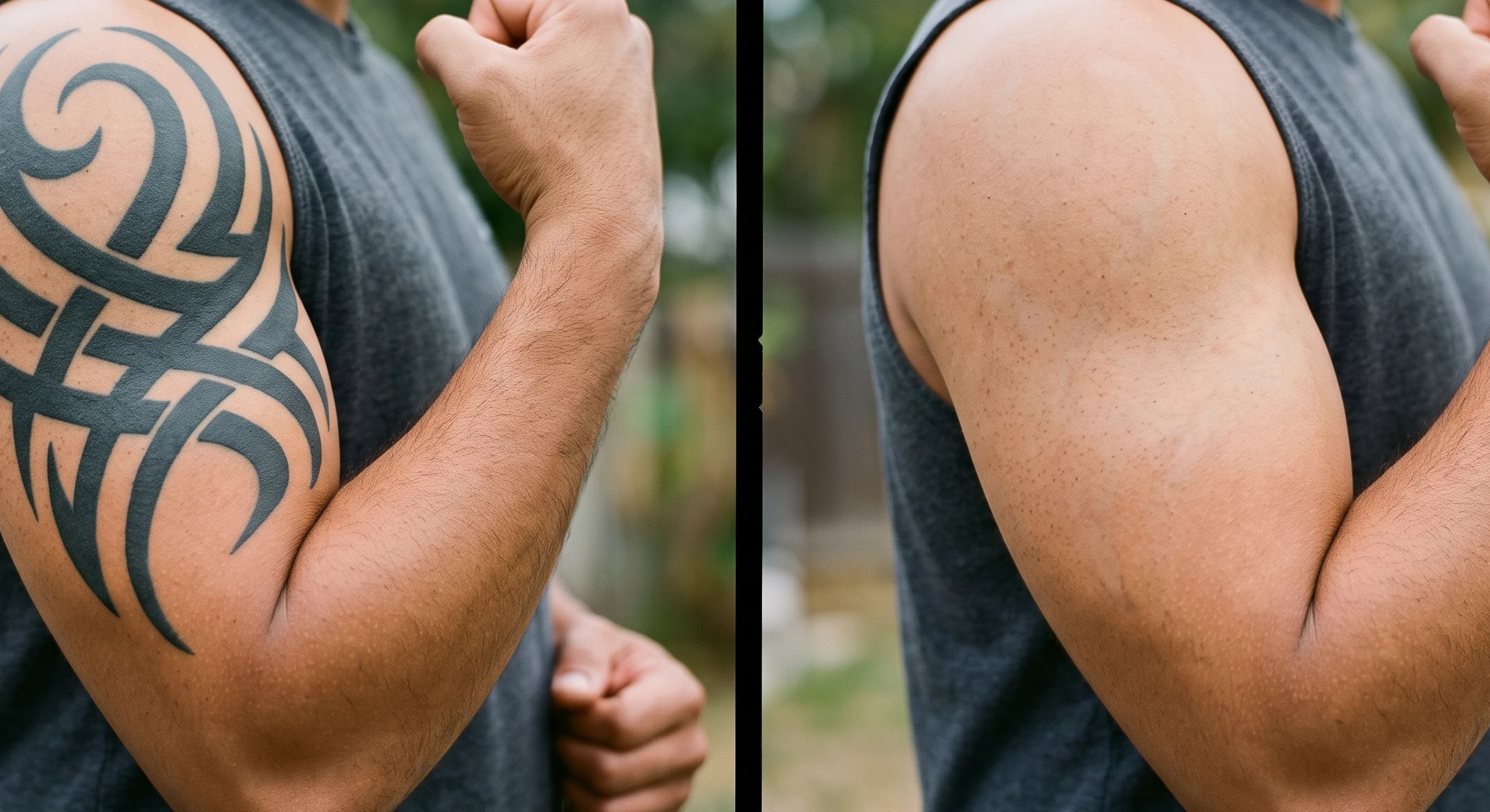 After a full course, only a faint 'ghost' — a barely-visible pale mark — may remain. Illustrative; results vary.
How clinic choice changes your risk
Because the leading causes of scarring are the wrong device, too much energy, and rushed spacing, the choice of clinic is the single biggest factor you control. Here is what lowers risk, and why.
| Risk factor | What lowers it | Why it matters |
|---|---|---|
| Wrong/outdated laser | A laser matched to your ink (Q-switched or picosecond) | Clean ink-shattering instead of heat burns |
| Over-treatment | Conservative fluence (energy) per pass | Excess heat is the main texture-damage cause |
| Rushed sessions | 6–8 week spacing between sessions | Skin must fully heal before the next pass |
| Unknown reaction | A patch test before the first full session | Reveals how your skin responds |
| Poor healing | Clear aftercare guidance and follow-up | Prevents infection and scab-picking scars |
None of this requires you to be a laser expert — it requires you to compare providers and ask a few direct questions: Which laser do you use for my ink colours? What energy, and will you patch-test first? How far apart are sessions? What's the aftercare? A clinic that answers these confidently is managing the exact variables that separate a clean result from a scar.
That is what our directory is built for. You can compare tattoo-removal clinics in your city side by side — or start with a dense market like tattoo removal in Melbourne to see how listed lasers and services stack up. For the full vetting method, see our guide to how to choose a tattoo-removal clinic, and for the broader safety picture, our pillar on whether laser tattoo removal is safe.
This is general information, not medical advice. Laser tattoo removal is a medical procedure with real risks, including scarring and pigment change. Whether you will scar depends on your skin, your tattoo and your provider's technique — no outcome can be guaranteed. Consult a licensed provider about your specific situation, and disclose any history of keloids or poor healing.
Frequently asked questions
Does laser tattoo removal leave scars?
Permanent scarring from modern laser tattoo removal is uncommon — well under roughly 5% of cases when the right laser and conservative settings are used. Most scarring that does occur is preventable and traces to an outdated laser, over-treatment, or picked scabs. Any pre-existing scar in the original tattoo will remain after the ink clears.
What causes scarring during tattoo removal?
Three things cause most laser-removal scarring: an outdated or wrong-wavelength laser used at too-high energy, so the skin is over-treated; poor aftercare, especially picking scabs before they heal; and scarring that was already present from how the original tattoo was applied. Keloid-prone skin also carries higher risk and needs a cautious approach.
Is scarring the same as pigment change after tattoo removal?
No. Scarring is a change in skin texture — raised or sunken tissue that is permanent. Pigment change is a colour change in otherwise normal-textured skin: hyperpigmentation (darkening) or hypopigmentation (lightening). Pigment changes are common, usually temporary, and fade over months, whereas true scars are a distinct, lasting outcome.
Can you remove a tattoo without scarring?
Often, yes — most people who use a suitable laser, conservative energy, correct 6–8 week spacing and good aftercare finish with no new scarring. But no clinic can guarantee a scar-free result, because healing varies by person and skin type. A patch test and an honest consultation are the best way to gauge your individual risk.
Does keloid-prone skin make tattoo removal riskier?
Yes. People who form keloids or hypertrophic scars are at higher risk of a raised scar after any skin trauma, including laser removal. It does not rule out treatment, but it makes conservative settings, wider session spacing, a patch test and an experienced provider especially important. Tell your clinician if you have ever formed a keloid.
Will hyperpigmentation after tattoo removal go away?
Usually. Hyperpigmentation is temporary darkening of the treated skin and typically fades over several months as the skin recovers, though it can persist longer on darker skin tones. Strict sun protection speeds recovery. Hypopigmentation, a lightening of the skin, can take longer and occasionally lingers — another reason correct laser settings matter.
How do I lower my risk of scarring from tattoo removal?
Choose a clinic that uses a laser matched to your ink, treats at conservative energy, spaces sessions 6–8 weeks apart, and offers a patch test. Then follow aftercare: keep the area clean and moisturised, protect it from the sun, and never pick scabs. Vetting the provider is the single biggest lever on your risk.
Related guides
Related Guides
- Safety & Risks
Why a Patch Test Matters Before Tattoo Removal (2026)
Why does a patch test matter before laser tattoo removal? It reveals how your skin and ink react — blistering, pigment change, rare reactions — before a full…
- Safety & Risks
Who Should Not Get Laser Tattoo Removal? The Contraindications
Who should not get laser tattoo removal? Most adults are candidates. The full contraindications checklist — when to wait and when to discuss carefully.
- Safety & Risks
Tattoo Removal While Pregnant or Breastfeeding
Can you get tattoo removal while pregnant? Most providers say wait — not from proven harm, but because the safety isn't studied.