Do Natural Tattoo Removal Remedies Work? The Honest Answer (2026)
Key Takeaways
Natural tattoo removal remedies do not work, and the reason is anatomical. Tattoo ink sits in the dermis — the second layer of skin — which does not shed. Salt scrubs, lemon juice, sand paste, aloe, hydrogen peroxide, and DIY acids all act on the epidermis, the surface layer above it, so they physically cannot reach the pigment. Several of them wound the skin to look like they're doing something — causing chemical burns, friction burns, scarring, and infection. "Natural" here means unregulated and, in some cases, dangerous — not gentle.
Here is why the ink is out of reach, what each popular remedy actually does, why the before-and-after photos are misleading, and what the evidence supports instead.
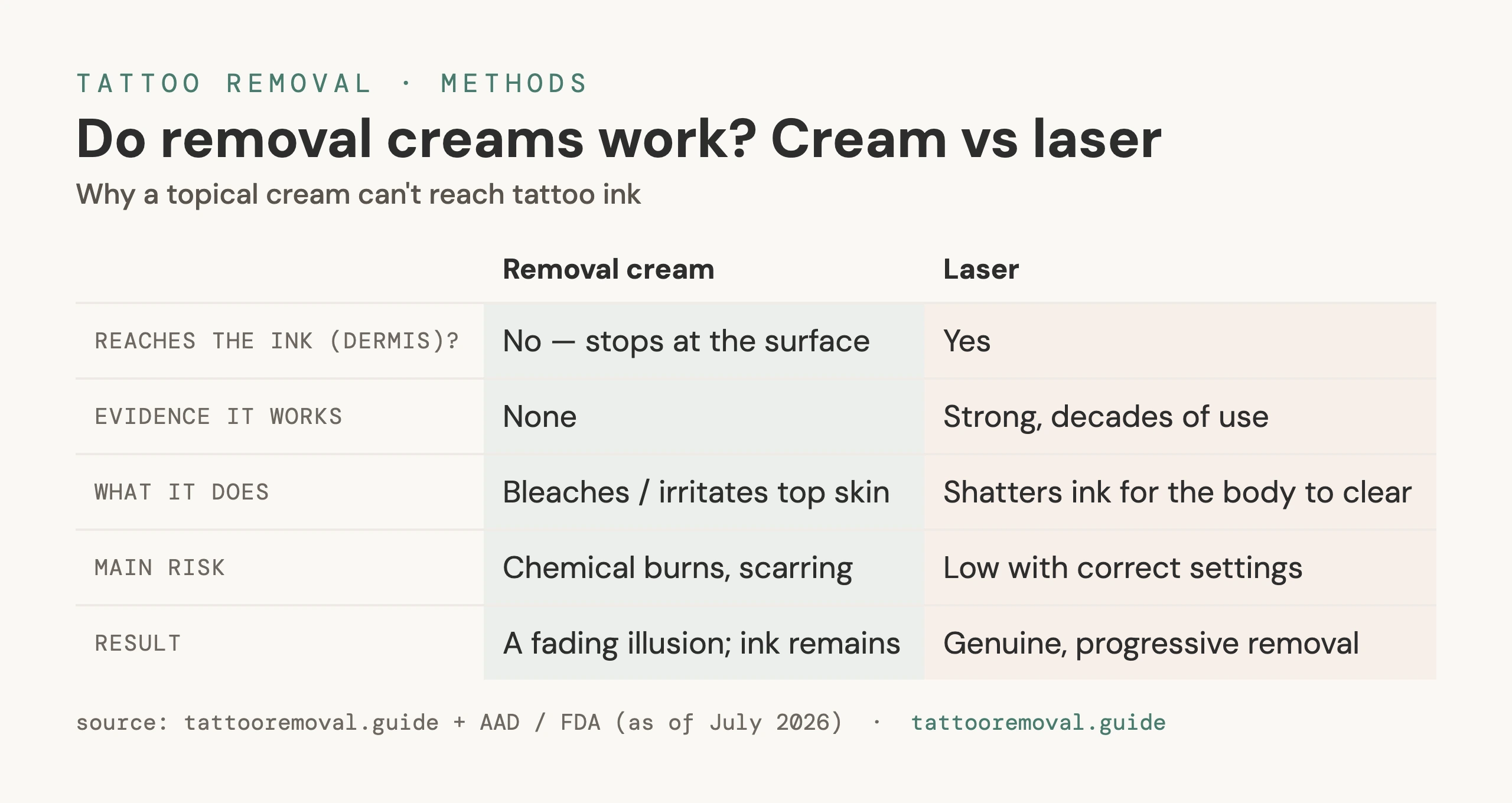 Topical and abrasive methods can't reach dermal ink — they just wound the skin.
Why the ink is below the layer that sheds
A tattoo is permanent by design. When a tattoo needle works, it drives ink roughly 1–2 millimetres into the skin — past the epidermis and into the dermis below. The pigment particles are deliberately large, too large for your body's immune cells to carry away, which is exactly why a tattoo stays put for decades. The Cleveland Clinic and NCBI StatPearls both describe this dermal deposition as the core reason removal is hard.
Natural tattoo removal is the idea that a topical or abrasive substance — salt, acid, an oil, an exfoliant — can lift or dissolve tattoo ink at home. It can't, for a simple structural reason. The epidermis on the surface is constantly shedding and renewing itself; the dermis underneath does not shed. Anything you rub on, scrub with, or soak into the skin acts on that renewing surface layer. To reach the ink, a method has to get into the dermis without simply wounding it — and no topical or abrasive remedy does that. That's the whole debunk in one sentence: the ink is under the one layer these remedies can affect.
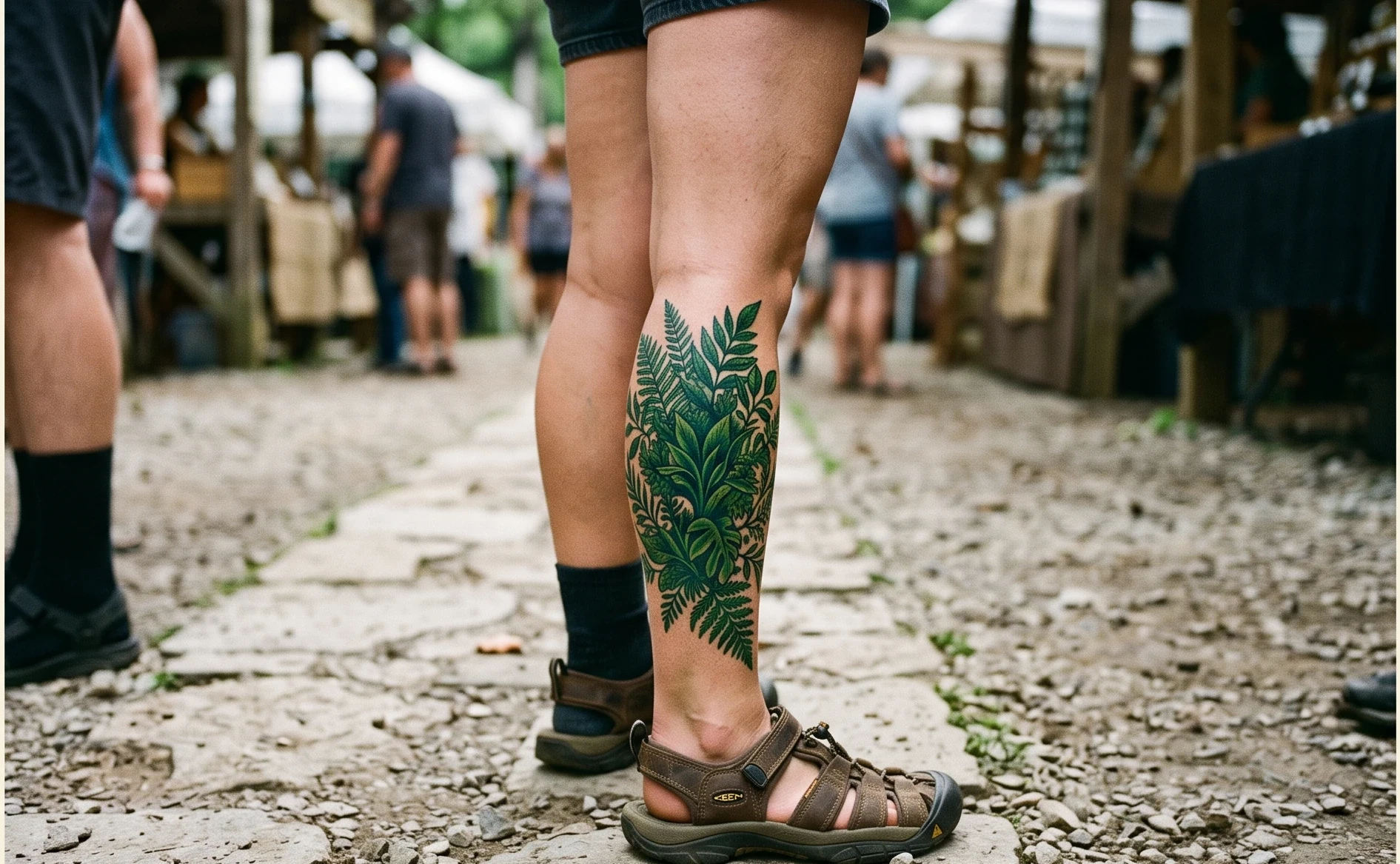 A green tattoo — one of the harder colours to clear.
What each "natural" remedy actually does
The popular home methods share a pattern — they either irritate the surface or injure it, and neither removes ink.
- Salt scrubs and salabrasion. Rubbing coarse salt into the skin abrades the epidermis. It's friction injury, not removal. You get raw, broken skin, not cleared pigment — and open skin means infection risk.
- Lemon juice. Mildly acidic and often paired with salt. It can irritate and lighten the surface slightly, which reads as "fading," but it never reaches dermal ink. On sensitive skin it can also trigger irritation and, with sun exposure, pigment reactions.
- Sand paste and abrasive scrubs. The DIY version of dermabrasion. Grinding the skin surface wounds it; it doesn't extract ink and it invites scarring.
- Aloe vera and oils. Soothing at best. They moisturise and calm skin but have no mechanism to move pigment out of the dermis.
- Exfoliation. Removes dead surface cells. It can make a tattoo look marginally hazier for a short time until the epidermis renews. No ink leaves.
- Hydrogen peroxide and DIY chemical mixes. Marketed as "bleaching" the tattoo. On intact skin these can burn, blister, and discolour — damaging skin without touching the ink beneath it.
The American Academy of Dermatology lists laser, surgical excision, and dermabrasion as tattoo-removal options performed by professionals — none of the home remedies above appear on any credible medical list.
 A blue tattoo, which needs a 694/755nm laser.
Why the before-and-after photos fool people
The photos are the engine of the myth, so it's worth being precise about what they show. A "before" is a clear tattoo. The "after" is almost always a fresh wound — red, scabbed, swollen skin where salt or acid has broken the surface. That inflammation temporarily obscures the ink and looks like dramatic progress.
Then the video ends. What the clip never shows is the same skin four to six weeks later, healed, with the tattoo still there — and now sometimes a scar or a pale patch on top of it. You're watching an injury in progress being sold as removal. Irritation and scabbing are not pigment clearance.
Natural remedies vs what actually works: the honest comparison
Here is how the common home remedies stack up against the clinical methods. The decisive column is the second one — whether the method can even reach the ink.
| Remedy | Claim | Reality | Main risk |
|---|---|---|---|
| Salt scrub / salabrasion | "Scrubs the ink out" | Abrades surface skin only; ink stays in the dermis | Friction burns, open wounds, infection, scarring |
| Lemon juice | "Acid fades the tattoo" | Mild surface irritation; no effect on dermal ink | Skin irritation, sun-triggered pigment changes |
| Sand paste / abrasives | "Sands the tattoo away" | Wounds the epidermis; no ink removed | Scarring, infection |
| Aloe / oils | "Naturally lifts pigment" | Soothes skin; no mechanism to move ink | Ineffective (low risk) |
| Hydrogen peroxide / DIY acid | "Bleaches the ink out" | Can't reach dermal ink; damages skin | Chemical burns, blistering, permanent scarring |
| Laser removal | Evidence-based clinical treatment | Light passes into the dermis and fragments ink | Temporary blistering; multiple sessions needed |
Professional saline removal — a clinical procedure performed by trained technicians, most often on permanent makeup — is a separate, supervised method. It is not a home saline you soak into the skin.
Why not one professional clinic recommends these
This is the tell that outranks any viral post. Across the 5,700 clinics in the Tattoo Removal Guide directory, spanning 1,043 cities (as of July 2026), none offer or endorse salt, lemon, or acid home removal. The businesses whose entire livelihood is removing tattoos have standardised on lasers — the technology that physically reaches the ink. If a kitchen remedy worked, the market that does this every day would use it. It doesn't.
The same directory shows the laser tools clinics actually use: roughly 18% note picosecond and 15% note Q-switched lasers (as of July 2026) — both effective, differing in pulse duration rather than one being superior. That's the real toolkit for reaching dermal ink, and none of it lives in your pantry.
So what does work — and what to do next
Laser removal is the evidence-based first-line treatment. Short, high-intensity pulses of light pass into the dermis and shatter the ink into smaller particles, which your immune system then clears over a course of sessions spaced several weeks apart. It reaches the layer a scrub or an acid can't, which is the entire point. For tattoos that aren't a good laser candidate, surgical excision — and, for permanent makeup, professional saline removal — are clinical alternatives a provider can assess.
How many sessions and what result you'll get depends on your ink colours, its depth and age, your skin, and your immune response — which is why no honest source promises a fixed number or a scar-free guarantee. That's a consultation conversation, not a claim on a viral video.
If you've been tempted by a natural remedy, the better move is a proper consultation — and, critically, do not abrade or apply acid to your skin at home, because the burns and scars are permanent in a way the tattoo never had to be. Read our tattoo removal methods compared pillar for how laser, excision, and the rest stack up, see why removal creams don't work either, then compare laser tattoo removal clinics in your city — or start with a dense market like Melbourne — to see who's near you before you book anything.
This article is general information, not medical advice. Tattoo removal is a medical procedure — consult a licensed dermatologist or a qualified laser provider about your specific tattoo and skin before starting any treatment, and never apply salt, acid, or any removal product to broken or intact skin at home.
Frequently asked questions
Do natural tattoo removal remedies work?
No. Tattoo ink sits in the dermis, the second layer of skin, below the epidermis that naturally sheds and renews. Salt scrubs, lemon juice, sand paste, aloe, and hydrogen peroxide all act on the surface epidermis and cannot reach the dermal pigment. There is no natural or home method shown to remove a tattoo, and several of these cause chemical or friction burns.
Why can't salt or lemon juice remove a tattoo?
Because they only affect the surface skin. A tattoo needle deposits ink 1–2 millimetres deep into the dermis, where the particles are too large for the body to clear — which is why tattoos are permanent. Salt scrubs and acidic juices like lemon abrade or irritate the epidermis on top; they never reach the ink. Any "fading" you see is skin irritation and scabbing, not pigment leaving.
Does salabrasion (salt scrubbing) remove tattoo ink?
No. Salabrasion is the practice of rubbing salt into abraded skin. It wounds the skin rather than removing ink, and dermatology sources do not list it as an effective or safe removal method. The likely results are friction burns, open wounds, infection risk, and scarring where the tattoo was — often more visible than the tattoo itself.
Is hydrogen peroxide or a DIY acid safe for removing a tattoo?
No. Hydrogen peroxide, trichloroacetic acid, and other DIY "chemical" methods can burn deeper than intended on intact skin and leave permanent scars, blistering, and pigment changes. The U.S. FDA has not approved any home product for tattoo removal and cautions against self-treatment. These are not safe to use on yourself.
Why do before-and-after photos of natural removal look convincing?
Because they usually show a fresh wound, not a cleared tattoo. Abrasion and acids leave the skin red, scabbed, and swollen, which temporarily obscures the ink and looks like progress. Once the skin heals over the following weeks, the tattoo typically looks the same — but now there may be scarring on top of it.
Can aloe vera or exfoliation fade a tattoo over time?
No. Aloe soothes skin and exfoliation removes dead surface cells, but neither reaches the dermis where the ink lives. At most, exfoliation can make a tattoo look marginally hazier for a short time before the epidermis renews. Neither removes any pigment, and repeated aggressive exfoliation can damage the skin barrier.
If natural remedies don't work, what actually removes a tattoo?
Laser removal is the evidence-based first-line treatment: short pulses of light pass into the dermis and break the ink into fragments the immune system clears over several sessions. Professional saline removal (mainly for permanent makeup) and surgical excision are clinical alternatives for specific cases. All are performed by trained providers — a consultation comes first.
Ready to look at what actually reaches the ink? Compare laser tattoo removal clinics in your city and check real per-session pricing before you book. For the full method-by-method breakdown, see our tattoo removal methods compared guide.
Related guides
Related Guides
- Methods & Decisions
TCA & Acid Tattoo Removal: Does It Work, and Is It Safe? (2026)
Does TCA remove tattoos? Acid removal works by chemically wounding the skin so ink sheds with the damaged tissue — imprecise, high scarring risk, and dangerous as a…
- Methods & Decisions
Tattoo Removal vs Cover-Up: Which Is Right for You? (2026)
Tattoo removal vs cover-up: removal wins if you want bare skin or a clean canvas; a cover-up wins if you want new art fast. Plus the hybrid path — and how to decide.
- Methods & Decisions
12 Questions to Ask at a Tattoo Removal Consultation (2026)
The 12 questions to ask at a tattoo removal consultation — on credentials, the laser, the plan, safety and cost — plus a green-flag vs red-flag answer table.