Blue Ink Tattoo Removal: Why Light Blue Is Harder Than Dark Blue
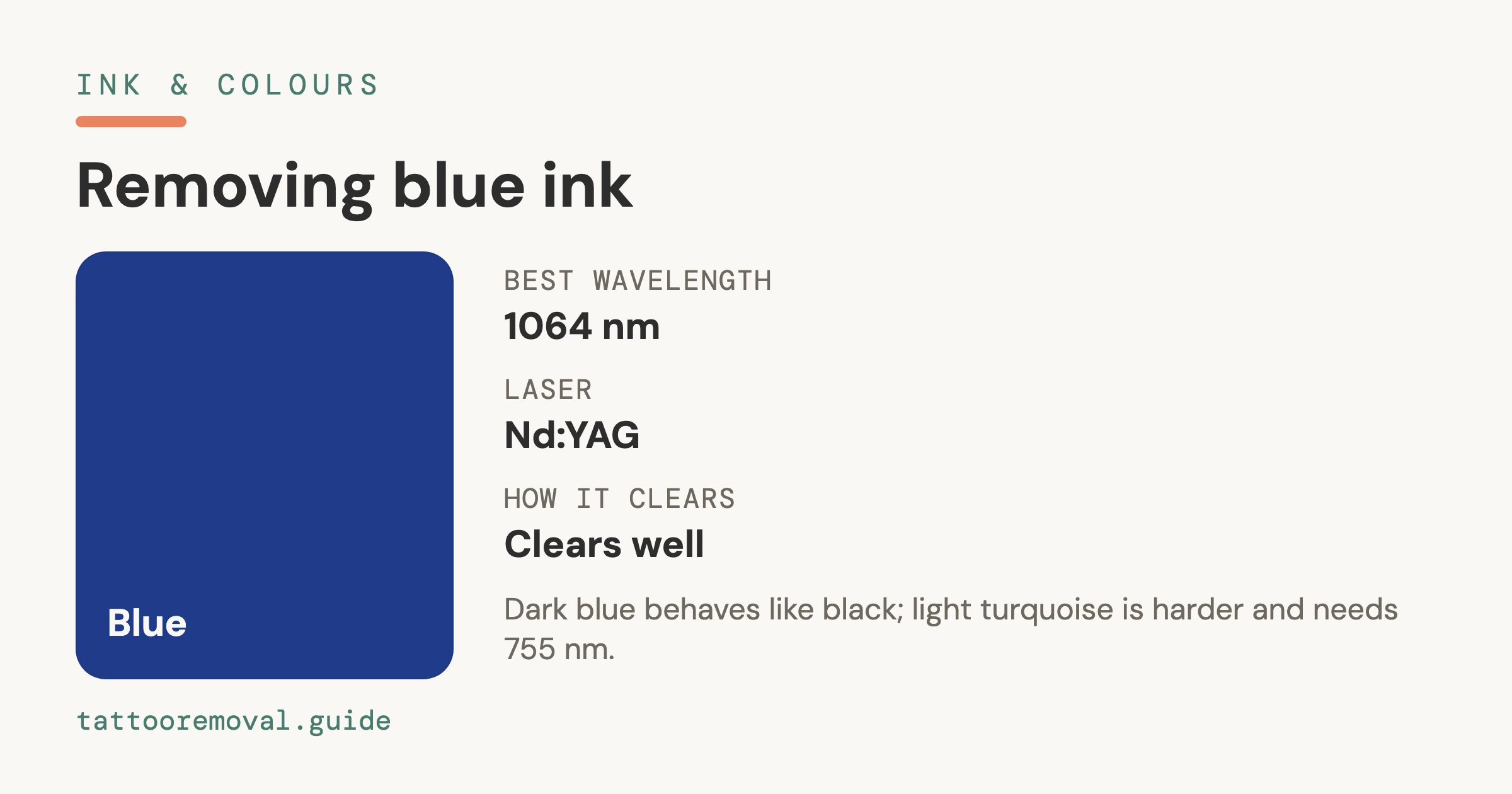
Blue ink tattoo removal is entirely possible, but blue sits among the harder colours to clear — and the difficulty splits sharply by shade. Dark navy blue usually responds to the 1064nm Nd:YAG laser most clinics already own, while light and pastel blues absorb that light poorly and need a 694nm ruby or 755nm alexandrite laser. Either way, blue typically takes more sessions than black.
That shade-by-shade split is the thing most people (and some clinics) miss. "Blue" is not one removal problem — it's two. This guide explains the physics using medical sources, distinguishes dark blue from light blue, and shows why the laser a clinic owns matters more than almost anything else, with figures from the Tattoo Removal Guide directory stamped (as of July 2026).
Key Takeaways
- Blue can be removed, but it's one of the harder colours — and dark blue is easier than light blue.
- Dark/navy blue often clears on the deep-penetrating 1064nm Nd:YAG laser most clinics own (given enough power).
- Light/sky/pastel blue reflects that light and needs a 694nm ruby, 755nm alexandrite, or picosecond laser — equipment only a minority of clinics have.
- Blue usually takes more sessions than black, and complete removal is common but not guaranteed.
- Of the 5,700 clinics we track, about 18% note picosecond lasers and 15% note Q-switched (as of July 2026) — so the right machine for light blue is far from universal.
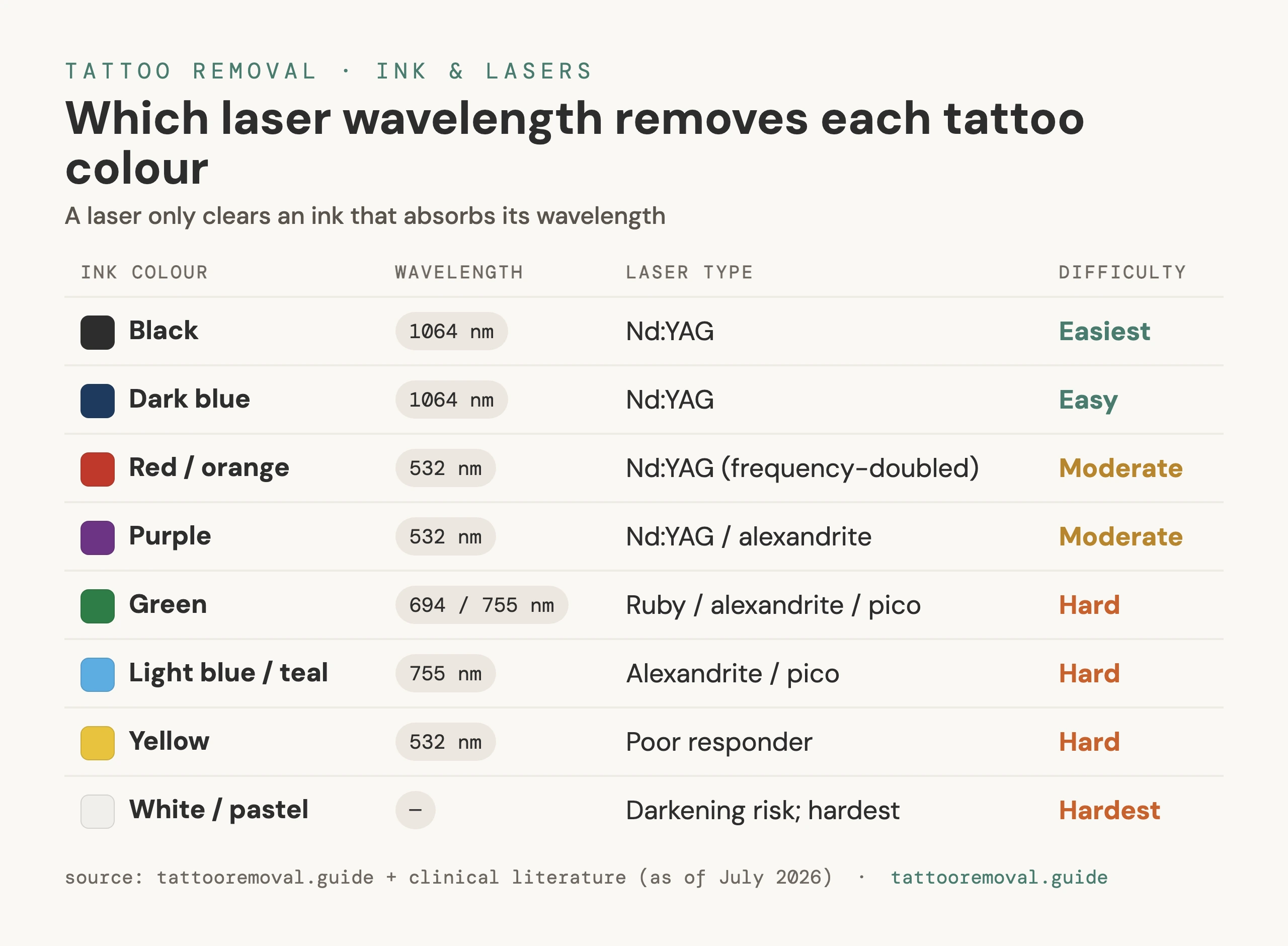 A laser only clears an ink that absorbs its wavelength.
The one rule that governs every colour: selective photothermolysis
Every question about blue ink traces back to a single principle. Selective photothermolysis is the mechanism behind laser tattoo removal: a laser fires an extremely short pulse of a single wavelength (colour) of light, the ink particle absorbs that light faster than the surrounding skin can shed the heat, and the particle shatters into fragments small enough for your immune system to carry away. The American Academy of Dermatology describes the same sequence: the laser breaks ink into tiny pieces the body then clears over the following weeks.
The catch is in the word absorbs. A pigment only heats and shatters if it absorbs the laser's wavelength — and a colour, by definition, reflects its own light. That single fact is why colour, not size, is the biggest driver of how hard a tattoo is to remove, and why blue behaves so differently depending on its shade.
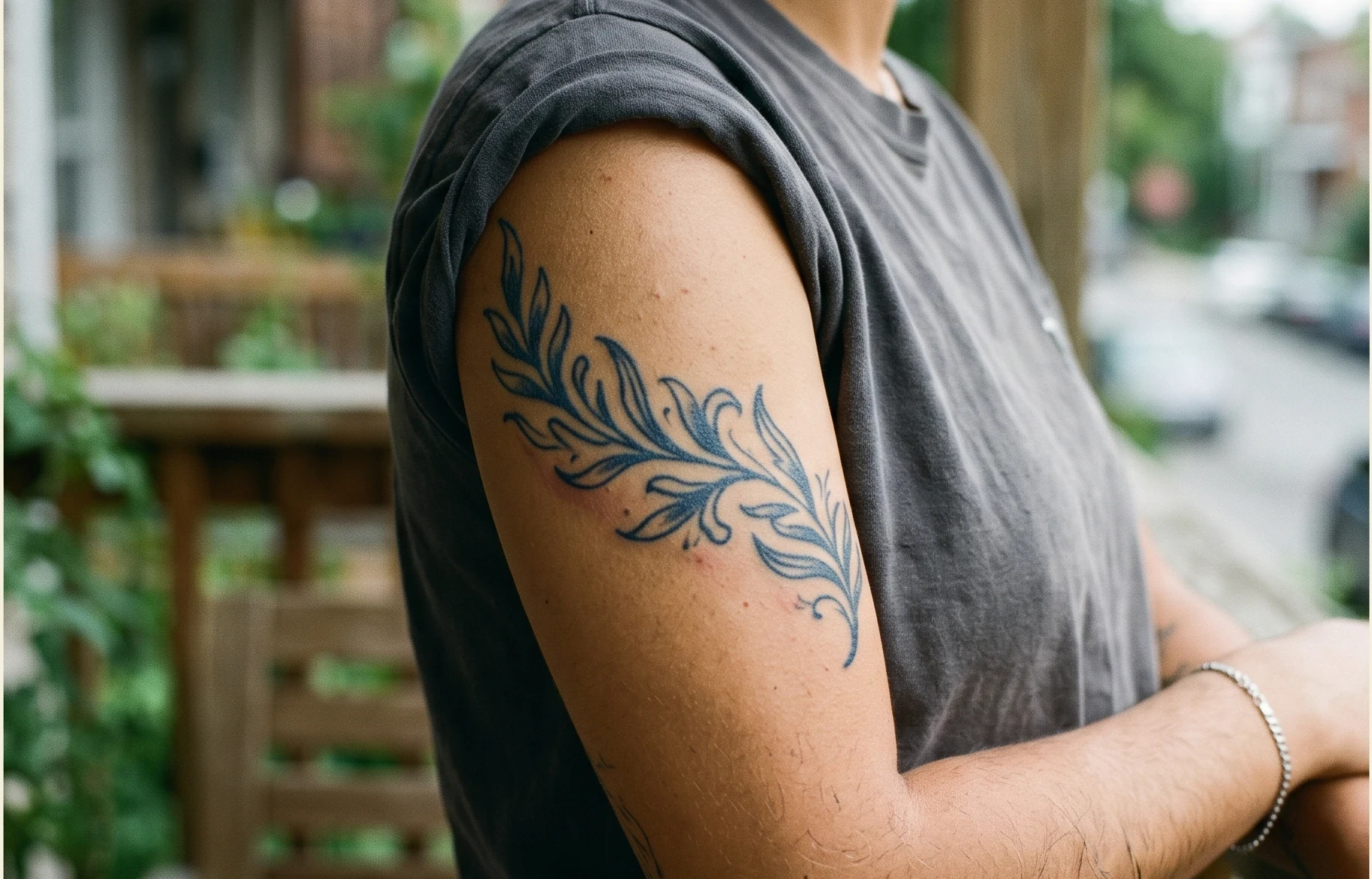 A blue tattoo, which needs a 694/755nm laser.
Why blue is hard — and why the shade decides how hard
Blue pigment absorbs light in the red and near-infrared part of the spectrum. How well it absorbs depends on how dark the blue is:
- Dark navy and blue-black pigments are dense and absorb the invisible 1064nm near-infrared wavelength reasonably well — the same deep-penetrating beam that clears black ink. Because most clinics own a laser that produces 1064nm, dark blue often behaves much like a slightly slower black.
- Bright, sky and pastel blues reflect more visible light and absorb 1064nm far less efficiently. To shatter them you generally need red-spectrum light around 694–755nm, which a standard clinic laser doesn't produce.
Here is where most clinics fall down. The workhorse machine across the industry is the dual-wavelength Q-switched Nd:YAG, which fires 1064nm (superb on black and dark inks) and 532nm (visible green light, good for red, orange and warm colours). Notice what's missing: red-spectrum light in the 694–755nm band. A 532nm green beam does little for a light blue, and the 1064nm beam struggles with pale shades. So a clinic with only a standard Nd:YAG can make real progress on your navy lettering while stalling on the pale blue in the same design. Cleveland Clinic notes that removal difficulty and the number of sessions vary by ink colour, with some colours needing more treatments than others.
Blue's close relative here is green — it also absorbs red-spectrum light and responds to the same ruby, alexandrite, or picosecond machines. A clinic set up to clear green is usually set up to clear light blue too. For the full colour-by-colour breakdown, see the pillar guide on the hardest tattoo colours to remove, and the sibling piece on whether green tattoos can be removed.
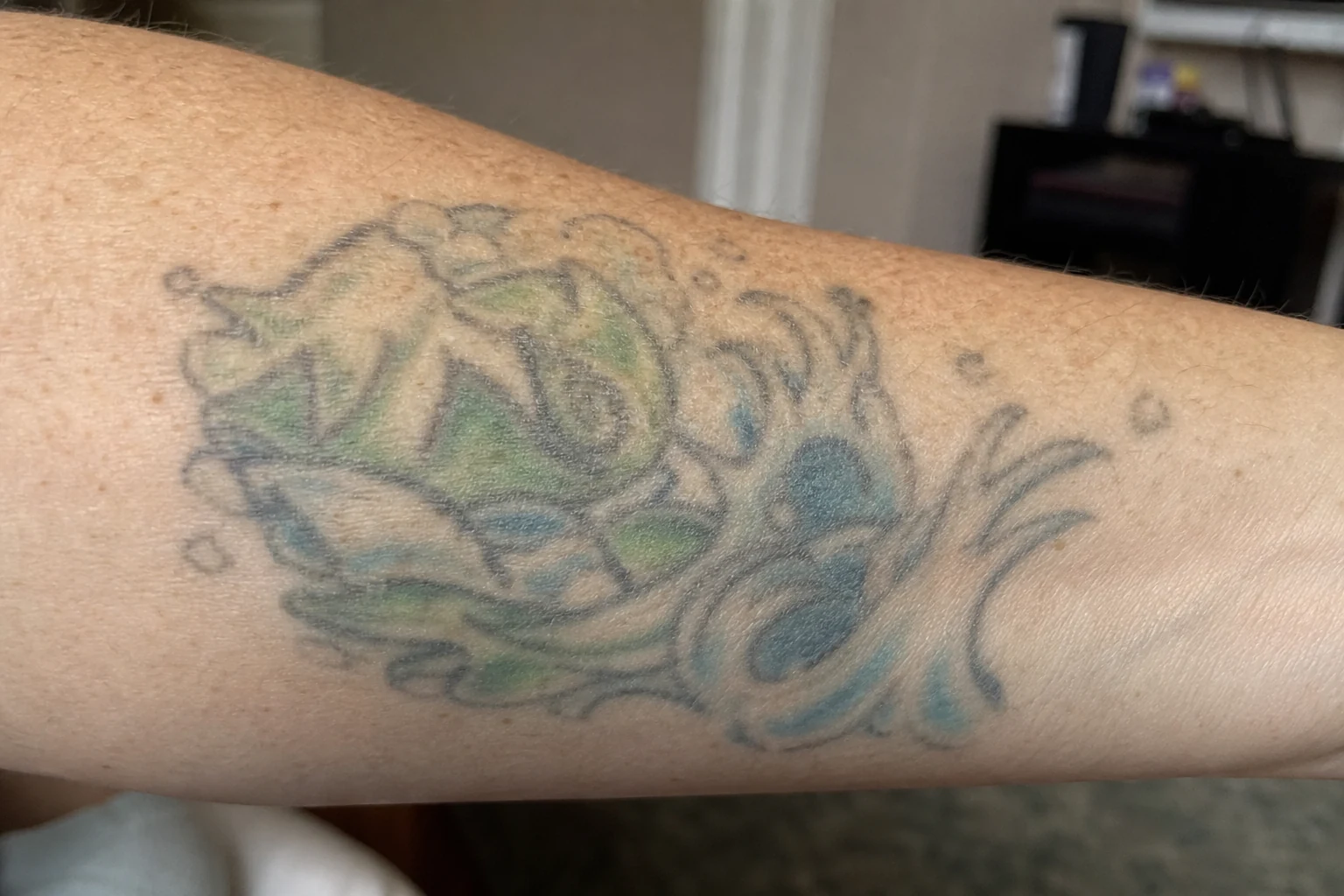 A green tattoo — one of the harder colours to clear.
Colour → laser → relative difficulty
| Ink colour | Laser / wavelength that targets it | Relative difficulty |
|---|---|---|
| Black | Nd:YAG 1064nm (absorbs almost everything) | Easiest |
| Dark / navy blue | Nd:YAG 1064nm (adequate power); ruby/alexandrite for stubborn shades | Easier |
| Red, orange | Nd:YAG 532nm (green light) | Moderate |
| Green | Ruby 694nm / alexandrite 755nm / picosecond | Hard |
| Light / sky / pastel blue | Ruby 694nm / alexandrite 755nm / picosecond | Hard |
| Yellow, white | Poorly absorbed by all wavelengths | Hardest / often incomplete |
General guidance only — actual response depends on the specific pigment, its depth and density, your skin tone, and your immune clearance. A clinician should assess your tattoo.
Two honest caveats. First, expect more sessions for blue than for black even on the right machine — blue absorbs laser light less efficiently, so clearance is slower, and light blue is slowest of all. A published review of laser tattoo removal notes that shorter picosecond pulses can improve clearance of stubborn colours (Kent & Graber, Dermatologic Surgery). Second, no reputable clinician can promise a colour will vanish completely; some blue tattoos fade dramatically, others clear fully, and a few leave a faint shadow. The FDA notes that complete removal isn't guaranteed and results vary.
A note on darkening: test the patch first
One extra caution with certain blues and — especially — cosmetic or permanent-makeup pigments that include iron-oxide-based components: some can darken paradoxically when first hit with a laser, shifting toward grey or black instead of fading. It's usually reversible with further sessions, but it's the reason a careful clinician does a small test patch before committing to a full course on any pigment they're unsure of. If your "blue" is actually a blue-toned cosmetic tattoo, flag it and ask for a test spot.
It's an equipment question — so compare before you book
If clearing light blue comes down to which laser the clinic owns, then choosing a clinic is the whole game. The trouble is that a clinic with only a standard Nd:YAG will still happily book you in — and then under-deliver on the pale blues.
This is exactly the gap a directory closes. Across the 5,700 specialist clinics the Tattoo Removal Guide tracks, only about 18% note a picosecond laser (as of July 2026) — and picosecond systems are one of the main routes to the red-spectrum wavelengths light blue needs (ruby and alexandrite machines add to that pool). In other words, the equipment that reliably clears light blue is the exception, not the default — which makes comparing before you book worth the effort.
Rather than ring around asking every clinic which lasers they own, filter for it. Compare clinics in your city to see which ones list the equipment and services relevant to coloured ink, or start from a dense market like tattoo removal in Melbourne and work outward. When you enquire, ask one specific question: "For light blue ink, do you have a ruby, alexandrite, or picosecond laser — or only a standard Nd:YAG?" The answer sorts the clinics that can help from the ones that will simply try their Nd:YAG and shrug.
This article is general information, not medical advice. Laser tattoo removal outcomes vary by individual, and no result is guaranteed — consult a licensed provider to assess your specific tattoo.
Frequently asked questions
Can blue tattoos be removed?
Yes, blue tattoos can be removed, but blue is one of the harder colours. Dark navy blue usually responds to the 1064nm Nd:YAG laser most clinics own, while light or sky blue absorbs those wavelengths poorly and needs a 694nm ruby or 755nm alexandrite laser. Blue typically takes more sessions than black.
Why is blue ink hard to remove?
Blue ink is hard to remove because a laser only shatters pigment that absorbs its wavelength, and lighter blues reflect much of the light that common lasers produce. Deep navy blue absorbs near-infrared 1064nm reasonably well, but bright and pastel blues need red-spectrum light around 694–755nm that many clinics can't deliver.
Is dark blue or light blue easier to remove?
Dark blue is generally easier to remove than light blue. Deep navy and blue-black pigments absorb the 1064nm Nd:YAG wavelength that most clinics have, so they respond more like black ink. Light, sky and pastel blues reflect more light and need a ruby or alexandrite laser, making them slower and harder to clear.
What laser removes blue tattoos?
Dark blue tattoos often clear with a 1064nm Q-switched or picosecond Nd:YAG laser. Lighter blues respond best to a 694nm ruby laser, a 755nm alexandrite laser, or a picosecond system tuned to those wavelengths, because they emit the red-spectrum light that light-blue pigment absorbs. The right choice depends on the shade.
Does blue ink take more sessions than black?
Usually yes. Black absorbs almost every laser wavelength, so it clears fastest, while blue absorbs less efficiently and typically needs more sessions. Light blue takes the most. There is no guaranteed number — pigment shade, depth, density, your skin tone and immune clearance all affect it, so a clinician should assess your tattoo.
What is selective photothermolysis?
Selective photothermolysis is the principle behind laser tattoo removal: a laser fires a very short pulse of a single wavelength that a target absorbs faster than the surrounding skin can dissipate the heat, so the target shatters while nearby tissue is spared. For tattoos, the target is the ink, matched to a wavelength it absorbs.
How do I find a clinic that can remove blue ink?
Look for a clinic that lists a picosecond, ruby (694nm), or alexandrite (755nm) laser, since these cover light blue as well as dark. About 18% of the 5,700 clinics in the Tattoo Removal Guide directory note a picosecond laser (as of July 2026), so comparing clinics in your city is the fastest way to find the right equipment.
Related guides
Related Guides
- Ink & Colours
Selective Tattoo Removal: Erasing Part of a Tattoo (2026)
Selective tattoo removal targets one part of a tattoo — a name, a figure, one colour — while leaving the rest.
- Ink & Colours
Removing an Ex-Partner's Name Tattoo: Your Options in 2026
Removing an ex's name tattoo? A partner's name is one of the most-removed tattoos — and small black lettering is among the quickest and cheapest to clear.
- Ink & Colours
Name & Lettering Tattoo Removal
Name and lettering tattoos are usually small and black, so per-unit they're among the easier tattoos to remove — but dense, deep script needs patience.