Are Amateur Tattoos Easier to Remove Than Professional Ones?
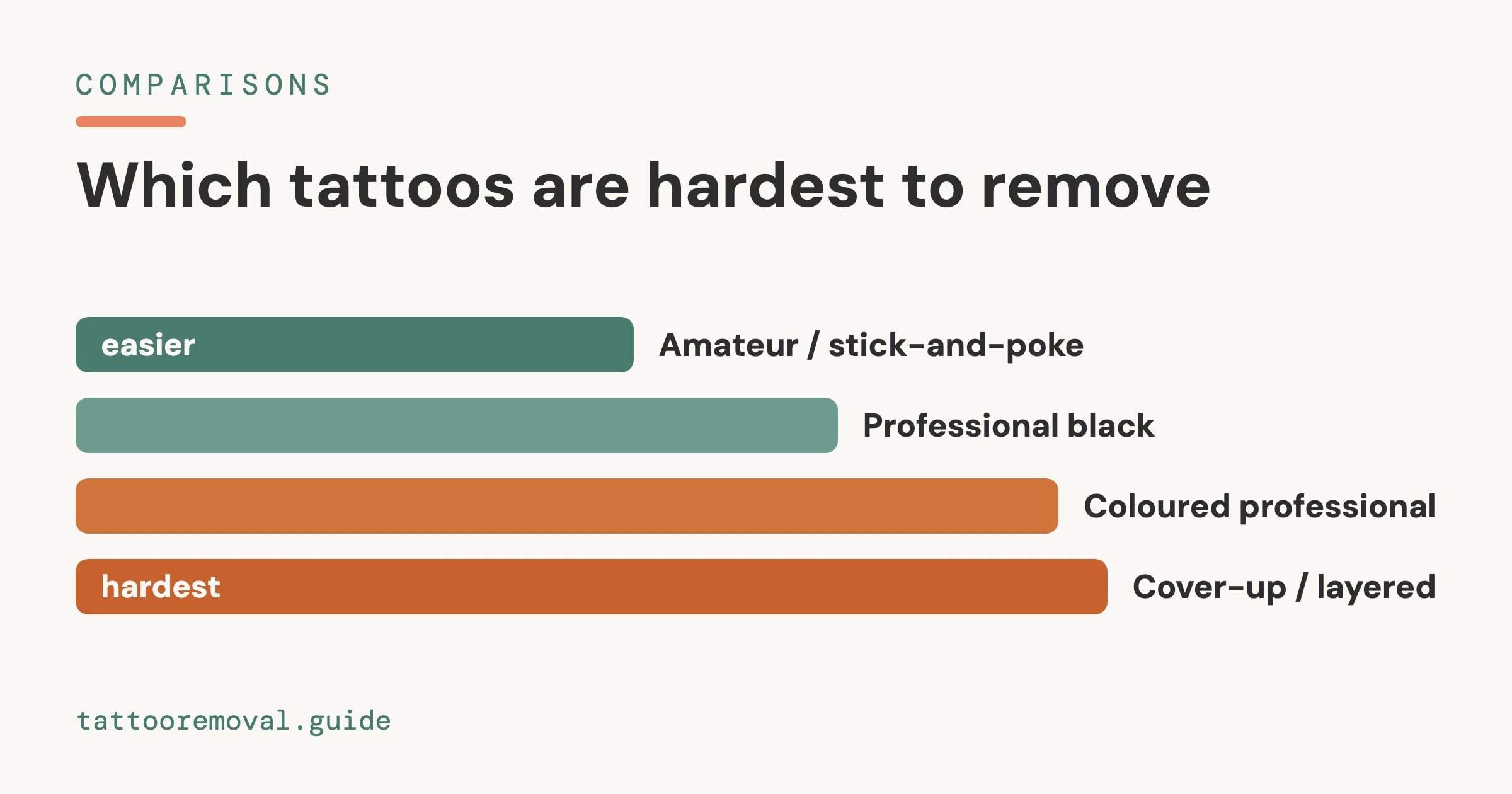
It's a common belief that a homemade or "stick-and-poke" tattoo will lift faster than the work of a seasoned artist. The honest answer is: usually, but not always. What actually drives removal difficulty is how deep the ink sits, how densely it was packed, what colours were used, and how long it's been in your skin — and amateur and professional tattoos each carry a mix of those traits.
What actually determines removal difficulty
A laser doesn't care whether a tattoo came from a licensed clinic or a friend's kitchen. It responds to physics: the type of pigment, where that pigment sits in the skin, and how much of it there is. Four factors do most of the work.
Ink depth. Laser energy has to reach the pigment to break it up. Ink placed shallowly in the upper dermis is generally easier for the laser — and the immune system — to clear. Ink driven deep or unevenly is harder to reach in a single pass.
Ink density. A solid block of saturated colour needs more sessions than fine, sparse linework, because there's simply more pigment to break down over the 6–8 week clearing window your body needs between sessions.
Colour. Black and dark blue absorb laser light well and tend to respond most predictably. Greens, light blues, and some yellows are more stubborn and may need a different wavelength. This is true regardless of who applied the tattoo.
Age. Older tattoos have already faded somewhat as the body slowly clears pigment over the years, so they often need fewer sessions than a fresh one.
Where amateur tattoos tend to be easier
Many amateur and hand-poked tattoos are applied with less ink, less saturation, and shallower, more uneven placement than professional work. Less pigment overall can mean fewer sessions. They're also frequently done in plain black, which responds well to modern lasers.
That's the kernel of truth behind the "amateur tattoos come out faster" idea — and for a lot of people, it holds.
Where amateur tattoos can be harder
The same unpredictability cuts both ways. Amateur tattoos are sometimes applied with non-regulated inks whose exact composition is unknown, which can make the laser response harder to predict. Hand-poked work can also drive ink to inconsistent depths — some patches shallow, some surprisingly deep — so clearance across a single piece can be uneven. And homemade tattoos occasionally carry more scarring from the original application, which a clinician will want to assess before starting.
Where professional tattoos can be more predictable
Professional tattoos are often denser and more saturated, which usually means more sessions. But there's an upside: a skilled artist tends to lay ink at a consistent depth with regulated, known pigments. That consistency can make a clinician's plan more predictable, even if the total session count is higher.
In other words, "professional" often means more work, but more foreseeable work — while "amateur" often means less work, but with more surprises along the way.
What this means for your sessions and budget
Most tattoos take roughly 8–12 sessions to clear, spaced 6–8 weeks apart, with each session usually running 15–30 minutes — but your number depends entirely on the factors above, not on a label. A small, single-colour amateur piece might clear in fewer; a dense professional sleeve will need more.
Cost follows session count, which is where shopping around matters. Across our directory, the price for a single session varies widely within the same city — in Melbourne, a typical session runs about $50–$200 (as of July 2026), and Sydney also sits around $50–$200 (as of July 2026). Multiplied across a full course of treatment, that same-city gap can mean hundreds of dollars in difference for an identical tattoo. A consultation that includes a written, session-by-session estimate is worth more than a single headline price.
The honest bottom line
Whether your tattoo is amateur or professional matters far less than its ink depth, density, colour, and age. The only reliable way to know your own timeline is an in-person assessment, where a clinician examines the tattoo and recommends the right laser and a realistic session estimate. If your tattoo involves scarring, raised skin, or any medical concern, raise it with the clinic — and for any question about your skin's health, speak to a doctor.
Frequently asked questions
Do amateur tattoos always come off faster than professional ones?
No. Many do, because they often use less ink and plainer colours, but not all. Amateur tattoos can use unknown inks and uneven depths, which sometimes makes them harder or less predictable to remove than a professionally applied piece.
Does the type of ink affect how many sessions I need?
Yes. Black and dark blue tend to respond most predictably to modern lasers, while greens and some yellows can be more stubborn and may need a different wavelength. Non-regulated inks in some homemade tattoos can also make the response harder to predict.
How many sessions will my tattoo take?
Most tattoos take around 8–12 sessions, spaced 6–8 weeks apart, but the real number depends on depth, density, colour, and age rather than on whether the tattoo was done professionally. A consultation gives you a realistic estimate for your specific tattoo.
Is a deeper tattoo harder to remove?
Generally, yes. The laser has to reach the pigment to break it up, so ink placed deep in the skin can take more sessions than shallower ink. Both amateur and professional tattoos can sit at varying depths.
Should I worry about scarring from an old amateur tattoo?
Possibly. Some homemade tattoos carry scarring from how they were originally applied. A clinician will assess existing scarring during your consultation before recommending a treatment plan, and any medical concern should be raised with a doctor.
Difficulty comes down to your tattoo, not its label — and so does the price. Compare tattoo removal clinics in your city to see session estimates and the real price range near you before you book a consultation.
Related Guides
- Comparisons
Tattoo Removal Numbing Options Compared
Numbing cream, cooling, or nothing at all — an even-handed comparison of what each option actually does, and the trade-offs clinics don't always mention.
- Comparisons
Laser Tattoo Removal vs Laser Hair Removal: What is the Difference?
They look similar but target completely different things in your skin. Here's why a hair-removal laser can't remove a tattoo, and can burn you trying.
- Comparisons
In-Clinic Laser vs At-Home Tattoo Removal Devices
At-home devices and clinical lasers work on different physics with very different risk profiles. Here's what each actually does, and where each fits.