Laser Tattoo Removal vs Laser Hair Removal: What is the Difference?
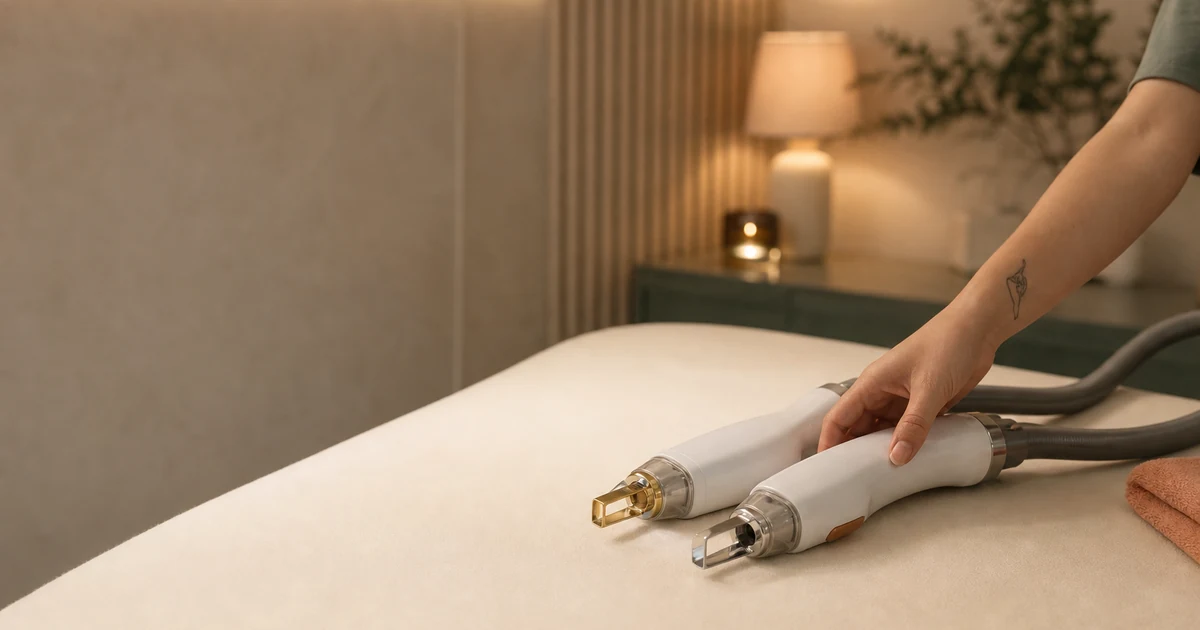
A friend just told you her laser hair removal clinic can "probably" fade your tattoo too, since it's the same machine anyway. It isn't, and booking on that assumption is how people end up with a burn instead of a fade. Both treatments use a handpiece, protective eyewear and a series of sessions, so the confusion is understandable — but they target completely different things in your skin, and a machine built for one usually cannot do the other job at all, safely or otherwise.
They aim at two different targets
The two treatments are easy to confuse because the technology family is the same, but the goal of each is opposite.
Laser hair removal targets the pigment (melanin) in the hair follicle. The laser heats the follicle enough to slow or stop it producing hair. The energy is delivered in relatively long pulses — measured in milliseconds — because the aim is to gently heat a structure and damage it over time, across repeat sessions.
Laser tattoo removal targets the ink particles sitting in the deeper layer of your skin. The laser delivers energy in extremely short pulses — nanoseconds (Q-switched) or picoseconds (picosecond systems) — to shatter the ink into fragments small enough for your immune system to carry away. The mechanism is mechanical and thermal at once: a fast, high-peak burst that breaks the particle apart.
That difference in pulse duration is the whole story. Hair removal heats a target slowly; tattoo removal hits it almost instantly. A machine tuned for one timescale physically cannot produce the other.
Why you cannot swap the machines
A hair-removal laser cannot remove a tattoo, and a tattoo-removal laser is not the right tool for hair. Using the wrong device is, at best, ineffective and, at worst, a burn or scarring risk.
- Pulse duration is fixed by the hardware. Hair-removal systems (diode, alexandrite, long-pulse Nd:YAG) deliver millisecond pulses. Tattoo systems are Q-switched or picosecond and deliver nano- or picosecond pulses. One cannot mimic the other.
- Wavelengths are matched to the target. Tattoo systems often run multiple wavelengths so different ink colours can be addressed — for example, green and blue inks usually respond to wavelengths that red and black do not. Hair-removal wavelengths are chosen for follicle depth and melanin, not ink.
- The risk profile differs. Pointing a long-pulse hair laser at dense tattoo ink can overheat the skin and cause a burn rather than clearing the ink. Neither result is what you want.
A useful way to think about it: laser tattoo removal is not about one laser being "better" — it is about the right laser for your specific tattoo, set up by someone who treats tattoos regularly. Across our directory of thousands of specialist clinics in Australia, the UK, the US, Canada and New Zealand, about 18% note picosecond systems and about 15% note Q-switched systems in their listings (as of July 2026) — both are effective, established technologies, and the better choice depends on your ink, not the brand name on the machine. Neither one, by the way, makes the process faster than the other — the honest limit on speed is always your own immune system, not the laser type.
Sessions, time and cost compare differently too
Because the targets differ, so do the timelines and the price logic.
Hair removal typically runs 6–8 sessions spaced a few weeks apart, working with the hair growth cycle. Sessions are usually quick.
Tattoo removal usually takes 8–12 sessions for most tattoos, each spaced around a 6–8 week clearing window so your immune system has time to clear the shattered ink between visits. Each session is short — often 15–30 minutes — but the full course commonly runs a year or more. Results vary with ink colour, depth, age, your skin and the laser used, and no clinic can guarantee complete clearance.
Price is where the directory data is most revealing. For tattoo removal, the same tattoo can cost very different amounts in the same city. In Melbourne, the typical per-session price runs about $50 to $200, close to a 4× spread (as of July 2026) — and that is before you multiply by 8–12 sessions. Run the low and high end across a 10-session course and you're comparing roughly $500 against $2,000 for the same tattoo. That is the practical stakes of choosing where you go — a bigger swing, in most cities, than anything the laser hair removal comparison ever raises.
See typical tattoo-removal pricing in your city, and read our guide to how many sessions tattoo removal takes before you book a consultation.
How to pick the right treatment — and the right clinic
If your goal is permanent hair reduction, you want a clinic running hair-removal lasers and a practitioner experienced with your skin tone. If your goal is removing, fading for a cover-up, or reworking a tattoo, you want a clinic that treats tattoos routinely and can match the laser to your ink.
A consultation should confirm which laser the clinic will use, why it suits your case, and a realistic session estimate. If a provider offers to remove a tattoo with what is really a hair-removal device, treat that as a reason to look elsewhere. Surgical excision, medication interactions, or any concern about scarring or an existing skin condition is a question for a doctor, not a directory.
Frequently asked questions
Can a laser hair removal machine remove a tattoo?
No. Hair-removal lasers deliver long, millisecond pulses tuned to heat hair follicles, while tattoo removal needs the extremely short nano- or picosecond pulses that shatter ink particles. Using a hair-removal device on a tattoo is usually ineffective and can risk burns or scarring.
Is laser tattoo removal more painful than laser hair removal?
Most people describe tattoo removal as more intense, often compared to the snap of an elastic band against the skin, though it is brief. Pain varies a lot by location, ink density and individual tolerance, and many clinics use cooling or numbing to help.
Why does tattoo removal take so many more sessions?
Tattoo ink sits deeper in the skin and must be broken up gradually, then cleared by your immune system over the 6–8 week window between sessions. Most tattoos take 8–12 sessions, whereas hair removal usually needs 6–8 because it works with the hair growth cycle.
Is picosecond better than Q-switched for tattoos?
Neither is universally better. The difference is pulse duration, not one being superior — both are effective and widely used. The right choice depends on your tattoo's ink colours, depth and age, which a clinic experienced in tattoo removal can assess at a consultation.
Can one clinic do both treatments?
Some clinics own separate machines for each and offer both, but they are genuinely different devices — one cannot substitute for the other. Always confirm the clinic uses a dedicated tattoo-removal laser for your tattoo, not a repurposed hair-removal system.
Don't assume your hair-removal clinic doubles as a tattoo-removal one — confirm it, then check the going rate. See what Melbourne clinics actually charge per session before you book, so the only surprise at your consultation is a good one.
Related Guides
- Comparisons
Tattoo Removal Numbing Options Compared
Numbing cream, cooling, or nothing at all — an even-handed comparison of what each option actually does, and the trade-offs clinics don't always mention.
- Comparisons
Are Amateur Tattoos Easier to Remove Than Professional Ones?
It's not about who did the tattoo — it's ink depth, density, colour and age. Here's what actually determines how many sessions yours will need.
- Comparisons
In-Clinic Laser vs At-Home Tattoo Removal Devices
At-home devices and clinical lasers work on different physics with very different risk profiles. Here's what each actually does, and where each fits.