In-Clinic Laser vs At-Home Tattoo Removal Devices
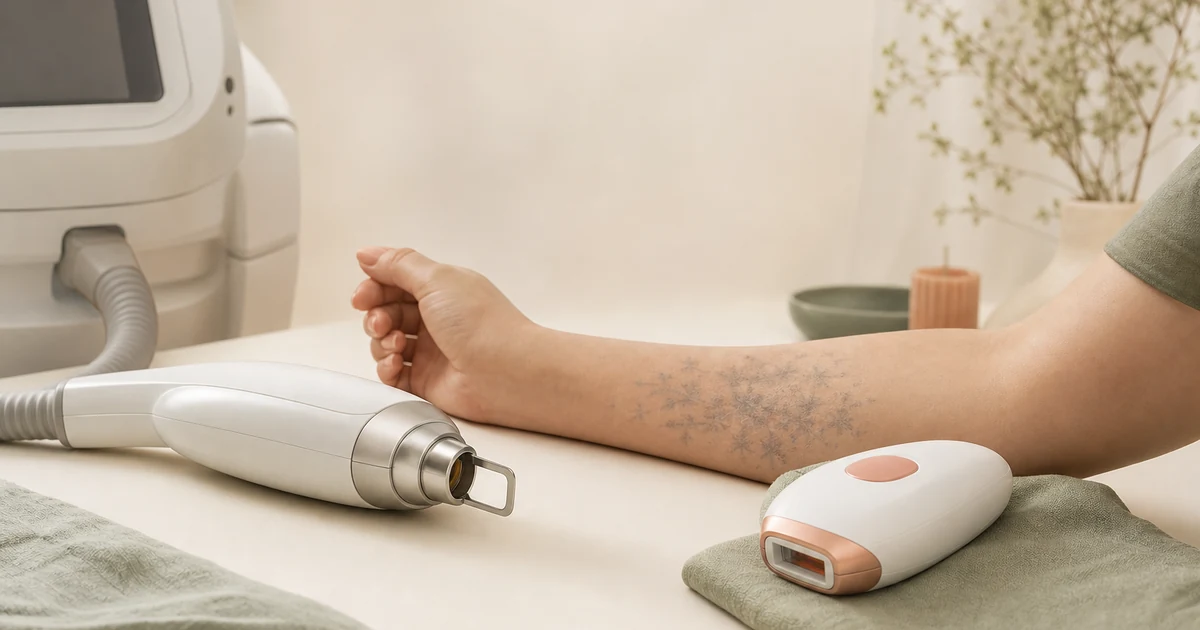
At-home gadgets promise to fade a tattoo for the price of one clinic session — so it's fair to ask why a clinic charges far more for the same job. The honest answer is that the two work on different physics, carry different risks, and suit different goals. Here's what each actually does, where each fits, and how to decide.
How clinical lasers remove tattoo ink
A clinical Q-switched or picosecond laser fires extremely short, high-energy pulses (billionths or trillionths of a second) tuned to the colour of the ink. The pulse shatters ink particles into fragments small enough for your immune system to carry away over the following weeks — the reason removal is spread across the 6-8 week clearing window between sessions rather than done in one visit.
Both laser types are effective. The difference is pulse duration, not one wavelength being "better" than the other — a clinic chooses the right laser for your tattoo based on ink colour, depth, age, and your skin tone. Most tattoos take 8-12 sessions, each running 15-30 minutes, though that range depends heavily on the individual tattoo.
What at-home devices actually do
Consumer "tattoo removal" devices fall into a few categories, and most do not use a true Q-switched or picosecond laser:
- IPL and low-power diode units — emit broad or continuous light that heats the skin rather than delivering the ultra-short pulse needed to fracture ink. They are designed for hair reduction, and manufacturers of reputable hair devices usually warn against using them on tattoos.
- Abrasion and "fading" creams — work on the upper skin layers, not the dermis where tattoo ink sits.
- Picosecond-style handhelds sold online — marketed with clinic terminology but operating at a fraction of clinical power and without the calibration, cooling, or wavelength control of a medical device.
Because tattoo ink sits in the dermis — the layer your body deliberately protects — a device that can't reach and selectively target that layer has limited ability to clear ink, and a device powerful enough to reach it without proper control raises the risk of skin damage.
Safety: the real point of difference
This is where the comparison stops being about price. Clinical removal is performed by trained operators who screen your skin type, set parameters for your ink, cool the skin, and manage healing — and even then, removal can sting, blister, and occasionally scar.
At-home use removes the screening step. The most reported risks with unsupervised devices are burns, blistering, pigment changes (lighter or darker patches), and scarring, which can be harder to treat than the tattoo itself. There is also an outcome risk: partial or uneven fading can make a later professional removal or a planned cover-up harder to work with, not easier.
If you have a darker skin tone, a history of keloid scarring, or a tattoo over a mole or recent skin change, a professional assessment matters more, not less — these are questions for a clinician, not a gadget's instruction sheet.
Where each one genuinely fits
An at-home device may suit you if you want gentle, gradual lightening of a small, old, faded tattoo, you accept it may take a long time with modest results, and you've checked the manufacturer actually approves it for tattoos (many don't). Cost and privacy are the real draws.
In-clinic laser tends to fit better if you want meaningful clearing, you have coloured ink, a large or dense tattoo, darker skin, or you're fading a tattoo for a cover-up and need predictable, controlled results. The mechanism is built for the job, and a professional can tell you early whether your tattoo is a good candidate.
Neither is a guaranteed result — outcomes vary by ink, skin, and tattoo, and any medical removal should follow a consultation.
A practical way to compare cost
The headline price gap is real but easy to misread. Within a single city, in-clinic sessions can range widely — in Melbourne, a typical session runs about $50 to $200 (as of July 2026), and most tattoos need several sessions. An at-home device is a one-off purchase, but slow, partial results can mean you end up paying for clinic sessions anyway.
A useful first step is a consultation: most clinics will tell you roughly how many sessions your tattoo would need, which turns a vague "it's expensive" into a number you can actually weigh against a device.
For more on session counts and spacing, see our guide to how the removal process works, or compare what clinics charge near you on the Melbourne tattoo removal page.
Frequently asked questions
Do at-home tattoo removal devices actually work?
Results are usually limited. Most consumer devices can't deliver the ultra-short, high-energy pulse that fractures dermal ink, so they tend to lighten small, old tattoos slowly at best. Many are designed for hair reduction, and their makers often advise against using them on tattoos.
Are at-home devices safe to use on a tattoo?
They carry real risks when used without screening — burns, blistering, pigment changes, and scarring are the most commonly reported. Risk is higher on darker skin, over moles, or with a history of keloid scarring. A professional assessment is the safer starting point.
Why is in-clinic removal so much more expensive?
You're paying for a medical-grade laser tuned to your ink, a trained operator, skin screening, cooling, and aftercare — not just the light itself. Most tattoos also need 8-12 sessions over several months, which spreads the cost.
Can I start at home and finish at a clinic?
It's possible, but partial or uneven home fading can sometimes make professional removal harder to plan. If full removal or a cover-up is the goal, it's worth getting a clinic's view before you begin.
How many sessions does professional removal take?
Most tattoos take 8-12 sessions spaced 6-8 weeks apart, with each session lasting 15-30 minutes. The exact number depends on ink colour, depth, age, and your skin — a consultation gives you a more accurate estimate.
Not sure which path fits your tattoo? Compare verified clinics in your city, see typical session prices, and book a consultation to get a real estimate before you decide. No clinic pays to rank higher, and no leads are sold — just the directory.
Related Guides
- Comparisons
Tattoo Removal Numbing Options Compared
Numbing cream, cooling, or nothing at all — an even-handed comparison of what each option actually does, and the trade-offs clinics don't always mention.
- Comparisons
Are Amateur Tattoos Easier to Remove Than Professional Ones?
It's not about who did the tattoo — it's ink depth, density, colour and age. Here's what actually determines how many sessions yours will need.
- Comparisons
Laser Tattoo Removal vs Laser Hair Removal: What is the Difference?
They look similar but target completely different things in your skin. Here's why a hair-removal laser can't remove a tattoo, and can burn you trying.