Laser Wavelengths Explained: Nd:YAG, Alexandrite and Ruby
"That green won't come out." If a tattoo artist has ever told you that, they weren't lying to you — they were describing the one laser the clinic they trained near happened to own. Green and sky-blue ink genuinely resist some machines completely, while shrugging off almost nothing under a different wavelength. Your tattoo's colours decide which laser clears them, not the other way around, and black ink absorbs almost anything — which is exactly why "it won't come out" is so often a statement about the equipment in the room, not your ink. This page explains what Nd:YAG, alexandrite and ruby lasers each do well, so you can read a clinic's equipment list and know before you book whether it can actually reach your specific colours.
How wavelength and ink colour fit together
A tattoo-removal laser works by sending a pulse of light that a particular ink pigment absorbs. The pigment heats, shatters into smaller fragments, and your immune system carries those fragments away over the following weeks — the reason most tattoos need 8–12 sessions spaced roughly 6–8 weeks apart.
The catch: each ink colour absorbs some wavelengths and reflects others. A wavelength a pigment reflects passes straight through and does nothing. So "the best laser" is not a single machine — it is the wavelength that matches the colour in front of it. That is why many clinics run more than one laser, or a single platform that switches wavelengths.
Wavelength is measured in nanometres (nm). Three names come up most often on clinic listings.
Nd:YAG: 1064 nm and 532 nm
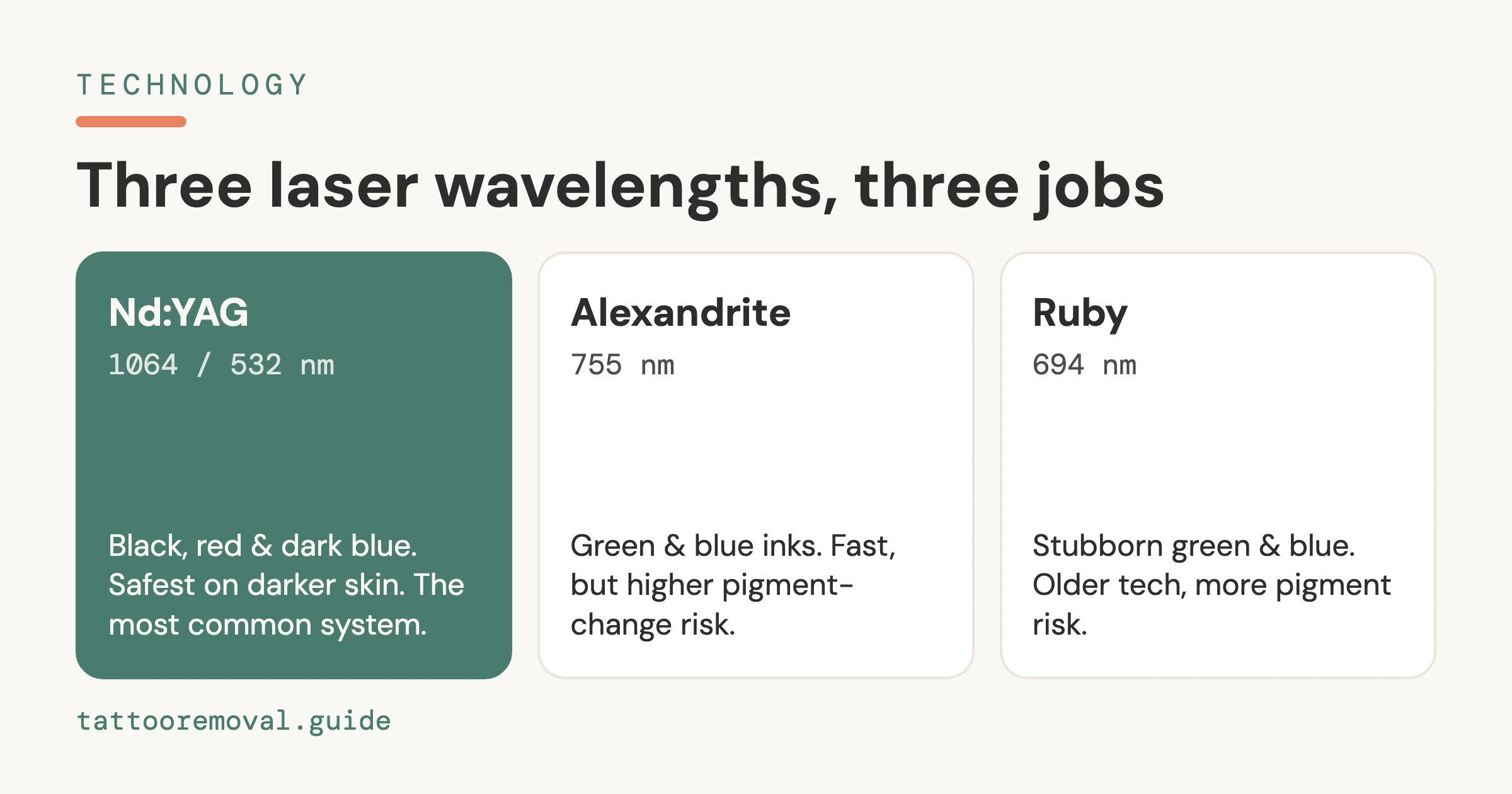
The Nd:YAG is the most common laser you will see listed, partly because one machine produces two useful wavelengths.
- 1064 nm is strongly absorbed by black and dark blue ink. Because longer wavelengths scatter less in skin, 1064 nm is also the wavelength most clinics reach for on darker skin tones, where shorter wavelengths carry a higher risk of pigment change.
- 532 nm (the same beam passed through a crystal that halves the wavelength) targets red ink, and helps with orange and some purples.
What an Nd:YAG handles less well on its own is green and sky-blue ink — those colours sit in a band this laser doesn't absorb strongly. A clinic working a green-heavy piece will often pair it with another wavelength.
Alexandrite: 755 nm
The alexandrite laser fills the gap the Nd:YAG leaves. Its 755 nm wavelength is well absorbed by green and blue pigments, the two colours people are most often told "won't come out." If your artist warned you that the green won't budge, an alexandrite wavelength is usually the reason it can.
Alexandrite is less suited to red ink, which 532 nm covers, and it is generally used more cautiously on deeper skin tones than 1064 nm. It is common to see alexandrite and Nd:YAG listed together at the same clinic precisely because they cover different colours.
Ruby: 694 nm
The ruby laser was one of the earliest used for tattoo removal and remains valued for the colours it reaches: green, blue, and some of the hardest stubborn pigments, including certain purples. Its 694 nm wavelength sits close to alexandrite and overlaps on green and blue.
Ruby is less widely available than Nd:YAG or alexandrite, in part because the technology is older and the machines are less common in newer fit-outs. It is generally considered higher-risk on darker skin and is used selectively rather than as an all-purpose laser. If you have a specific stubborn colour, it is worth asking whether a clinic has access to it.
Pulse duration: the other half of the picture
Wavelength decides which colour a laser reaches. Pulse duration decides how the energy is delivered. This is where picosecond and Q-switched (nanosecond) lasers differ — and it is a difference in timing, not in the colours they can target.
Picosecond lasers fire shorter pulses than Q-switched lasers; both are effective and both are widely used. A picosecond and a Q-switched machine can run the same 1064 nm or 755 nm wavelength. So a clinic's wavelength range tells you which colours it can treat, while its pulse technology is a separate question about how it delivers the energy. The right laser for your tattoo is the one whose wavelength matches your ink — picosecond or Q-switched both come in the wavelengths above.
For a closer look at that timing difference, see our picosecond vs Q-switched guide. For a wider view of what removal involves session to session, see how the removal process works.
Reading a clinic's equipment list
A short way to match your tattoo to a clinic's listed lasers:
- Mostly black ink: an Nd:YAG (1064 nm) covers it. The most common setup will do.
- Reds, oranges: look for 532 nm, which most Nd:YAG platforms include.
- Greens and blues: look for 755 nm (alexandrite) or 694 nm (ruby) — these are the wavelengths most worth confirming before you book.
- Multi-colour pieces: look for a clinic listing more than one wavelength, or a platform that switches between them.
- Darker skin tones: ask which wavelength the clinic plans to use and at what settings; 1064 nm is the usual starting point, and a consultation should cover this directly.
Not every clinic lists its exact wavelengths, and equipment is only one factor — operator experience and a proper consultation matter as much. Across the directory, picosecond technology is noted by about 18% of listed clinics and Q-switched by about 15% (as of July 2026), so it is always worth confirming the specifics rather than assuming. The honest caveat: owning the right wavelength doesn't guarantee a fast result. A green tattoo hit with the correct laser still clears in stages over the same 6–8 week windows as everything else — the right machine avoids wasted sessions, it doesn't skip them.
Frequently asked questions
Which laser wavelength removes green tattoo ink?
Green ink is most strongly absorbed at around 755 nm (alexandrite) and 694 nm (ruby). Green is the colour people are most often told won't come out, usually because the clinic only had a wavelength that green reflects rather than absorbs. Confirm a clinic lists one of these wavelengths if your tattoo is green-heavy.
Is one wavelength better than another?
No single wavelength is best overall — they target different ink colours. Nd:YAG (1064/532 nm) suits black and red, while alexandrite (755 nm) and ruby (694 nm) suit green and blue. The right laser is the one whose wavelength matches your ink, which is why many clinics use more than one.
What's the difference between wavelength and picosecond vs Q-switched?
Wavelength is the colour of light the laser emits, which determines which ink colours it can treat. Picosecond and Q-switched describe pulse duration — how briefly the energy is delivered. Both are effective and widely used, and both come in the wavelengths above; they are separate questions.
Does skin tone change which wavelength is used?
Usually yes. On darker skin tones, clinicians generally favour 1064 nm because longer wavelengths are less absorbed by skin pigment, lowering the risk of pigment change. Shorter wavelengths can still be used, but settings and spacing are adjusted. This is a conversation to have at consultation.
How many sessions will I need regardless of wavelength?
Most tattoos take 8–12 sessions spaced about 6–8 weeks apart, though this varies with ink density, colour, age, and your skin. Matching the right wavelength to your ink colours helps each session do more, but it does not remove the need for the full clearing window.
If green or blue ink is the part of your tattoo you've been told to give up on, don't take one clinic's equipment list as the final word. See which clinics near you list alexandrite or ruby wavelengths before you accept that "it won't come out."
Related Guides
- Cosmetic & PMU
Why Permanent Makeup Fades (and Turns Orange or Grey) (2026)
Why permanent makeup fades and shifts colour, explained neutrally: shallow pigment placement, iron-oxide oxidation, sun exposure and skin turnover, why warm browns…
- Safety & Risks
Why a Patch Test Matters Before Tattoo Removal (2026)
Why does a patch test matter before laser tattoo removal? It reveals how your skin and ink react — blistering, pigment change, rare reactions — before a full…
- Safety & Risks
Who Should Not Get Laser Tattoo Removal? The Contraindications
Who should not get laser tattoo removal? Most adults are candidates. The full contraindications checklist — when to wait and when to discuss carefully.