Eyebrow Tattoo Removal: Saline vs Laser, Cost & the Darkening Risk

Eyebrow tattoos can be removed. Microblading, powder brows and older cosmetic brow work are usually faded or removed using one of two methods — saline (a non-laser lifting solution) or laser — and the right one depends on your pigment. Expect roughly 6–10 sessions and a per-session cost of about $70–$500 (as of July 2026). There is no guaranteed clean slate, and a test spot comes first.
That opener is deliberately plain, because eyebrow removal is where cosmetic-tattoo marketing gets furthest from the chemistry. The studios that rank for "eyebrow tattoo removal" usually sell one method — saline or laser — and frame it as the answer. It isn't. Brow pigments behave differently from body ink, and choosing the wrong method can turn a fixable brow grey. This guide is written from the directory's seat: across the 5,700 specialist clinics we track in 1,043 cities (as of July 2026), we don't perform removal or sell either method — so we can tell you when each one is the wrong choice.
This is a spoke of our permanent makeup removal pillar, focused on the brow.
Key Takeaways
- Eyebrow ink is not body ink. Cosmetic brow pigments often contain iron oxide and titanium dioxide, which can darken under a laser instead of fading — the single most important thing single-method studios bury.
- Saline vs laser is the real decision, and it turns on pigment colour, how old and deep the work is, and whether you want to protect the natural brow hair. See the table below.
- A test spot before treating the full brow is non-negotiable, and it should be read by a PMU-experienced clinician — it's how you catch paradoxical darkening before it spreads across the whole brow.
- Brows commonly need 6–10 sessions, spaced roughly 6–8 weeks apart (as of July 2026). Powder/ombré brows generally take more than light microblading.
- Cost is per-session × session-count. Saline ~$70–$350 and laser ~$150–$500 per session (as of July 2026) — a full course often reaches four figures, so ask for the course total.
- Remove, correct, or redo are three different paths. Removal isn't always the first move.
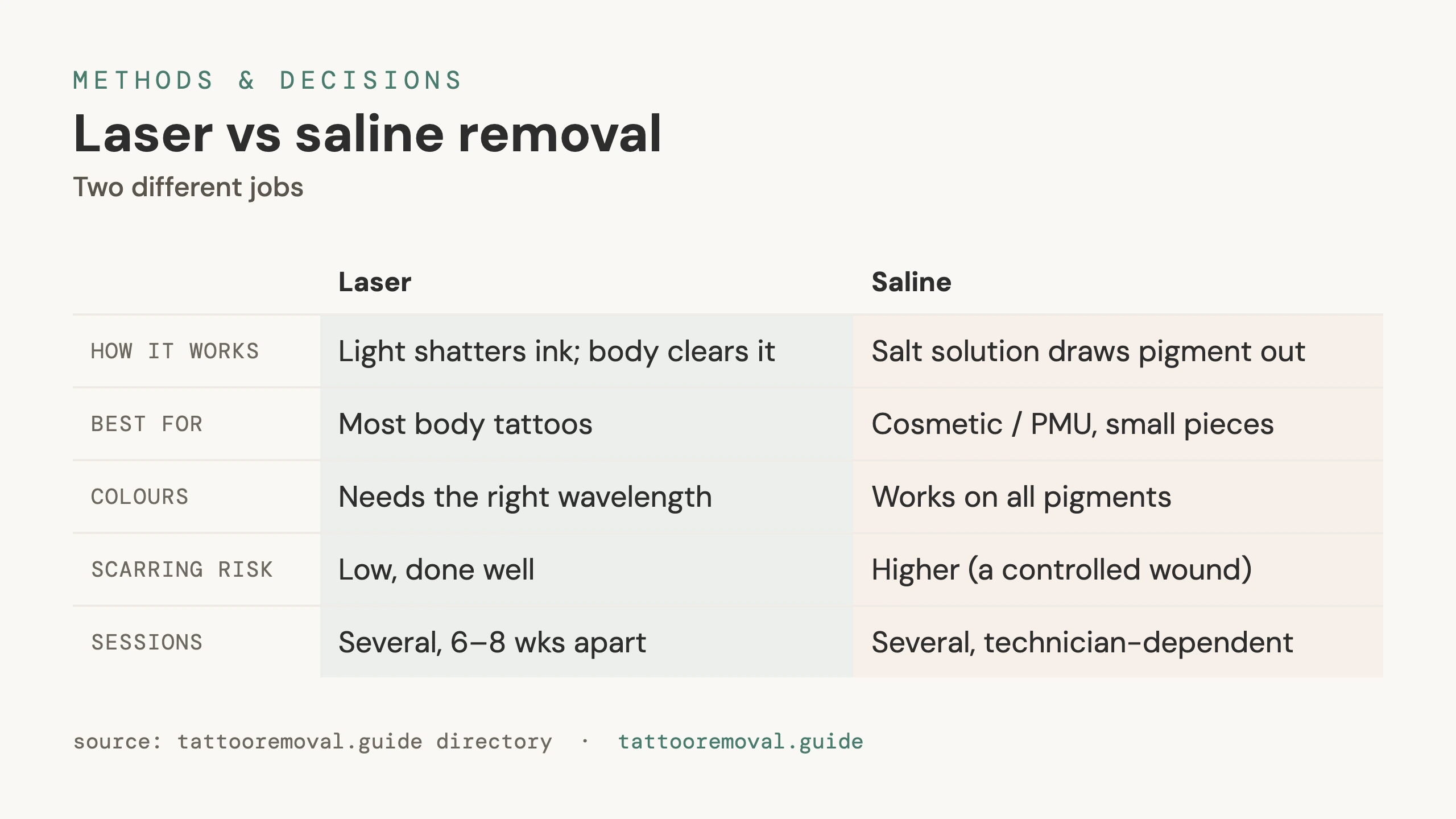 Laser suits most body tattoos; saline suits cosmetic/PMU and small pieces.
Can eyebrow tattoos actually be removed?
Yes — but "removed" honestly means faded, usually substantially, over a course of sessions, not erased in one visit. Cosmetic brow tattoos sit in the upper dermis, and the pigment is designed to soften over years, so removal is a controlled acceleration of fading rather than an instant undo.
Two variables set the difficulty. Saturation: microblading deposits fine hair-stroke lines and tends to be lighter; powder or ombré brows saturate a wider area more densely and generally need more work. Chemistry: brow shades lean brown, flesh, reddish and grey — exactly the pigments most prone to reacting badly under a laser (more on that below). A third complication is unique to brows: you usually want to keep the natural brow hair underneath, which pushes the method choice.
Microblading is a cosmetic tattoo technique that deposits pigment in fine, hair-stroke-like cuts in the upper layer of the skin to mimic individual brow hairs. Powder (or ombré) brows are a cosmetic tattoo that shades the brow with a soft, denser, filled-in look rather than individual strokes.
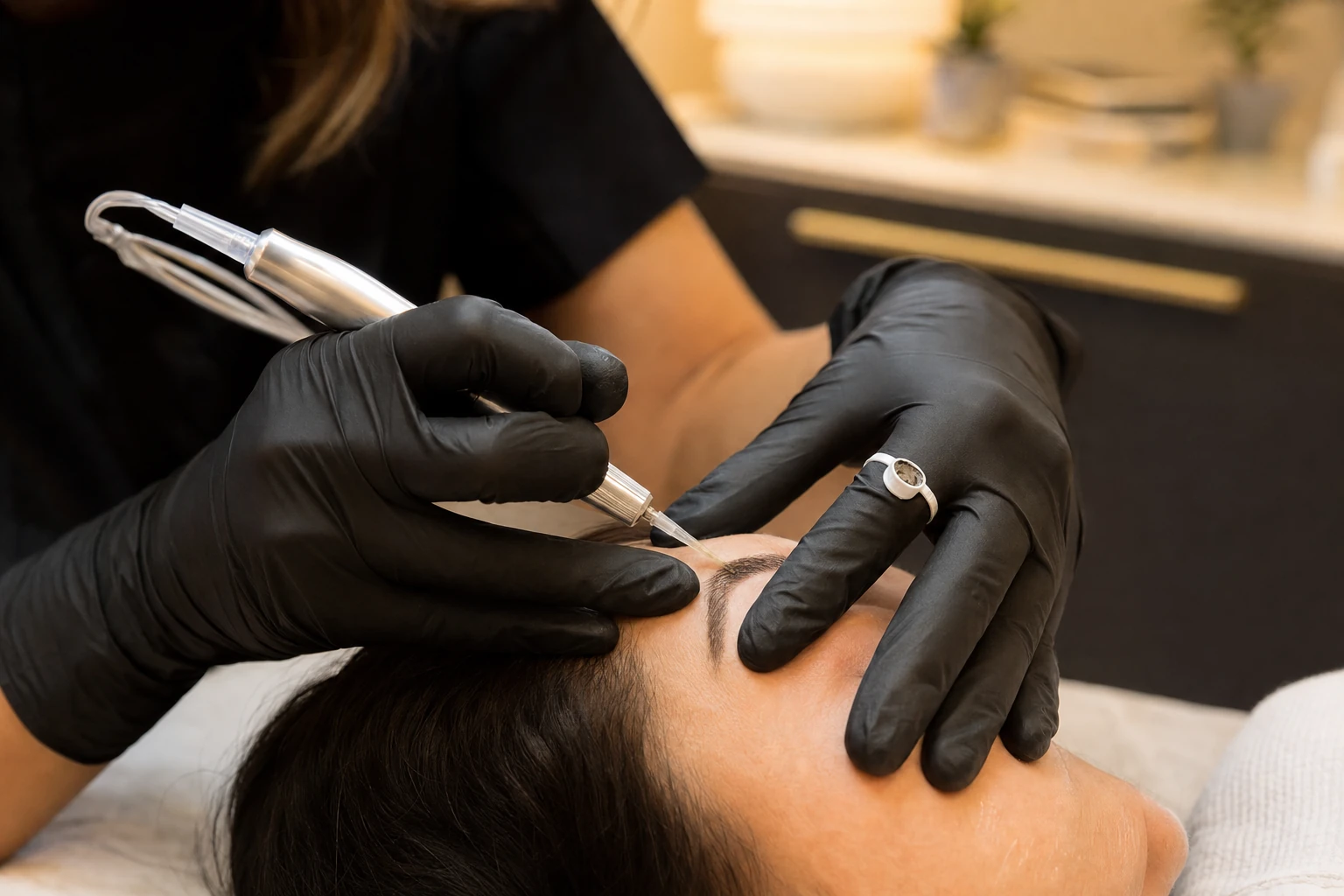 Cosmetic (permanent-makeup) tattooing on the face.
Saline vs laser: the core decision
This is the choice that actually determines your outcome, and it's the one single-method studios are structurally unable to give you straight. Saline removal is a non-laser method in which a saline or lifting solution is tattooed into the brow to draw pigment up and out through the natural scabbing process as the skin heals. Laser removal uses short, high-intensity light pulses to fragment the pigment particles so the body's immune system can clear them. Each wins in different situations.
| Factor | Saline removal | Laser removal |
|---|---|---|
| How it works | A saline/lifting solution is implanted like a tattoo; pigment scabs and lifts as it heals | A laser pulse fragments pigment particles; the immune system clears them |
| Best for (pigment) | Flesh, pink, brown, red, grey — the shades a laser can darken; fresh work | Black, dark brown, dense/saturated pigment; older, settled work |
| Typical sessions (brows) | Often more sessions, spaced to let skin heal fully | Often fewer for suitable pigment, spaced ~6–8 weeks |
| Pain | Stinging/scratching over a small area; open-wound aftercare | Rapid hot-elastic snapping sensation; brief |
| Healing | Scabs form and must be left to fall naturally; slower turnaround | Redness, frosting then scabbing; heals between sessions |
| Typical cost / session (as of July 2026) | ~$70–$350 | ~$150–$500 |
| Colour / pigment suitability | Handles colours that can darken under a laser; no photothermal reaction | Excellent on black/dark; real darkening risk on iron-oxide / titanium-dioxide shades — test first |
| Preserving brow hair | Gentler on surrounding follicles in most cases | Strong pulses may lighten nearby brow hairs |
The practical read: fresh, flesh-toned, pink or brown microblading often points toward saline; older, dark, saturated brow work often points toward laser. But those are tendencies, not rules — the only reliable decider is a test spot on your actual pigment, ideally reviewed by a provider who offers both methods (or will refer you) rather than one who only sells the one they own. For the full method-by-method breakdown, see laser vs saline removal.
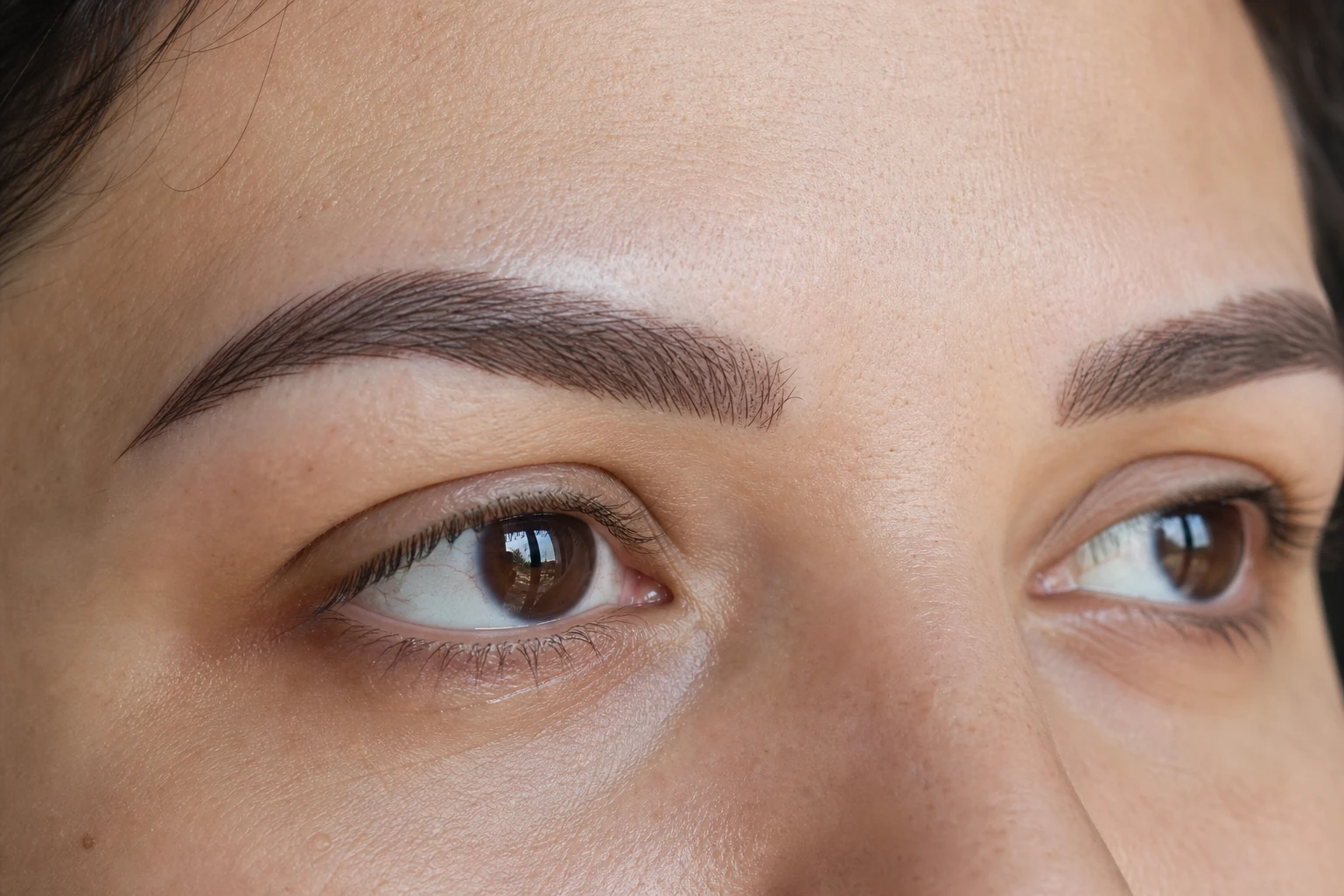 Cosmetic (permanent-makeup) tattooing on the face.
The key warning: why brow ink can darken under a laser
Body tattoo inks are largely carbon and organic pigments. Cosmetic brow pigments are different chemistry, and that difference is the whole ballgame. Flesh, pink, brown and grey brow shades frequently contain titanium dioxide (a white opacifier) and iron oxides (browns and reds). When a Q-switched or picosecond laser heats those compounds, they can undergo a chemical reduction and turn grey or black.
Paradoxical darkening is when a cosmetic pigment turns darker — grey or black — after a laser pulse instead of fading, because heat chemically reduces the titanium dioxide and iron oxides in the ink. This isn't fringe. It's documented in the peer-reviewed literature for decades: a foundational report described cosmetic tattoo ink darkening as a complication of Q-switched and pulsed-laser treatment, and later work specifically implicated titanium dioxide in tattoo darkening and laser non-response. Clinical reviews of laser tattoo removal and the U.S. FDA's guidance on tattoos and permanent makeup both flag that cosmetic pigments can react unpredictably.
Two rules follow, and neither is optional:
- Demand a test spot. A small, discreet test patch treated a few weeks ahead reveals whether your specific pigment fades, resists, or darkens — before the reaction is spread across your whole brow. Any provider who waves this off is telling you how they'll handle the risk.
- Insist on a PMU-experienced clinician. Removing cosmetic pigment is not the same job as removing a body tattoo. The person choosing the wavelength and reading the test spot needs specific experience with brow pigments; a general laser operator may not recognise or manage a darkening reaction. Modern picosecond lasers — noted by about 18% of the 5,700 clinics we track (as of July 2026) — can help with stubborn pigment, but Q-switched lasers remain effective and widely used, and no laser removes the darkening risk on iron-oxide colours. The test spot does the protecting, not the machine.
Eyebrow tattoo removal cost and sessions: the reality, not the ad
The honest cost of brow removal is a per-session price multiplied by a session count you can't know exactly upfront — which is why a "$150 a session" ad tells you almost nothing on its own.
| Brow work | Typical method lean | Typical sessions | Notes |
|---|---|---|---|
| Light microblading (hair strokes) | Saline or laser | 6–8 | Lighter saturation; brown/flesh pigment carries darkening risk |
| Powder / ombré brows | Saline or laser | 8–10 | Denser saturation drives a higher count |
| Old / dark saturated brow tattoo | Laser (test first) | 8–10+ | Settled, deep pigment; longest courses |
Sessions are typical ranges as of July 2026, spaced roughly 6–8 weeks apart to let skin recover. Old, dark or over-saturated work runs longer.
On price: saline removal typically runs about $70–$350 per session and laser about $150–$500 per session (as of July 2026), varying by city, provider and brow size. Run the multiplication: a powder brow needing 8 laser sessions at $250 is a $2,000 project, not a $250 one. When you compare quotes, ask for the likely full-course total and what happens if it needs more sessions than estimated — the per-session number is the hook, the course total is the truth. Pricing transparency is patchy across the field: only about 38% of the clinics in our directory publish any price at all (as of July 2026), so you will often have to ask.
Remove, correct, or redo? A simple framework
Not every unhappy brow story ends in removal. Match the problem to the path:
- Shape or symmetry is slightly off, colour is still true → correction / rework by a skilled PMU artist may be enough. Removal isn't always the first move.
- Colour has turned (grey, blue-black or orange brows) or migrated/blurred → you usually need fading or removal first, then optionally a redo once the canvas is clean.
- You want it gone, full stop → removal, method chosen by pigment per the table above.
- You're not sure → get a neutral second opinion — ideally not from the studio that did the original brows, whose incentive is to rework and re-charge, not to tell you to remove.
That last point is why this guide exists. The businesses that dominate brow-removal search results are overwhelmingly studios selling a single method, or the very artists who apply the brows. Their advice is often sincere and skilled — but it is not neutral. We don't remove tattoos, don't sell saline or laser, and don't take payment from clinics to rank higher. That's the only vantage point from which "actually, saline is safer for your pigment" is a free thing to say.
Safety and what to ask
Every removal carries some risk: temporary redness, swelling and scabbing are normal, while blistering, infection (if aftercare slips), scarring and permanent pigment change are possible rather than expected. The eyebrow area is sensitive and sits close to the eye, so it deserves an experienced hand. Before you book, ask:
- Do you use a test spot on cosmetic brow pigment, and how do you handle it if it darkens?
- How much experience do you have specifically with PMU / brow removal (not just body tattoos)?
- Which method and wavelength do you recommend for my pigment, and why?
- What's the likely full-course total, and what happens if it needs more sessions?
This is general information, not medical advice. Removal outcomes and risks depend on your skin, pigment and health — consult a licensed, experienced provider, and never assume a guaranteed result.
Find a clinic that offers the right method for your brows
The method is pigment-specific, so the clinic is too. Compare clinics offering brow and PMU removal near you — filter by saline, laser, or picosecond and see who actually offers the approach your pigment needs. If you're in a major metro, start with a dense market like Melbourne, where you can compare a wide range of providers and per-session pricing before you book.
Before you commit anywhere, ask for a test spot, confirm the clinician has PMU-specific experience, and get the likely full-course total. Those three questions separate a safe, honest provider from a good ad.
Frequently asked questions
Can eyebrow tattoos be removed?
Yes. Microblading, powder brows and older cosmetic brow tattoos can usually be faded substantially or removed using saline or laser, but no honest provider guarantees a clean slate. Results depend on the pigment colour, how deep and old the work is, and your skin. Expect gradual fading over several sessions, not an instant erase.
Is saline or laser better for eyebrow tattoo removal?
Neither is universally better. Saline suits fresh work, flesh, pink and brown pigments a laser can darken, and cases where you want to protect the natural brow hair. Laser suits older, deeper, darker or dense pigment. Brow shades carry a real darkening risk, so a test spot on your actual pigment is what decides it.
How much does eyebrow tattoo removal cost?
Saline removal typically runs about $70–$350 per session and laser about $150–$500 per session (as of July 2026), varying by city, provider and area. Brows commonly need 6–10 sessions, so a full course often reaches four figures. Ask for the likely full-course total, not just the per-session price.
How many sessions to remove an eyebrow tattoo?
Cosmetic eyebrows commonly take about 6–10 sessions, spaced roughly 6–8 weeks apart to let the skin recover (as of July 2026). Colour, saturation, ink depth and age drive the count — old, dark or heavily saturated microblading runs longer. A provider can only estimate a range after seeing the work and, ideally, a test spot.
Why can laser turn my eyebrow tattoo black or darker?
This is called paradoxical darkening. Brow pigments often contain iron oxide and titanium dioxide, which can chemically reduce when heated by a laser and turn grey or black. It is well documented in the dermatology literature, which is exactly why a test spot before treating the full brow — with a PMU-experienced clinician — is essential.
Is microblading removal different from powder brow removal?
The method logic is the same, but saturation differs. Microblading deposits fine hair-stroke lines in the upper dermis; powder or ombré brows saturate a wider area more densely. Denser, darker powder brows generally need more sessions than light microblading. Both use the same saline-or-laser decision, driven by the pigment colour and depth.
Should I remove, correct, or redo my eyebrow tattoo?
It depends on the problem. Slight shape or symmetry issues with true colour can sometimes be reworked by a skilled artist; a colour that has turned grey, blue or orange usually needs fading or removal first, then optionally a redo. If you just want it gone, removal is the path. A neutral second opinion helps you choose.
Does eyebrow tattoo removal hurt or leave scars?
Both methods are uncomfortable but usually tolerable, often described as a stinging or scratching sensation over a small area. Temporary redness, swelling and scabbing are normal. Scarring and permanent pigment change are possible risks rather than expected outcomes, which is why an experienced provider and proper aftercare matter. This is general information, not medical advice.
Related guides
Related Guides
- Cosmetic & PMU
Why Permanent Makeup Fades (and Turns Orange or Grey) (2026)
Why permanent makeup fades and shifts colour, explained neutrally: shallow pigment placement, iron-oxide oxidation, sun exposure and skin turnover, why warm browns…
- Cosmetic & PMU
How to Remove Permanent Makeup to Redo It: Lighten vs Remove (2026)
How to remove permanent makeup to redo it: partial lightening vs full removal, why saline is often preferred pre-redo, and how much fading is enough.
- Cosmetic & PMU
Removing Old or Faded Permanent Makeup
How to remove old or faded permanent makeup, explained neutrally: why aged PMU turns orange, grey or dark, the paradoxical-darkening trap, saline vs laser, sessions…