Does Tattoo Removal Cause Cancer? What the Evidence Actually Says

Does tattoo removal cause cancer? Based on the current evidence, there is no proven causal link between laser tattoo removal and cancer. A 2024 population-based study from Sweden's Lund University found a statistical association between having tattoos and malignant lymphoma — and a larger association among people who had undergone laser removal — but an association is not proof of cause, and the overall result was not statistically significant.
That headline has travelled widely, often stripped of its caveats. This guide lays out, neutrally and in three parts, exactly what the study found, what it did not prove, and what mainstream dermatology and oncology say — plus the underlying biology of where tattoo ink actually goes. Figures from the Tattoo Removal Guide directory are stamped (as of July 2026).
Key Takeaways
- No proven causal link. No study has shown that laser tattoo removal causes cancer. The 2024 evidence is an association, not causation.
- The Lund study found tattooed people had a 21% higher risk estimate for lymphoma (IRR 1.21, 95% CI 0.99–1.48) — a result that was not statistically significant on its own.
- A subgroup who had laser removal showed a higher estimate (IRR 2.99), but on very small numbers with a wide confidence interval — it cannot stand alone.
- The proven risks of laser removal are skin effects: blistering, scarring, infection and pigment change. Cancer is a theoretical concern, not an established one.
- We track 5,700 specialist removal clinics across 1,043 cities (as of July 2026) — the practical step is comparing providers and asking them about risks and aftercare, not avoiding treatment out of headline fear.
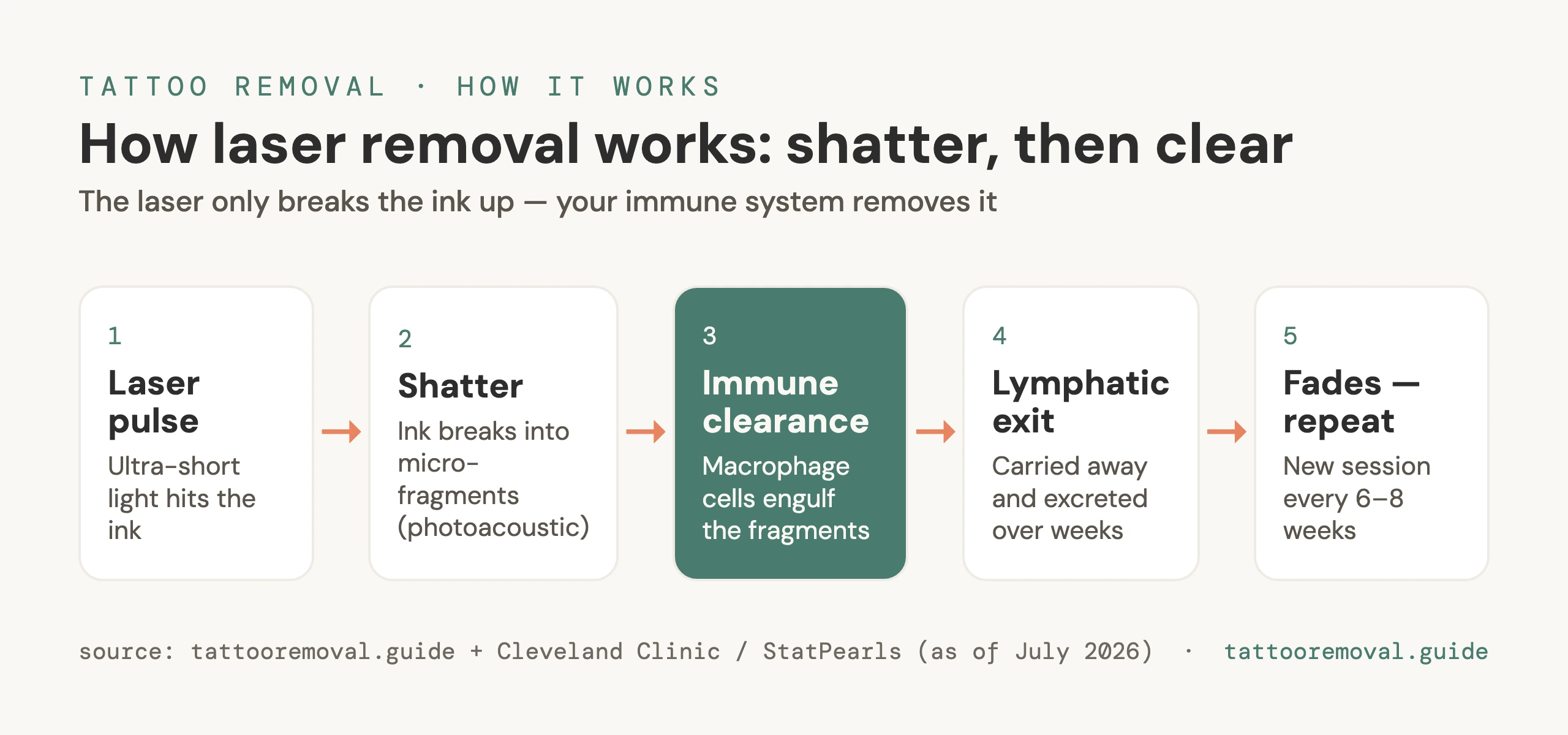 The laser breaks the ink up — your body removes it over months.
What the 2024 study actually found
The research that started the conversation is Nielsen and colleagues' 2024 paper, Tattoos as a risk factor for malignant lymphoma, published in eClinicalMedicine (a Lancet-family journal; the open-access version is on PMC). It is a population-based case–control study — meaning researchers took people who already had a disease (1,398 malignant lymphoma patients, aged 20–60, diagnosed 2007–2017 in Sweden) and compared their tattoo history against 4,193 matched people without lymphoma, to see whether tattoos were more common in the first group.
The main result: tattooed people had an adjusted incidence rate ratio of 1.21 (95% CI 0.99–1.48) — roughly a 21% higher risk estimate. Two details matter. First, because the confidence interval crosses 1.0, the finding was not statistically significant: statistically, the true effect could be no increase at all. Second, the risk estimate was highest in the first two years after getting a tattoo (IRR 1.81, 95% CI 1.03–3.20) and lower for older tattoos — a pattern the authors themselves found hard to explain if tattoo ink were a straightforward cause.
The finding the brief-readers seized on is the laser-removal subgroup: those who had undergone tattoo removal showed a markedly higher estimate, IRR 2.99 (95% CI 1.37–6.52). It sounds alarming. But it is built on a small number of people, which is exactly why its confidence interval is so wide, and it is one exploratory slice of a larger dataset.
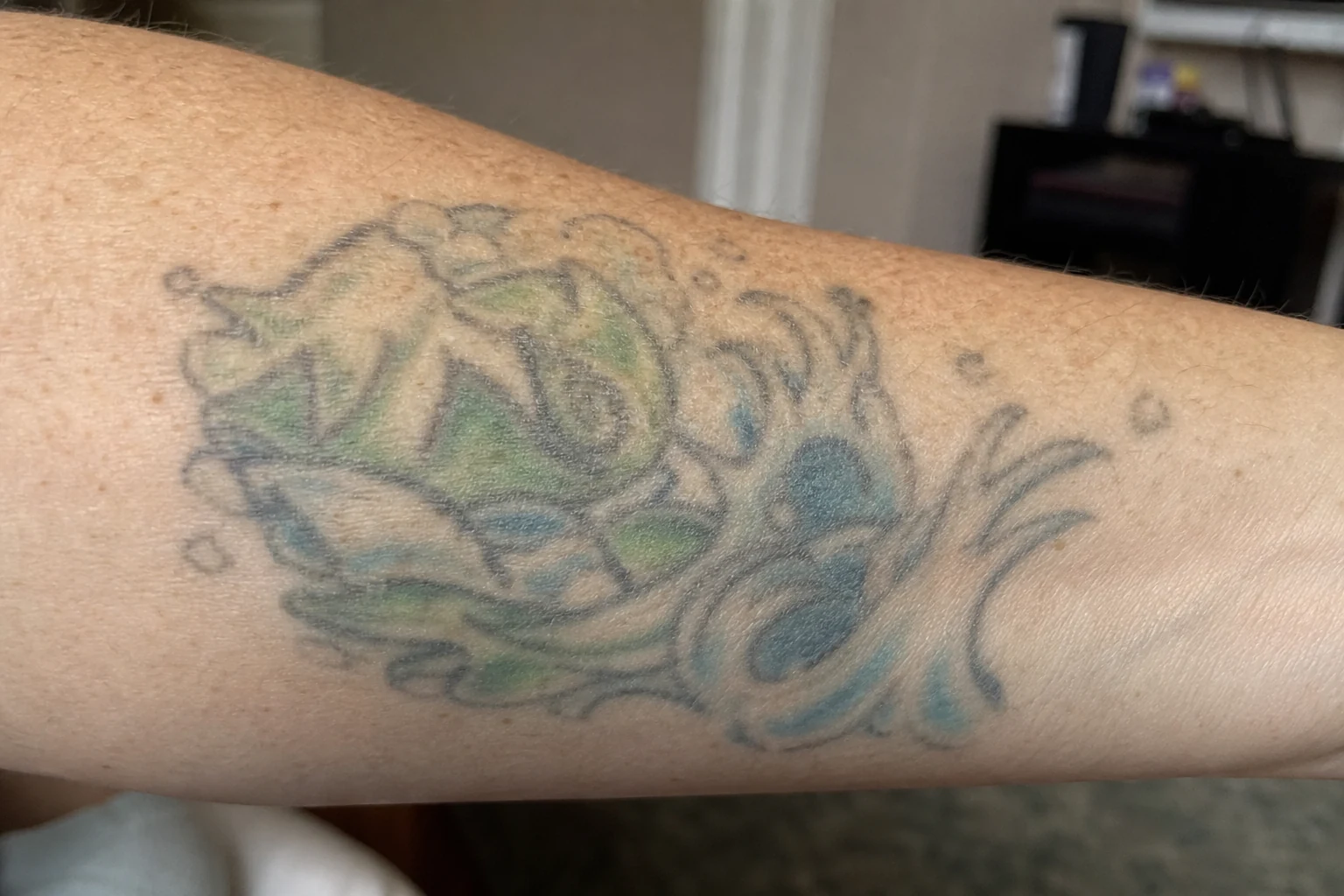 A green tattoo — one of the harder colours to clear.
What the study did not prove
This is the part that headlines routinely drop. An association is a statistical link between two things; causation means one thing actually produces the other — and an association can appear for reasons that have nothing to do with cause. The study's own authors were explicit: "Causality cannot be conferred from a single epidemiologic study and the results need to be confirmed by further research."
Several limitations, several of them acknowledged in the paper, keep this firmly in "hypothesis-generating" territory:
- Small numbers in the key subgroups. The laser-removal and recent-tattoo findings rest on few cases, which is why the confidence intervals are wide and unstable.
- Confounding. People who get tattooed — or who seek removal — may differ from those who don't in ways that independently affect lymphoma risk (lifestyle, other exposures). The study adjusted for smoking and socioeconomic factors but can't rule out unmeasured differences.
- Reverse causation and timing. The risk being highest soon after tattooing is biologically odd for a slow cancer, and raises the possibility that something other than the ink is driving the signal.
- No dose–response. Crucially, the study found no increased risk with larger tattooed area. If tattoo ink caused lymphoma, you would generally expect more ink to mean more risk. Its absence weakens a simple causal story.
| Claim you may have seen | What the evidence actually supports |
|---|---|
| "Tattoo removal causes cancer" | Not supported — no causal link has been shown |
| "Tattoos raise your lymphoma risk 21%" | An estimate that was not statistically significant (CI 0.99–1.48) |
| "Laser removal triples your risk" | A subgroup estimate (IRR 2.99) on very small numbers, wide CI, not confirmed |
| "Bigger tattoos are more dangerous" | Not supported — the study found no effect of tattoo size |
| "This is settled science" | The authors call for further research; a single study can't prove cause |
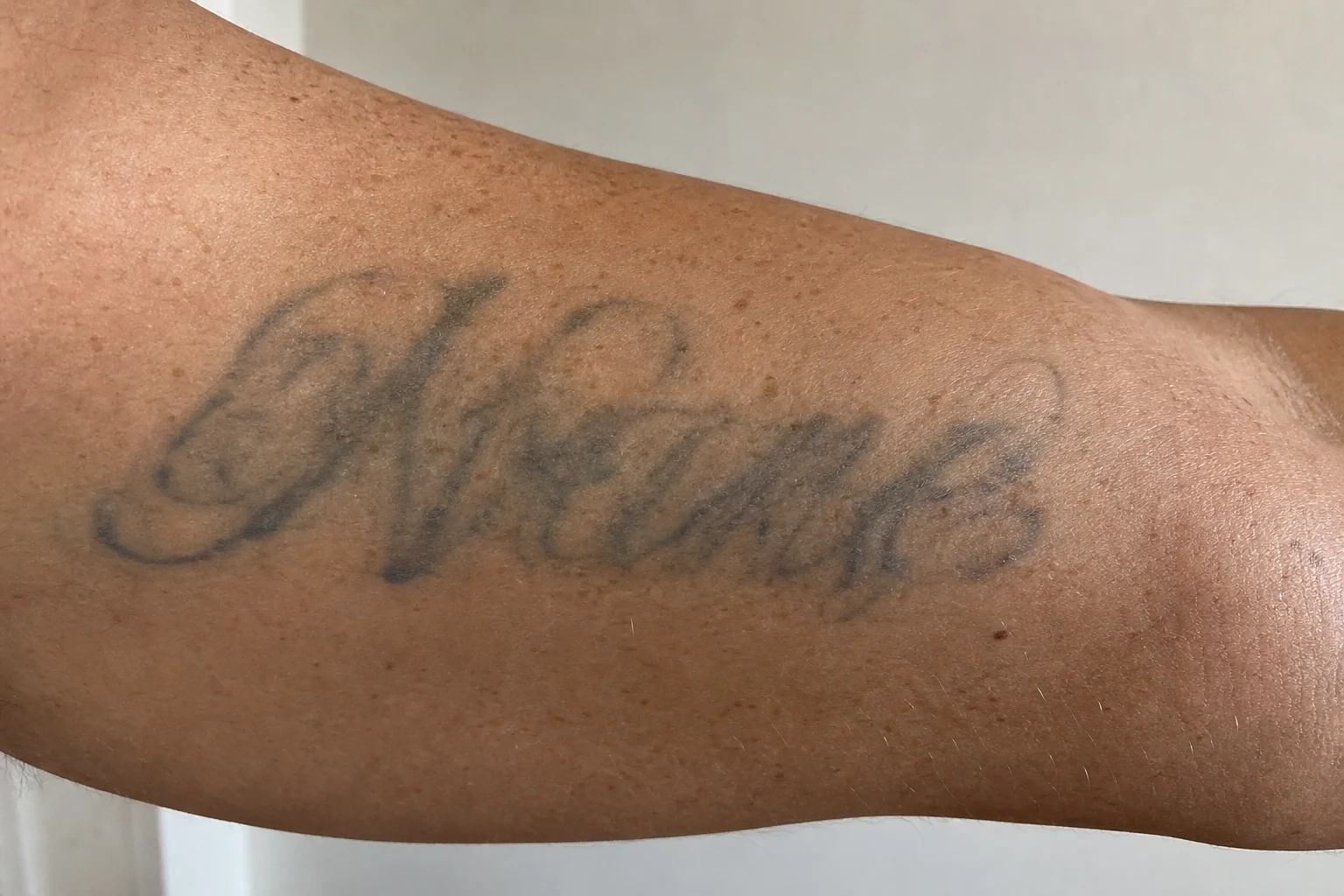 A fine-line name/script tattoo.
The azo-amine hypothesis: why some researchers worry
There is a genuine mechanistic question underneath the epidemiology, and it deserves an honest airing. The azo-amine hypothesis is the concern that when laser light shatters certain tattoo pigments, it can break them down into smaller chemicals — including aromatic amines — some of which are known or suspected carcinogens. Many coloured tattoo inks are azo pigments, and laboratory studies have shown that laser (and even sunlight) can cleave them.
In one widely cited in-vitro study, Vasold and colleagues found that laser light cleaved tattoo pigments into hazardous compounds, and a later systematic review in the Journal of Exposure Science & Environmental Epidemiology catalogued breakdown products such as 2-methyl-5-nitroaniline, o-toluidine and 3,3′-dichlorobenzidine — chemicals flagged as toxic or carcinogenic.
The honest caveat: this is laboratory and chemical evidence, not proof of harm in living people. Showing that a laser can produce a worrying molecule in a test tube is not the same as showing it causes cancer in a person, at the doses involved, over a lifetime. It is a plausible reason to keep researching — and a reason regulators are scrutinising ink ingredients — not a demonstrated danger.
Where tattoo ink goes (in plain language)
To make sense of the lymphoma question, it helps to know what removal physically does. The laser doesn't vaporise ink out of your body — it shatters it, and your immune system clears the fragments. A macrophage is an immune cell that engulfs foreign particles; macrophages swallow the shattered ink and carry it into the lymphatic system, the network that drains fluid and filters it through lymph nodes.
Some of that pigment is excreted over the following weeks, but research has confirmed that some ends up deposited in nearby lymph nodes — which is why tattoo pigment is sometimes found there, and can occasionally show up on medical imaging. This is established biology (it also happens slowly with an intact tattoo). What remains genuinely unknown is the long-term health significance of pigment sitting in lymph nodes. That open question — not any proven event — is the biological thread the lymphoma studies are tugging at. (For the full mechanism, see our guide to how laser tattoo removal works.)
What mainstream dermatology and oncology say
The consensus position among health authorities is measured: laser tattoo removal is a widely used, generally safe medical procedure whose established risks are skin-related, and cancer is not among its proven risks. The American Academy of Dermatology describes the recognised complications of tattoos and their removal in terms of infection, allergic reaction, scarring and pigment change — not cancer. The U.S. FDA's tattoo fact sheet likewise centres its warnings on infection, allergic reactions, granulomas, scarring and removal-related skin problems, while noting that the long-term effects of ink in the body are still being studied.
In other words, the bodies whose job is to flag population risks treat the cancer question as unresolved and worth researching — not as an established hazard that should stop people from removing a tattoo they no longer want. The concrete risks worth planning around are the skin ones, which a qualified provider manages with appropriate settings, technique and aftercare — see our pillar guide, is laser tattoo removal safe?
What this means if you're considering removal
Put practically: the known risks of laser removal are the skin ones — temporary blistering and swelling, scabbing, a small infection risk, possible scarring, and changes in skin pigment (more likely on darker skin). The cancer concern is, at present, theoretical and unproven. That balance is a reason to choose your provider carefully and go in informed — not a reason to avoid removal. If you have specific worries — a personal or family history of lymphoma or other cancers, an immune condition, or a lot of coloured (azo) ink — raise them directly with a licensed clinician, who can also give you honest, tattoo-specific answers on sessions and expected outcomes.
This is general information, not medical advice. The research on tattoos, removal and cancer is preliminary and evolving. Laser tattoo removal has real, documented skin risks. For guidance about your specific situation — especially any cancer or immune-related history — consult a licensed medical provider.
Why you can trust this neutral take
Tattoo Removal Guide is an independent directory — we don't own clinics, sell laser devices, or take a cut of treatments, so we have no reason to either downplay a real risk or amplify a scary headline for clicks. Our incentive is to give you the straight version so you can decide well. That's also why we report the numbers with their confidence intervals and limitations intact, rather than as a slogan.
The most useful next step isn't fear — it's information. When you're ready, compare tattoo-removal clinics in your city and ask them directly about risks, aftercare and their experience with your ink type; a dense market like tattoo removal in Melbourne shows how providers, lasers and pricing stack up side by side. We track 5,700 specialist clinics across 1,043 cities (as of July 2026) — including that roughly 18% publicly note picosecond lasers and 15% note Q-switched (as of July 2026), a floor rather than a full count, since most listings don't specify their equipment at all.
Frequently asked questions
Does tattoo removal cause cancer?
There is no proven causal link between laser tattoo removal and cancer. A 2024 Swedish study reported a statistical association between having tattoos and malignant lymphoma, but an association is not causation, the overall result was not statistically significant, and the authors said the finding needs to be confirmed by further research.
Does laser tattoo removal cause lymphoma?
No study has shown that laser removal causes lymphoma. The 2024 Lund University study did note a higher risk estimate among people who had laser removal (IRR 2.99), but this was based on very small numbers with a wide confidence interval, could reflect other factors, and cannot establish cause and effect on its own.
What did the 2024 Swedish tattoo lymphoma study find?
The Lund University study compared 1,398 lymphoma patients with 4,193 matched controls. Tattooed people had a 21% higher adjusted risk estimate (IRR 1.21, 95% CI 0.99–1.48) — a result that was not statistically significant because the confidence interval crossed 1.0. Risk appeared highest within two years of getting tattooed.
Is laser tattoo removal linked to cancer?
The known, proven risks of laser removal are skin effects: blistering, scarring, infection and pigment change. A theoretical cancer concern exists because laser light can break azo pigments into potentially harmful compounds in the lab, but this has not been shown to cause cancer in people. Discuss any concerns with a licensed provider.
Where does tattoo ink go after laser removal?
The laser shatters ink into fragments that immune cells called macrophages carry into the lymphatic system. Some pigment is excreted, and some is deposited in nearby lymph nodes — a finding confirmed in research. The long-term health effects of pigment in lymph nodes are still being studied and are not fully understood.
What are the proven risks of laser tattoo removal?
The documented risks are skin-related: temporary blistering, swelling, scabbing, infection if aftercare is poor, scarring, and changes in skin pigment (lightening or darkening), which are more likely on darker skin. Complete removal is not guaranteed. Cancer is not on the list of established risks, only theoretical or unproven ones.
Should I be worried about cancer from removing my tattoo?
Based on current evidence, there is no proven cancer risk from laser tattoo removal, so it is not a reason to avoid treatment. The evidence that does exist is preliminary and hypothesis-generating. If you have specific concerns — for example a personal or family cancer history — raise them with a licensed clinician before starting.
Related guides
Related Guides
- Safety & Risks
Why a Patch Test Matters Before Tattoo Removal (2026)
Why does a patch test matter before laser tattoo removal? It reveals how your skin and ink react — blistering, pigment change, rare reactions — before a full…
- Safety & Risks
Who Should Not Get Laser Tattoo Removal? The Contraindications
Who should not get laser tattoo removal? Most adults are candidates. The full contraindications checklist — when to wait and when to discuss carefully.
- Safety & Risks
Tattoo Removal While Pregnant or Breastfeeding
Can you get tattoo removal while pregnant? Most providers say wait — not from proven harm, but because the safety isn't studied.