Why Some Removal Sessions Show Almost No Change (It's Normal)
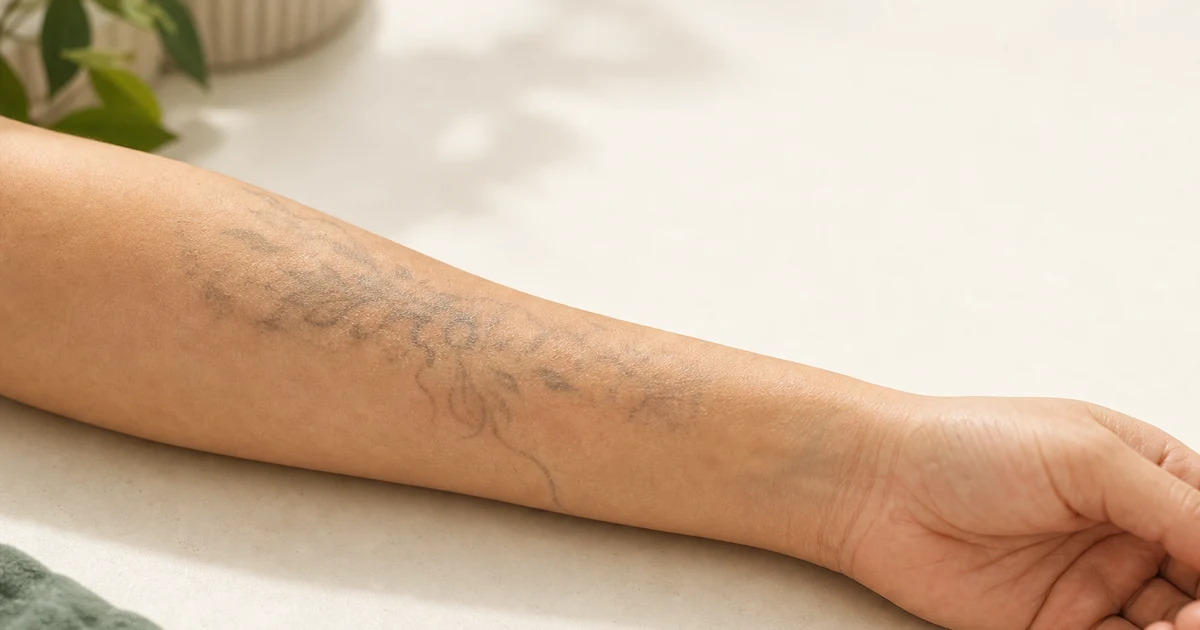
You go back for your third session. The technician zaps the tattoo. You go home. Two weeks later you hold your arm up to the light and it looks almost identical to before the session. Maybe even the same as before the last one.
This is probably the most common moment at which people either quit or start shopping for a different clinic. Neither is usually the right move.
What's happening is a biology problem, not a clinic problem — and understanding it is the difference between a course that finishes and one that stalls.
The clearing window is longer than a session
Laser tattoo removal doesn't dissolve ink. It shatters ink particles into fragments small enough for your immune system to carry away through your lymphatic system. The laser part is fast — a typical session is 10 to 30 minutes. The clearing part is slow: your body needs roughly 6 to 8 weeks to process what the laser broke up.
That 6 to 8 week clearing window is a well-established mechanism in how tattoo removal actually works. It's also why clinics that space sessions any closer than that tend to produce worse results — they're retreating tissue that hasn't finished recovering, and potentially retreating ink fragments that were already in transit.
Here's the important part: visible fading happens during the clearing window, not during the session. The session sets the biological process in motion. The session itself changes nothing you can see.
So when someone says "that session did nothing," what they usually mean is "I checked too early." The fading that gets attributed to one session is almost always the immune system's work from the session before.
Why some sessions genuinely look like nothing happened
The biology above explains most cases, but not all. Some sessions do produce less visible progress than others — and that's real, not imagined.
The ink depth problem
Tattoo ink is not laid at a uniform depth. Different needles, different artists, different areas of the body — the ink sits at varying depths in the dermis. The laser breaks up whatever it reaches most effectively in a given pass. Ink that sits deeper, or ink that sat in a dense cluster, may need more sessions before the visible layer thins enough to show a change.
The colour resistance hierarchy
Not all ink colours absorb the same wavelengths of light equally. Black and dark blue absorb broadly and break down fastest. Green, turquoise, and yellow are harder — they reflect many of the wavelengths most commonly used. A session on a multi-coloured tattoo may visibly fade the black areas while leaving the turquoise looking untouched. That's not a failed session. It's the colour physics doing what colour physics does.
Ink density and age
A bold, heavily saturated new tattoo — lots of ink packed in — takes more passes to thin to the point where you can see daylight through it. Old, already-faded tattoos often respond faster because the density is already lower. If your tattoo is dark and dense, the first few sessions may feel invisible. The ink is still being broken up; the change isn't visually detectable until there's enough cumulative clearance.
Your immune system's pace
People clear ink at genuinely different rates. Age, metabolism, and how much fluid you drink all appear to affect the speed of lymphatic clearance — the mechanism that carries the shattered ink away. This is one reason two people with the same tattoo at the same clinic can look quite different after four sessions: one person's immune system is processing the debris faster than the other's. It doesn't mean either person's sessions "didn't work."
The clinic-hopping trap
After a session that looks unchanged, the tempting conclusion is that the clinic isn't very good and a different one would do better.
Sometimes that's true — if a clinic has been setting wildly incorrect energy levels or treating too frequently, finding a better clinic is the right call. But in the majority of "nothing happened" cases, the problem is timing, not technique. Switching clinics at that point means starting the process of building a treatment history with someone new, often at the cost of the first few sessions' cumulative effect.
The cost reality makes this worth taking seriously. On the Tattoo Removal Guide directory, the typical per-session price in Melbourne runs about $50 to $200 (typical spread, P10–P90, as of July 2026) — and that's a single city. Run 8 to 12 sessions at the higher end of that range and the decision to switch clinics after session three has a real dollar value attached.
Before switching, ask the current clinic two specific questions: what energy level are they using, and how are they adjusting it session by session? A good clinic tracks this. A clinician who can show you that they've been progressive — starting conservative, increasing as your skin proves it can tolerate more — is giving you the right answer.
What honest timelines actually look like
Most full removals take 8 to 12 sessions, typically over one to two years. That range is wide because the variables are wide: tattoo age, ink colour, ink density, placement, skin type, and immune system pace all shift the number.
Within that range, progress is not linear. It's common for sessions 1 to 3 to show very little visible change, sessions 4 to 7 to show the most dramatic fading as cumulative clearance compounds, and the final sessions to be slow again as the stubborn residual ink takes longer to clear.
That "slow start" phase is the moment most people quit — or switch clinics — unnecessarily. The visible change was always coming. It just hasn't arrived yet.
What distinguishes a session that really didn't work
There are signs that a session was genuinely suboptimal, rather than just biologically delayed:
- No immediate skin reaction at all. Redness, swelling, and sometimes frosting (a white haze from the gas produced by the laser) are normal immediate responses to a laser session. If there was nothing — no reaction on the surface — the energy may have been too low to do meaningful work on the ink.
- Consistently identical-looking results over multiple sessions with the same clinic. One session looking unchanged is normal. Four consecutive sessions with no change at all, no visible shift in any part of the tattoo, is a conversation to have with the clinic.
- Sessions spaced fewer than 6 weeks apart. Rushing breaks the mechanism. If you're being booked back in at 3 or 4 weeks, ask why — the science doesn't support that pace.
One question worth asking your clinician: "What's changed in your settings since the last session?" A clinic that adjusts based on your skin's response is doing this properly. One that applies the same settings session after session, regardless of how your skin is responding, is not.
The reassurance that's actually honest
The reassurance that usually gets offered — "it's working, you just can't see it yet" — is technically correct but feels hollow if it isn't grounded in anything.
Here's the grounding: the ink was shattered. Your lymphatic system is in the process of removing it. That process takes 6 to 8 weeks. If your session was 4 weeks ago, the clearing window isn't closed. If your session was 8 weeks ago and the fading is minimal, that's worth discussing with the clinic.
The biology is not mysterious — it just doesn't run on the schedule most people expect it to.
Should you pause between sessions if it feels like nothing's happening?
No. Taking a longer break doesn't accelerate the clearing. The immune system processes the ink fragments over its standard window regardless. The main effect of a longer gap between sessions is a longer course overall.
What does help: staying hydrated (supporting lymphatic flow), protecting the treated area from the sun (which can both affect pigmentation and slow healing), and not picking at any blistering or scabbing that appears after a session. Picking at a healing area is also where most avoidable scarring comes from — scarring from properly delivered laser removal is uncommon, but it isn't impossible, and disturbing a scab is the easiest way to invite it. The aftercare phase is one of the few places where your choices directly affect how quickly your body clears what the laser broke up.
For a full explanation of what to expect session by session, see the tattoo removal process guide. If you're considering whether your current clinic is performing well, what to expect at a tattoo removal consultation covers what a proper clinical assessment looks like.
Find clinics in your city
If you're at the point of asking whether your sessions are actually working, comparing the clinics available to you is worth doing — not to switch on impulse, but to understand what the range looks like and what questions to ask. The Tattoo Removal Guide directory lists thousands of specialist clinics across the US, UK, Australia, Canada and New Zealand, with no clinic paying to rank higher and no leads sold.
See the price spread and clinic ratings in your city →
Frequently Asked Questions
(rendered as FAQPage schema — see frontmatter faqItems)
Where to next
Related Guides
- Treatment Process
What Realistic Tattoo Removal Progress Looks Like, Month by Month
A realistic, phase-by-phase look at tattoo removal progress — what changes in months 1–4, 4–12, and 12–18+, and why the timeline isn't a straight line.
- Treatment Process
The Middle of a Removal Course — Why Progress Stalls, Then Jumps
Why tattoo removal progress seems to stall mid-course, why it jumps back later, and how to tell a normal plateau from a session that isn't working.
- Treatment Process
Tattoo Removal Sessions: The Complete Guide to Your Number
Most tattoos need 8-12 sessions over 12-24 months. The six factors that set your number (incl. Kirby-Desai), real per-session prices, and the full timeline.