How Long Does Tattoo Removal Actually Take? A Directory-Wide Timeline
Most people asking about tattoo removal want to know one thing before everything else: how long? Not how much per session, not which laser, just the calendar. When can I stop explaining it at the beach?
The honest answer is 12 to 18 months for a typical tattoo, and that's not a worst-case estimate, it's the realistic middle of the distribution. This report explains what drives that number, where it compresses, and where it stretches, drawing from the TRG directory of specialist clinics (as of July 2026).
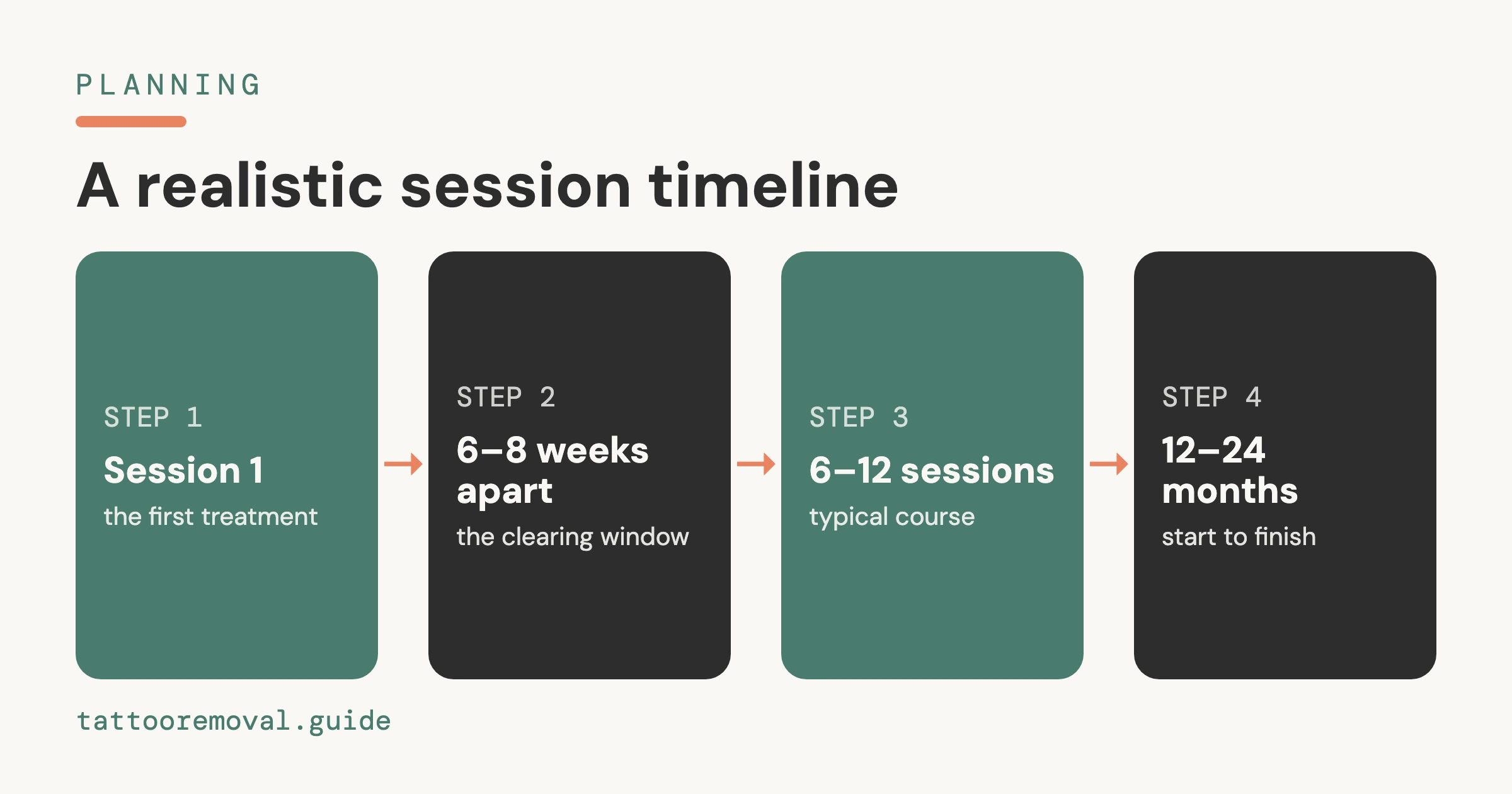
Citable headline figure: A typical tattoo removal course runs 8–12 sessions spaced 6–8 weeks apart, placing most people on a 12–18 month calendar. Full clearance takes longer than the session count alone suggests — the waiting time between treatments is the real clock.
The structure of a removal course
Tattoo removal isn't a single procedure stretched across visits. Each session does one discrete job: the laser fractures ink particles into fragments small enough for your immune system to carry away. Then you wait. The 6–8 week clearing window is the time it takes for your lymphatic system to remove those fragments before the next session can work on what's left.
Skip that window, or shorten it, and you're sending the laser into skin that hasn't cleared. The result is less progress per session, not more, and in under-cooled treatments, a higher risk of thermal injury. The clearing window isn't a scheduling preference; it's how the mechanism works.
What that means for your calendar:
- 8 sessions at 6 weeks each: ~48 weeks — just under 12 months
- 8 sessions at 8 weeks each: ~64 weeks — just over 15 months
- 12 sessions at 6 weeks each: ~72 weeks — about 17 months
- 12 sessions at 8 weeks each: ~96 weeks — about 22 months
The 12–18 month figure covers the most common scenario: a black-ink tattoo of moderate size, 8–10 sessions, 6–7 week spacing. Tattoos at the harder end of the removal spectrum — older multi-coloured pieces, deep saturation, professionally applied ink with heavy layering — regularly sit in the 15–24 month range.
What drives the session count
Session count is the biggest variable in the timeline, and it's shaped by the tattoo more than the clinic.
Ink and colour
Black and grey ink absorbs laser energy across the broadest wavelength range and clears most predictably. Blues and greens require wavelengths that fewer lasers carry, and they tend to need more sessions. Reds and oranges respond variably. No published figure reliably predicts outcome for a specific tattoo; a consultation is the only way to get a credible session estimate.
Tattoo age
Older tattoos often clear faster. Ink deposited years ago has already been degraded somewhat by the body's ongoing low-level immune activity. A 20-year-old blue tattoo may respond faster than a 3-year-old one. This is counterintuitive to most people who assume older ink is harder to shift.
Ink depth and saturation
Professionally applied tattoos, especially those done by experienced artists using modern machines, are deposited at a consistent depth and with high saturation. That consistency is good for the art and harder to clear. Homemade or amateur tattoos are often shallower and less saturated — fewer sessions, though less predictable depth can mean uneven response.
Skin type
Fitzpatrick skin types V and VI require more conservative treatment parameters to avoid post-inflammatory hyperpigmentation. Conservative parameters mean lower fluence per session, which typically means more sessions to achieve the same level of clearance. This isn't a limitation of care quality; it's responsible clinical practice.
Cover-up preparation vs. full removal
A tattoo being faded for a cover-up is a meaningfully different goal than full clearance. Cover-up preparation typically requires 2–5 sessions to get the existing tattoo light enough for a new design, compared to 8–12 for full removal. The timeline compresses to 3–12 months. If fading for a cover-up is the goal, say so at the initial consultation; the treatment plan is different.
The 6–8 week clearing window: what actually happens between sessions
The interval between sessions isn't arbitrary. After a session, your lymphatic system is actively moving fragmented ink particles from the treatment site through lymph nodes for clearance. That process takes time, and it sets the floor for how soon the next session can be productive.
Three things affect how quickly the window clears:
- Cardiovascular fitness and hydration. The lymphatic system has no pump; it depends on muscle contraction and circulation. Clinics that suggest light exercise and good hydration between sessions are reflecting genuine mechanism, not upselling wellness.
- Immune health. Illness, stress, or medications that affect immune function can slow clearance.
- Treatment site. Tattoos on extremities (feet, hands) sit further from the areas with the richest blood supply doing most of the clearance work, and can clear more slowly than tattoos on the torso or upper body — a blood-flow effect, not a distance-from-the-heart one.
The upper end of the clearing window, waiting 10–12 weeks between sessions, is sometimes recommended for difficult cases, more sensitive skin types, or simply to let the body fully finish before adding another load. Extending the interval doesn't reduce efficacy; it can improve it.
The directory picture: what listed clinics show
From the TRG directory of 5,700 specialist clinics across five countries (as of July 2026):
- About 38% of clinics list a per-session price. The other 62% require a consultation to quote, partly because session count and total cost genuinely depend on the tattoo.
- The per-session range runs from roughly $50 to $2,030, with a median of approximately $200 across listed clinics.
- About 27% of clinics offer a free consultation, which is the only reliable way to get a session-count and cost estimate for a specific tattoo.
- About 20% offer payment plans, relevant when a realistic 10-session course is being budgeted.
The directory is international: United States 47%, Australia 22%, United Kingdom 15%, Canada 13%, New Zealand 2% (as of July 2026). Timeline estimates are consistent across markets because the laser-skin mechanism doesn't change by country, but session intervals and pricing do vary by clinic and market.
Course cost: what the timeline means in dollar terms
A session count is really a multiplier. If you're planning against a timeline, the per-session price matters a lot less than the course total.
Using the typical same-city price spread from the directory (as of July 2026):
| City | Typical per session (P10–P90) | 10-session course (typical range) |
|---|---|---|
| Melbourne | $50–$179 | ~$500–$1,790 |
| Sydney | $50–$197 | ~$500–$1,970 |
| London | £80–£174 | ~£800–£1,740 |
| Toronto | $200–$399 | ~$2,000–$3,990 |
| New York | $200–$420 | ~$2,000–$4,200 |
| Calgary | $200–$299 | ~$2,000–$2,990 |
| Brisbane | $50–$211 | ~$500–$2,110 |
| Perth | $50–$199 | ~$500–$1,990 |
The 10-session figure is a planning estimate, not a quote. Actual course length should come from a consultation. These session prices are each clinic's lowest published "from" rate; larger or more complex tattoos quote higher.
Source: tattooremoval.guide directory (as of July 2026). Prices in local currency per market.
When timelines are longer than 18 months
Some tattoos and some journeys take longer. This isn't a failure of treatment; it's an honest feature of the mechanism.
Reasons a course extends past 18 months:
- The tattoo has extensive colour saturation, particularly blues, greens, or layered cover-ups
- Skin type requires conservative fluence, spreading the effective work across more sessions
- The goal shifted mid-course (fading for a cover-up became full removal)
- Appointments were delayed — for skin health, illness, travel, or simply scheduling — which extends calendar time without reducing efficacy per session
- The immune clearance rate is slower for this individual, requiring extended intervals
A skilled clinician will reassess the treatment plan at each session. Some very complex tattoos take 15–20+ sessions. Knowing this before starting, rather than expecting clearance in 8 and discovering otherwise at session 8, is the main reason a realistic initial consultation matters.
What to ask at your first consultation
Because session count is genuinely uncertain at the start, a good consultation should give you a range, not a single number. Questions worth asking:
- What's the estimated session range for my tattoo specifically (low end and high end)?
- What interval do you recommend between sessions, and why?
- At what point would you reassess the plan?
- Is this tattoo likely to clear fully, or should I expect significant lightening only?
A clinic that gives a flat number with no range is either very confident for good reason (a simple black-ink piece) or underqualified to estimate. Ask what factors would push toward the higher end.
Methodology
- Source. The TRG directory of specialist clinics across the United States, Australia, United Kingdom, Canada, and New Zealand, as of July 2026. Clinic count: 5,700 specialist clinics (T1–T3 tiers) spanning 1,043 cities.
- Session and interval figures. The 8–12 session range and 6–8 week clearing window are established clinical reference points, not TRG-proprietary figures. They appear in peer-reviewed laser dermatology literature and are the parameters clinicians in the directory work to. TRG cites them as the mechanism, not as data extracted from our listings.
- Timeline arithmetic. Calendar estimates are computed directly from the stated session ranges and clearing-window intervals. No modelling or weighting was applied. Uncertainty at both ends is explicit.
- Pricing figures. Per-session prices are each clinic's lowest published "from" rate in local currency, where listed, computed via
scripts/city-stats.py. Only clinics with a published price are included in price figures. Typical range = P10–P90; the cheapest and most expensive 10% are trimmed to reduce outlier distortion. - Analyst. Compiled by the TRG editorial team from directory data, with methodology and basis exposed for independent verification.
- Commercial disclosure. Tattoo Removal Guide is an independent directory. No clinic pays to rank higher in the directory, and no leads are sold. This report is published for informational and citation purposes. Nothing here constitutes medical advice; consult a qualified clinician for an assessment of your specific tattoo.
- Drift. Directory figures (clinic counts, pricing coverage percentages) are point-in-time and change as clinics are added and owners update their data. Always check the live figure on any city page as the current source of truth.
Frequently Asked Questions
(rendered as FAQPage schema — see frontmatter faqItems)
This report is free to cite with attribution to tattooremoval.guide. To find clinics in your city and compare what they offer, start with your city or postcode.
Related Guides
- Planning & Timing
The Seasonal Start Clock: How Cleared You'll Be by Summer
When to start tattoo removal by hemisphere: how the seasons set your ideal start month north and south, so treated skin heals away from peak summer sun.
- Planning & Timing
Why You Can't Rush Tattoo Removal (and Why Every Extra Session in
Why rushing tattoo removal sessions backfires: the 6–8 week clearing window explained, the real cost of shortened gaps, and when starting in January helps.
- Planning & Timing
New Year, Real Plan: What Tattoo Removal Actually Takes (and the
A realistic tattoo removal timeline: why 8–12 sessions means 12–18 months, what drives your specific count, and the true cost across a full course.